
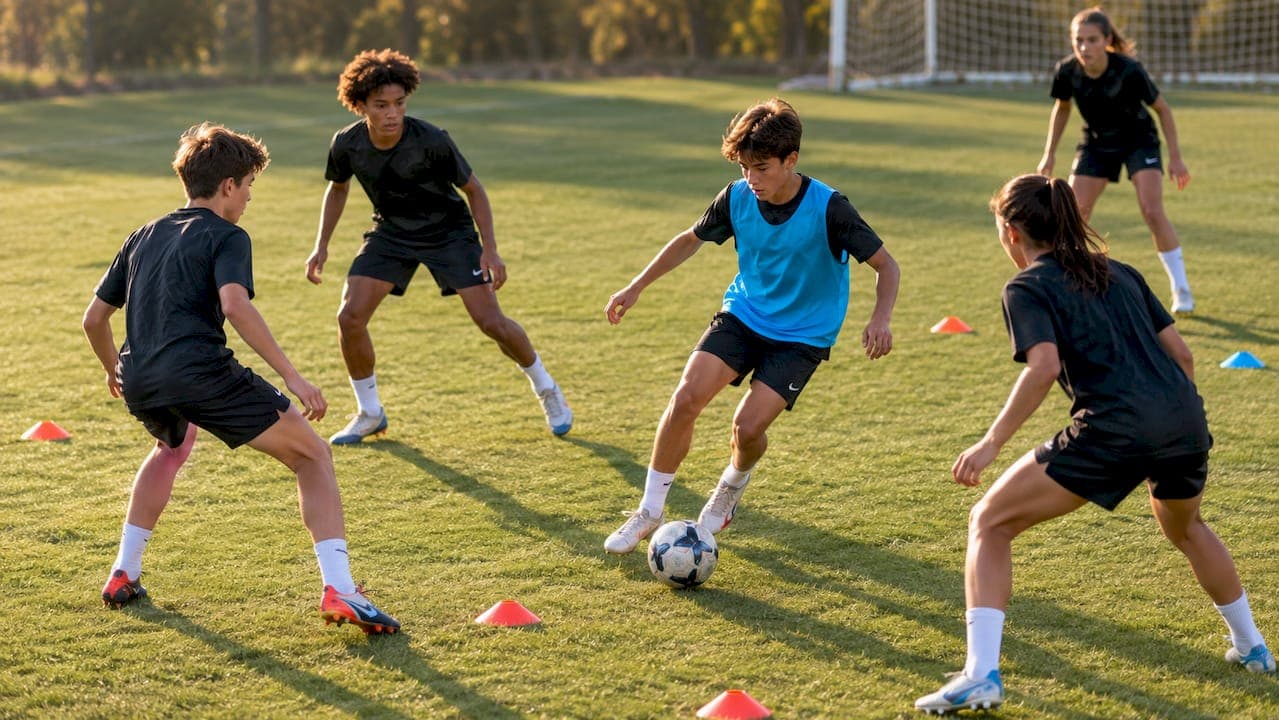
The fastest way to build real match fitness is a program that pairs HIIT and repeated-sprint work with small-sided games on the field, plus two strength and plyometric sessions in the gym each week. Run three to four field sessions and two lifting days for six to eight weeks, easing volume during fixture-heavy stretches, and you'll see measurable gains in speed, endurance, and repeated-sprint ability by weeks four through eight. Test before you start and retest at the end so the numbers, not guesswork, tell you it worked.
TL;DR:
- A soccer conditioning program focusing on HIIT, repeated sprints, small-sided games, and strength work can produce significant fitness gains within four to eight weeks, especially if properly phased.
- Structuring training into distinct phases—base, build, and peak—ensures progressive overload, with intensity increasing in the build phase and volume tapering before matches.
- Testing with Yo-Yo IR1, repeated sprints, 20-meter sprints, and vertical jumps helps monitor progress and prevent injury by guiding adjustments and verifying gains.
- Maintaining injury prevention exercises like Nordic hamstring curls and Copenhagen adductor work twice weekly significantly reduces soft-tissue injury risk.
- During in-season, reduce conditioning volume by around a third and focus on maintenance, with one or two light strength sessions weekly to preserve fitness levels.
Table of Contents
- What Goes Into a Soccer Conditioning Program?
- How Do You Structure a Soccer Conditioning Program?
- Two Ready-to-Use 6 to 8 Week Conditioning Templates
- Field Sessions and Conditioning Drills That Work
- Youth Conditioning: What Changes by Age
- Testing and Injury Prevention: How to Know It's Working
- Author And Evidence: Coach Justin And Repphilosophy
- What Coaches Get Wrong About Conditioning
- How Repphilosophy Turns This Plan Into Real Sessions
- Sources
- FAQ
What Goes Into a Soccer Conditioning Program?
A soccer conditioning program isn't a running plan with a ball added on. It's a blend of energy-system training, strength work, and movement quality built to match what actually happens in a 90-minute game: repeated bursts of sprinting, sudden changes of direction, and technical decisions made while fatigued.
Here’s what belongs in the mix and why each piece earns its spot:
- High-intensity interval training (HIIT): Short, hard efforts (think 30 seconds to 4 minutes) at 85 to 95 percent of max heart rate, followed by active or passive recovery. A 2026 systematic review and network meta-analysis found HIIT was the most effective intervention for improving VO2max and soccer-specific endurance, ranking highest of all methods tested for Yo-Yo IR1 performance, 20-meter sprint speed, change of direction, and repeated-sprint ability.
- Repeated-sprint ability (RSA): The capacity to fire off near-maximal sprints with incomplete recovery, over and over, without a big drop in speed. This is the quality that separates a player who's fresh in minute 10 from one who's still sharp in minute 85.
- Small-sided games (SSGs): Reduced-pitch, reduced-player formats (think 4v4 or 6v6) that load the aerobic and anaerobic systems while forcing constant decision-making. Research on youth players backs this up directly: an eight-week SSG program produced significant improvements in Yo-Yo IR1 distance and passing performance compared with a control group.
- Strength training: Squats, deadlifts, split squats, and pulling patterns that build the force production behind every sprint, jump, and tackle. A 2023 meta-analysis found strength and combined training produced larger gains in lower-body strength than plyometric training alone.
- Plyometrics: Bounding, hopping, and jump variations that teach the nervous system to produce force quickly, which shows up on the field as first-step quickness and jump height in aerial duels.
- Agility and change of direction (COD): Drills that train deceleration and redirection under control, not just straight-line speed. Most goals and tackles happen in tight spaces, not open sprints.
- Aerobic base: The engine underneath everything else. Without it, high-intensity work breaks down fast and recovery between sprints suffers.
- Mobility and recovery: Often skipped, always costly when it is. Hip and ankle mobility work and dedicated recovery days keep the higher-intensity stuff productive instead of destructive.
Injury prevention deserves its own line item, not an afterthought. Nordic hamstring curls and Copenhagen adductor exercises are two of the most well-supported exercises for reducing soft-tissue injury risk, and they belong in the program twice a week, typically tacked onto a strength session or a light field day rather than crammed in right before a hard sprint session.
How Do You Structure a Soccer Conditioning Program?
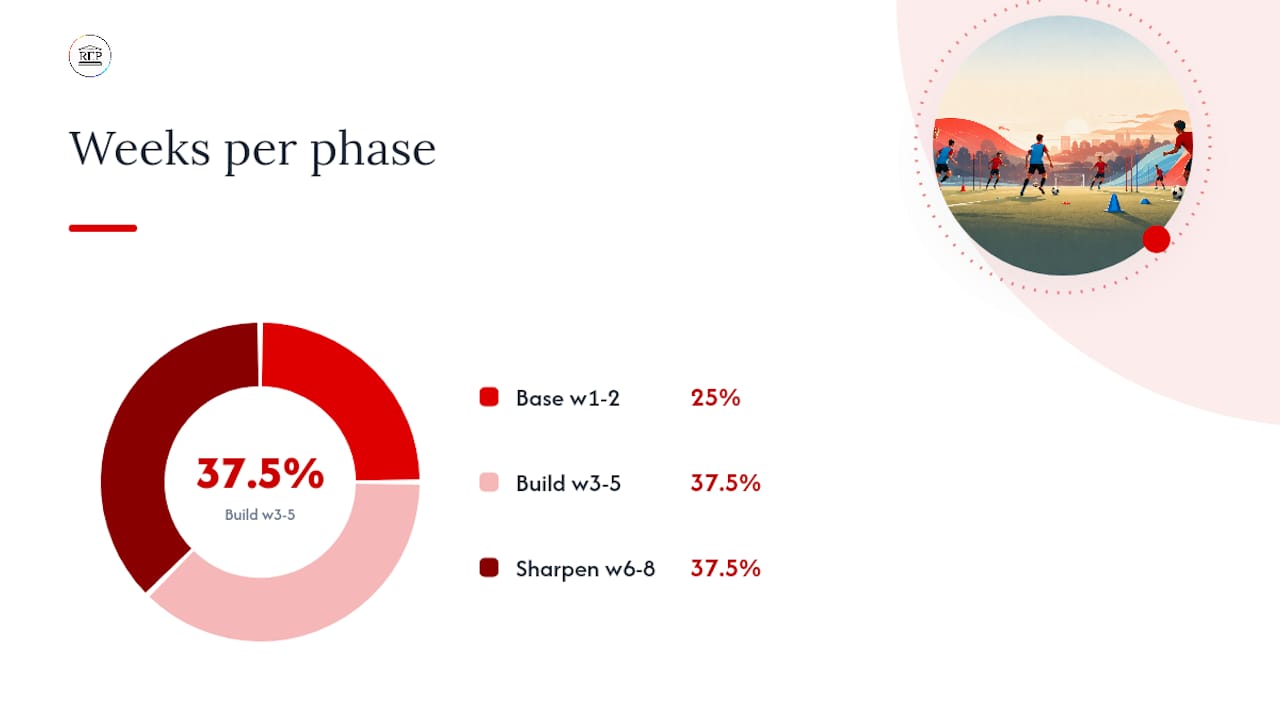
Structure separates a program that builds fitness from a pile of workouts that just makes players tired. The clearest way to organize six to eight weeks is in three phases, each with a distinct job to do.
Phase 1: Base (weeks 1 to 2). The goal here is building an aerobic foundation and reintroducing load safely, especially if players are coming off a break. Volume is moderate, intensity is controlled, and technical work gets equal billing with conditioning. This is where you establish baseline fitness numbers you'll compare against later.
Phase 2: Build (weeks 3 to 5). Intensity climbs. HIIT intervals get shorter and sharper, small-sided games shrink in pitch size to raise intensity, and strength sessions move from general strength toward power expression. This is the meat of the program, where the biggest fitness gains happen.
Phase 3: Sharpen and peak (weeks 6 to 8). Volume drops, intensity stays high, and the focus shifts to sharpness and readiness rather than building new capacity. Think shorter, faster repeated-sprint sets and match-simulation SSGs rather than long grinding intervals.
Inside each phase, the weekly microcycle matters as much as the macro plan. Coaches who plan around match day (MD) language keep sprint exposure controlled instead of accidental, which directly affects both performance readiness and hamstring injury risk. A typical week looks like this:
- MD+1 (day after match, or Day 1 of a training week): Light recovery, mobility, low-intensity technical work.
- MD-4: Strength session (lower-body focus) paired with a moderate SSG or aerobic interval session.
- MD-3: High-intensity field day. This is where HIIT intervals or repeated-sprint work live, since players have maximum recovery time before the next match.
- MD-2: Strength or power session (often shorter, more explosive) plus light technical work. Volume tapers here.
- MD-1: Very light activation, sprint primers, no fatigue accumulation. Save the legs.
- MD (Match Day): Compete.
Sequencing within a session also matters more than most coaches assume. A trial in adolescent male players found that when strength and endurance work were combined in the same session, endurance-before-strength (ES) sequencing produced better gains in linear sprint speed than the reverse order, while most other fitness measures responded similarly regardless of sequence. If sprint speed is your priority for a given phase, run the conditioning work first and lift afterward. If pure strength gains matter more, flip it.
Pro Tip: Don't just plan the hard days. Plan the recovery days with the same intent. Sleep, hydration, and rest between sessions determine how much of your hard work actually converts into fitness, and factors like sleep quality and stress load can meaningfully change how fast a player bounces back between sessions.
In-season, cut total conditioning volume by roughly a third compared with off-season peaks and lean on maintenance dosing rather than fresh gains. One or two short strength sessions a week is often enough to hold onto off-season strength once the season starts, freeing up energy for match performance and technical work.
Two Ready-to-Use 6 to 8 Week Conditioning Templates
You don't need to reinvent this from scratch. Below are two templates, one built for pre-season match preparation, one for off-season base building, each following the phase structure and sequencing rules already covered.
The 6-Week Pre-Season Match-Prep Template
This template assumes players are already reasonably active and need to sharpen match fitness fast. It runs four field sessions and two strength sessions weekly, tightening intensity as match day approaches.
| Week | Phase | Field focus | Strength/power focus |
|---|---|---|---|
| 1-2 | Base | Aerobic intervals (4 min on/3 min off), 8v8 SSG on full-width pitch | General strength: squat, hinge, pull, 3x8-10 |
| 3-4 | Build | Repeated-sprint sets, 5v5 SSG on reduced pitch | Strength moving toward power: trap-bar jumps, 4x5 |
| 5 | Build/Sharpen | Short HIIT (30s on/30s off), 4v4 SSG, high-intensity | Power focus: box jumps, sled pushes, 3x5 |
| 6 | Sharpen/Peak | Match-simulation SSG, short sharp sprints, taper volume | Light activation only, no new fatigue |
Sample Week 3 session (Build phase, MD-3 day): warm up 10 minutes with dynamic mobility and short accelerations, then run 6 sets of 30-second maximal shuttle sprints with 90 seconds rest, followed by a 15-minute 5v5 SSG on a 30x40 yard pitch with two-touch restrictions to keep intensity high without letting the game turn into standing around.
The 8-Week Off-Season Base-Building Template
This one is for players starting from a lower fitness baseline or coming off an extended break. It leans harder on aerobic development and general strength before introducing sharper speed and power work.
| Weeks | Phase | Field focus | Strength focus |
|---|---|---|---|
| 1-3 | Base | Fartlek runs, aerobic SSG (large pitch, low intensity), technical circuits | General strength foundation: 3x10-12, focus on movement quality |
| 4-6 | Build | Repeated-sprint introduction, mid-size SSG, ladder and agility work | Strength progressing toward moderate loads, 4x6-8 |
| 7-8 | Sharpen | Short HIIT, small-pitch SSG, sprint mechanics work | Power introduction: jumps, bounds, light Olympic-lift variations |
Progression rules that apply to both templates:
- Increase intensity before volume once you hit the build phase. Shorter, harder intervals beat longer, moderate ones for soccer-specific transfer.
- Shrink the SSG pitch and player count as the weeks progress to raise physiological demand without adding total training time.
- Cap week-to-week jumps in high-speed running distance at roughly 10 percent to avoid a spike that outpaces tissue tolerance.
- If gym access is limited, bodyweight and band-based strength work (split squats, single-leg RDLs, resisted sprints with a partner) can substitute for barbell lifts without losing the strength-quality stimulus. Home-based sessions in the 10 to 25 minute range can cover this gap effectively when gym time isn't an option.
- During fixture congestion (two matches in a week), drop one field conditioning session entirely and keep only light strength maintenance work. The match itself becomes the conditioning stimulus.
Both templates are adaptable starting points, not rigid scripts. Coach Justin's own 6 to 8 week tryout conditioning plan uses this same phase logic with a 72-hour taper built in before evaluation day, which is worth studying if you're prepping players for a specific test date rather than an ongoing season.
Field Sessions and Conditioning Drills That Work
Good conditioning drills do two things at once: they load the right energy system, and they mimic something that actually happens in a match. Here's a rundown of the staples, followed by two complete sessions you can run tomorrow.
Shuttle runs. Set two cones 20 to 30 yards apart and sprint back and forth for a set time or number of reps. Simple, brutal, and effective for repeated-sprint conditioning when you control the work-to-rest ratio.
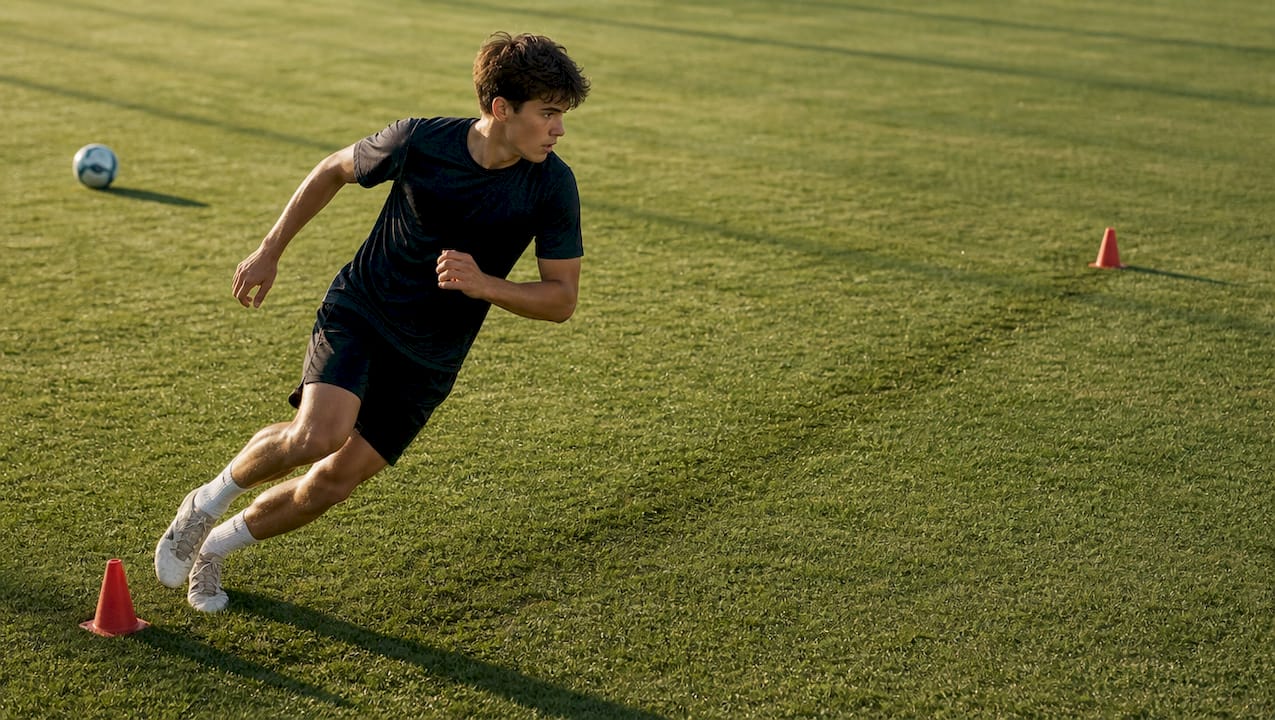
Tic-tac-toe sprints. Arrange nine cones in a 3x3 grid. Call out a pattern (top row, diagonal, middle column) and have players sprint to touch each cone in sequence. This adds a reactive, decision-making layer to straight sprint work, closer to how players actually move on the ball.
Ladder drills. Quick-feet patterns through an agility ladder build the coordination and ankle stiffness that support faster change of direction. These work best as a warm-up primer, not a conditioning stimulus on their own.
Fartlek runs. Continuous running with periodic surges of pace mixed into a steady aerobic effort. Useful in the base phase when the priority is building an aerobic floor without the joint stress of constant high-speed sprinting.
50/50 lap runs. Jog half a lap, stride the other half, repeat. An easy way to build aerobic capacity for players who aren't ready for harder interval work yet.
You control the intensity of any small-sided game by manipulating three levers: pitch size, player numbers, and touch restrictions. A 4v4 game on a tight pitch with one-touch restrictions will spike heart rate and decision speed far faster than an 8v8 on a full-width field, even with the same number of players on the ball.
Session A: Repeated-Sprint Conditioning
- Warm up 10 minutes: dynamic stretching, build-up runs, 3 x 20-yard accelerations.
- Run 8 sets of 20-yard shuttle sprints (there and back = one rep), 20 seconds of work, 40 seconds of rest.
- Rest 3 minutes, then run 6 sets of tic-tac-toe sprints, 15 seconds of work, 45 seconds of rest.
- Cool down 10 minutes with light jogging and static stretching.
- Progression: reduce rest by 5 seconds per set every two weeks, or add one extra set once players hit target reps at the current rest interval.
Session B: Small-Sided Game Conditioning
- Warm up 10 minutes with rondos (small possession games) to raise heart rate and touch the ball early.
- Play 4 x 4-minute rounds of 5v5 on a 30x40 yard pitch, two-touch maximum, 2 minutes rest between rounds.
- Monitor intensity by feel: players should report a rate of perceived exertion (RPE) of 7 to 8 out of 10 by the final round, or heart rate readings sitting in the 85 to 90 percent of max range if you're tracking with a monitor.
- Finish with 2 rounds of 3-minute 3v3 on an even smaller pitch to spike intensity one more time before cooling down.
- Progression: shrink the pitch by 5 yards per side every two weeks, or drop the touch restriction to one-touch once technical quality allows it.
Youth Conditioning: What Changes by Age
Youth conditioning isn't a scaled-down version of the adult template. It follows its own developmental logic, generally described through long-term athletic development (LTAD) and youth physical development (YPD) frameworks, which map training emphasis to a young player's growth stage rather than the calendar.
Younger children (roughly ages 6 to 11) should spend the bulk of their time on movement skill and technical work, not structured conditioning. Games-based activity, agility, and coordination work do more for this age group than intervals or lifting ever will.
As players move into early adolescence, strength and power work becomes appropriate, introduced gradually and with close coaching attention to technique. This is also the window where structured speed and sprint mechanics training starts paying real dividends, especially when introduced safely rather than rushed.
Practical rules worth following across youth age groups:
- Cap total field session length at 45 to 60 minutes for younger age groups; older adolescents can handle 60 to 75 minutes.
- Limit high-intensity conditioning to two sessions a week for pre-teens, three for older teens closer to adult training tolerance.
- Introduce gym-based strength work with bodyweight and light-resistance movements first; age-smart progressions matter more than loading heavy early.
- Favor games and competitive drills over isolated conditioning circuits. A cautionary note from coaches who've watched this go wrong: mindless, high-volume "gasser" running that doesn't match soccer's start-stop demands is one of the most common mistakes in youth programs, and it burns motivation faster than it builds fitness.
- Keep a library of specific, low-equipment speed drills on hand for players who need more individual attention than a group session allows.
Testing and Injury Prevention: How to Know It's Working
A conditioning program without testing is a guess dressed up as a plan. Run a baseline test in week one and retest every four to eight weeks to see whether the work is translating into real fitness gains.
A simple, field-friendly testing battery covers four bases:
- Yo-Yo IR1: The gold standard for soccer-specific aerobic and repeated-sprint capacity, directly tied to match running performance.
- Repeated-sprint test: Six to ten sprints of 20 to 30 yards with short recovery, measuring how much speed drops off across reps.
- 20-meter sprint: A clean measure of straight-line speed and acceleration.
- Countermovement jump (CMJ): A quick gauge of lower-body power output, useful for tracking whether strength and plyometric work is translating to explosiveness.
The 2026 systematic review found HIIT ranked highest of all training methods tested for Yo-Yo IR1 improvement (SUCRA = 86.2) and 20-meter sprint performance (SUCRA = 90.6), which is a strong signal for why interval work anchors this program rather than sitting on the periphery.
On the injury side, two exercises consistently punch above their weight: the Nordic hamstring curl and the Copenhagen adductor exercise. Both target the muscle groups most commonly strained during high-speed running and cutting, and both fit easily into an existing strength day rather than requiring extra training time. Program them twice weekly, starting with low volume (2 sets of 3 to 5 reps) and building slowly, since both exercises produce significant muscle soreness if progressed too fast. Understanding why these injuries happen in the first place helps explain why prevention work deserves a fixed slot rather than an occasional add-on.
When test numbers plateau or drop, that's your cue to adjust load, not push harder blindly. A flat or declining Yo-Yo IR1 score after four weeks usually means recovery is lagging behind training stress, not that the player needs more volume.
Author And Evidence: Coach Justin And Repphilosophy
Coach Justin built the templates in this article around a straightforward standard: use what the evidence actually supports, then make it work for real players with real schedules. These templates get tested against actual constraints like limited gym time and packed fixture calendars, not theoretical ideal conditions.
The programming choices throughout this piece trace back to four sources: the 2026 systematic review confirming HIIT's edge for endurance and speed, the applied SSG study showing measurable Yo-Yo IR1 and passing gains, the sequencing trial guiding endurance-before-strength ordering, and the strength and plyometric meta-analysis behind the gym-based progressions.
What Coaches Get Wrong About Conditioning
The biggest mistake I see is coaches defaulting to long, mindless running because it feels like "real work." Soccer is stop-start, not steady-state, so gassers train the wrong energy system entirely. Poor sequencing is the second trap: stacking a heavy lift right before a sprint session kills the quality of both.
With limited days, cut volume before you cut intensity. And keep sessions competitive. A timed shuttle relay with a loser's consequence gets more genuine effort than the same drill run silently against a stopwatch, and it doesn't cost you a single degree of conditioning specificity.
— Coach Justin
How Repphilosophy Turns This Plan Into Real Sessions
Repphilosophy is the alternative to piecing together workouts from scattered PDFs and YouTube playlists. Instead of guessing whether your sequencing, sets, and recovery are right, you get a coach in the room (or on the screen) checking your work in real time.

If you're in the San Diego area, small-group training lets you run these templates with coaching cues and accountability, at a lower cost than solo one-on-one sessions. Prefer to start with a single session before committing? A personal training trial is the lowest-friction way to see how the coaching feels before you build a full six to eight week block around it. If you're not local, or you want the flexibility to train on your own schedule, the Exercise Video Library Membership runs $12.50 a month and gives you a full catalog of coached exercise videos to build sessions from. For a more hands-on remote option, Virtual Coaching Sessions pair you with a coach for custom programming without needing to be in 4S Ranch at all.
Whichever route fits your situation, the next step is simple: book a session or start the video library this week, and run your baseline Yo-Yo IR1 or sprint test before you begin so you have something real to measure against in four weeks.
Sources
- Systematic review and network meta-analysis (HIIT effectiveness) — 2026-03-27
- Sequencing effects of concurrent training in young male soccer players — PMC
FAQ
How Long Does It Take to Get Conditioned for Soccer?
Most players see measurable improvements in aerobic capacity and repeated-sprint ability within four to eight weeks of consistent training, based on the phase structure covered earlier in this program. Full match sharpness, including sustained high-intensity output for 90 minutes, typically takes the full eight-week cycle plus ongoing in-season maintenance work.
Where Do You Put Your Weakest Players in Small-Sided Games?
Weaker players benefit most from larger pitch sizes and fewer touch restrictions early on, since this gives them more time and space to make decisions before facing tighter constraints. Pair them with stronger players in mixed-ability SSGs rather than isolating them, since the game intensity and technical exposure both drive faster improvement than isolated drilling alone.
What Are Some Good Soccer Conditioning Drills?
Shuttle runs, tic-tac-toe sprints, fartlek runs, and small-sided games are the core drills covered in this program, each targeting a different energy system or skill. The right choice depends on the training phase: fartlek and larger SSGs for aerobic base building, shuttle runs and tight-pitch SSGs for repeated-sprint and high-intensity work.
What Are Good Soccer Conditioning Drills for 10-Year-Olds?
At this age, games-based drills like tic-tac-toe sprints and small-sided games on larger pitches work better than structured intervals, since they build movement skill and light conditioning without overloading a developing body. Session length should stay in the 45 to 60 minute range, with high-intensity work limited to two sessions a week.