
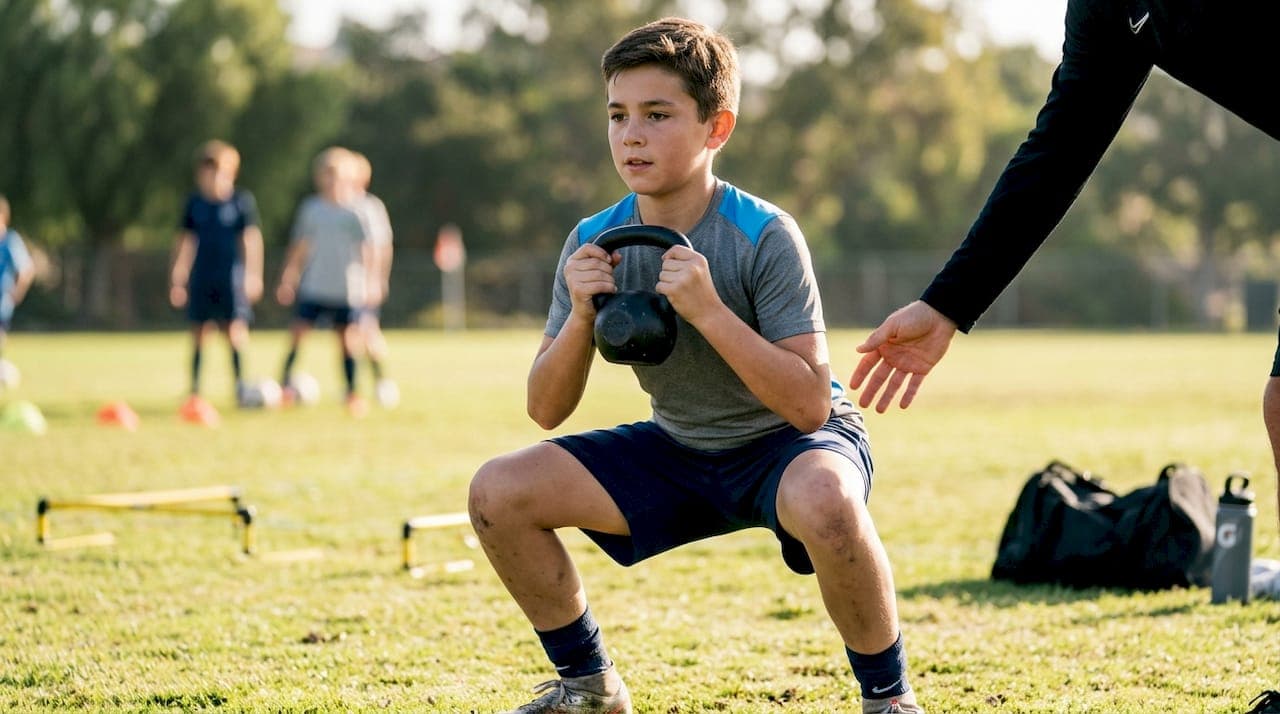
Yes — supervised, age-appropriate strength training is safe and beneficial for youth soccer players when it matches their biological maturity and movement competency. Start here: check whether your player can perform a solid squat, single-leg balance, and hip hinge before adding any load. Then schedule two short strength sessions per week alongside regular practice, and keep a qualified adult supervising every rep.
Three immediate steps to get started:
- Screen movement competency first (squat, hinge, lunge, push, pull, single-leg balance).
- Add two 20–30 minute sessions per week, spaced away from game days.
- Prioritize technique and progressive overload over load or intensity.
Quick safety checklist:
- Avoid heavy barbell loading before mid-to-late puberty (post-PHV).
- Screen for recent pain, growth-plate tenderness, or rapid-growth discomfort before each session.
- Do not train through sharp joint pain; refer to a sports medicine provider immediately.
- Never program strength sessions the day before a high-stakes match.
- Younger players (U10 and below) should use bodyweight, bands, or light medicine balls only.
Key Takeaways
Age-appropriate, supervised strength training is safe and effective for youth soccer players when programming matches biological maturity, not just chronological age.
| Point | Details |
|---|---|
| Maturity over age | Use PHV markers to guide program emphasis; pre-PHV prioritizes velocity, post-PHV prioritizes force. |
| Two sessions per week | Add two 20–30 minute strength sessions alongside regular practice for meaningful performance gains. |
| Technique before load | Follow NSCA-aligned dosing: 1–3 sets of 6–15 reps, increasing load by no more than 5–10% per week. |
| Supervision is non-negotiable | Look for CSCS-credentialed coaches with youth experience and a supervision ratio of no more than 1:8. |
| Repphilosophy locally | Repphilosophy's 4S Ranch youth performance program applies maturation-based progressions in supervised small-group sessions. |
Table of Contents
- Why strength training makes youth soccer players better
- When to begin structured strength work and why maturity matters more than age
- Age-appropriate guidelines from U8 through U16+
- The best exercises for youth soccer players, with regressions and progressions
- How to structure sessions and training blocks that actually work
- Safety checklist: supervision, equipment, and red flags every coach should know
- Two ready-to-run 8-week sample programs
- What the research actually says, and what it doesn't
- When to bring in a professional, and what credentials to ask for
- What I've learned coaching youth athletes at Repphilosophy
- Repphilosophy's youth performance program in 4S Ranch
- Sources
Why strength training makes youth soccer players better
Strength work does more than build muscle. For young soccer players, it directly improves the physical qualities that determine performance on the field: jump height, acceleration, change-of-direction speed, and the ability to hold position under pressure. A systematic review and meta-analysis covering 34 studies and 1,396 youth players found that strength and combined training produced larger lower-body strength gains (effect size g ≈ 1.07) than plyometric training alone (g ≈ 0.27), with meaningful improvements in jump and acceleration across all training types.
Injury prevention is just as compelling. Posterior chain work, particularly eccentric hamstring loading, reduces hamstring strain risk, which is one of the most common injuries in youth and adult soccer. Bone density, body composition, and psychological benefits like self-confidence round out the case. Mass General Brigham's clinical resources confirm that supervised, progressive programs show no major adverse events and carry genuine health benefits for young athletes.
The practical payoff is durability. Players who build a strength base handle the cumulative volume of a full season better, recover faster between matches, and arrive at tryouts physically prepared rather than worn down. Even highly trained youth players make meaningful gains from short-duration strength interventions of 12 weeks or less, showing that added strength work transfers even when soccer training volume is already high.
When to begin structured strength work and why maturity matters more than age
Chronological age is a poor guide for programming. Two 13-year-olds can be two full years apart in biological maturity, which means the same program that challenges one appropriately will overload the other. The concept that changes everything here is Peak Height Velocity (PHV), the period of fastest growth in adolescence. Training responses differ significantly depending on where a player sits relative to PHV.
A study on maturation status and training adaptations in elite male youth soccer players found that pre-PHV athletes improved most in sprinting and coordination, while post-PHV athletes responded more strongly to eccentric hamstring loading and higher-intensity strength work. That finding has direct programming implications: matching training emphasis to maturity stage produces better results and lower injury risk than applying a one-size-fits-all plan.
Practical maturity indicators you can use without clinical testing:
- Rapid shoe size increases or clothing outgrowth in the past 6 months suggest active growth.
- Noticeable coordination dips or "clumsy phases" often signal mid-PHV.
- A simple PHV estimate: measure standing height and sitting height; the ratio (sitting height / standing height) tends to decrease as a player approaches and passes PHV.
- Movement competency screens (single-leg squat quality, landing mechanics) give a practical readiness signal regardless of age.
Training focus by maturation stage:
- Pre-PHV: Prioritize velocity, coordination, and integrative movement circuits. Load is minimal.
- Mid-PHV: Begin introducing force development with bodyweight and light resistance. Monitor growth-related discomfort closely.
- Post-PHV: Progress to heavier strength work, barbell variants, and structured power training.
Pro Tip: A simple proxy for PHV timing is to ask parents when they noticed the most rapid height gain. Most boys hit PHV between ages 13–14; most girls between 11–12. Use that window to shift program emphasis from velocity-first to force-first work.
Age-appropriate guidelines from U8 through U16+
Stage-based programming keeps training safe, engaging, and productive. The table below summarizes the key parameters at each stage; the notes that follow explain what each stage looks like in practice.
U8/U10: Keep it playful. A 14-week circuit program for U9–10 players produced superior handgrip strength gains and showed full feasibility and safety in grassroots settings. Game-based circuits, animal locomotion drills, and partner challenges build strength without the kids ever feeling like they're "training."
U11/U12: Introduce integrative neuromuscular training (INT). An 8-week in-season INT protocol using 20-minute sessions three times per week improved speed, jump, change-of-direction, and strength in early-adolescent players with no reported injuries. Short, structured circuits with clear technique cues work well here.
U13/U14: This is where unilateral loading becomes a priority. Single-leg Romanian deadlifts, split squats, and lateral band walks address the asymmetries that drive injury risk. Introduce the trap bar or goblet squat for bilateral loading once the player demonstrates a clean hinge pattern.
U15/U16+: Post-PHV players can handle progressive barbell work under tight supervision. Front squats, Romanian deadlifts, and trap bar deadlifts form the backbone of a strength block. Plyometric progressions (depth drops, broad jumps, hurdle hops) can be layered in during preseason.
The best exercises for youth soccer players, with regressions and progressions
Every program should build from six foundational movement patterns: squat, hinge, lunge, push, pull, and anti-rotation. Single-leg work belongs in every session from U12 onward. Here is a practical exercise bank organized by pattern, with regressions for younger or less experienced players and progressions for post-PHV athletes.
Squat pattern:
- Regression: Goblet squat with light kettlebell, box squat to a target height.
- Standard: Bodyweight squat, goblet squat, trap bar squat.
- Progression: Front squat, barbell back squat (post-PHV, supervised only).
Hinge pattern:
- Regression: Hip hinge with dowel rod, Romanian deadlift with bands.
- Standard: Trap bar deadlift, single-leg RDL with bodyweight.
- Progression: Barbell RDL, single-leg RDL with kettlebell.
Lunge/single-leg:
- Regression: Reverse lunge, split squat with hands on wall.
- Standard: Walking lunge, Bulgarian split squat with bodyweight.
- Progression: Loaded Bulgarian split squat, lateral lunge with reach.
Push/pull:
- Regression: Wall push-up, band pull-apart.
- Standard: Push-up variations, inverted row, band rows.
- Progression: Dumbbell bench press, cable row, pull-up progressions.
Anti-rotation and core:
- Pallof press (band or cable), dead bug, bird dog.
- Progression: Single-leg Pallof press, plank variations with perturbation.
Posterior chain and hamstring eccentrics: Nordic hamstring curls are the gold standard for hamstring injury prevention. Start with a partner-assisted eccentric-only version (lowering slowly over 3–5 seconds) before progressing to full Nordics. Glute bridges and single-leg hip thrusts build the posterior chain without spinal loading, making them ideal for U12 and up.
Plyometric progressions: Begin with broad jumps and box step-downs before progressing to depth drops, hurdle hops, and reactive bounding. Landing mechanics (soft knees, hip hinge on contact, no valgus collapse) must be clean before adding height or speed.
Pro Tip: Watch for knee cave (valgus collapse) during any squat or landing. If you see it, regress the load immediately and add lateral band walks and single-leg glute bridges to the warm-up until the pattern cleans up.
How to structure sessions and training blocks that actually work
Adding two strength sessions per week to regular soccer practice is a commonly effective training structure for youth players, supported by research. One session can emphasize strength (heavier loads, lower reps), while the other targets power and velocity (lighter loads, faster movement, plyometrics).
General dosing guidance (NSCA-aligned):
- Sets: 1–3 per exercise, progressing from 1 set for beginners to 3 sets as competency develops.
- Reps: 6–15, with younger or less experienced players working in the 10–15 range.
- Load progression: increase load by no more than 5–10% per week once the player completes all sets with clean technique.
- RPE target: 6–7 out of 10 for most sessions; never push to failure with youth athletes.
In-season vs. preseason planning:
- Preseason (8–10 weeks before season): Build strength and power. Two full sessions per week, progressive overload, higher volume.
- Early in-season: Maintain gains with two shorter sessions (20–25 min) per week. Reduce total sets by roughly one-third.
- Mid-to-late in-season: One maintenance session per week is enough to preserve most strength gains. Keep intensity moderate, volume low.
- Off-season: Rebuild and address weaknesses. This is the window for introducing new movements or heavier loading.
Scheduling dos and don'ts:
- Place strength sessions at least 48 hours before a match.
- Avoid pairing a heavy strength session with a high-intensity soccer training day.
- Schedule strength work after technical soccer training, not before, to protect skill quality.
- Never add a new exercise or increase load in the week before a tournament.
Safety checklist: supervision, equipment, and red flags every coach should know
Safety in youth strength training comes down to three things: proper screening before you start, qualified supervision during every session, and clear criteria for when to stop and refer. None of these are complicated, but skipping any one of them is where programs go wrong.
Pre-session checks:
- Ask about recent pain, joint swelling, or growth-plate tenderness at the knee (Osgood-Schlatter) or heel (Sever's disease) before every session.
- Any player with a recent fracture, surgery, or unresolved soft-tissue injury needs medical clearance before returning to loading.
- Rapid growth spurts (more than 2 inches in 6 months) warrant a temporary reduction in load and a closer watch on movement quality.
Supervision and coach qualifications:
- Look for coaches holding a CSCS (Certified Strength and Conditioning Specialist) credential from the NSCA, or specific youth training experience with a pediatric or sports-medicine background.
- Supervision ratios matter: one coach per 6–8 athletes is a reasonable ceiling for technique-focused sessions.
- A youth fitness program checklist can help parents evaluate whether a program meets basic safety standards before enrolling.
Equipment choices:
- Trap bar over conventional barbell for early deadlift progressions; the neutral grip and upright torso position reduce technical error.
- Soft landing surfaces (rubber flooring, grass) for all plyometric work.
- Bands, kettlebells, and medicine balls are the right tools for U12 and younger; barbells belong in post-PHV programming only.
Red flags during training:
- Sharp or localized joint pain (not general muscle fatigue): stop immediately.
- Compensatory movement patterns that appear mid-set (knee cave, lumbar rounding): reduce load or regress the exercise.
- Dizziness, nausea, or unusual fatigue: end the session and assess hydration and sleep.
Pro Tip: Use the FIFA 11+ warm-up protocol as your standard pre-session warm-up. It takes 15–20 minutes, requires no equipment, and has a strong evidence base for reducing lower-limb injury risk in youth soccer.
Two ready-to-run 8-week sample programs
Program A: Ages 11–12 (INT + light resistance focus)
This program runs twice per week, with sessions lasting 20–25 minutes. It fits inside a regular practice week without adding significant fatigue.
Weekly layout:
Weeks 1–2: Establish movement patterns. Bodyweight squats, reverse lunges, glute bridges, push-ups, bird dogs, lateral hops. 2 sets × 10–12 reps. Focus entirely on technique.
Weeks 3–4: Add band resistance to squats and hip hinges. Introduce Nordic eccentric (partner-assisted, 3-second lowering). 2–3 sets × 10 reps.
Weeks 5–6: Progress to single-leg RDL with bodyweight, split squats, and medicine ball throws. 3 sets × 8–10 reps.
Weeks 7–8: Introduce light kettlebell goblet squats and trap bar deadlifts if technique is clean. 3 sets × 8 reps. Test CMJ and 10-m sprint at end of week 8.
Progression rule: Increase load or complexity only when the player completes all sets with clean form and an RPE of 6 or below.
Program B: Ages 13–15 (strength + power focus)
Two sessions per week, 30–35 minutes each. One session emphasizes strength; the other emphasizes power and velocity.
Weekly layout:
Weeks 1–2: Trap bar deadlift (3 × 8), Bulgarian split squat (2 × 10 each leg), Nordic eccentric (3 × 5), push-up variations (3 × 10), Pallof press (2 × 12).
Weeks 3–4: Increase trap bar load by 5–10%. Add broad jumps (3 × 5) and lateral hurdle hops (3 × 6 each side) to the power session.
Weeks 5–6: Introduce front squat or goblet squat (3 × 6–8). Progress Nordics to 4-second lowering. Add depth drops (3 × 5) to power session.
Weeks 7–8: Test CMJ, handgrip strength, and 20-m sprint. Increase load on primary lifts by 5–10% if all reps were clean in weeks 5–6. Introduce one reactive bounding drill.
An 8-week supervised strength program in adolescent soccer players produced improvements in jump height, 20-m sprint speed, and change-of-direction, confirming this timeline is realistic and achievable.
What the research actually says, and what it doesn't
The evidence base for youth soccer strength training has grown substantially over the past decade, and the headline finding is consistent: supervised strength, plyometric, and combined training improve physical performance in youth players without significant injury risk.
Key takeaways from the research:
- Strength and combined training produce the largest lower-body strength gains; plyometrics alone produce smaller strength effects but still improve jump and speed.
- INT programs added in-season are time-efficient and safe, even at three sessions per week.
- Play-based and circuit-style programs work well for younger players (U9–10) and preserve engagement over longer program durations.
- Maturation status shapes adaptation: pre-PHV players gain more from coordination and velocity work, post-PHV players from force and eccentric loading.
Limitations worth knowing:
- Most published trials use small samples (often under 40 players) and short durations (7–14 weeks), which limits how confidently findings generalize.
- Sex and maturation reporting is inconsistent across studies; most published data comes from male players, so female-specific programming guidance remains thinner.
- Study populations are often elite or semi-elite youth, so results may not transfer directly to recreational or grassroots settings without adjustment.
Research consistently supports supervised youth strength training as safe and effective, but the evidence is strongest for short-duration programs in male players. Apply findings with appropriate caution in female athletes and recreational settings, and always prioritize individual maturity and movement competency over published age norms.
For cross-sport context, safe youth training practices from baseball mirror the same supervision and progression principles that apply to soccer, reinforcing that these guidelines hold across youth team sports.
When to bring in a professional, and what credentials to ask for
Some situations call for more than a well-designed program. Knowing when to refer is one of the most important skills a parent or coach can develop.
Triggers for professional referral:
- Ongoing joint pain lasting more than two weeks, especially at the knee or hip.
- A history of stress fractures, growth-plate injuries, or surgery in the past 12 months.
- Early specialization with high weekly training volume (more than 16 hours per week across all sports).
- Rapid growth-related pain at the heel or knee that persists through warm-up.
- Any player who has not had a sports physical in the past year.
Credentials and experience to prioritize:
- CSCS (Certified Strength and Conditioning Specialist) from the NSCA, with documented youth athlete experience.
- Pediatric physical therapist for players with injury history or growth-related pain.
- Sports medicine physician for medical clearance questions or persistent pain.
- Coaches with specific youth sports performance training experience, not just adult fitness backgrounds.
Questions to ask a potential coach:
- What is your supervision ratio during youth sessions?
- How do you adjust programming for players at different maturity stages?
- How do you communicate progress to parents?
- What is your protocol when a player reports pain?
Repphilosophy's youth sports performance program in 4S Ranch applies maturity-based progressions in small-group settings, with qualified coaching and clear parent communication built into every session. A first visit typically includes a movement screen and a conversation about the player's current training load and goals.
For parents exploring how sport-specific training fits into a broader athletic development plan, that context helps frame what a professional program actually delivers beyond generic fitness.
What I've learned coaching youth athletes at Repphilosophy
The single biggest mistake I see in youth soccer strength programs is skipping the movement screen and jumping straight to load. A player who can't hinge cleanly with bodyweight will not hinge better with a barbell. Every athlete who comes through our program at Repphilosophy starts with a movement competency assessment, regardless of age or experience level. That screen tells us more about where to begin than any birth certificate.
What I've also learned is that maturation-based programming isn't just a research concept; it's the difference between a player who thrives and one who gets hurt or burned out. We adjust session emphasis based on where each athlete sits relative to PHV, which means two players the same age might be doing meaningfully different work on the same day. That individualization is what makes supervised, small-group training worth the investment.
Parents often ask me how quickly they'll see results. The honest answer is that movement quality improves within the first two to four weeks, and measurable performance gains (jump, sprint, COD) typically show up by weeks six to eight of a consistent program. The deeper gains, the ones that show up as a full season without a hamstring strain or a player who can hold their position in the 80th minute, take longer. But they're the ones that matter most.
Repphilosophy's youth performance program in 4S Ranch
If you're a parent or coach in the San Diego area looking for supervised, maturity-aware strength training for your player, Repphilosophy delivers exactly what this article describes, without the guesswork of a generic gym program.

Our youth sports performance sessions at the 4S Ranch facility use small-group formats, qualified coaching, and maturation-based progressions to build strength safely and progressively. Every session starts with a FIFA 11+ style warm-up, moves through movement-pattern work matched to the player's stage, and finishes with a brief cool-down and feedback. Parents receive progress updates, and programming adjusts as players grow and develop.
For families who prefer flexibility, the virtual exercise library gives you coached, on-demand sessions you can run at home or at a local field. Ready to get your player started? Book a trial session and see what a first movement screen and supervised session looks like in practice.
Sources
The claims in this article draw on peer-reviewed trials, systematic reviews, and established coaching guidelines. Here are the primary sources, with a note on what each contributes.
- Impact of a Strength Training Program on Physical Performance in U10 Soccer Players: A Quasi-Experimental Trial
- Effects of Maturation Status on Physical Performance Adaptations Following a Combined 7-Week Strength and Power Training Program in Elite Male Youth Soccer Players
- The Effects of Strength, Plyometric and Combined Training on Strength, Power and Speed Characteristics in High-Level, Highly Trained Male Youth Soccer Players: A Systematic Review and Meta-Analysis
- FIFA 11+ Injury Prevention Booklet
- Preseason training programs for youth baseball players (NSCA-style youth resistance training recommendations)
- Soccer Strength Training (Mass General Brigham resources and reviews)
This article is general information, not a substitute for advice from a qualified doctor. Consult a qualified healthcare professional about your own circumstances before acting on anything here.