
Sport-specific training is the targeted development of the physical qualities, movement patterns, and conditioning demands that align directly with a young athlete’s chosen sport. For parents trying to give their child the best possible foundation, understanding why sport-specific training matters for youth is the clearest path forward. A PLOS ONE 2026 randomized trial confirmed that progressively dosed, supervised plyometric programs improve sprint speed, jump performance, and leg stiffness safely across maturity stages in youth soccer players. The CDC further documents that structured physical activity builds bone strength, cardiometabolic health, and mental well-being in children. This is not generic exercise. It is purposeful preparation.
How does sport-specific training improve youth athletic performance?
Sport-specific training works because it targets the exact physical qualities a sport demands, rather than developing general fitness that may never transfer to the field or court. A young basketball player needs reactive jumping ability and lateral quickness. A young soccer player needs sprint acceleration and single-leg stability. Generic conditioning programs miss these distinctions entirely.
The PLOS ONE 2026 trial demonstrated that a 12-week plyometric jump training program produced measurable improvements in sprint speed, jump height, and relative leg stiffness in youth soccer players both before and after peak height velocity. This means the benefits hold regardless of where a child sits in their growth curve, provided the program is properly supervised and progressively loaded. That last part matters enormously.
A 2026 MDPI cross-sectional study of 84 youth athletes found that training experience and biological maturity influence performance differently depending on the task. Jump height and explosive output responded more to training experience, while strength and motor control were more tied to maturation. This tells us that not all physical qualities develop on the same timeline, and a well-designed sport-specific program accounts for both.
Key performance benefits of sport-specific training for youth athletes include:
-
Sprint and acceleration mechanics tailored to the sport’s movement demands
-
Reactive strength and jump capacity developed through structured plyometric progressions
-
Sport-relevant motor patterns that reduce wasted movement and improve efficiency
-
Neuromuscular coordination that matures faster with targeted stimulus than with general play alone
Pro Tip: Ask any program director how they adjust training loads based on a child’s growth stage. If they cannot answer that question clearly, the program is not truly sport-specific.
What role does sport-specific training play in injury prevention?
Sport-specific training, when properly dosed and managed, is one of the most effective tools for reducing injury risk in young athletes. The connection between targeted conditioning and injury prevention is well established, and it goes beyond simply “getting stronger.”
Cedars-Sinai clinicians recommend that youth athletes cap weekly sport hours at roughly their age in years. A 10-year-old should train no more than approximately 10 hours per week across all sport activities. Exceeding that threshold significantly increases overuse injury risk, particularly during growth spurts when bones and tendons are under additional stress.
Structured sport-specific programs address this by building the physical resilience young bodies need to handle sport demands safely. Programs like FIFA 11+ for soccer and the Thrower’s 10 for overhead athletes are purpose-built examples. They combine strength, balance, and neuromuscular control exercises matched to the specific injury patterns most common in each sport. Elite U17 football injury surveillance confirms the need for targeted conditioning during biologically vulnerable growth phases, particularly for muscle and tendon injuries that spike during rapid height gains.
Here is a practical framework for managing injury risk through sport-specific training:
-
Match weekly training hours to your child’s age. Use the age-to-hours guideline as a ceiling, not a target.
-
Prioritize movement quality over volume. A young athlete who moves well at low volume builds a safer foundation than one who trains hard with poor mechanics.
-
Include structured warm-up protocols. Programs like FIFA 11+ reduce lower extremity injuries by addressing activation, balance, and dynamic stability before practice.
-
Build in recovery weeks. One reduced-load week every three to four weeks allows tissue adaptation and prevents cumulative overuse.
-
Watch for warning signs. Persistent joint pain, fatigue that does not resolve with rest, and declining performance are signals to reduce load immediately.
“Training that is not properly matched in dose and movement type can fail to maximize benefits or increase injury risk.” — PLOS ONE practitioner insight
Pro Tip: If your child complains of the same joint pain after multiple practices, do not wait for it to become a diagnosis. Reduce load, consult a sports medicine professional, and review the training program with the coach.
Multi-sport vs. early specialization: what does the research say?
One of the most common questions parents ask is whether their child should specialize in one sport early or play multiple sports. The research gives a clear answer, and it may surprise you.
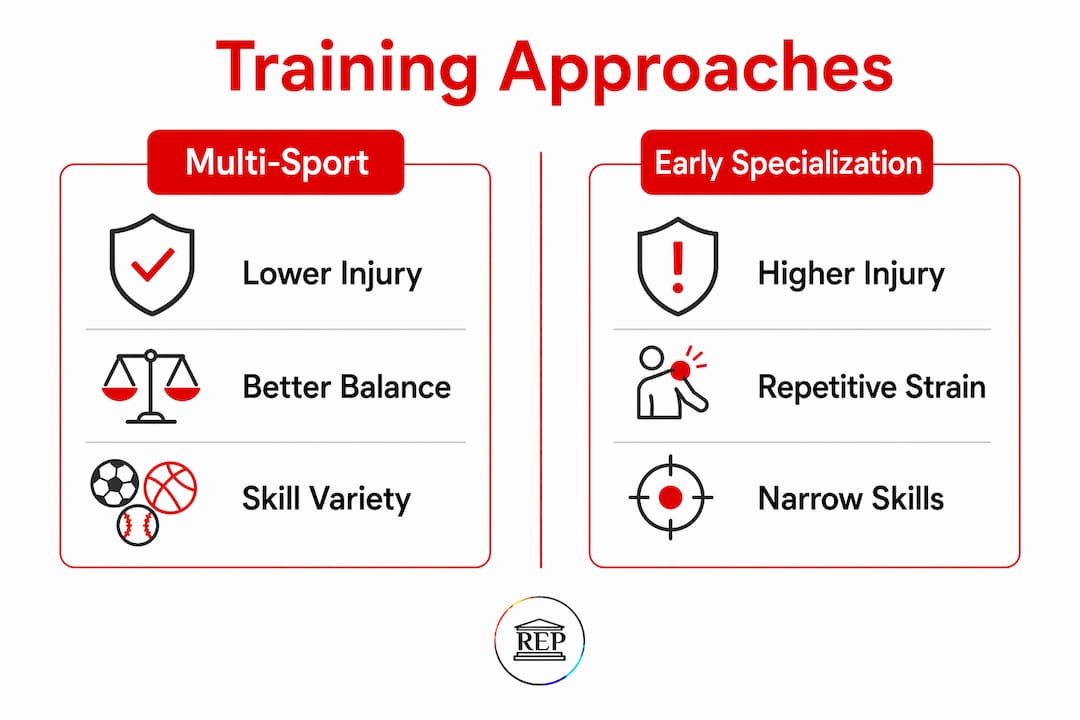
Sanford Sports Performance highlights research showing that multi-sport youth athletes experience lower rates of overuse injuries and burnout compared to early single-sport specializers. They also show better long-term physical activity adherence, meaning they are more likely to stay active into adulthood. Early specialization before age 12 to 14 is consistently associated with higher dropout rates and a narrower athletic foundation.
Here is how the two approaches compare across key development factors:
| Factor | Multi-sport participation | Early single-sport specialization |
|---|---|---|
| Injury risk | Lower, due to varied movement demands | Higher, due to repetitive stress patterns |
| Burnout rate | Lower, sustained motivation | Higher, especially after age 14 |
| Athletic foundation | Broader motor skill base | Narrower, sport-specific only |
| Long-term activity | Better adherence into adulthood | Higher dropout risk |
| Performance ceiling | Often higher due to transfer of skills | Can plateau without varied stimulus |
Sport-specific training fits naturally within a multi-sport model. The goal is not to lock a child into one sport year-round. It is to develop the physical qualities that serve their primary sport while preserving the variety that keeps them healthy and motivated. Think of it as targeted preparation within a broader athletic life, not a replacement for it.
The practical guidance is straightforward:
-
Before age 12, prioritize multi-sport participation and general athletic development
-
Between ages 12 and 15, introduce more focused sport-specific work while maintaining at least one secondary sport
-
After age 15, gradual specialization becomes appropriate if the athlete is motivated and physically mature enough to handle increased load
What can parents do to support effective sport-specific training?
Your role as a parent is more influential than you might realize. The quality of your child’s training experience depends not just on the coach or the program, but on the environment you help create around it.
Start by evaluating the program itself. A quality sport-specific training program for youth should include qualified supervision, progressive load management, and clear communication about how training is adjusted for each child’s maturity and experience level. The benefits of sports performance coaching go well beyond physical gains when the program is designed with the whole athlete in mind.
Recovery, sleep, and nutrition are not optional extras. They are where adaptation actually happens. A young athlete who trains hard but sleeps six hours a night and skips breakfast is not getting the full benefit of any program. Aim for eight to ten hours of sleep per night for school-age athletes, and make sure they are eating enough to support both growth and training demands.
The holistic approach to youth development emphasized in a 2026 Phys.org review synthesis makes clear that sport success in youth depends on coaching quality, mental well-being, and parent involvement working together. Your attitude toward competition, mistakes, and effort shapes how your child experiences training more than any single workout does.
Key things to monitor and support at home:
-
Sleep quality and duration. Eight to ten hours is the target for most youth athletes.
-
Appetite and energy levels. Sudden drops in energy or appetite can signal overtraining.
-
Enjoyment and motivation. A child who dreads practice consistently is sending an important signal worth addressing.
-
Communication with the coach. Regular check-ins about your child’s progress and any physical concerns keep everyone aligned.
Pro Tip: Ask your child after each training session what they worked on and how they felt. That two-minute conversation gives you a reliable window into both the program quality and your child’s emotional relationship with their sport.
Key takeaways
Sport-specific training for youth athletes works best when it is matched to the sport’s demands, the child’s biological maturity, and a broader developmental model that includes multi-sport participation and genuine enjoyment.
| Point | Details |
|---|---|
| Performance gains are real | A 12-week plyometric program improves sprint speed and jump height safely across maturity stages. |
| Injury prevention requires load management | Cap weekly sport hours at roughly the child’s age in years to reduce overuse injury risk. |
| Multi-sport participation protects development | Youth who play multiple sports show lower burnout rates and better long-term athletic adherence. |
| Training must match biological maturity | Explosive capacity responds to training experience; strength and motor control track more closely with maturation. |
| Parent involvement shapes outcomes | Recovery habits, coach communication, and a positive home environment directly influence training results. |
What I’ve learned coaching youth athletes in 4S Ranch
I have worked with young athletes long enough to know that the biggest mistake parents make is not under-training their kids. It is over-programming them. I see it regularly. A motivated 11-year-old playing one sport year-round, attending three practices a week, competing on weekends, and then showing up to additional sport-specific sessions already running on empty. The training itself is fine. The total load is the problem.
What I have found actually works is treating sport-specific training as a complement to the rest of a child’s athletic life, not the centerpiece of it. When a young athlete comes to me with a clear sport goal and we build a program around their current maturity level, their enjoyment of the sport, and their recovery capacity, the results are consistently better than when we just pile on volume and intensity.
The research backs this up. The path to youth athletic success runs through coaching quality, mental well-being, and a positive relationship with sport, not just physical output. I genuinely believe that a kid who loves what they are doing and feels physically capable will outperform a kid who is technically trained but burned out.
My honest advice to every parent I work with: protect your child’s love of the game first. The physical development follows when the environment is right.
— Coach Justin
Train smarter with Repphilosophy
At Repphilosophy, we build sport-specific training programs for youth athletes that are grounded in the same research principles covered in this article. Every program is designed around your child’s sport demands, maturity level, and goals, with supervision and progressive load management built in from day one.

Whether you are looking for local training at our 4S Ranch sports performance center or prefer the flexibility of virtual coaching memberships, we have options that fit your family’s schedule and budget. We also offer group training and bring-a-buddy memberships that make quality coaching more accessible. Ready to give your young athlete the foundation they deserve? Explore our coaching programs and let’s get started.
FAQ
What is sport-specific training for youth athletes?
Sport-specific training is a structured program that develops the exact physical qualities, movement patterns, and conditioning demands required by a young athlete’s sport. It differs from general fitness by targeting sprint mechanics, reactive strength, or sport-relevant motor skills based on what the sport actually demands.
At what age should youth athletes start sport-specific training?
Most sports medicine professionals recommend introducing focused sport-specific training between ages 12 and 15, after a foundation of multi-sport participation has been established. Before age 12, general athletic development and varied movement experiences produce better long-term outcomes.
How does sport-specific training reduce injury risk in youth?
Targeted conditioning builds the strength, balance, and neuromuscular control that protect joints and tendons during sport-specific movements. Programs like FIFA 11+ and the Thrower’s 10 are structured examples that directly address the most common injury patterns in their respective sports.
How many hours per week should a youth athlete train?
Cedars-Sinai clinicians recommend capping total weekly sport hours at approximately the child’s age in years. A 12-year-old should not exceed roughly 12 hours of combined sport activity per week to avoid overuse injuries.
Should my child specialize in one sport or play multiple sports?
Research from Sanford Sports Performance shows that multi-sport participation reduces overuse injury risk and burnout while building a broader athletic foundation. Gradual specialization after age 14 to 15 is generally the safer and more effective path for most young athletes.