

The most effective offseason training program follows a phase-based structure: two weeks of active recovery, then a build through hypertrophy, maximal strength, and power, converting into sport-specific speed before preseason. The block should run 8 to 16 weeks with most athletes landing in the 12-week range, training 3 to 5 days weekly. Start with baseline testing, take a period of true active recovery, then commit to a template and stick with it.
TL;DR:
- Offseason training length should match your schedule, with 12 weeks as the optimal duration for most athletes to progress through all phases.
- Each phase focuses on specific goals: tissue recovery, hypertrophy, maximal strength, and power/speed, with proper timing and workload for safe, effective development.
- Testing baseline metrics in week 1 and every 4 to 8 weeks ensures progress tracking and prevents overtraining or premature peak attempts.
- Program details, such as deloads and recovery, are critical, with scheduled rest every 4 to 6 weeks and attention to sleep and nutrition to support adaptation.
- Tailoring training volume and emphasis based on sport, training age, and individual constraints improves results, especially for youth and endurance athletes.
Table of Contents
- How Long Should Your Offseason Training Program Be?
- What Should Each Offseason Training Phase Actually Look Like?
- How Do You Adjust an Offseason Program by Sport?
- Sample Weekly Templates and Two Sessions Worth Copying
- How Do You Test and Monitor Progress All Block Long?
- Recovery and Nutrition Rules That Make the Program Work
- Why Coach Justin Built This Approach Around Testing First
- The Mistakes That Quietly Wreck an Offseason Block
- Get a Custom Offseason Program Built Around Your Sport
- Where This Offseason Training Guidance Comes From
- Sources
- FAQ
How Long Should Your Offseason Training Program Be?
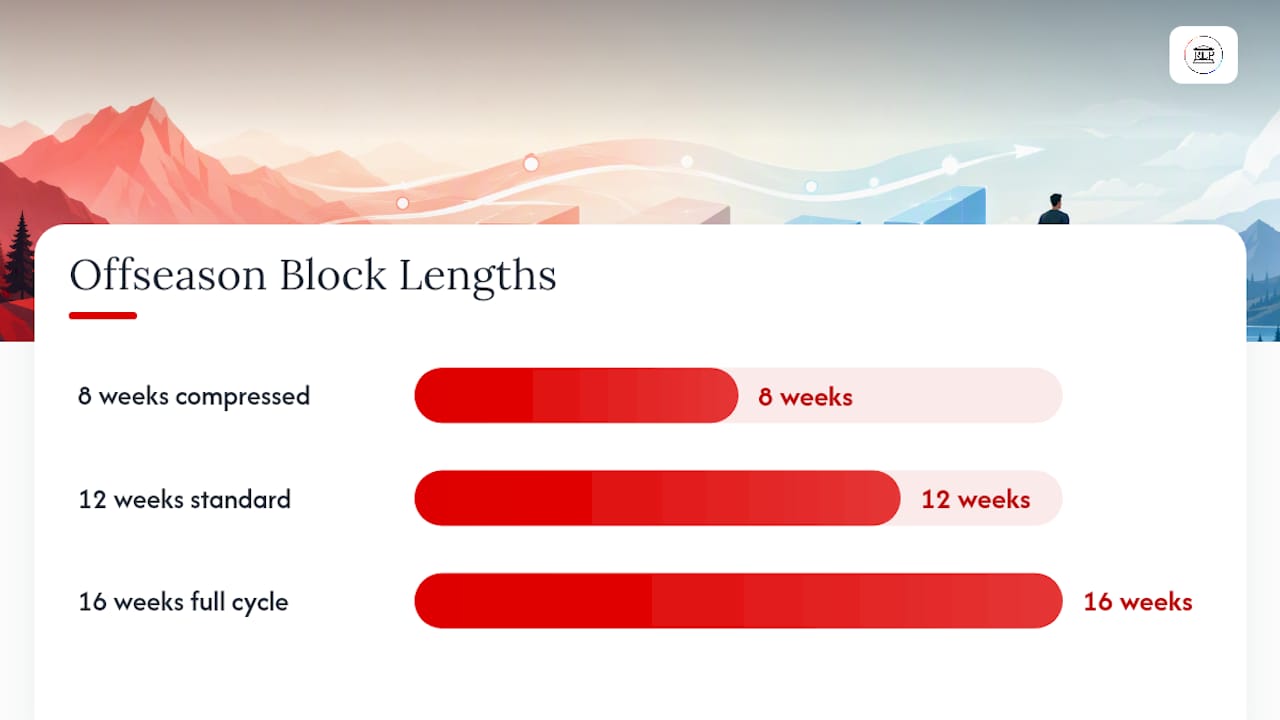
The right block length depends on your calendar, not your ambition. If you have less than 8 weeks before tryouts or camp, you're building a compressed conditioning bridge, not a full development cycle. If you have a full 12 to 16 weeks, you can run every phase at proper dosage and still leave a buffer for a late-block deload.
Here's how to choose:
- 8 weeks: Use when preseason is close. Compress hypertrophy into 2 to 3 weeks and spend more time on strength-to-power conversion and sport speed.
- 12 weeks: The workhorse length for most team-sport and individual athletes. Roughly 3 to 4 weeks per phase, with one deload week built in around week 7 or 8.
- 16 weeks: Ideal for athletes coming off injury, younger athletes still building a training base, or anyone whose season doesn't return until late summer. This length lets you run a full 16-week phase-based development framework without rushing any single quality.
Weekly layout depends on training age and sport demands. A 3-day split (full-body strength plus one conditioning day) suits multi-sport high schoolers or anyone rebuilding a base. A 4-day split separates lower and upper body strength from power and speed work, which fits most club and collegiate athletes. A 5-day split adds a dedicated hypertrophy day and a standalone mobility/prehab session, best reserved for athletes with a longer training history and good recovery capacity.
Place deload weeks every 4 to 6 weeks and schedule active recovery days after your highest CNS-demand sessions, never the day before a testing session.
What Should Each Offseason Training Phase Actually Look Like?
A phase-based offseason program works because each block has one primary job. Trying to build strength, power, and conditioning all at once is how athletes end up mediocre at everything by week 6.
-
Restoration and foundation (weeks 1 to 2). The goal is tissue recovery and movement quality, not loading. Keep intensity low, focus on mobility, unilateral stability work, and light aerobic sessions. This is also when beginning with active recovery reduces the injury risk that comes from jumping straight into heavy lifting on accumulated in-season fatigue.
-
Hypertrophy and base building (weeks 3 to 5, or longer in a 16-week block). Work in the 65 to 80% 1RM range for 8 to 12 reps on compound lifts like squats, deadlifts, and presses. The target here is muscle cross-section and connective tissue resilience, the raw material strength gets built from later.
-
Maximal strength (weeks 6 to 9). Loads climb to 75 to 92% 1RM for 2 to 5 reps. Add lower-volume plyometric work, two or three sets of bounds or box jumps, to start bridging toward power without overtaxing the nervous system. Track bar velocity where you can. A stall in velocity at the same percentage load is your signal to hold or drop intensity for a week.
-
Power and speed bridge (weeks 10 to 12+). Loads drop to 30 to 60% 1RM, but bar speed and jump height become the priority metrics. Sprint work moves from short acceleration sets to longer flying sprints, and plyometric volume peaks here rather than earlier. Benchmark against your baseline CMJ and sprint times from week 1. A 5 to 10% improvement by the end of this phase is a realistic, evidence-supported target.
How Do You Adjust an Offseason Program by Sport?
A powerlifter and a distance runner cannot run the same block and expect the same result. The phases stay the same; the emphasis inside each one shifts hard — for example, team-sport athletes can benefit from soccer match analysis and coaching tools that help optimize training phases relevant to their sport.
- Endurance athletes should prioritize strength-to-weight ratio over max strength, keeping hypertrophy volume moderate. Two HIIT sessions per week during the base and strength phases preserve aerobic capacity that would otherwise erode while lifting takes priority.
- Team-sport athletes (soccer, basketball, lacrosse) benefit from scheduling plyometrics and power work early in the week, when the nervous system is freshest, and pushing high-fatigue strength days later so practice or scrimmage quality doesn't suffer.
- Sprinters and power-sport athletes can compress the hypertrophy phase and expand velocity-based and plyometric training earlier and longer, provided jump and sprint metrics are monitored closely enough to catch overreach before it shows up as a hamstring strain.
- Youth athletes need capped intensity and volume, strict movement-quality standards before adding load, and supervised plyometric progressions rather than self-directed jump training. Longer restoration windows between hard sessions matter more here than in adult programming, and sport-specific transfer should guide exercise selection more than raw intensity.
Sample Weekly Templates and Two Sessions Worth Copying
Pick the template that matches your training age and time available, not the one that looks most impressive on paper.
- 3-day (full-body): Monday strength, Wednesday power/conditioning, Friday strength. Roughly 60 to 75 minutes per session.
- 4-day (upper/lower split): Monday lower strength, Tuesday upper strength, Thursday power/plyometrics, Friday conditioning. About 45 to 60 minutes per session.
- 5-day (high-volume development): Add a Saturday mobility and prehab session, plus a dedicated hypertrophy accessory day, to the 4-day structure above.
Example power/HIIT session (Power and Speed Bridge phase): Depth jump progressions 3x5, 10-meter acceleration sprints 6x, then a HIIT finisher of 30-second bike or sled push efforts at high intensity with 90-second rest, 6 rounds, guided by the same HIIT protocol shown to maintain aerobic capacity during detraining periods.
Pro Tip: Beginners should cut plyometric volume in half and use the extra time on landing mechanics; advanced athletes can add a third weekly power session once CMJ scores stabilize for two straight weeks.
How Do You Test and Monitor Progress All Block Long?
Run a baseline battery in week 1: countermovement jump (CMJ), 10 and 20 meter sprint times, a sport-relevant conditioning test like the Yo-Yo Intermittent Recovery Test, and a basic force-velocity profile if you have access to it.
- Check daily readiness with a quick pre-session CMJ or subjective wellness score.
- A CMJ drop greater than 5% from baseline is your cue to cut load that day, not push through it.
- Track session RPE multiplied by duration to estimate weekly training load, and watch the acute-to-chronic workload ratio. Anything above 1.5 is a documented injury risk zone.
- Retest the full baseline battery every 4 to 8 weeks and adjust the next block's emphasis based on what actually moved.
Recovery and Nutrition Rules That Make the Program Work
None of the programming above matters if recovery collapses underneath it.
- Program a deload every 4 to 6 weeks: cut volume by 40 to 50% while keeping intensity mostly intact.
- Target 7 to 9 hours of sleep nightly, and use active recovery, easy movement, foam rolling, mobility work, on off days.
- Shift calories with the phase: a slight surplus during hypertrophy, maintenance during strength and power phases, with protein intake staying high throughout to support the connective tissue repair that off-season training demands.
- Build a five-minute daily prehab routine (hips, shoulders, ankles) rather than treating injury prevention as a once-a-week afterthought.
Pro Tip: If sleep drops below 6 hours for more than two nights in a row, treat the next session as a recovery day regardless of what the calendar says.
Why Coach Justin Built This Approach Around Testing First
Coach Justin and the REP Philosophy coaching team have built youth and adult sport-performance programming around one non-negotiable: you can't fix what you haven't measured. Two rules get applied to every athlete on day one. First, active recovery starts the block, no exceptions, no skipping ahead to lifting heavy. Second, baseline testing happens in week 1, every time, because it tells you whether an athlete needs more force or more velocity before you waste six weeks guessing. The youth athlete home workout checklist reflects that same testing-first philosophy scaled down for younger training ages.
— Coach Justin
The Mistakes That Quietly Wreck an Offseason Block
Most offseason programs don't fail because the exercises are wrong. They fail because of three repeatable errors.
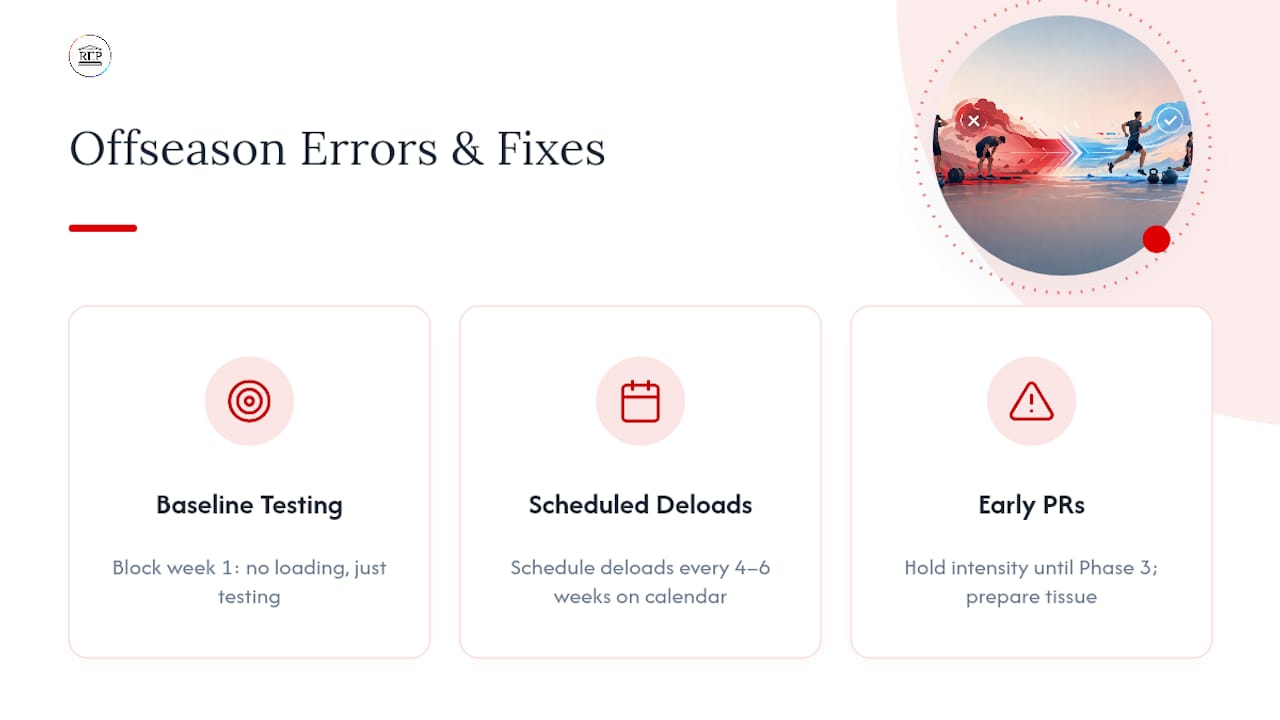
Skipping baseline testing is the most common one. Fix it by blocking out week 1, no loading, just testing, so every phase after that is built on real numbers instead of guesses.
Skipping deloads is the second. Fix it by literally scheduling one every 4 to 6 weeks on the calendar before the block even starts, not waiting until fatigue forces the issue.
Chasing personal records too early is the third, and it's the one that ends offseasons in the training room. Hold intensity steady until Phase 3 arrives; the strength phase exists to prepare the tissue for that testing, not to rush it.
Get a Custom Offseason Program Built Around Your Sport
Templates get you started, but they can't account for your actual sprint times, your CMJ baseline, or the fact that your shoulder has been cranky since March. Repphilosophy builds that missing layer: a coached alternative to guessing your way through a generic PDF program, with real progression tracking instead of a spreadsheet you abandon in week 3.

If you're in the 4S Ranch area and want hands-on coaching through each phase, in-person personal training memberships give you direct programming and load adjustments session to session. Prefer to train on your own schedule? The Exercise Video Library Membership runs $12.50 per month and gives you a structured video library to pull sessions from without booking a single appointment. Want live feedback without the drive? Virtual Coaching Sessions put a coach's eyes on your form remotely. Not sure which fits? Start with a personal training trial session and let a coach map the right phase length to where you actually are right now.
Where This Offseason Training Guidance Comes From
The phase structure and monitoring thresholds in this guide draw on a randomized controlled trial on youth soccer detraining, a 16-week off-season development framework, and practical off-season workout templates. Full source links appear throughout the article above.
Sources
- Supervised Offseason Training Programs are able to mitigate the Effects of Detraining in Youth Men Soccer Players Physical Fitness: A Randomized Parallel Controlled Study
- Off-Season Physical Development Plan: A 16-Week Framework for Athletes
- The Ultimate Off-Season Workout Routine for Athletes: Stay Game-Ready All Year - Halftime Hits
- Athletic training in the offseason
FAQ
What Is the 3-3-3 Rule for Running?
There's no single accepted definition of a "3-3-3 rule" in offseason running programming; if you've seen it referenced, treat it as informal shorthand rather than an established training standard, and rely on structured phase progression and baseline testing instead.
What Is a Good Offseason Running Program for Distance Athletes?
A solid distance-running offseason program builds strength-to-weight ratio through a hypertrophy-to-strength progression while keeping two weekly HIIT sessions to preserve aerobic capacity, following the same phase-based structure used across other endurance sports.
Should a 12-Year-Old Baseball Player Do Drills in the Offseason?
Yes, but volume and intensity should stay capped, with an emphasis on movement quality and supervised plyometric progressions rather than heavy loading or high-volume throwing drills.
How Much Does a Custom Offseason Training Program Cost?
Repphilosophy's Exercise Video Library Membership is listed at $12.50 per month, while pricing for personal training memberships and virtual coaching sessions is available directly on the Repphilosophy site.