
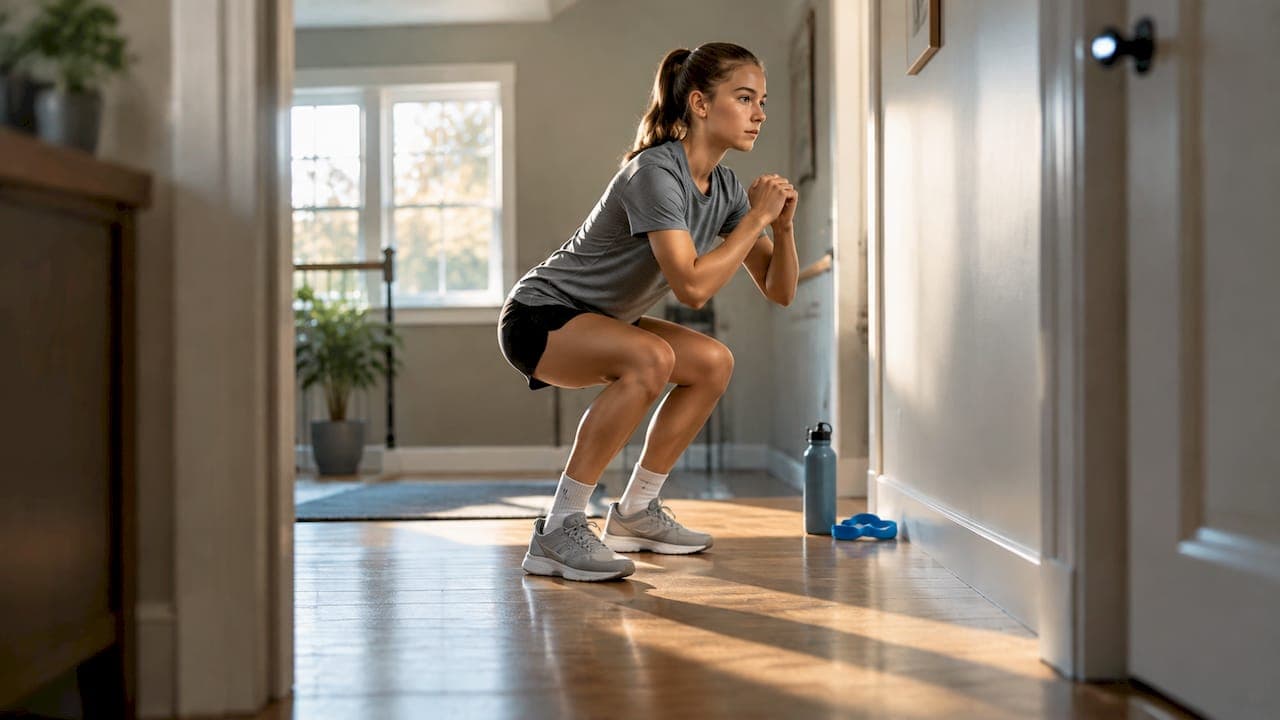
Yes, home workouts can build real athleticism in young athletes. Equipment-free training works when sessions stay short, focus on movement quality over load, and follow age-appropriate progression. The formula is simple: bodyweight strength, brief power and agility work, and a proper warm-up, all done consistently under a watchful eye.
TL;DR:
- Short, focused workouts two to three times a week provide sufficient strength gains without risking overtraining in young athletes.
- Emphasizing proper form through visual feedback and regression options helps prevent injuries and builds good movement habits.
- Speed and agility drills can be made using household items, with each session kept under five minutes to maximize benefits.
- Sharp or joint pain during training indicates a need to stop and consult a healthcare professional, especially for younger athletes.
- Guided, age-specific programs and fun, play-based activities are more effective for long-term engagement and progress than overly complex routines.
Table of Contents
- Bodyweight Exercises for Youth: What Should Kids Actually Learn?
- Speed and Agility Drills You Can Run in Your Driveway
- How Long Should a Youth Athlete Warm Up and Cool Down?
- Building a Weekly Home Training Plan Without Overdoing It
- Safety First: Red Flags Every Parent Should Watch For
- Sample Home Workouts by Age Group
- Coach Justin's Program Checklist and Where to Learn More
- Why Fun Beats Perfect Programming
- Want Guided Programming Instead of DIY Templates?
- Sources and Further Reading
Bodyweight Exercises for Youth: What Should Kids Actually Learn?
Five movements do most of the heavy lifting in youth athlete training: the squat, lunge, push-up, glute bridge, and plank. Each one builds a movement pattern your athlete will use in nearly every sport, from a defensive stance in basketball to a sprint start on the track.
- Squat: "Sit back like you're reaching for a chair," knees tracking over toes.
- Lunge: Step forward, drop the back knee toward the ground, keep the torso tall.
- Push-up: Hands under shoulders, body in a straight line from head to heel.
- Glute bridge: Lie on the back, push through the heels, squeeze at the top.
- Plank: Hold a straight line, ribs down, no sagging hips.
For younger or newer athletes, regress the push-up to an elevated surface like a couch cushion or step, and the squat to a box or low chair for depth reference. Once form is solid, progress with single-leg variations, slower tempos, or added pauses instead of just piling on reps.
The most common mistake? Chasing rep counts before the pattern is clean. A collapsing knee on 20 sloppy squats teaches a bad habit 20 times.
Pro Tip: Film 10 seconds of your athlete's squat on your phone and watch it back together. Kids often correct their own form once they see it.
Speed and Agility Drills You Can Run in Your Driveway
Footwork and change-of-direction skills don't require a single piece of gear. A strip of tape, a few water bottles, or chalk marks on the driveway can substitute for an agility ladder.
- Marker drills: Set five household items in a line, 18 inches apart, and cycle through quick-step, lateral shuffle, and skip patterns.
- Shuttle runs: Mark two points 10 to 15 yards apart, sprint between them for 3 to 5 rounds with 30 to 60 seconds of rest.
- Lateral bounds: Jump side to side, landing softly on one foot, holding the landing for a two-count before the next bound.
- Reaction games: Call out a direction and have your athlete cut that way; this builds the reactive quickness that static drills miss.
Keep each drill block under five minutes. Youth athletes get more benefit from crisp, fresh reps than from grinding through fatigue.
How Long Should a Youth Athlete Warm Up and Cool Down?
A warm-up needs about four to five minutes, and a cool-down needs roughly three. That's it. The goal is raising body temperature and prepping joints, not exhausting the athlete before the real work starts.
- March in place with high knees for 30 seconds to raise heart rate.
- Leg swings and hip circles (front to back, then side to side) for 30 seconds per leg to open the hips.
- Arm circles and shoulder rolls for 30 seconds to loosen the upper body.
- Ankle bounces and light skips across the room to prime the lower legs for speed work.
- Cool-down: finish with static holds for the hamstrings, hip flexors, and calves, 20 to 30 seconds each.
This short sequence covers the hips, ankles, and shoulders, the three areas most prone to tightness in growing bodies, and sets up whatever strength or agility work follows.
Building a Weekly Home Training Plan Without Overdoing It
Frequency matters more than intensity for young athletes. The WHO and CDC both point to structured strength work about two days a week as enough to support healthy bone and muscle development in kids and teens, layered on top of daily general activity.
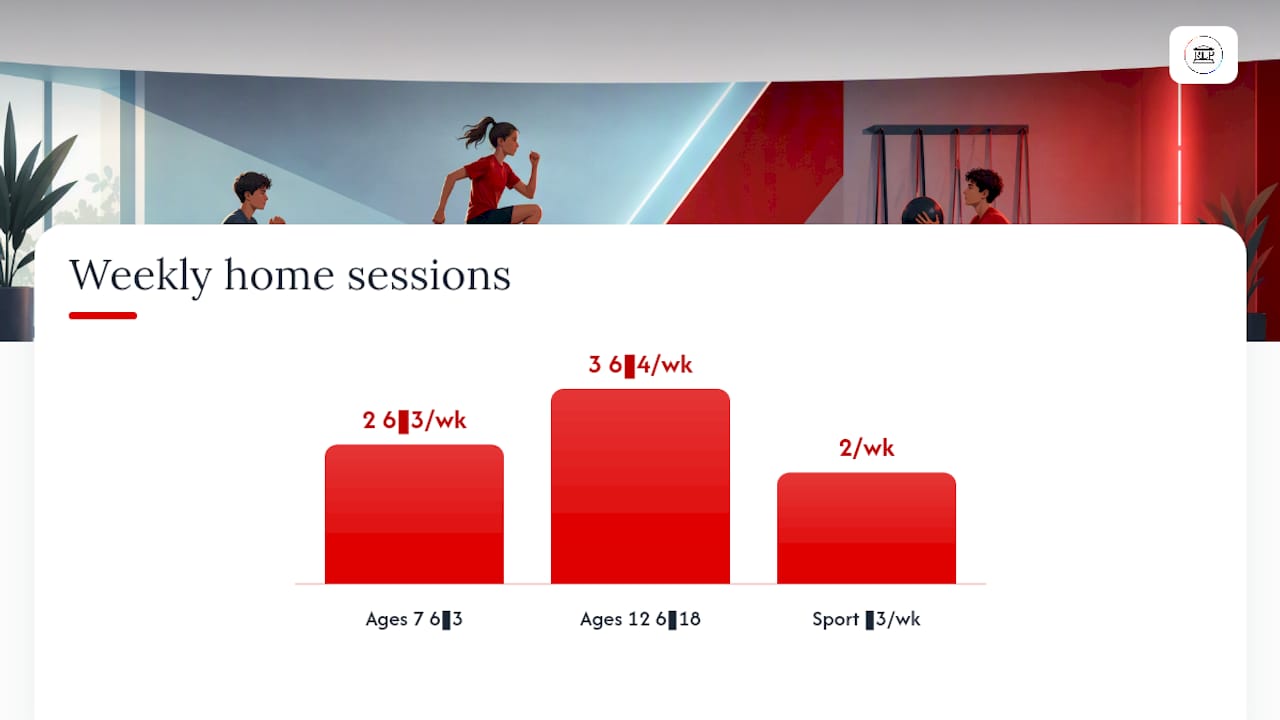
For ages 7 to 11, two to three short sessions per week of around 10 to 15 minutes each is ample, especially when much of that time is play-based. For ages 12 to 18, three to four sessions per week lasting about 20 to 30 minutes allow for more structure, such as a dedicated strength day, a power and agility day, and an optional conditioning circuit.
- Strength day: squats, push-ups, lunges, bridges, planks.
- Power and agility day: bounds, shuttle runs, reactive footwork.
- Conditioning circuit (optional, older athletes only): short intervals mixing both.
Progress reps and form before adding new movement complexity, and always leave a rest day between strength sessions.
Pro Tip: If your athlete already practices their sport three or more times a week, trim home sessions to two per week. Recovery is training too.
Safety First: Red Flags Every Parent Should Watch For
Muscle soreness a day after a new exercise is normal. Sharp pain, joint pain, or pain that changes how a child walks or moves is not, and it means stop and check with a doctor before resuming.
- Stop immediately for sharp or localized joint pain, not general muscle fatigue.
- Supervise every session for kids under 12; they need cueing on form, not just a list of exercises.
- Cap jumps and plyometric work at low volumes with long rest for beginners, prioritizing clean landings over rep counts.
- Reduce volume and complexity for younger or newer athletes; add variety and choice before adding load.
- Watch for one-sided complaints (only the left knee, only the right shoulder), which often signal overuse rather than normal fatigue.
Younger athletes especially benefit from a coach or parent actively watching form rather than working out independently.
Sample Home Workouts by Age Group
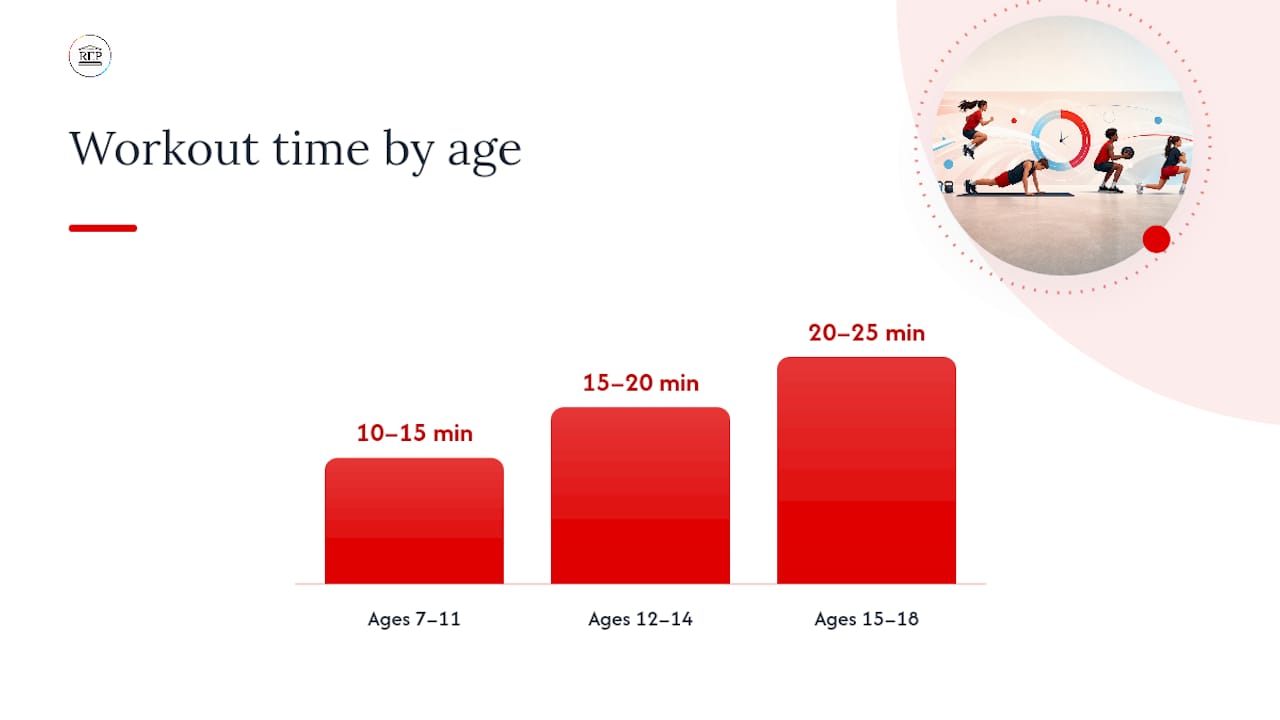
Ages 7 to 11 (10 to 15 minutes, play first): Run an "animal walk" relay (bear crawl, crab walk, frog jump) for 5 minutes, then a freeze-tag style reaction game for 5 to 10 minutes. Skip formal sets, let movement variety do the work.
Ages 12 to 14 (15 to 20 minutes, light structure):
- Warm-up (4 minutes).
- Circuit: 10 squats, 8 push-ups, 10 lunges per leg, 30-second plank, repeat twice.
- Agility: 4 rounds of shuttle runs with 45 seconds rest.
- Cool-down (3 minutes).
Ages 15 to 18 (20 to 25 minutes, sport transfer focus):
- Warm-up (5 minutes).
- Strength: 3 rounds of 12 squats, 12 push-ups, 12 single-leg glute bridges per side, 45-second plank.
- Power: 4 rounds of lateral bounds and reactive cuts.
- Cool-down (3 minutes).
Coach Justin's Program Checklist and Where to Learn More
Vetting a program matters as much as running it. Repphilosophy's Youth Fitness Program Checklist helps parents evaluate whether a coach or plan follows age-appropriate volume and supervision standards. For drill-specific progressions, safe youth speed training and youth speed drills break down landing mechanics and acceleration work in more detail.
Why Fun Beats Perfect Programming
I'll say this plainly: the parents who see the best results aren't running the most sophisticated programs. They're the ones who keep sessions short, playful, and consistent week after week. A 10-minute game your kid actually looks forward to beats a flawless 45-minute circuit they dread.
— Coach Justin
Want Guided Programming Instead of DIY Templates?
You can find shortcut solutions past the trial and error of building your own plan. Instead of guessing whether a drill progression is right for your 9-year-old versus your 16-year-old, look for age-specific programming built by experienced youth coaches.

Families who want a done-for-you option can browse the on-demand exercise library for guided youth workout videos covering everything in this guide, from warm-ups to strength progressions. If you're in the San Diego area and want in-person coaching, WayALife Athletics at 4S Ranch runs structured youth sports performance sessions in a supervised setting. Not sure which fits your athlete? A personal training trial session is a low-commitment way to find out.
Sources and Further Reading
- Junior training plan — Darebee
- Fun at-home workouts for kids — ACE Fitness
- Free youth strength training exercise videos — Mighty Oak Athletic
- Indoor and at-home exercises for kids — Children's Health
- School safe snack options — parent nutrition guidance