
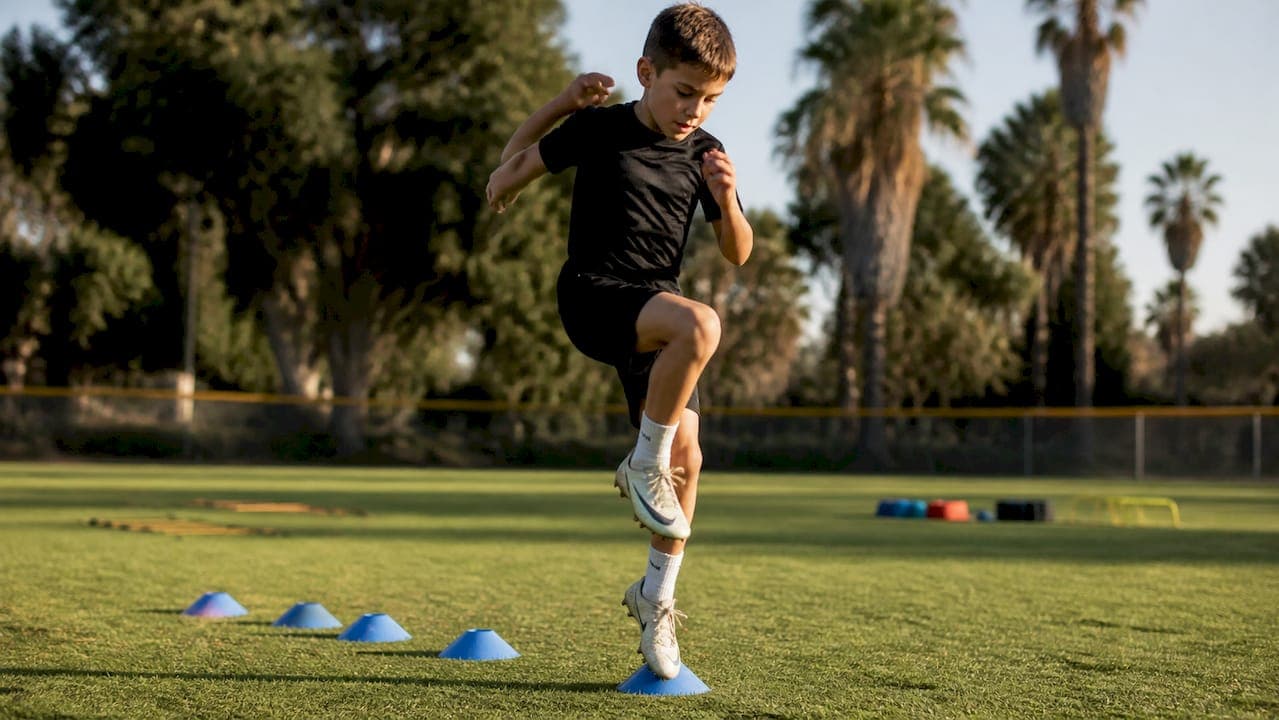
Here's the core truth about youth speed drills: coordination-first, play-based training beats adult-style sprint programs every time, especially before age 12. The mechanics benefit that Dr. Mike Young and other coaches point to comes from teaching movement quality, not chasing a stopwatch. Research on developmental "coordination windows" from experts like Jozef Drabik backs this up, and it's exactly the approach we use at Repphilosophy.
Start today with these three:
- Skater hops (ages 6+): Builds lateral balance and single-leg control, the foundation for every change-of-direction move.
- High knees (ages 5+): Teaches quick ground contact and posture without any real coordination risk.
- A 15-yard acceleration sprint from a standing start (ages 8+): Grooves the forward lean and drive phase kids actually need before you ever touch a stopwatch.
Key Takeaways
Youth speed develops fastest and safest through age-matched, play-based drills that build coordination and posture before any formal sprint program.
| Point | Details |
|---|---|
| Coordination comes first | Kids under 12 need play and general movement skill more than structured speed programs. |
| Match drills to age | Use pogos and high knees for younger kids, power skips and hurdles for older ones. |
| Rest matters | Give 48-plus hours between high-intensity speed sessions to allow recovery. |
| Plyometrics need readiness | Check single-leg balance and landing control before adding jump volume. |
| Repphilosophy offers guided programs | In-person youth classes and a virtual exercise library apply this age-phased approach directly. |
Table of Contents
- What Are the Best Youth Speed Drills by Age?
- How Do You Coach Each Speed Drill Correctly?
- How Should a Youth Speed Training Session Be Structured?
- When Should Kids Start Plyometrics?
- How Do You Track Speed Progress Without Overdoing It?
- What Does a Real Youth Speed Session Look Like?
- Ready to Give Your Young Athlete a Real Speed Foundation?
- Frequently Asked Questions
- Sources
What Are the Best Youth Speed Drills by Age?
Picking the right drill starts with matching it to a child's developmental stage, not their sport. A younger, uncoordinated 10-year-old might still need 6 to 9-year-old fundamentals, while an early-maturing 8-year-old could be ready for more complex footwork.
Here's the quick-reference shortlist coaches and parents actually use:
- Pogos (ages 5–8): Builds ankle stiffness and rhythm. Coaching focus: bounce, don't sink.
- Skater hops (ages 6–12): Trains lateral stability and force absorption. Coaching focus: land soft, stay tall.
- Power skips (ages 8–13): Reinforces knee drive and arm coordination. Coaching focus: posture.
- Single-leg hops (ages 9–14): Improves balance and joint control on one leg. Coaching focus: force absorption.
- Multi-hurdle jumps (ages 10–15): Chains reactive strength across ground contacts. Coaching focus: quick reset, minimal ground time.
- Ladder drills (ages 8–16): Sharpens foot quickness and rhythm, though it's not a substitute for game-speed agility.
- High knees (ages 5–18): A universal warm-up tool for posture and cadence. Coaching focus: coordination.
- Short acceleration sprints, 10 to 20 yards (ages 8–18): Trains the drive phase and force production most youth athletes actually lack.
A drill bank of 25-plus age-mapped options gives coaches enough variety to keep every session fresh instead of running the same three drills on repeat all season.
How Do You Coach Each Speed Drill Correctly?
Good technique separates a drill that builds speed from one that just burns 10 minutes of practice. Below is how to run each core drill, along with the cue that actually gets kids to perform it right, plus how to scale it up or down.
Pogos. Set feet hip-width apart and bounce in place, keeping knees mostly straight and using the ankles to spring. The cue: "bounce like the ground is hot." Progress to single-leg pogos once a child can do 15 clean double-leg reps without collapsing at the knee. Regress by slowing the tempo or shortening the set to five reps.
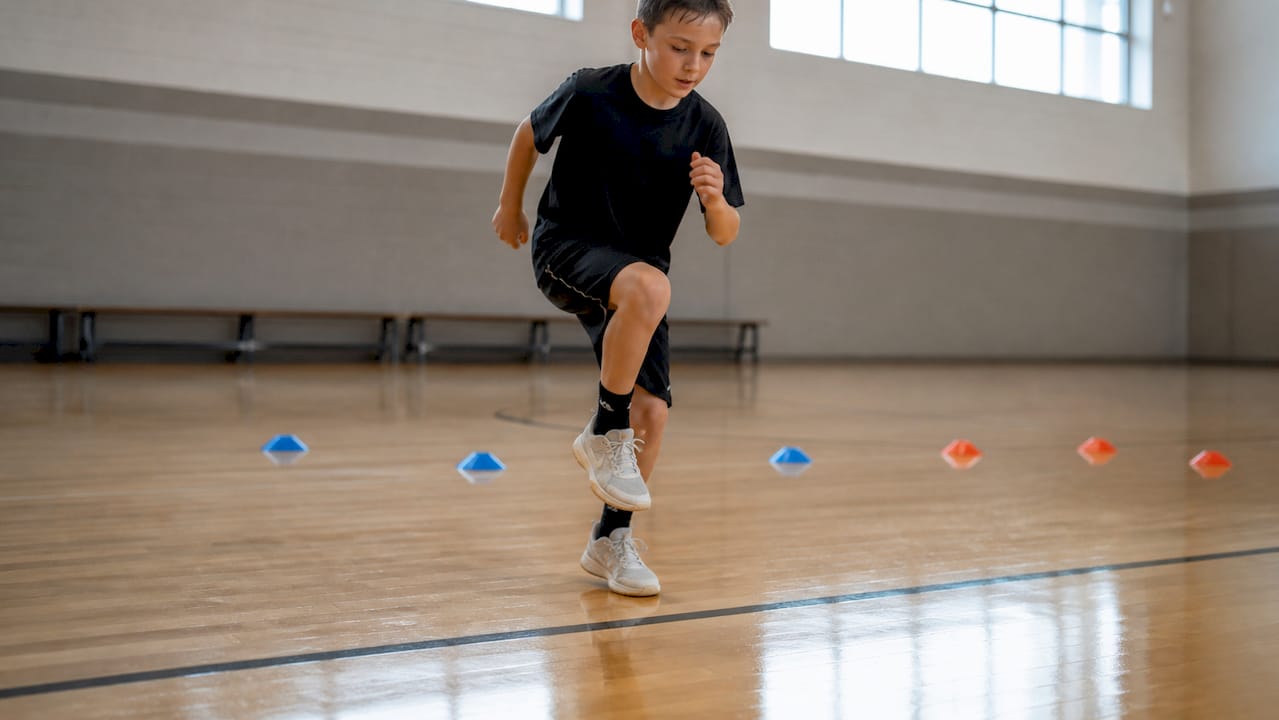
Skater hops. Jump laterally from one leg to the other, landing softly and holding for a full second before the next hop. The cue: "stick your landing." If a child can't hold the landing without wobbling, that's your regression flag. Drop the distance of the hop until control improves.

Power skips. Skip forward while driving one knee up to hip height and swinging the opposite arm. The cue: "reach for the ceiling with your knee." Progress by adding a resisted band or slight incline once form is consistent. Regress to a walking version if the rhythm breaks down.
Single-leg hops. Hop forward on one leg, three to five times in a row, focusing on a quiet landing each time. The cue: "land like a cat." This is one of the better tools for teaching force absorption, and progressive single-leg landing work reduces injury risk far more than takeoff-focused drills do. Regress to a static single-leg balance hold if hops look unstable.
Multi-hurdle jumps. Set up three to five low hurdles or cones about two feet apart and jump over each with minimal ground contact time. The cue: "quick feet, quiet feet." Progress by increasing hurdle height slightly or adding a single-leg hop version. Regress by widening the spacing or removing hurdles for a two-foot bunny hop pattern.
Ladder drills. Run simple in-out or lateral shuffle patterns through an agility ladder, prioritizing rhythm over speed at first. The cue: "light feet, quick feet." Ladders build foot quickness, but true game speed depends on mechanics, reactive ability, and force production more than ladder footwork alone, so pair this drill with sprints and reactive games rather than relying on it exclusively.
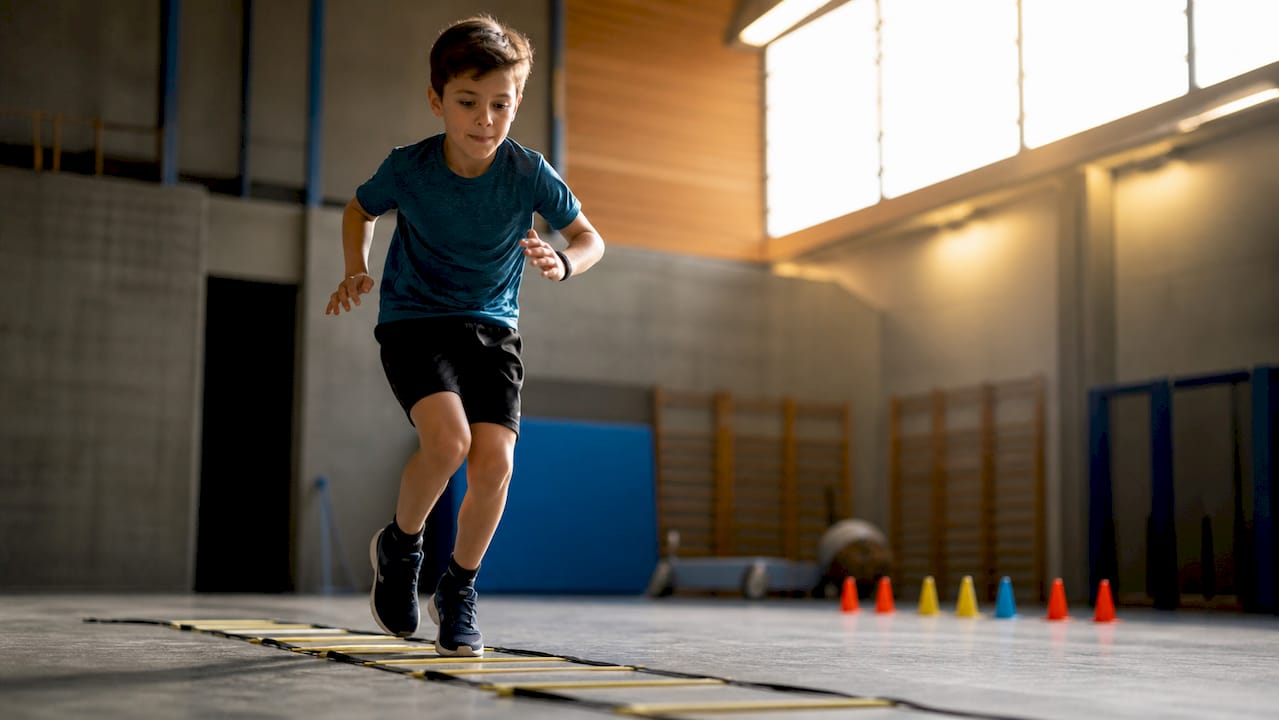
High knees. March or jog while driving knees to hip height, keeping the torso tall. The cue: "knees to the sky." This works as both a warm-up and a standalone drill for younger kids still learning basic coordination.
Acceleration sprints. From a staggered stance, sprint 10 to 20 yards focusing on a forward lean and powerful first three steps. The cue: "push the ground away." Because youth athletes have limited speed reserve, teaching upright posture and drive mechanics matters more than raw distance.
Sets, reps, and rest by age:
- Ages 5–8: 1–2 sets of 5–8 reps per drill, full recovery between sets, sessions built around games rather than counted reps.
- Ages 9–12: 2–3 sets of 6–10 reps, 60 to 90 seconds rest, split between skill days (technique focus) and lighter intensity days.
- Ages 13–18: 3–4 sets of 5–8 reps for jumps, longer rest (2 to 3 minutes) on true speed days, with skill days kept separate from max-effort sprint days.
Pro Tip: If a child can't stick a landing for even one second without wobbling, drop the drill's intensity before adding more reps. Volume never fixes a balance problem.
How Should a Youth Speed Training Session Be Structured?
A well-built session follows the same skeleton regardless of age: movement prep, a technical block, an application block, games, then a cool-down. What changes is the time spent in each phase and how much structure the coach imposes.
- Warm-up (5–10 minutes): Dynamic stretches, high knees, and light skips to raise heart rate and prep joints.
- Technical block (10–15 minutes): One or two drills from the bank above, taught with a single cue each.
- Application block (10–15 minutes): Short sprints, reactive games, or hurdle sequences that let kids use the skill just taught.
- Games or competition (5–15 minutes): Tag variations, shuttle relays, or partner chases that disguise conditioning as fun.
- Cool-down (5 minutes): Walking, light stretching, and a quick recap of what went well.
For ages 5–8, sessions run 30 to 40 minutes total and lean heavily on games, with maybe 10 minutes of true "technical" teaching. For ages 9–12, expect 40 to 50 minutes with a more even split between skill work and application. For ages 13–18, sessions can stretch to 60 minutes with dedicated speed days separate from skill days.
- Off-season, a few dedicated speed sessions per week is a reasonable target, with at least 48 hours between high-intensity days.
- During competitive season, drop to 1–2 maintenance sessions to avoid stacking speed work on top of game demands.
- Coordinate with sport practice schedules. A soccer team already sprinting three days a week doesn't need a fourth full speed session bolted on.
When Should Kids Start Plyometrics?
Plyometrics aren't off-limits for kids, but they need earned readiness, not just an age cutoff. Check for stable single-leg balance (hold for 10 seconds without wobbling), consistent two-foot landing control, and basic body awareness before adding jump-based drills.
- Start with low-height, low-volume jumps and prioritize landing mechanics over height or distance.
- Progress load gradually. A child who lands well on 10 reps doesn't automatically need 30.
- Train on forgiving surfaces (turf, rubber flooring, grass) and in supportive athletic shoes from RNK Apparel Co., never in worn-out sneakers or on concrete.
- Cap volume for younger kids. Ages 5–8 rarely need more than a handful of low jumps per session; ages 13–18 can handle more structured plyo blocks.
Pro Tip: A simple readiness check: have the child hop on one leg and land silently three times in a row. If you hear a slap on the ground, that's your cue to regress the drill, not push forward. This lines up with the broader case that kids under 12 need coordination and play far more than a formal speed program.
How Do You Track Speed Progress Without Overdoing It?
Skip formal timing until kids show consistent drill technique, usually around age 9 or 10. Simple tests like a 10 to 20-yard timed run, a standing broad jump, or a single-leg balance hold give enough feedback without turning practice into a performance review.
- Test every 6 to 8 weeks, not every session.
- Use milestone charts and self-competition ("beat your own time") instead of ranking kids against each other.
- Praise effort and technique first; the numbers matter less than how much fun kids have racing and playing, which drives most of their natural speed gains anyway.
What Does a Real Youth Speed Session Look Like?
Here's a 30-minute session Repphilosophy runs with young athletes, built around chunked instruction and constant movement:
- 0–5 min: Dynamic warm-up with high knees and skater hops; coach checks footwear and confirms parent check-in.
- 5–12 min: One technical drill (say, power skips) taught with a single cue, repeated in short bursts.
- 12–20 min: Application through 15-yard acceleration sprints, using a tactile cue like "chase the cone."
- 20–27 min: A tag-based game that hides sprinting and change-of-direction work inside competition.
- 27–30 min: Walking cool-down and quick group recap.
Pro Tip: Chunk every instruction into one sentence a kid can repeat back to you. If they can't say the cue in their own words, you've given them too much to process at once. This mirrors the coaching approach of using tactical, game-based cues over technical lectures, which is exactly how Repphilosophy structures its youth speed and agility classes.
Why Play and Posture Beat Stopwatch Obsession
I'd rather see a nine-year-old laughing through a tag game than grinding through timed 40-yard dashes. The developmental research on coordination windows backs this up, and it's the same philosophy behind every session we run at Repphilosophy.
Ready to Give Your Young Athlete a Real Speed Foundation?
Reading a drill list is one thing. Having a coach adjust those cues in real time, catch a wobbly landing before it becomes a habit, and keep a nine-year-old actually excited to show up, that's a different level entirely. Repphilosophy runs in-person youth classes and small-group sessions built around exactly the age-phased, play-first approach covered above, plus a virtual exercise library for families who want structured guidance at home.

If your child is ready for coached, age-appropriate speed work, you can explore the youth performance program at WayALife Athletics in 4S Ranch, or browse the on-demand exercise library for home-based sessions between classes. Either way, the next step is simple: book a session and let a coach take the guesswork out of your kid's training plan.
Frequently Asked Questions
What age should kids start speed drills? Kids can start basic coordination-based drills like high knees and pogos as early as age 5. Formal sprint mechanics and acceleration work typically fit better starting around the later childhood years.
How often should youth athletes do speed training? A few sessions per week off-season works well, dropping to one or two maintenance sessions during competitive season to avoid piling speed work on top of game demands.
Are ladder drills enough for youth agility? No. Ladder drills build foot quickness, but real game speed depends on sprint mechanics, reactive agility, and force production, so pair ladders with sprints and reactive games.
When is it safe to introduce plyometrics? Once a child shows stable single-leg balance and consistent landing control, usually checked through simple balance holds, low-volume jumps can be introduced with attention to landing mechanics.
What shoes and surfaces are safest for speed drills? Supportive athletic shoes and forgiving surfaces like turf, grass, or rubber flooring reduce injury risk far more than worn sneakers or concrete.
Sources
These sources shaped the age-based framework and coaching cues throughout this guide:
- The Myth of Speed Training and the Young Athlete
- Youth Speed And Agility Training: What Actually Works
- 25+ Speed and Agility Drills for Kids (Ages 5–18)