

Explosive workouts are defined as training sessions that force your muscles to generate maximum force in the shortest possible time. The industry term for this is power training, and it sits at the intersection of strength and speed. Athletes who add power training exercises to their programs see measurable gains in sprint speed, jump height, and change-of-direction ability. Whether you play a sport or simply want to move with more authority, building explosive strength is one of the highest-return investments you can make in your fitness.
What are the best explosive exercises for building power?
The core exercise families for explosive power are plyometrics, Olympic lifting variations, and ballistic movements. Each family trains a different expression of power, and the best programs pull from all three.
Plyometric movements
Plyometrics use the stretch-shortening cycle to produce rapid force. Box jumps, broad jumps, lateral bounds, and depth jumps all qualify. The key is intent: you land, absorb, and immediately redirect force. Plyometric training routines progress through three phases, starting with foundational landing skills, moving to developmental force production, and finishing with advanced peak explosiveness. This phased approach conditions tendons and muscles safely before high-impact work begins.
Olympic lifting and ballistic movements
Power cleans, hang cleans, and snatches are the gold standard for full-body explosiveness. They require you to accelerate a barbell through the entire lift, which directly trains the nervous system to fire fast. Ballistic movements like medicine ball slams, chest passes, and rotational throws fill the gap for athletes who lack access to a barbell. Sled pushes and kettlebell swings also build explosive power, but only when performed with maximal speed in short sets. Treating them as conditioning circuits eliminates the power benefit entirely.

Bodyweight options
No barbell? No problem. Squat jumps, tuck jumps, clap push-ups, and single-leg bounds are all effective bodyweight plyometrics. They are especially useful for athletes early in their training or those working out at home. The rule is the same: move with maximum intent on every rep.
Pro Tip: Always perform explosive exercises at the start of your workout, before any fatigue sets in. A tired nervous system cannot produce maximum velocity, and that is the entire point of this training.
How should you structure explosive workouts for results?
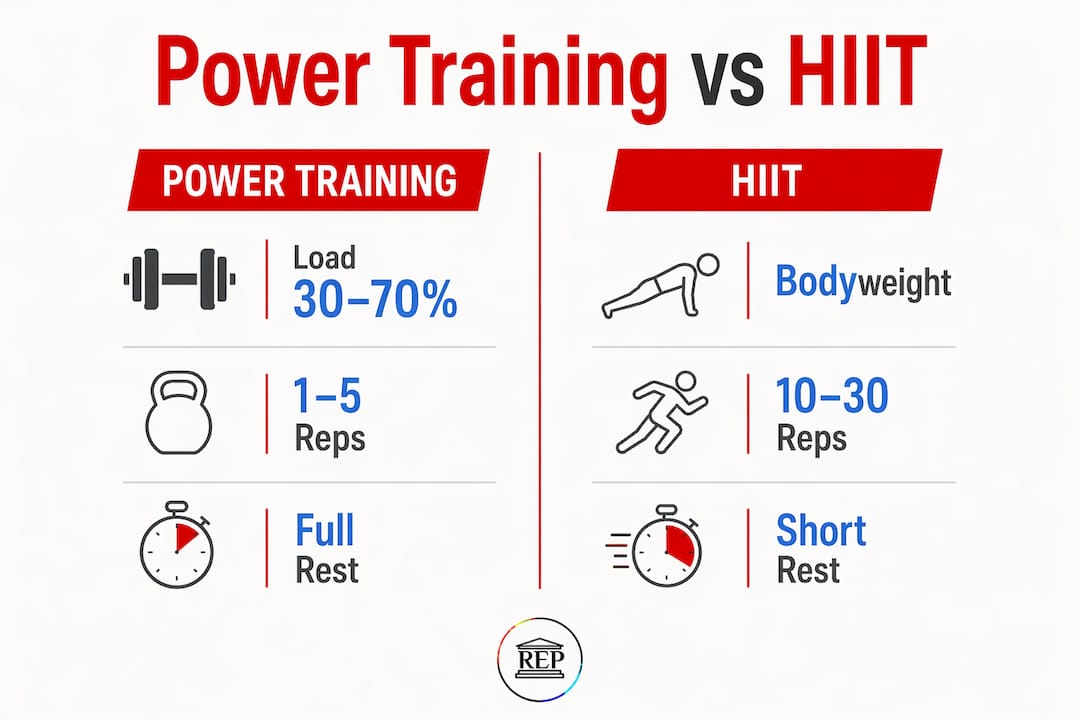
Training parameters matter more in power work than almost any other fitness category. Power training requires loading between 30–70% of your one-rep max, 1–5 reps per set, 3–4 sets total, and roughly two minutes of rest between sets. That rest period is not optional. Your nervous system needs it to reset and fire at full capacity again.
Here is how a well-structured explosive session looks in practice:
- Warm-up (10 minutes). Dynamic mobility, skips, and low-intensity jumps to prime the nervous system.
- Primary power movement (15–20 minutes). One Olympic lift or high-load plyometric. Keep reps at 3–5 and rest fully.
- Secondary ballistic movement (10–15 minutes). Medicine ball throws or sled push sprints. Short sets, full effort.
- Accessory strength work (10–15 minutes). Squats, deadlifts, or single-leg work at moderate load to build the base.
- Cool-down (5 minutes). Light stretching and breathing to bring heart rate down.
The distinction between power training and high-intensity interval training matters here. HIIT targets 80–95% max heart rate with short rest periods. Power training depends on maximum velocity and intentional rest. Cutting rest short turns a power session into metabolic conditioning, which is a different goal entirely.
| Training Variable | Power Training | HIIT |
|---|---|---|
| Load | 30–70% 1RM | Bodyweight or light load |
| Reps per set | 1–5 | 8–20+ |
| Rest between sets | ~2 minutes | 20–60 seconds |
| Primary goal | Maximum velocity | Cardiovascular endurance |
Pro Tip: Watch your bar speed or jump height across sets. If your third set looks noticeably slower than your first, stop. Grinding through fatigued power reps trains the wrong quality.
How often should you do explosive workouts?
Frequency is where most athletes get this wrong. Beginners should start with one explosive session per week and progress to two sessions as their body adapts. Even experienced athletes should cap high-intensity power sessions at 2–3 per week, with full rest days in between. That ceiling exists because the nervous system, tendons, and connective tissue need more recovery time than muscles do.
Progression should follow a phased structure:
- Weeks 1–4: Focus on landing mechanics and foundational movement quality. Stick to low-impact jumps and bodyweight plyometrics. This is the phase most people skip, and it is the one that prevents most injuries.
- Weeks 5–8: Introduce loaded movements like power cleans or jump squats at the lower end of the 30–70% loading range. Keep volume modest.
- Weeks 9–12: Add complexity. Depth jumps, heavier Olympic lifts, and combination movements become appropriate once your connective tissue has adapted.
For athletes who are new to strength training, building a base of foundational strength first makes every explosive movement safer and more effective. Tendons and ligaments adapt more slowly than muscles, so the phased approach is not just cautious. It is the fastest path to real results.
Consistent, progressive training over months and years produces far better athletic outcomes than sporadic bursts of intense effort. The athletes who stay healthy and keep showing up are the ones who build lasting power.
What are the most common mistakes in explosive training?
The biggest mistake in dynamic strength workouts is treating power exercises like conditioning. Maximal intent during the concentric phase is what separates a true explosive rep from a tired, heavy grind. The moment you are moving slowly through a power exercise, you are no longer training power.
Watch for these errors:
- Skipping landing proficiency. High-impact plyometrics require quiet, stable landings from lower heights before you progress to depth jumps or loaded bounds. Noisy, collapsing landings signal your joints are not ready.
- Ignoring velocity drop-off. Stopping sets when speed drops 20–30% from your first rep is the standard used by elite coaches. That drop signals fatigue has taken over, and continuing only trains you to move slowly.
- Placing power work at the end of a session. Explosive moves done while fatigued reinforce poor movement patterns and raise injury risk significantly.
- Progressing load before progressing skill. Adding weight to a movement you cannot perform cleanly at bodyweight is a fast path to injury.
Elite coaches use velocity-based training to monitor bar speed in real time and stop sets before power declines. You do not need expensive equipment to apply the same principle. Video your sets, watch your jump height, and trust what you see.
Key Takeaways
Explosive power training produces its best results when you combine the right exercises, precise loading parameters, and consistent weekly frequency over several months.
| Point | Details |
|---|---|
| Use the right load range | Train at 30–70% of your 1RM with 1–5 reps per set to maximize velocity and power output. |
| Rest fully between sets | Allow roughly two minutes between sets so your nervous system can fire at full capacity again. |
| Start with one session weekly | Beginners should train explosively once per week before progressing to two or three sessions. |
| Master landing mechanics first | Quiet, stable landings are a prerequisite for high-impact plyometrics and injury-free progression. |
| Stop sets before speed drops | Ending a set when velocity falls 20–30% keeps every rep training power, not fatigue. |
Coach Justin's take on building real explosiveness
The athletes I see make the fastest progress are not the ones who train the hardest in any single session. They are the ones who show up consistently, keep their technique sharp, and resist the urge to do too much too soon.
One thing I push hard at Repphilosophy is the idea that strength and power belong together. A squat or deadlift builds the force capacity your jumps and cleans draw from. Without that base, you are trying to express power you do not actually have. The athletes who pair both in a well-organized weekly schedule see results that neither approach delivers alone.
The other thing I see constantly is what I call the "weekend warrior" pattern. Someone trains hard twice in one week, skips the next two, then wonders why they are not progressing or why they keep getting nagged by minor injuries. Consistent training over time is what builds real athletic capacity. Two solid sessions per week, every week, beats five sessions in one week followed by nothing.
My honest advice: measure your progress with something objective. Track your vertical jump, your broad jump distance, or your sprint time over 20 yards. Numbers do not lie, and they keep you honest about whether your program is actually working.
— Coach Justin
Ready to train with a coach who gets results?
At Repphilosophy, we build programs around your goals, your schedule, and where you are right now. Whether you want to add explosive power to your sport, train with a buddy to split the cost, or follow a guided program from anywhere in the world, we have a format that fits.
Our on-demand exercise library gives you structured, coach-guided explosive workouts you can follow at home or in the gym. If you want hands-on coaching, our personal training sessions in 4S Ranch are built around the same evidence-based principles covered in this article. Youth athletes can also train at our 4S Ranch sports performance center, where we specialize in safe, progressive power development for young competitors.
FAQ
What is the difference between explosive workouts and HIIT?
Explosive workouts prioritize maximum velocity with full rest between sets, while HIIT targets cardiovascular endurance with short rest periods. Cutting rest in a power session converts it into metabolic conditioning and removes the power benefit.
How many reps should I do for explosive power?
Power training calls for 1–5 reps per set at 30–70% of your one-rep max. Higher rep ranges shift the training effect away from power and toward muscular endurance.
Can beginners do explosive training safely?
Yes, but beginners should start with one session per week and focus on landing mechanics and bodyweight plyometrics before adding load. A phased approach that builds foundational skills first prevents most common injuries.
Do I need a barbell for explosive workouts?
No. Squat jumps, tuck jumps, clap push-ups, and medicine ball throws all develop explosive power without a barbell. The key is performing every rep with maximum intent and full recovery between sets.
When in a workout should I do explosive exercises?
Perform explosive movements at the very start of your session, after a dynamic warm-up but before any strength or conditioning work. Fatigue reduces velocity, and velocity is the entire training stimulus for power development.
Recommended
- Plyometric Training for Athletes: Build Power and Speed
- Online Personal Trainers Video Library | Structured Workouts On-Demand | REP Philosophy Coaching
- Online Personal Trainers Video Library | Structured Workouts On-Demand | REP Philosophy Coaching
- Youth Speed and Agility Classes: A 2026 Parent's Guide