

Full body strength is defined as the capacity to produce force across all major muscle groups, trained together in a single session for maximum efficiency. This approach, known formally as total body strength training, delivers balanced muscle development and fits almost any schedule. Compound movements like squats, deadlifts, and rows form the backbone of every effective full body workout. The NSCA backs training each muscle group multiple times weekly, and Jeff Cavaliere has popularized the concept of accumulating "effective reps" to cut gym time without cutting results. Whether you are brand new to lifting or a seasoned athlete, full body strength routines give you a clear, proven path forward.
What is the best frequency for full body strength training?
Training each major muscle group 2–3 times per week optimizes both strength and muscle growth. That finding, validated by Schoenfeld et al. (2016) and reinforced by NSCA guidance, is the single most important number in strength programming. Three full body days per week hits that target perfectly for most people.
The efficiency advantage is real. Effective full body sessions can be as short as 20–30 minutes when you use compound movements and keep rest intervals tight. That means you can build genuine strength without living in the gym.
Here is how frequency stacks up against split routines:
- 2–3 days per week: Full body workouts win. Each muscle group gets hit multiple times with adequate recovery between sessions.
- 4+ days per week: Split routines become superior because they allow higher per-muscle volume that full body sessions cannot match in a single visit.
- 1 day per week: Neither approach works well. Frequency is too low for meaningful strength adaptation.
The practical takeaway is simple. If you train three days a week, a full body routine is your best option. If you are ready to commit to five or six days, a push/pull/legs or upper/lower split gives you more room to grow.
Pro Tip: Schedule your three full body days with at least one rest day between each session. Monday, Wednesday, and Friday is the classic setup for a reason. Your muscles repair and grow during recovery, not during the workout itself.
Which full body strength exercises should you include?
The foundation of any total body strength training program is the compound lift. These multi-joint movements recruit the most muscle in the least time, and they mirror the way your body actually moves in real life.
The six movement patterns every full body workout should cover are:
- Squat: Barbell back squat, goblet squat, or Bulgarian split squat. Targets quads, glutes, and core.
- Hinge: Deadlift, Romanian deadlift, or kettlebell swing. Targets hamstrings, glutes, and lower back.
- Horizontal push: Bench press or dumbbell press. Targets chest, front delts, and triceps.
- Horizontal pull: Barbell row, dumbbell row, or cable row. Targets lats, rhomboids, and biceps.
- Vertical push: Overhead press or Arnold press. Targets shoulders and triceps.
- Vertical pull: Pull-up, chin-up, or lat pulldown. Targets lats and biceps.
Multi-joint exercises maximize training efficiency by accumulating effective reps, which are the reps close to muscular failure that actually drive adaptation. Jeff Cavaliere's research-informed approach shows that prioritizing effective reps reduces the total gym time you need. That is a meaningful advantage for anyone with a packed schedule.
| Exercise Type | Example Movements | Primary Muscles |
|---|---|---|
| Squat | Back squat, goblet squat | Quads, glutes, core |
| Hinge | Deadlift, Romanian deadlift | Hamstrings, glutes, back |
| Horizontal push | Bench press, dumbbell press | Chest, front delts, triceps |
| Horizontal pull | Barbell row, cable row | Lats, rhomboids, biceps |
| Vertical push | Overhead press | Shoulders, triceps |
| Vertical pull | Pull-up, lat pulldown | Lats, biceps |

Isolation exercises for arms and calves work well as accessory work at the end of a session. Bicep curls, tricep pushdowns, and calf raises round out the program without adding significant fatigue to your main lifts. Keep accessory work to two or three sets per exercise so it supports your compound work rather than competing with it.
Pro Tip: If you only have time for three exercises in a session, pick a squat, a hinge, and a row. Those three movements alone cover every major muscle group and give you a complete full body workout in under 25 minutes.
How to structure and progress your full body strength workouts
Effective programming is what separates people who plateau after six weeks from those who keep getting stronger for years. Structure matters as much as exercise selection.
Follow this sequence within each session:
- Warm-up (5–10 minutes). Dynamic stretches, light cardio, and one or two warm-up sets of your first compound lift. Cold muscles produce less force and are more prone to injury.
- Primary compound lift. Start with your heaviest, most technically demanding movement. Squats and deadlifts belong here. Your nervous system is freshest at the start of a session.
- Secondary compound lift. A push or pull movement that complements your primary. If you squatted first, bench press or overhead press fits well here.
- Third compound or accessory superset. Pair a pull movement with a lighter push or isolation exercise to save time without sacrificing quality.
- Accessory work (optional). Arms, calves, or core work for 2–3 sets each.
- Cool-down. Static stretching for 5 minutes to support recovery.
Progressive overload is the engine of strength gains. Add weight, add reps, or reduce rest time every one to two weeks. Tracking your lifts in a notebook or an app like Strong makes this automatic. You cannot manage what you do not measure.
| Training Level | Weekly Sets per Movement | Rest Between Sets |
|---|---|---|
| Beginner | 2–3 sets | 90–120 seconds |
| Intermediate | 3–4 sets | 60–90 seconds |
| Advanced | 4–5 sets | 45–60 seconds |
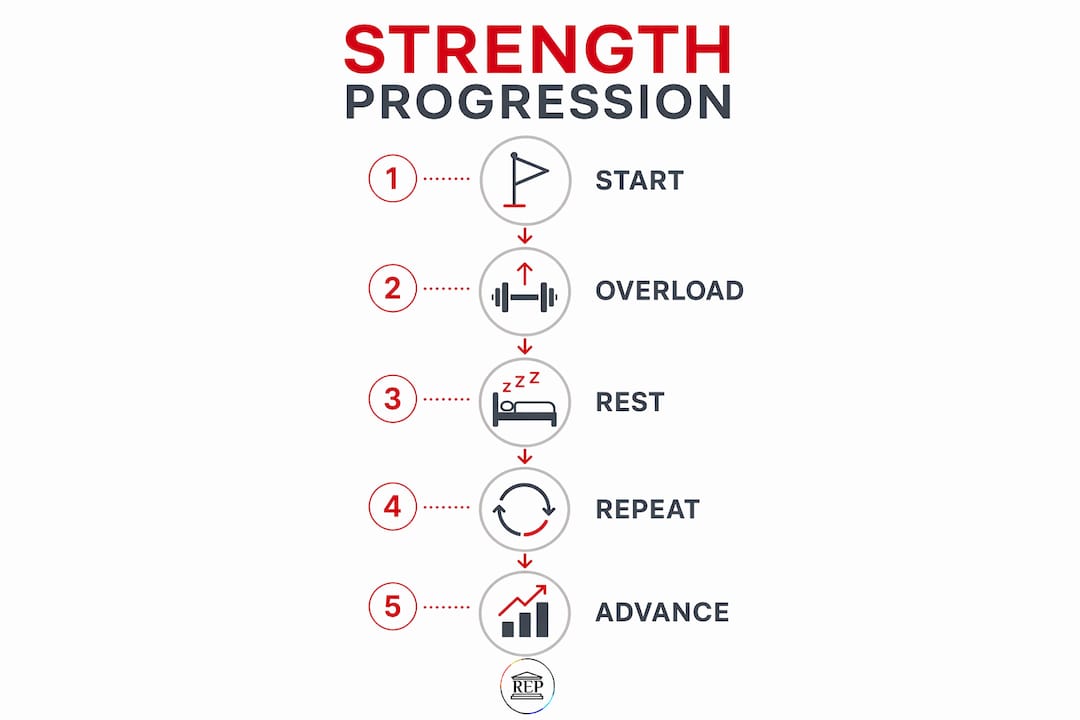
Rest-pause techniques, using 15–30 second micro-rests within a set, help you maintain high intensity without needing long breaks between sets. This keeps you in a productive training zone and shortens your total session time. Beginners should stick to standard rest periods first and add rest-pause work once their form is solid.
Beginners benefit most from full body routines because balanced programming reduces overtraining risk and builds consistency. Starting with beginner-friendly strength training principles gives you a safe foundation before you layer in more volume or intensity.
What mistakes hold back full body strength gains?
Most people who stall on a full body program make the same handful of errors. Recognizing them early saves months of wasted effort.
- Insufficient recovery between sessions. Training the same muscle groups on back-to-back days without adequate rest prevents repair. Muscle grows during recovery, not during the workout. At least 48 hours between full body sessions is the standard.
- Poor form on compound lifts. A rounded lower back on a deadlift or knees caving on a squat puts joints at risk and limits the force you can produce. Record yourself or work with a coach to catch form breakdowns early.
- Ignoring movement balance. Doing three pushing exercises for every one pulling exercise creates shoulder imbalances over time. Structured, deliberate exercise selection is what separates effective strength programming from random effort.
- Skipping progressive overload. Lifting the same weight for the same reps every week produces no new adaptation. Your body adapts to stress, then needs more stress to keep improving.
- Not tracking progress. Without data, you cannot tell if you are improving or spinning your wheels. A simple training log is one of the highest-return habits in strength training.
"Mainstream portrayals of full-body training often oversimplify. Effective strength programming requires structured, deliberate exercise selection, not just showing up and moving weight around."
Plateaus are normal and expected. When progress stalls, the fix is usually one of three things: more sleep, more food, or a planned deload week where you drop volume by 40–50% to let your body recover fully. Advanced trainees often need higher per-session volume for continued progress, which is why moving to a split routine at four or more sessions per week makes sense as you advance.
Key takeaways
Total body strength training built around compound movements, trained 2–3 times per week with progressive overload, is the most time-efficient path to balanced, lasting strength for most people.
| Point | Details |
|---|---|
| Train 2–3 times per week | Hit each muscle group multiple times weekly to maximize strength and muscle growth. |
| Lead with compound movements | Squats, deadlifts, rows, and presses cover all major muscle groups in every session. |
| Apply progressive overload | Add weight, reps, or reduce rest every 1–2 weeks to keep driving adaptation. |
| Recover between sessions | Allow at least 48 hours between full body sessions to let muscles repair and grow. |
| Track your lifts | A training log turns guesswork into a clear record of what is working. |
Why I think full body training is underrated for most people
Here is my honest take after working with clients at every level: most people do not need a split routine. They need consistency, and full body workouts make consistency far easier to maintain.
When a client misses a session with a split program, they miss an entire muscle group for the week. When a client misses a full body session, they just reschedule it. That flexibility is not a small thing. It is often the difference between someone who trains for years and someone who quits after three months.
I have seen beginners walk in convinced they need a five-day bro split because that is what they saw online. We put them on three full body days instead, and within eight weeks they are moving better, feeling stronger, and actually enjoying training. Sports performance training principles reinforce this: athletes train movement patterns, not muscles in isolation, and that philosophy transfers directly to general strength training.
The one place I push back on full body training is with advanced lifters chasing maximum hypertrophy. At that level, you genuinely need more per-muscle volume than three full body sessions can deliver. But for the vast majority of people reading this, full body training is not a compromise. It is the smarter choice.
— Coach Justin
Structured coaching for your full body strength goals
Building real strength takes more than a good exercise list. It takes a program built around your schedule, your current fitness level, and where you want to go.
Repphilosophy offers structured workout programs through virtual coaching memberships, giving you access to time-efficient full body routines you can follow from anywhere. If you want personalized guidance, the coaching shop connects you with programs designed to match your goals and keep you progressing. Whether you are in 4S Ranch or training remotely, Repphilosophy has a solution that fits your life and your budget.
FAQ
How many days a week should I do a full body workout?
Three days per week is the sweet spot for most people. Research from Schoenfeld et al. (2016) confirms that training each muscle group 2–3 times weekly maximizes strength and muscle growth.
Can full body workouts build serious strength?
Yes. Full body workouts built around compound lifts like squats, deadlifts, and overhead presses produce significant strength gains. They are the preferred approach for anyone training three or fewer days per week.
How long should a full body strength session last?
Sessions can be as short as 20–30 minutes with compound movements and short rest intervals. Longer sessions are not automatically better if your exercise selection is tight and your effort is high.
Are full body workouts good for beginners?
Full body routines are the best starting point for beginners. Balanced programming across all muscle groups reduces overtraining risk and builds the movement skills needed for long-term progress.
When should I switch from full body to a split routine?
Consider switching to a split routine when you are training four or more days per week and need higher per-muscle volume for continued progress. Most people reach that point after one to two years of consistent training.
Recommended
- 4S Ranch/Del Sur/Poway Personal Trainer | 1-on-1 & Tailored Fitness | REP Philosophy Coaching
- Beginner-Friendly Strength Training: Start Strong
- Online Personal Trainers Video Library | Structured Workouts On-Demand | REP Philosophy Coaching
- Online Personal Trainers Video Library | Structured Workouts On-Demand | REP Philosophy Coaching