
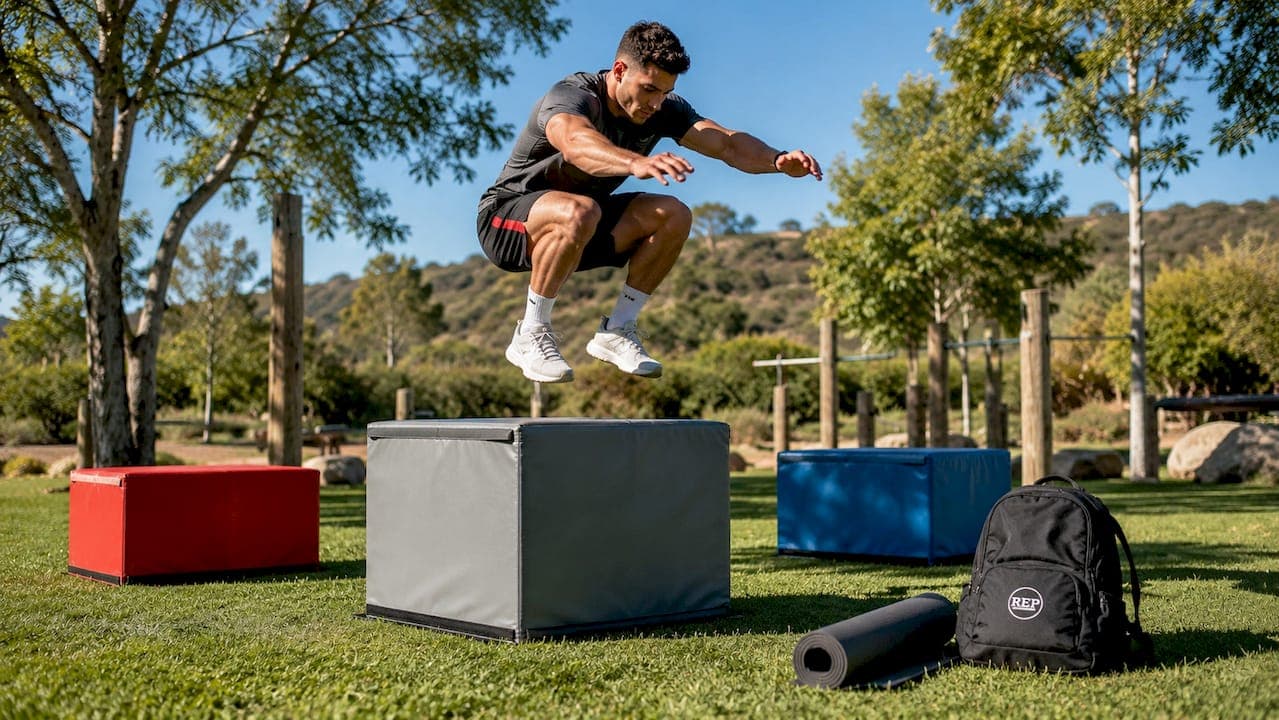
Plyometric training is defined as a method of exercise that uses rapid, explosive movements to develop power, speed, and agility by exploiting the body's stretch-shortening cycle (SSC). The SSC is the sequence where a muscle rapidly lengthens under load (eccentric phase), briefly transitions (amortization phase), then contracts explosively (concentric phase). This elastic recoil is what makes plyometrics uniquely effective for sports performance. Research shows that 6–8 weeks of consistent plyometric training improves running economy by 4–8% and 5K race times by 2–3% through enhanced tendon stiffness and neuromuscular efficiency. That kind of measurable gain is why coaches at every level build plyometrics into their programs. Whether you are a beginner learning your first box jump or an advanced athlete refining single-leg bounds, the principles stay the same: move fast, land well, and progress with purpose.
How does plyometric training improve athletic performance?
The stretch-shortening cycle is the engine behind every plyometric gain. When your muscle-tendon unit stretches rapidly before a jump or bound, it stores elastic energy. The faster you transition from that stretch to your push-off, the more of that energy converts to explosive power rather than heat.
The amortization phase is the most overlooked part of this process. Minimizing ground contact time preserves elastic energy for maximal explosive output. Linger too long between landing and takeoff, and stored energy dissipates as heat instead of propelling you forward or upward. This is why pogo hops and quick-response drills are so valuable: they train your nervous system to shorten that transition window.
Neuromuscular adaptations are equally important. Plyometrics recruit fast-twitch muscle fibers more effectively than traditional strength training. Over time, your nervous system learns to fire more motor units simultaneously, which translates directly into faster sprints, higher jumps, and sharper direction changes.

The benefits of plyometric exercises extend beyond raw power. Plyometrics reduce injury risk by increasing muscles' and tendons' capacity to handle rapid loading and distribute forces across joints. Think of it as "controlled chaos" training: your body learns to manage unpredictable forces, which is exactly what happens in sport.
Key performance outcomes from plyometric work include:
- Power output: Greater rate of force development from fast-twitch fiber recruitment
- Running economy: More efficient energy use per stride, reducing fatigue over distance
- Agility: Faster reactive changes of direction from improved neuromuscular coordination
- Tendon stiffness: Stiffer tendons return more elastic energy per stride or jump
- Injury resilience: Better force distribution across the ankle, knee, and hip during landing
Pro Tip: Focus on the quality of your landing before worrying about jump height. A quiet, controlled landing means your body is absorbing force correctly, which is the foundation of every safe plyometric progression.
What are the key principles of plyometric program design?
Safe and effective plyometric program design follows a few non-negotiable rules. Skip them and you trade performance gains for injury risk.
-
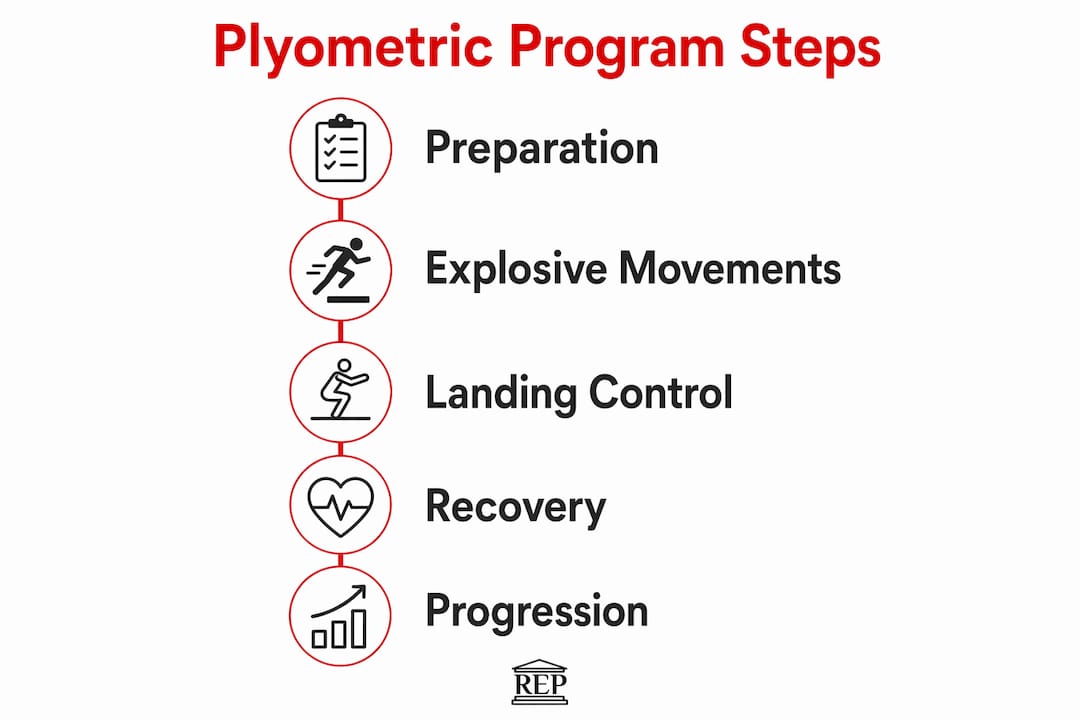
Start with technique mastery. Beginners should dedicate the first 8 weeks to movement mechanics before adding volume or intensity. A perfect two-foot landing with soft knees and a neutral spine matters more than how high you jump.
-
Apply progressive overload gradually. Increase weekly training volume by no more than 5–10% per week. Jumping from 50 to 100 foot contacts in a single week is a fast track to patellar tendon problems.
-
Train 2–3 sessions per week. Two to three plyometric sessions per week with 48–72 hours of recovery between them optimizes performance gains and reduces injury risk. Your nervous system needs that window to adapt.
-
Monitor movement velocity, not just effort. Plyometric training is neural-intensive. A velocity drop or jump height decrease signals that your nervous system is fatigued. When jump height drops noticeably within a set, stop. Continuing through neural fatigue reinforces poor movement patterns.
-
Prioritize warm-up and cool-down. A dynamic warm-up that includes hip circles, leg swings, and light skipping prepares tendons and joints for explosive loading. Skipping this step is the single most common mistake athletes make.
Pro Tip: If you do not have access to a velocity tracker, use a simple rule: when your jumps start feeling "heavy" or your takeoff slows down, end the set. Your subjective sense of speed is a reliable fatigue signal when you train consistently.
Recovery is not passive. Sleep, nutrition, and soft tissue work all contribute to how well your body absorbs plyometric stress. Athletes who treat recovery as part of training progress faster than those who only focus on the workout itself.
What are the best plyometric exercises for every level?
The best plyometric workouts match the exercise to the athlete's current ability and sport demands. Here is a breakdown of the most effective movements across difficulty levels.
| Exercise | Target muscles | Difficulty | Key benefit |
|---|---|---|---|
| Pogo hops | Calves, Achilles | Beginner | Builds ankle stiffness and SSC timing |
| Box jumps | Quads, glutes, hamstrings | Beginner/Intermediate | Develops bilateral power and landing mechanics |
| Broad jumps | Full lower body | Intermediate | Trains horizontal power output |
| Single-leg bounds | Glutes, hamstrings, hip stabilizers | Intermediate/Advanced | Improves unilateral agility and stability |
| Depth drops | Full lower body, core | Advanced | Maximizes reactive strength and tendon loading |
| Lateral bounds | Adductors, glutes, quads | Intermediate/Advanced | Builds lateral power for court and field sports |
Unilateral plyometric training enhances single-leg tasks and agility more than bilateral training. Bilateral movements like box jumps are better for building maximal strength and overall power. This distinction matters for sport-specific programming: a basketball player benefits from single-leg bounds, while a weightlifter prioritizes bilateral jumps.
For athletes just getting started, beginner-friendly strength training lays the foundation before adding plyometric load. Pogo hops and two-foot box jumps are the right entry points. They teach landing mechanics, build ankle stiffness, and introduce the SSC without excessive joint stress.
Intermediate athletes can add broad jumps and lateral bounds to their rotation. These movements build horizontal and lateral power, which transfers directly to sprinting and cutting. Advanced athletes incorporate depth drops and single-leg bounds to push reactive strength and sport-specific agility.
A few execution rules apply at every level:
- Land softly with knees tracking over toes
- Reset fully between reps for power-focused sets
- Use continuous rhythm only for endurance-style plyometric circuits
- Never sacrifice landing quality for more reps
How do you integrate plyometrics into a full training program?
Plyometrics work best when they complement, not compete with, your other training. Placing a heavy squat session the day before a plyometric workout leaves your legs too fatigued to move explosively. Sequencing matters.
A practical weekly structure for most athletes looks like this:
- Day 1: Strength training (lower body focus)
- Day 2: Rest or light aerobic work
- Day 3: Plyometric session (lower body)
- Day 4: Strength training (upper body or full body)
- Day 5: Rest or mobility work
- Day 6: Plyometric session (sport-specific drills)
- Day 7: Full rest
For youth athletes, timing relative to growth and maturity is especially relevant. Plyometric benefits align with natural development in younger athletes, while compensating for power declines in mature athletes. This means a 14-year-old and a 35-year-old both benefit from plyometrics, but for different physiological reasons. Youth athletes build on natural neuromuscular development; older athletes use plyometrics to maintain fast-twitch fiber function. For parents and coaches, sport-specific training for youth provides more context on age-appropriate programming.
Plyometric training adaptations are outcome-specific, meaning you need to match exercises to your performance goals rather than expect universal results. A soccer player chasing agility needs different drills than a sprinter chasing top-end speed. Tailoring your program to your sport and position is not optional; it is the difference between training hard and training smart.
Endurance athletes benefit from plyometrics too. The running economy improvements from 6–8 weeks of jump training translate directly into faster race times with less energy expenditure per mile. Adding two short plyometric sessions per week during a training block is a low-cost, high-return investment for any runner.
Key Takeaways
Plyometric training builds athletic power, speed, and agility by training the stretch-shortening cycle through explosive movements, progressive overload, and consistent recovery.
| Point | Details |
|---|---|
| SSC is the foundation | Every plyometric gain comes from faster eccentric-to-concentric transitions during explosive movement. |
| Technique before volume | Beginners should master landing mechanics for 8 weeks before increasing intensity or foot contacts. |
| Train 2–3 times per week | Spacing sessions 48–72 hours apart optimizes neural recovery and reduces injury risk. |
| Match exercises to goals | Unilateral drills build agility; bilateral movements develop maximal power and strength. |
| Fatigue ends the set | Stop when jump height or movement speed drops noticeably within a set to protect quality and safety. |
Coach Justin's take on what most athletes get wrong
Most athletes treat plyometrics like a cardio finisher. They tack on a few box jumps at the end of a workout when they are already tired, then wonder why they are not getting faster. That is backwards. Plyometrics are a neural training tool. They belong at the start of your session, after a thorough warm-up, when your nervous system is fresh and ready to fire at full capacity.
The amortization phase is the piece I see overlooked most often, even by experienced athletes. Spending too long on the ground between landing and takeoff is the single biggest technical error in plyometric work. I spend more coaching time on ground contact speed than on jump height, because that transition window is where power is won or lost.
I also want to be honest about adaptation timelines. You will not feel dramatically different after two weeks. The neuromuscular changes that make plyometrics so effective take 6–8 weeks to show up in measurable ways. Consistency over that window is what produces results. The athletes I have seen make the biggest gains are not the ones who trained the hardest in week one. They are the ones who showed up every session, progressed gradually, and protected their recovery.
If you are training at home or in a gym without a coach, use movement quality as your guide. Every rep should look and feel controlled. The moment your landings get sloppy or your takeoffs slow down, the session is done. Pushing through that point does not build fitness. It builds bad habits and injury risk.
— Coach Justin
Ready to build real power with Repphilosophy?
At Repphilosophy, we build plyometric programs around your specific goals, whether you are a youth athlete chasing speed, a weekend competitor wanting more explosiveness, or a fitness enthusiast ready to take your training to the next level.
Our coaching programs include structured plyometric progressions, sport-specific drills, and personalized guidance from Coach Justin. You can train in person at our 4S Ranch facility, join a group class, or access our on-demand video library from anywhere. We also offer Bring a Buddy memberships and youth sports performance training in a safe, challenging environment. If you are serious about building power and moving better, we are ready to stand by your side every step of the way.
FAQ
What is plyometric training?
Plyometric training is a form of exercise that uses explosive, jump-based movements to develop power, speed, and agility through the stretch-shortening cycle. It trains muscles and tendons to generate maximum force in minimal time.
How often should I do plyometric workouts?
Two to three sessions per week with 48–72 hours of recovery between them is the recommended frequency for most athletes. This spacing allows the nervous system to adapt without accumulating excessive fatigue.
Are plyometric exercises safe for beginners?
Yes, plyometric exercises for beginners are safe when technique is the priority. Spend the first 8 weeks mastering landing mechanics and movement quality before increasing volume or intensity.
What is the difference between unilateral and bilateral plyometric training?
Unilateral training is superior for single-leg agility and sport-specific stability, while bilateral training builds maximal power and overall strength. Most programs benefit from both.
How long does it take to see results from plyometric training?
Six to eight weeks of consistent training produces measurable improvements in running economy and explosive power. Neuromuscular adaptations take time, so steady progression over that window is what drives real results.