

If you have a tryout coming, follow a sport-specific 6 to 8 week plan that builds a base, adds power and specificity, then sharpens and tapers before the whistle blows. Only two weeks left? Skip straight to the compressed daily plan below. Either way, the priorities stay the same: sport-specific conditioning, strength and power work, and a real taper with real sleep in the final days. That's the approach I use with athletes, and it works because it respects how the body actually adapts.
TL;DR:
- A 6 to 8 week training plan follows three phases: building aerobic capacity, adding sport-specific power, and tapering before the tryout with proper sleep and recovery.
- The weekly training focuses on gradual overload, with intensity peaking in the final weeks while volume decreases, especially during the taper.
- Sport-specific drills such as sprints, change of direction, jumps, and pressure skill reps should be emphasized, with practice under artificial pressure to simulate tryout nerves.
- Strength work, including compound lifts and single-leg exercises, supports performance but should be scheduled to avoid fatigue on key conditioning days.
- Proper tapering involves reducing volume by about half in the last 72 hours, prioritizing sleep, hydration, and familiar meals to optimize physical readiness.
Table of Contents
- How Long Should Your Tryout Conditioning Plan Be?
- What Do Sample Weekly Conditioning Plans Look Like?
- Which Sport-Specific Drills Should You Practice?
- How Much Strength and Power Work Do You Need?
- How Should You Taper and Sleep Before Tryouts?
- What Mistakes Should You Avoid, and What Do Coaches Notice?
- Coach Justin's Take on Adapting the Plan
- REP Philosophy: Your Next Step Before Tryouts
- Sources
How Long Should Your Tryout Conditioning Plan Be?
Your timeline decides your emphasis. An 8-week window lets you build real aerobic capacity before layering in speed and power. A 6-week window compresses that same arc without skipping steps. A 2-week window is damage control, built purely for sharpening what you already have.
Here's how I break the phases down for a full 6 to 8 week plan:
- Build phase (weeks 1 to 2): Aerobic base, general strength, and movement quality. Three to four sessions a week, moderate intensity, higher volume.
- Power and specificity phase (weeks 3 to 5): Sport-specific intervals, plyometrics, and heavier strength work. Volume plateaus while intensity climbs.
- Sharpen and taper phase (final 1 to 2 weeks): Cut volume, keep intensity, and drill the exact skills coaches will watch for.
A 6-week plan simply tightens each phase by a few days. A progressive overload approach works here because it adds stress gradually instead of front-loading fatigue you can't recover from before tryout day. Never increase volume and intensity in the same week. Pick one to push, hold the other steady.
What Do Sample Weekly Conditioning Plans Look Like?
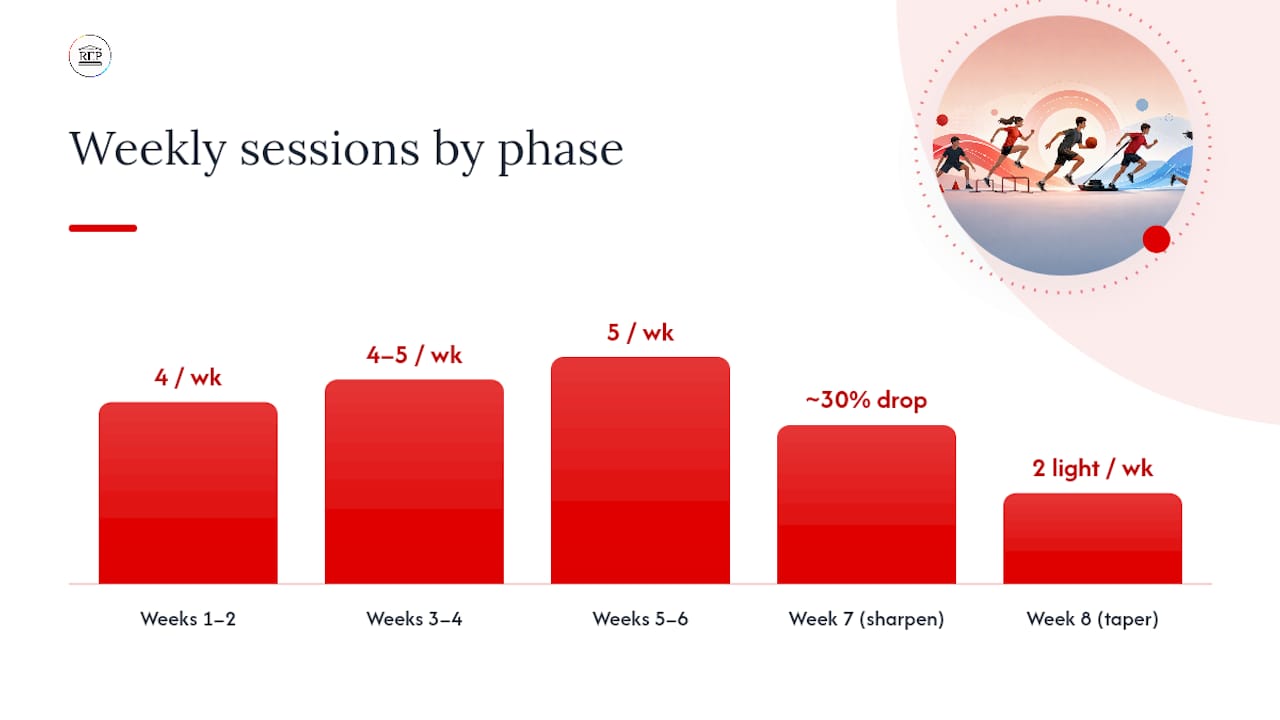
Structure beats improvisation. Here's what each track actually looks like on a weekly basis.
8-week template (following a build-to-peak structure similar to progressive sport plans):
- Weeks 1 to 2: Four sessions weekly, RPE 5 to 6, aerobic intervals plus bodyweight strength.
- Weeks 3 to 4: Four to five sessions, RPE 6 to 7, sport-specific intervals and moderate plyometrics.
- Weeks 5 to 6: Five sessions, RPE 7 to 8, peak intensity with heavier lifting days.
- Week 7: Sharpen, volume drops 30%, intensity holds.
- Week 8: Taper hard, two light sessions, rest, then tryout.
6-week template: Compress the build phase to one week, power phase to three weeks, sharpen and taper to two weeks. Same RPE targets, less runway.
2-week template: Daily microcycle. Alternate high-intensity skill days (RPE 7 to 8) with active recovery days (RPE 3 to 4). No new movements this late, only refinement.
- Days 1 to 4: Sport-specific intervals and skill reps.
- Days 5 to 7: Recovery, mobility, light technical work.
- Days 8 to 11: Final intensity push, pressure-simulated reps.
- Days 12 to 14: Full taper, sleep, and mental rehearsal.
Rest days aren't optional filler. They're where the adaptation from your last session actually locks in.
Which Sport-Specific Drills Should You Practice?
Coaches remember movement quality more than raw hustle, so drill the patterns your sport actually demands rather than generic cardio.
- Sprints and repeat efforts: 5 to 10 reps of 10 to 30 yard sprints with full recovery, twice weekly. For field and court sports, mirror actual game distances rather than track-style repeats.
- Change of direction: 5 to 10 shuttle or cone-based reps, cueing low hips and a strong plant step rather than raw speed.
- Jumps and reactive plyometrics: Box jumps, broad jumps, and depth jumps, 3 sets of 5 to 8 reps, always prioritizing a quiet landing over height.
- Skill reps under pressure: 15 to 20 focused reps per session, with a partner counting reps aloud or adding a small consequence for misses to mimic tryout nerves.
A youth speed drill progression built around these same movement patterns can guide how you sequence sprint and change-of-direction work across the week.
Pro Tip: Practice your two or three signature skills under artificial pressure, like a partner counting down or a miss costing you a sprint. Skills that hold up under manufactured stress tend to hold up under a coach's clipboard, too.
How Much Strength and Power Work Do You Need?
Strength training supports everything else in your tryout conditioning plan. Skip it and your sprints, jumps, and change of direction all lose their ceiling.
- Compound lifts: Squats, deadlifts, and split squats, 3 to 4 sets of 5 to 8 reps for power, or 8 to 12 reps for general strength maintenance.
- Single-leg work: Lunges and step-ups, 3 sets of 8 to 10 reps per leg, since most sport movements happen on one leg at a time.
- Plyometric progression: Start with double-leg landings, then progress to single-leg bounds only once landing mechanics look controlled and quiet.
- Combining lifting with conditioning: Lift on the same days as high-intensity conditioning rather than the day before, so your legs aren't dead for a key sprint session.
Younger athletes should lean on bodyweight and light-load versions of these lifts. An age-appropriate strength approach built around control and technique matters more than the number on the bar. For the jump-training piece specifically, explosive power progressions built around clean landings reduce injury risk while still building the pop coaches notice.
How Should You Taper and Sleep Before Tryouts?
This is where most athletes lose ground they already earned. Overtraining in the final week is more common, and more damaging, than undertraining.
- Cut volume, not intensity. Tapering research supports cutting training volume by roughly half in the final 72 hours while keeping intensity high, which preserves speed and power instead of just resting blindly.
- Sleep is non-negotiable. The CDC recommends 9 to 12 hours nightly for kids ages 6 to 12, and 8 to 10 hours for teens 13 to 18, both directly tied to recovery and reaction time.
- Hydrate two days out, not just the morning of. Sip water steadily rather than chugging right before you walk in.
- Eat a familiar meal 2 to 3 hours before tryouts. Tryout day is the wrong time to try a new pre-game food.
Missing even a few hours of sleep in the final days can undercut weeks of training, since the CDC's sleep guidance ties those recovery hours directly to physical performance the next day.
What Mistakes Should You Avoid, and What Do Coaches Notice?
Most athletes sabotage their own tryout in the final 72 hours, not the six weeks before it.
- Cramming extra workouts right before tryouts instead of tapering, which leaves legs heavy and reaction time slow.
- Skipping the warm-up to save energy, which raises injury risk and dulls first-rep sharpness.
- Ignoring feedback during the tryout itself, since coaches watch how you respond to correction as closely as how you perform.
- Ranking well against the field at the door: arriving early to introduce yourself signals initiative before a single drill starts.
Day-of checklist: arrive 15 minutes early, complete a full dynamic warm-up, have your two signature skills ready to show, sip water throughout, and bring backup gear.
Coaches consistently mention that hustle stats, first to sprint back on the line, consistent effort between reps, and how you take a correction, often outweigh small technical gaps between athletes. Pro Tip: Treat every water break like it's being watched. It usually is.
Coach Justin's Take on Adapting the Plan
I build every 6-week plan around progressive overload: small, deliberate increases in intensity, never volume and intensity together. A self-guided template works fine if you're disciplined and injury-free. If you're managing a nagging issue, coming off a layoff, or you genuinely don't know what "RPE 7" feels like, that's when coach-led prep earns its keep.
— Coach Justin
REP Philosophy: Your Next Step Before Tryouts

Youth sports performance programs built around exactly this kind of tryout timeline are available in-person at a facility in 4S Ranch, in small group classes, or through a Custom 6-Week Written Program if you want individualized coaching without daily sessions. Prefer to train on your own schedule? An on-demand exercise library provides video-guided progressions you can follow at home. If overtraining, poor landing mechanics, or an old injury are part of your story, a coached plan can provide benefits beyond a printed template. Check out the full range of training options and consider booking a session before your prep window shrinks any further.
Sources
- Centers for Disease Control and Prevention (CDC) — Sleep and Sleep Disorders
- Effects of tapering on performance (PMC article)