

Block sleep and your fixed commitments first, then build a weekly calendar that places study sprints around practice blocks. That's the whole strategy in one sentence: non-negotiables (sleep, classes, commute) get locked in before anything else, and everything flexible gets built around them, with recovery windows treated as seriously as the workouts themselves.
Here's what to do in the next 24 hours:
- Put sleep on your calendar for every night this week, treated like a practice you can't miss.
- Build one weekly calendar right now (paper or digital) and mark every fixed practice time.
If sleep keeps dropping below what your body needs, that's the signal to cut an activity. Grades and performance are the last things that should absorb the damage.
Key Takeaways
Balancing school and sports comes down to locking sleep and fixed commitments into one calendar first, then building study and training time around them, never the reverse.
| Point | Details |
|---|---|
| Sleep goes on the calendar first | Block 9 to 10 hours nightly for growing athletes before scheduling anything flexible. |
| One centralized calendar | Track school, practice, homework, and recovery in a single color-coded system. |
| Stack hard training days | Group intense sessions together and protect at least one full rest day weekly. |
| Communicate before the crunch | Message teachers and coaches ahead of heavy weeks, not during them. |
| Cut activities before sleep | When the week overflows, drop low-value commitments before touching rest or grades. |
Table of Contents
- How Do You Balance School and Sports Training Schedules?
- How Do You Build a Weekly Training Schedule?
- How Should You Plan Training Load and Recovery?
- How Do You Talk to Teachers and Coaches About Conflicts?
- What Changes by Age and Stage?
- Sample Weekly Schedule You Can Copy
- Coach Justin's Practitioner Checklist
- How Do You Manage Stress and Protect Mental Health?
- How Should Parents Get Involved in Schedule Planning?
- What Most Advice Gets Wrong About Balancing School and Sports
- Try a Coaching Approach Built Around This Schedule
- Frequently Asked Questions
- Sources
How Do You Balance School and Sports Training Schedules?
The real skill here isn't cramming more into your week. It's ranking what actually matters and protecting it before the rest of the week fills in around it.
Start with a simple filter: urgent and important tasks (tomorrow's quiz, tonight's practice) go first, important-but-not-urgent tasks (a paper due in two weeks) get scheduled deliberately, and everything else waits. This is a stripped-down version of the Eisenhower Matrix, and it works because it forces you to stop treating every task like an emergency.
Once you know what matters, put it somewhere permanent. A centralized calendar that blocks sleep, classes, practices, homework, and recovery beats scattered sticky notes or memory alone, and color-coding by category (blue for school, gray for training, green for rest) makes conflicts visible at a glance. Google Calendar works well for this because it syncs across phone and laptop; a paper planner works too if you actually open it daily.
For homework, chunk it into 25 to 40 minute sprints with short breaks between them rather than one long slog. Travel time to and from practice isn't dead time. Use it to review flashcards, listen to a recorded lecture, or read a chapter.
Pro Tip: Keep a running "cut list" of low-value time drains — extra scrolling, optional club meetings, a second lifting session you don't need. When your week overflows, cut from that list before you touch sleep or your grades.
- Rank every task as urgent/important, important/not urgent, or low value.
- Log fixed commitments (school, practice, commute) on one shared calendar.
- Block homework into short sprints, not open-ended chunks.
- Use travel and downtime for review, not scrolling.
- When something has to go, drop the lowest-value item first, and reduce training volume before you touch sleep.
How Do You Build a Weekly Training Schedule?
Building the calendar itself takes about fifteen minutes once you know the order of operations.
- Block sleep for every night of the week first, non-negotiable.
- Add fixed items: school hours, commute, and every scheduled practice or game.
- Reserve homework windows around those fixed blocks, matching sprint length to how much energy you'll realistically have.
- Add recovery time and social or downtime, even 30 minutes counts.
- Do a five-minute review every Sunday night to catch conflicts before Monday.
Start-of-week checklist:
- Confirm this week's practice and game times with your coach or team app.
- Check for upcoming tests or project deadlines and block extra study time now, not the night before.
- Color-code the calendar: one color for school, one for training, one for rest.
- Flag any day with double commitments and solve it before the week starts, not during it.
Google Calendar's color labels handle this well, and a printable weekly grid works just as well if you'd rather see the whole week on paper.
How Should You Plan Training Load and Recovery?

Recovery isn't the reward for training hard. It's part of the training.
Effective balance and neuromuscular training programs in athlete research commonly run about 8 weeks with 2 sessions per week of roughly 45 minutes each, which tells you something useful: you don't need daily marathon sessions to see real gains. In fact, higher session frequency of three or more times weekly tends to favor dynamic balance improvements, while shorter, more compact blocks favor static balance work. Match the format to the goal instead of just training harder.
- Stack your hardest training days together rather than spreading intensity evenly across the week.
- Protect at least one full rest day, since stacking intense sessions and scheduling real rest improves both physical and mental recovery.
- Aim for sufficient nightly sleep for growing athletes when your schedule allows it.
- Batch-cook proteins and carbs on Sunday so recovery meals take five minutes, not thirty.
If your scheduled hours consistently force sleep below that range, the answer is fewer activities, not less sleep.
How Do You Talk to Teachers and Coaches About Conflicts?
Reach out before the crunch, not during it. Contact teachers ahead of a heavy competition week, tell your guidance counselor early if travel will affect multiple classes, and flag your coach the moment you know academics need more room.
- To a teacher: "I have a tournament this week that overlaps with the essay deadline. Could I turn it in a day late or split the work into two shorter submissions?"
- To a coach: "I have three exams this week. Could I taper Thursday's practice or arrive late so I can finish studying?"
Ask specifically for what helps: a note taker, recorded lectures, or a prioritized assignment list. Proactive communication between student-athletes, teachers, and coaches correlates with better academic outcomes during exam weeks and heavy practice stretches, so follow up in writing once you've made a verbal ask.
What Changes by Age and Stage?
The schedule-first system stays the same, but who runs it and how much freedom it allows should shift with maturity.
- Elementary: Parents manage the calendar directly, homework happens in short focused blocks, and bedtime is fixed and enforced.
- High school: Students take more ownership through a weekly planning meeting with parents, negotiating practice loads directly with coaches when academics spike.
- College: Full self-management, leaning on campus tutors and academic advisors; planning study hours around travel and game schedules keeps consistency during road-heavy seasons.
Teaching time management habits early makes each later transition easier, since the underlying skill (rank, block, protect) doesn't change even as the responsibilities do.
Sample Weekly Schedule You Can Copy
A weekday template: 6:30 to 7:15 AM wake and breakfast, school 8 AM to 3 PM, practice 3:30 to 5:30 PM, dinner and a 30 minute break, two 30 minute homework sprints from 6:30 to 7:30 PM, wind-down and lights out by 9:30 to 10 PM depending on age.
Two quick variations:
- Heavy training week: Stack your two hardest sessions back to back, then protect two full recovery windows later in the week instead of one.
- Travel week: Shift homework sprints into bus or car time, and use the evening after arrival for a single review pass instead of new material.
When the week overflows anyway, drop things in this order:
- Optional clubs or activities with no deadline pressure.
- Extra, non-essential lifting or conditioning sessions.
- Social media and passive screen time, not sleep or homework.
Coach Justin's Practitioner Checklist
Coach Justin's approach at Repphilosophy comes down to three rules: progress training age-appropriately, stack intensity instead of spreading it thin, and treat rest as scheduled, not optional.
- Age-appropriate progression: match training complexity to development stage, not ambition.
- Stack hard days together, and build recovery in around them, never after they're forced.
- Non-negotiable rest days protect both performance and mood.
Parents building a youth athlete's calendar can start with the youth fitness program checklist or explore sports performance training for a fuller look at how progression should work.
Pro Tip: If your athlete plays a position with specific practice demands, like pitching, sport-specific guides such as this youth pitching workload guide can help you fine-tune volume beyond the general rules here.
How Do You Manage Stress and Protect Mental Health?
A packed schedule doesn't automatically mean a stressful one. What causes the stress spiral is usually a schedule that feels out of your control, not the number of hours in it.
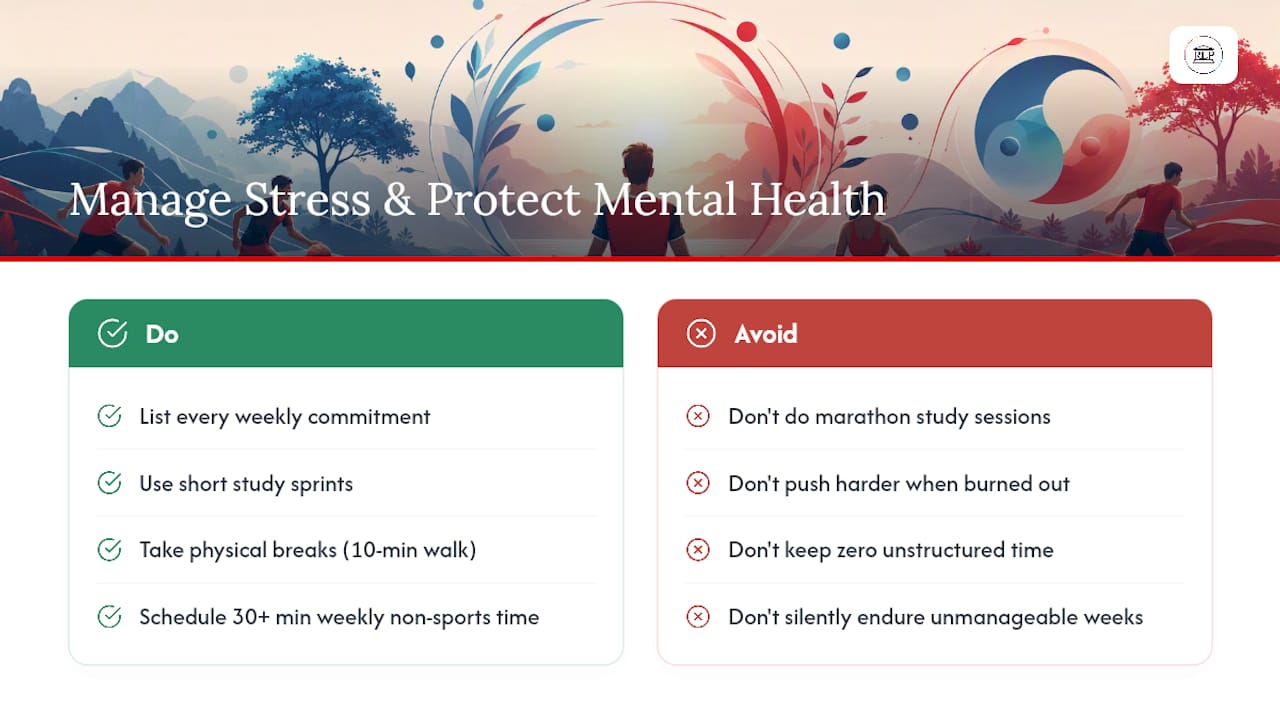
Naming the load helps. Write down every commitment for the week, even the ones that feel too small to count, and you'll often find the anxiety was about the unknown total, not any single task. Once it's on paper, it's manageable.
Short, focused study sprints paired with real physical breaks tend to work better than marathon study sessions, especially when your study windows are already tight between practice and dinner. A ten-minute walk between sprints resets focus more effectively than another ten minutes of forcing it.
Watch for the early signs that stress is tipping into burnout: dreading practice you used to enjoy, sleep that doesn't feel restful even when you get enough hours, or irritability that doesn't match the situation. Those are signals to talk to a parent, coach, or school counselor, not to push harder.
Build in something each week that has nothing to do with school or sports, even 30 minutes. A schedule with zero unstructured time isn't sustainable no matter how well it's color-coded. And when a week feels unmanageable despite good planning, that's worth a conversation, not silent endurance.
How Should Parents Get Involved in Schedule Planning?
The goal isn't for parents to run the calendar forever. It's to hand over more control as the student demonstrates they can handle it.
For younger athletes, parents should build and manage the calendar directly, since executive function skills are still developing. For teenagers, shift toward a weekly planning meeting, maybe fifteen minutes on Sunday, where the student presents their draft schedule and the parent flags conflicts or missing recovery time.
Ask specific questions rather than general ones: "Where's your sleep block? Where's the buffer before that Friday exam?" That teaches the reasoning behind the schedule, not just the schedule itself. Parents can also help spot warning signs the student might miss, like a week that looks fine on paper but has zero rest days once travel gets added.
For college-bound athletes, the best parental role becomes coaching from the sideline: asking how the semester's travel calendar looks, whether tutoring is scheduled, and whether the student has a plan for exam weeks that overlap with competition. Resources like a teen fitness program guide for parents can help frame those conversations without taking over the process entirely.
What Most Advice Gets Wrong About Balancing School and Sports
Most guidance on this topic treats time management as a motivation problem: try harder, want it more, hustle through. That's backward. The student-athletes who manage this well aren't the most driven ones in the room. They're the ones with the most honest calendar.
The conventional wisdom oversells willpower and undersells structure. Cutting sleep to fit in one more study session or one more lifting block feels productive in the moment and costs you far more the next day, in focus, in mood, in reaction time on the field. The data on stacking training intensity and protecting real rest days backs this up consistently, yet it's the first thing students sacrifice when a week gets tight.
If you take one thing from this article, take this: build the calendar before the crisis, not during it. A Sunday-night, fifteen-minute planning session prevents more burnout than any amount of grit applied on a Thursday when everything's already collided. Ready-made templates remove the friction of starting from scratch, and REP Philosophy's practitioner-backed rules around stacking and recovery give you the "why" behind the blocks, not just the blocks themselves.
Try a Coaching Approach Built Around This Schedule
Building a sustainable training rhythm gets a lot easier with a coach who already thinks this way. Repphilosophy's youth sports performance program at 4S Ranch is built around age-appropriate progression and real recovery windows, not just adding volume. If you'd rather test the waters first, a single training session trial lets you see how a properly stacked, recovery-conscious plan feels before committing to a full membership.
Frequently Asked Questions
How many hours should a student-athlete train per week? It depends on age and sport, but training research on balance and neuromuscular programs commonly uses two sessions per week at roughly 45 minutes each over about 8 weeks, which shows meaningful gains don't require daily marathon sessions.
What should I cut first when school and sports schedules collide? Drop optional clubs and non-essential extra training sessions before you touch sleep or core academic time. If the conflict is chronic rather than a one-off week, that's a sign to reduce total activities rather than keep pushing through.
How do I ask a teacher for flexibility during a competition week? Reach out before the deadline, not after it's missed, and propose a specific alternative like a one-day extension or splitting an assignment into smaller pieces. Proactive communication with teachers and coaches tends to produce better academic outcomes during heavy weeks than waiting until you're behind.
Should young athletes manage their own schedule? Not fully, no. Elementary-age athletes do best with a parent-managed calendar and strict routines, while high schoolers can take on more ownership through weekly planning check-ins, and college athletes typically manage their own schedule using campus academic supports.
Sources
- PubMed: systematic reviews of athlete training protocols (2016)
- PMC: systematic review/meta-analysis on instability and integrative neuromuscular training (2025)
- UCHealth: rest and recovery for athletes
- Akron Children’s: six tips to balance school and sports