

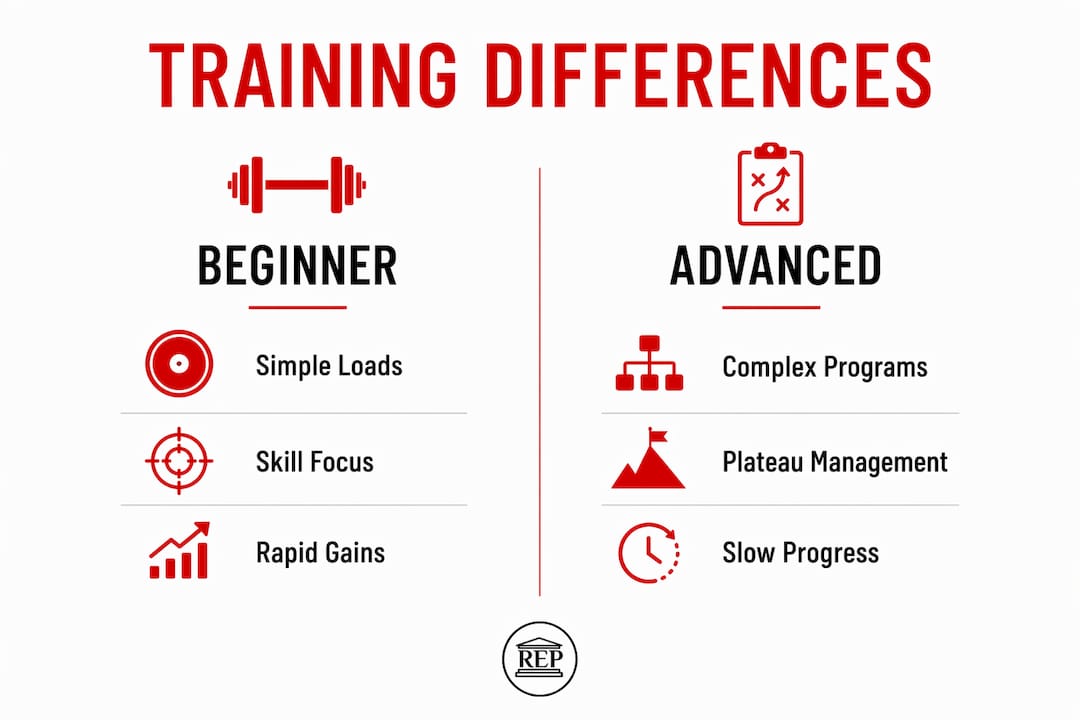
Beginner and advanced sports training differ in what stimulus they need and how precisely that stimulus must be dosed. The root cause is training age — a measure of how long your body has been consistently adapting to structured exercise. Beginners carry a large adaptive reserve, meaning almost any reasonable program produces fast, measurable gains. Advanced athletes are closer to their physiological ceiling, so progress slows and every programming decision carries more weight.
Here is what that means in practice:
-
Beginners gain strength and coordination quickly because neural adaptations dominate early training, not muscle size alone.
-
Advanced athletes need higher volume, precise intensity control, and planned recovery because their nervous system and muscles have already captured the easy wins.
-
Copying an elite program as a beginner does not accelerate progress. It usually stalls it or causes injury.
-
The right program is not a harder or easier version of the same thing. It is a fundamentally different structure built around where you actually are.
Pro Tip: If you are not sure which category you fall into, ask yourself one question: can you add weight to your main lifts every single session? If yes, you are still a beginner in training terms, and that is a great place to be.
Table of Contents
- What is training age, and why does it shape your program?
- Why do beginners adapt so much faster than experienced athletes?
- What should beginner programs actually prioritize?
- What does programming look like for advanced athletes?
- Practical rules of thumb: load, volume, and progression by level
- How do you know which level you actually are?
- Sample sessions: beginner vs advanced templates
- How Repphilosophy applies these principles
- Key Takeaways
- What I have seen coaching athletes at every level
- Ready to train smarter at your level?
- Useful sources and further reading
What is training age, and why does it shape your program?
Training age is not how old you are. It is how long your body has been consistently exposed to structured, progressive exercise. The NIA framework breaks this into three practical categories:
- Novice (0–12 months): Progress happens session to session. Your body responds to almost any reasonable stimulus.
- Intermediate (1–3 years): Progress slows to week-to-week increments. Programming needs more structure.
- Advanced (3+ years of consistent, quality training): Progress comes in monthly or multi-week blocks. Precision and recovery management become the primary levers.
What training age really signals is physiological readiness. Early on, your nervous system is learning to recruit muscle fibers efficiently, your connective tissues are toughening up, and your recovery capacity is still developing. Those three factors together determine how much volume you can absorb, how fast you can progress, and how complex your program needs to be. A person who has been casually lifting for five years but never followed a structured plan may still function as a novice physiologically. Technical mastery and consistent progressive overload matter more than calendar time.
Why do beginners adapt so much faster than experienced athletes?
The short answer: beginners have more room to grow, and their nervous systems are doing most of the heavy lifting early on.
Early strength gains are driven primarily by neural adaptations. The muscles are not dramatically bigger after six weeks of training, but the brain is firing them more efficiently. That is why beginners can double their squat in three months without gaining much visible muscle.
As research on neuromuscular adaptations confirms, elite athletes approach their physiological ceiling and need novel, precisely dosed stimuli to keep improving. Recreational athletes, by contrast, respond to virtually any reasonable training load.
This is the concept of adaptive reserve: the gap between where you are now and your biological ceiling. Beginners have a wide gap, so the dose-response curve is steep. A meta-analysis referenced by PoinT GO Research found that advanced athletes may need 3–5 times more weekly volume than novices to produce the same relative improvement. That is not a reason to pile on volume as a beginner. It is a reason to keep things simple and let the biology do the work.
The underlying adaptive biology is the same across all training ages. What changes is how close you are to your ceiling and how precisely you need to dose the stimulus to keep moving forward.
What should beginner programs actually prioritize?
Beginner programming is about building a foundation that will support everything that comes later. That means movement quality first, everything else second.
- Compound movements: Squats, hinges, presses, rows, and carries teach coordination across multiple joints and build the most transferable strength.
- Frequency: 2–3 full-body sessions per week gives enough stimulus for adaptation while leaving room for recovery.
- Linear progression: Add small amounts of weight or reps each session. This works because the adaptive reserve is wide enough to support it.
- Lower volume: 2–3 sets per exercise is enough. More sets do not produce faster gains at this stage; they just add fatigue.
- Intensity range: Working at 50–70% of your one-rep max (1RM) builds technique and strength simultaneously without overloading connective tissue.
The most common beginner mistake is adding complexity too soon. Periodization, advanced techniques, and sport-specific variations are powerful tools, but premature complexity can slow progress or cause burnout. Beginners also tend to underestimate how hard they are working or overestimate it, because they have not yet calibrated their internal effort gauge. Teaching reps-in-reserve (RIR) basics early helps them train at the right intensity without going to failure every set.
Simply using lighter weights does not make an advanced program appropriate for a beginner. The structure, exercise selection, and progression logic all need to change.

Pro Tip: Focus on one cue per movement per session. Trying to fix your squat depth, knee tracking, and bar position simultaneously overwhelms the nervous system. One cue, repeated consistently, builds lasting motor patterns faster.
What does programming look like for advanced athletes?
Advanced athletes face a different challenge: the easy gains are gone, and the margin for error is narrow. Their programs need to be specific, monitored, and periodized.
- Specificity: Target identified weaknesses directly. If your deadlift stalls because of a weak upper back, program rows and rack pulls, not more deadlifts at the same load.
- Higher volume: Advanced hypertrophy training can require a relatively high number of sets per muscle group per week, though this varies by individual recovery capacity and goal.
- Periodized blocks: Cycle through hypertrophy, strength, and power phases. Planned deload weeks are not optional; they are where adaptation consolidates.
- Precise intensity control: Reps-in-reserve and velocity-based cues replace simple percentage-based loading because the margin between productive and excessive is smaller.
- Objective monitoring: Heart rate variability (HRV), performance testing, and velocity-based tools become genuinely useful at this stage because they catch fatigue accumulation before it becomes a problem.
The most common advanced pitfall is chasing novelty. New exercises and methods feel productive, but they often just delay the harder work of pushing a well-designed program to its limits. Consistency within a block, not constant variation, is what produces results at this level. Advanced athletes also face real psychological challenges: burnout, performance anxiety, and the frustration of slow progress. Mental skills work and stress management belong in the program, not just the gym bag.
Pro Tip: If you are an advanced athlete and your performance testing numbers are flat for three consecutive weeks, that is a signal to deload, not to add more volume. More stress on an already-stressed system rarely produces the breakthrough you are looking for.
Practical rules of thumb: load, volume, and progression by level
Here is a side-by-side comparison of the key programming variables, grounded in the research:
| Variable | Beginner | Intermediate | Advanced |
|---|---|---|---|
| Weekly sessions | 2–3 | 3–4 | 4–6 |
| Sets per exercise | 2–3 | 3–4 | 4–6 |
| Intensity (%1RM) | 50–70% | 50–70% | 75–85% |
| Rest between sets | 60–90 sec | 90 sec | 2–5 min |
| Progression cadence | Session to session | Week to week | Block to block (4–8 weeks) |
A few things worth noting about these ranges. First, they are starting points, not rules. Your recovery capacity, sleep, nutrition, and stress levels all affect how much volume you can absorb. Second, the progression cadence column is the most important one. It tells you how often you should realistically expect to see measurable improvement, and matching your expectations to your training age prevents a lot of unnecessary frustration.
- Start with the lower end of each range and add only when you are consistently hitting your targets with good form.
- Track your sessions. Even a simple log of sets, reps, and weights tells you whether you are progressing or stalling.
- Match volume to recovery indicators, not to what an online program prescribes. If you are sleeping poorly, feeling run-down, or losing motivation, that is a recovery signal, not a willpower problem.
Pro Tip: Before adding a set, ask whether you completed the last session's sets with solid form and energy to spare. If the answer is no, adding volume will not help.
How do you know which level you actually are?
Honest self-assessment here matters more than most people realize. Here is a practical checklist:
- Progress cadence: Can you add weight or reps to your main lifts every session? Beginner. Every week? Intermediate. Only after a full training block? Advanced.
- Technical consistency: Can you maintain good form on your main lifts when fatigued, not just when fresh? Inconsistent form under load is a beginner signal regardless of how long you have been training.
- Effort calibration: Can you accurately predict how many reps you have left in a set before you stop? Experienced lifters estimate RIR accurately; beginners typically cannot, which is why coaching on effort calibration matters early.
- Recovery tolerance: How many high-intensity sessions per week can you sustain for four or more weeks without chronic fatigue or declining performance? Two to three suggests beginner-to-intermediate. Four or more with maintained performance points to advanced.
- Reclassification signal: When session-to-session progress stalls for three or more consecutive weeks despite good sleep, nutrition, and consistency, it is time to shift your progression model.
Technical mastery is the true metric of training age. Years in the gym with inconsistent form do not advance your training age the way consistent, quality reps do.
Sample sessions: beginner vs advanced templates
Beginner strength session
- Warm-up: 5–10 minutes of light cardio and dynamic mobility (leg swings, arm circles, hip circles)
- Goblet squat: 3 sets × 8–10 reps at RPE 6–7 (about 50–60% 1RM)
- Dumbbell Romanian deadlift: 3 sets × 8–10 reps at RPE 6
- Dumbbell bench press or push-up variation: 3 sets × 8–10 reps
- Seated cable row or dumbbell row: 3 sets × 10 reps
- Cool-down: 5 minutes of light stretching
For beginner conditioning, a simple 20-minute steady-state walk or bike at a conversational pace (RPE 4–5) on non-lifting days builds aerobic base without interfering with strength adaptation.
Advanced strength session (hypertrophy block, week 3 of 4)
- Back squat: 4 sets × 6 reps at 75–85% 1RM, 3-minute rest, velocity monitored
- Romanian deadlift: 3 sets × 8 reps at RPE 8
- Bulgarian split squat: 3 sets × 10 reps each leg, 90-second rest
- Leg press: 3 sets × 12–15 reps, RPE 8–9
- Hamstring curl: 3 sets × 12 reps
- Core work: 3 sets of Pallof press or ab wheel rollout
For advanced conditioning, sport-specific intervals (e.g., 6 × 30-second all-out efforts with 90-second recovery) replace steady-state work, with HRV checked the following morning to assess readiness for the next session.
How Repphilosophy applies these principles
At Repphilosophy, training age is the first thing Coach Justin considers when placing a new client into a program. Before anything else, movement competency gets assessed, because movement quality and coaching are the real foundation of safe, lasting progress.
- New clients start with simple, full-body progressions focused on compound movements and consistent session habits, regardless of their athletic background.
- Intermediate and advanced clients move into periodized blocks with targeted accessory work, deload planning, and performance tracking built in.
- Repphilosophy's sports performance training approach applies these same principles to youth athletes, adjusting for developmental stage as well as training age.
- Virtual program options give athletes at every level access to structured progressions they can follow on their own schedule.
Pro Tip: Coach Justin's rule: complexity gets added only after movement competency is established. A client who cannot squat consistently well with bodyweight does not need a periodized squat program. They need reps, feedback, and patience.
Key Takeaways
Training age, not chronological age, determines whether a beginner's simple linear program or an advanced athlete's periodized block will produce the best results.
| Point | Details |
|---|---|
| Training age drives program design | Novices progress session to session; advanced athletes need block-to-block periodization. |
| Adaptive reserve explains fast beginner gains | Neural adaptations and a wide ceiling mean beginners respond to almost any reasonable stimulus. |
| Volume scales with experience | Advanced hypertrophy training can require 20–30+ sets per muscle group per week; beginners need only 2–3 sets per exercise. |
| Assess level honestly | Consistent form under load and accurate effort calibration are better indicators than years in the gym. |
| Repphilosophy matches programs to training age | Coach Justin assesses movement competency first and builds complexity only after that foundation is solid. |
What I have seen coaching athletes at every level
The gap between beginner and advanced training is real, but the psychological gap is just as wide, and it catches people off guard.
Beginners often underestimate how much the basics will do for them. They see an advanced athlete's program online and assume that is the target. What they miss is that the advanced athlete spent years building the movement quality, recovery capacity, and effort calibration that makes that program productive. Handed to a beginner, the same program produces fatigue, frustration, and usually an injury.
Advanced athletes face the opposite problem. Progress slows, and the temptation is to add more: more volume, more exercises, more complexity. But at that stage, more is rarely the answer. Precision is. The athletes who keep improving are the ones who get honest about their weaknesses, track their data, and trust the process through the slow weeks.
What I find most rewarding is watching a beginner realize that simple works. Three sessions a week, a handful of compound movements, and consistent effort over six months produces results that surprise them every time. That foundation is what makes everything else possible later.
Ready to train smarter at your level?
Whether you are just getting started or pushing past a plateau, the right program makes all the difference. Repphilosophy works with athletes at every training age, from first-timers learning the squat to competitive athletes fine-tuning their performance blocks.

For beginners, the on-demand exercise library gives you guided sessions you can follow at your own pace, with coaching cues built in. If you want hands-on technique work, a personal training trial session in 4S Ranch gets you a full movement assessment and a clear starting point. Advanced athletes looking for a structured, periodized plan can explore custom program options built around your specific goals and training history. Reach out today and let's build something that actually fits where you are.
Useful sources and further reading
- Neuromuscular Adaptations to Resistance Training in Elite vs. Recreational Athletes — Frontiers in Physiology review on neural adaptation differences across training levels.
- Training Age Progression Roadmap: Beginner to Advanced — PoinT GO Research guide covering dose-response differences, volume ranges, and progression cadence by training age.
- Novice, Intermediate, and Advanced Strength Training — Barbell Medicine overview of the NIA framework and progression logic.
- Beginners vs Experienced Lifters: 4 Essential Training Differences — Functional Strength Academy breakdown of movement competency, effort calibration, and program design differences.
- Repphilosophy Blog — Applied coaching templates, sport-specific programming guides, and practical training resources from Coach Justin.