
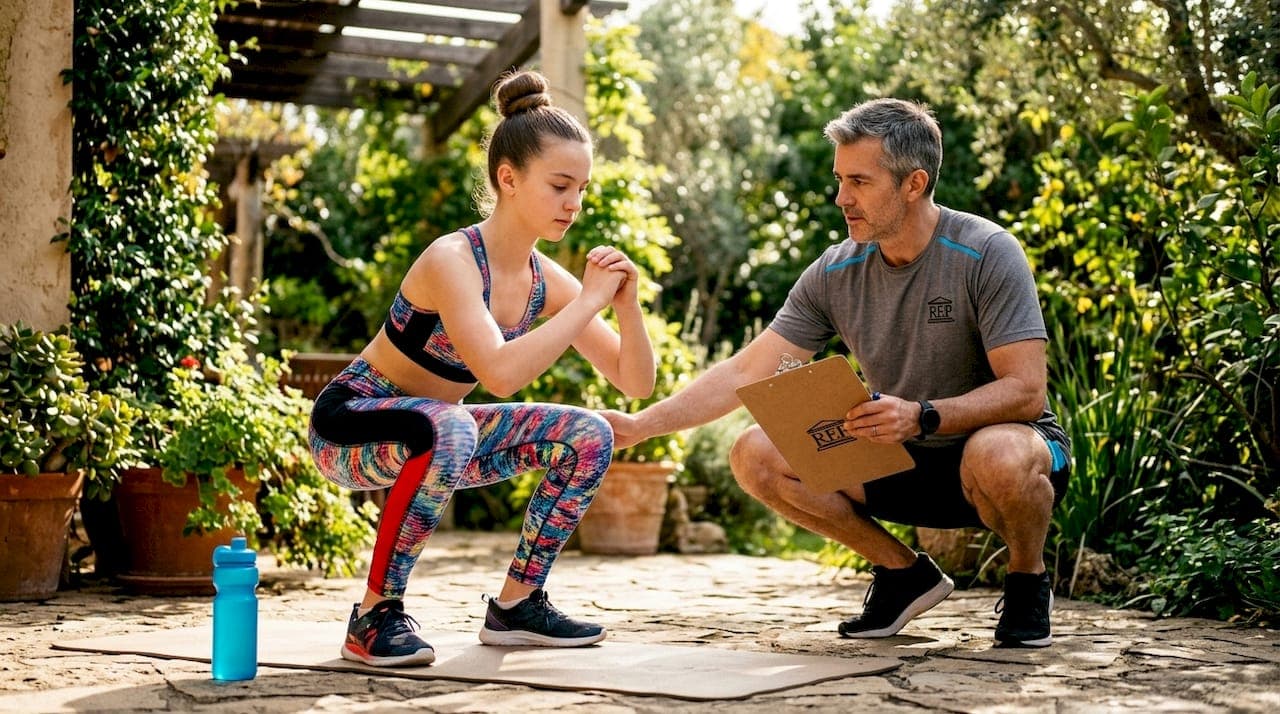
Introducing weight training to teenagers safely means starting with supervised bodyweight movements, building technique over weeks, and adding resistance only when form is consistent and controlled. The American College of Sports Medicine and practitioners like Head2Toe Physio confirm that properly supervised resistance training does not stunt growth or damage growth plates. The real risk is not the weights themselves. It is poor technique, unsupervised maximal lifts, and skipping recovery. When you get those three variables right, your teenager gains strength, confidence, and injury resilience that carries into every sport and daily activity they pursue.
Research backs this up clearly. Resistance training over 12 weeks improves muscle strength, cardiorespiratory fitness, and body composition in adolescents. That is not a minor benefit. It means your teenager can move better, feel stronger, and build habits that protect their health for decades.
How to introduce weight training to teenagers safely with foundational movements
Before your teenager touches a barbell or dumbbell, they need to own five fundamental movement patterns: squat, hip hinge, push, pull, and carry. Mastering these with bodyweight before adding any external load reduces technique drift and injury risk significantly. Think of it like learning to drive in an empty parking lot before merging onto the freeway. The skill has to come first.
Here are the beginner exercises that build each pattern cleanly:
- Squat: Bodyweight squat, focusing on knees tracking over toes and chest staying tall
- Hip hinge: Romanian deadlift with a dowel rod along the spine to teach neutral back position
- Push: Push-ups with full range of motion, elbows at roughly 45 degrees from the torso
- Pull: Inverted rows using a low bar or TRX, pulling the chest to the bar with a straight body
- Carry: Farmer carries with light dumbbells or water jugs, walking with a tall posture and braced core
Movement quality, control, and confidence matter far more than speed or load at this stage. A teenager who can perform 10 clean bodyweight squats with full depth and a neutral spine is ready to progress. One who rushes through with a caved chest and rounded back is not, regardless of how strong they feel.
Pro Tip: Use a dowel rod or broomstick as a teaching prop for the hip hinge. Have your teen hold it along their spine with three contact points: the back of the head, between the shoulder blades, and the tailbone. If any contact point breaks during the movement, they have found their mobility or control limit.

What does a safe 12-week progression plan look like for teens?
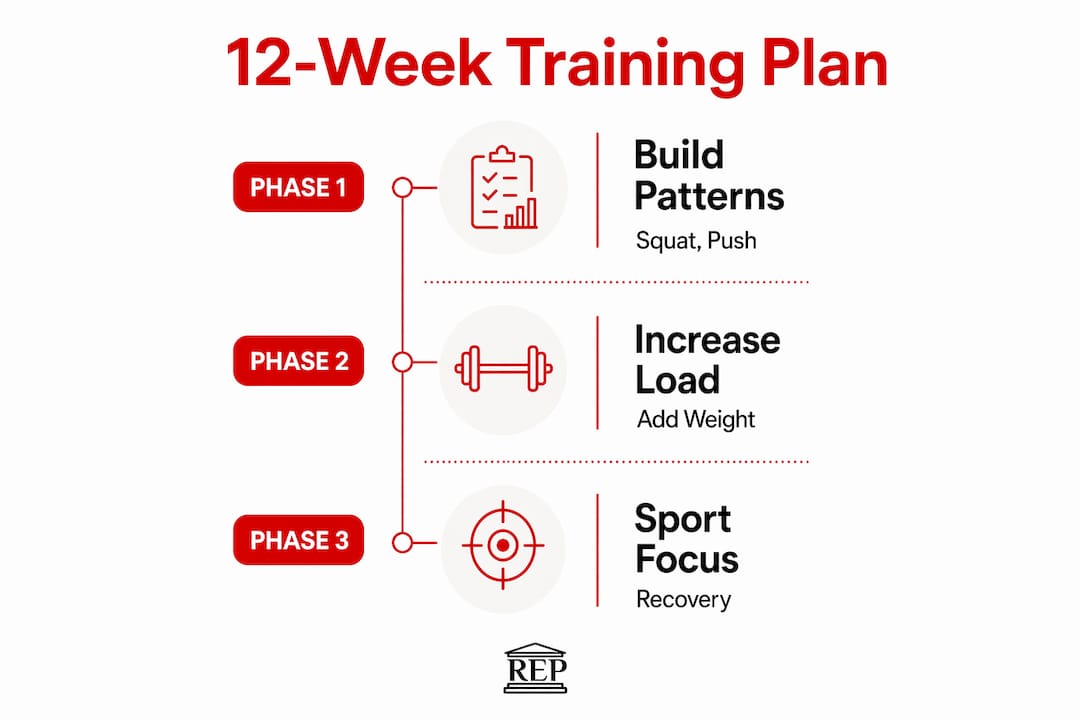
A well-structured plan for beginner weight lifting teenagers follows three clear phases over 12 weeks, each building on the last. The weekly structure stays consistent throughout: 2 to 3 sessions per week with at least 48 hours of rest between sessions. That spacing is not optional. Insufficient recovery between sessions is one of the most common causes of stalled progress and overuse injuries in young athletes.
Here is how the phases break down:
- Weeks 1 to 4 (Technique phase): All work is bodyweight or very light resistance. The goal is movement quality, not fatigue. Sets of 3, reps of 8 to 12, with full rest between sets. Every rep should look the same as the first.
- Weeks 5 to 8 (Light resistance phase): Introduce resistance bands, light dumbbells, or a lightly loaded barbell. Load increases only when technique stays clean across all reps of all sets. Keep 2 to 3 reps in reserve at the end of every set.
- Weeks 9 to 12 (Moderate load phase): Increase load modestly while maintaining the same rep quality standard. Avoid maximal effort lifts entirely. Progress is measured by consistent, clean reps at a slightly heavier load, not by hitting a personal record.
| Phase | Goal | Key exercises |
|---|---|---|
| Weeks 1 to 4 | Build movement patterns | Bodyweight squat, push-up, inverted row, dowel hinge |
| Weeks 5 to 8 | Add light resistance | Dumbbell goblet squat, resistance band row, dumbbell RDL |
| Weeks 9 to 12 | Build moderate strength | Barbell squat, dumbbell press, trap bar deadlift |
Less-trained teens typically see 10 to 20% strength gains over a consistent program of this length. That kind of progress is motivating, but it only happens when the plan is followed with patience.
Pro Tip: If your teenager plays a sport in-season, reduce training volume by roughly 30% and shift the focus to recovery. The goal during a competitive season is to maintain what they have built, not push for new gains.
What equipment and environment keep teen training safe?
Equipment quality matters far less than supervision quality. A teenager training with a certified coach in a space with adequate room, stable flooring, and proper footwear is safer than one training alone with expensive equipment. Start with what you have: bodyweight, resistance bands, and a pair of light dumbbells cover the entire first phase of any beginner program.
When choosing a training environment, consider these factors:
- Flooring: Rubber or padded flooring reduces slip risk and absorbs impact. Avoid smooth tile or hardwood for loaded movements.
- Space: Your teen needs enough room to move through a full squat, lunge, or carry without obstacles nearby.
- Footwear: Flat-soled shoes like Converse Chuck Taylors or dedicated lifting shoes provide a stable base. Running shoes with thick cushioning compress under load and reduce stability.
- Supervision: A parent, coach, or certified personal trainer should be present for every session during the first 12 weeks. This is non-negotiable for technique feedback and safety.
If a gym is the right environment, choosing a qualified trainer who has experience with youth athletes makes a measurable difference. A good coach spots a form breakdown before it becomes an injury.
Pro Tip: Set up a mirror or use your phone to record a side-view video of your teen's squat or deadlift once per week. Watching their own movement is one of the fastest ways for teenagers to self-correct and take ownership of their technique.
What mistakes and risks should parents watch for?
The most common mistake parents make is confusing enthusiasm with readiness. A teenager who wants to lift heavy immediately is not a problem. Letting them do it without a foundation is. Prioritizing rep quality over load is the single most effective injury prevention strategy available, and it costs nothing.
Here is a direct comparison of safe versus risky training behaviors:
| Safe behavior | Risky behavior |
|---|---|
| Increase load only when technique is consistent | Add weight every session regardless of form |
| Train 2 to 3 times per week with 48-hour rest | Train daily or skip rest days |
| Stop a set when form breaks down | Push through fatigue with deteriorating technique |
| Use submaximal loads with reps in reserve | Attempt one-rep maxes or near-maximal effort |
| Celebrate movement quality and consistency | Focus only on how much weight is on the bar |
The psychological environment matters just as much as the physical one. Teenagers who feel judged or pressured to perform beyond their ability are more likely to hide fatigue, skip rest, or attempt loads they are not ready for. Create a space where trial, error, and gradual learning are celebrated. That mindset produces long-term physical and mental health outcomes that go well beyond the gym.
Watch for these signs of overtraining: persistent soreness lasting more than 72 hours, declining performance across sessions, disrupted sleep, irritability, or loss of motivation. Any of these signals means the program needs more recovery time built in.
How do you track progress and know when to advance?
Progress in teen strength training is best measured by technique trends over weeks, not by how much weight is on the bar. Monitoring progress trends rather than single-session readings gives you a far more accurate picture of whether your teenager is adapting safely.
Use these markers to guide advancement decisions:
- Technique consistency: Can your teen complete all sets and reps with the same form quality from the first rep to the last?
- Rep completion: Are they finishing every rep of every set with 2 to 3 reps still in reserve, without grinding or losing position?
- Recovery quality: Are they recovering fully between sessions, arriving to each workout feeling ready rather than depleted?
- Confidence: Does your teen feel in control of the movement, or are they still working out the coordination?
When all four markers are consistently positive across two consecutive sessions, a modest load increase of 5% or less is appropriate. Avoid one-rep max testing entirely during the first year. It provides minimal useful data for beginners and carries unnecessary risk.
Pro Tip: A simple training journal or a free app like Strong or Google Sheets works perfectly for tracking reps, loads, and technique notes. Reviewing three to four weeks of data at a time reveals trends that a single session never will. Encourage your teen to write one sentence about how the session felt. That subjective note often predicts recovery needs better than any number.
For teens involved in youth sports performance training, tracking strength alongside sport-specific metrics gives the clearest picture of overall athletic development.
Key takeaways
Safe teenage weight training requires technique mastery before load, consistent recovery between sessions, and a supportive environment where progress is measured in movement quality first and weight second.
| Point | Details |
|---|---|
| Start with movement patterns | Master squat, hinge, push, pull, and carry with bodyweight before adding any resistance. |
| Follow a 12-week progression | Use three phases: technique, light resistance, and moderate load, each building on the last. |
| Prioritize recovery | Train 2 to 3 times per week with 48 hours between sessions to avoid overuse injuries. |
| Measure technique first | Advance load only when form is consistent across all sets and reps with reps in reserve. |
| Build a safe environment | Supervision, stable flooring, flat footwear, and video feedback reduce injury risk significantly. |
What I have learned coaching teens through their first year of lifting
Here is something I tell every parent who comes to me with a teenager ready to start lifting: the biggest obstacle is almost never the teenager. It is the adult pressure to see fast results. I have worked with teens who came in wanting to bench press their bodyweight on day one, and within four weeks of patient, technique-focused work, they were moving better than athletes twice their age. That transformation does not happen by rushing the process.
What I have seen consistently is that teenagers who learn to move well first become the most coachable athletes over time. They understand their body, they recognize when something feels off, and they are far less likely to push through pain because they have been taught to listen to feedback, both from a coach and from their own body. That is a skill that protects them for life.
The mental side is just as real. Teenagers who train in a supportive, non-judgmental environment build genuine confidence. Not the kind that comes from lifting a heavy weight once, but the kind that comes from showing up consistently and watching themselves get better week after week. That is the outcome worth chasing. And when parents stay curious, ask good questions, and celebrate the process alongside their teen, the results are genuinely remarkable.
— Coach Justin
Ready to build a safe, structured program for your teen?
At Repphilosophy, we specialize in exactly this kind of work. Our youth sports performance training programs are built around the same progressive, technique-first principles covered in this article, delivered in a safe and challenging environment right here in 4S Ranch.
Whether your teenager is just getting started or ready to take their training to the next level, we have options that fit your schedule and budget. From group classes and buddy training memberships to one-on-one coaching and virtual programs, there is a path that works for your family. Explore our coaching programs and memberships to find the right fit, or check out our on-demand video library for structured workouts your teen can follow from anywhere.
FAQ
Is weight training safe for teenagers?
Yes. Supervised resistance training does not stunt growth or damage growth plates when technique is sound and maximal lifts are avoided. Safety depends on supervision, programming quality, and recovery, not on age alone.
How many days per week should a teen lift weights?
Two to three non-consecutive sessions per week is the recommended starting point, with at least 48 hours of rest between sessions to allow full recovery and adaptation.
What exercises should teenagers start with?
Bodyweight squats, push-ups, inverted rows, Romanian deadlifts with a dowel, and farmer carries are the best starting exercises. These foundational patterns build movement quality and injury resilience before any external load is introduced.
When should a teen increase the weight they are lifting?
Increase load only when your teen completes all sets and reps with consistent technique and still has 2 to 3 reps in reserve. Rep quality is the gating factor, not a set number of weeks or sessions.
Do teenagers need a personal trainer to start lifting?
A certified trainer is not required, but qualified supervision during the first 12 weeks significantly reduces injury risk and accelerates technique development. For teens involved in sports, working with a youth-focused coach provides the most targeted and safe programming available.