

Yes, you can and should maintain, and sometimes modestly add, strength during your competitive season using low-volume, maintained-intensity sessions plus autoregulation. Aim for one to two focused sessions per week, keep intensity high while cutting volume, and let readiness checks guide daily adjustments. Coaches build entire seasons around this principle. A 2024 study found in-season strength work cuts non-contact injury rates dramatically. Fifteen to thirty minutes, two times a week, protects the athlete you spent all off-season building.
TL;DR:
- Maintaining high intensity at 78 to 85 percent of one-rep max with minimal volume twice weekly effectively preserves strength over a season.
- Reducing volume by 40 to 70 percent and scheduling sessions around competition helps prevent fatigue and injury while safeguarding neural power.
- Monitoring tools like velocity-based training, CMJ testing, and workload ratios guide autoregulation and protect athletes from overtraining and injury.
- Fewer, high-quality sessions, sometimes as brief as 15 minutes, can be enough during intense competition weeks, especially with proper load management.
- Coaches should focus on daily adjustments and monitoring to avoid common pitfalls such as dropping intensity, overloading, or scheduling high-volume sessions near games.
Table of Contents
- Why In-Season Strength Training Matters
- Core Principles For In-Season Programming
- Programming Variables And Quick Templates
- Monitoring Readiness And Autoregulation
- Common Mistakes That Undermine In-Season Strength
- Two Sample Weekly Plans You Can Copy
- How coaches apply this in practice
- The Editorial Take: What Coaches Get Wrong About In-Season Strength
- Ready To Put A Real In-Season Plan In Place?
- Sources
Why In-Season Strength Training Matters
Strength is not something you bank in the off-season and coast on until playoffs. It decays, and it decays fast if you let it.
The evidence on injury reduction is hard to argue with. The 2024 study of soccer athletes found that in-season strength training performed at 40 to 85% of one-rep max dropped non-contact injury rates from 2.62 to 0.48 per 1,000 hours of exposure compared to athletes who did no supplemental strength work.
That's not a marginal edge. That's a five-fold difference in injury risk, tied directly to whether an athlete kept lifting during the season.
The goal in-season isn't building bigger muscles. It's preserving the neural qualities that let an athlete produce force fast, sprint hard in the 70th minute, and decelerate without their knee buckling. Muscle mass holds up reasonably well with reduced training. Neuromuscular power and rate of force development do not. Keep an athlete's nervous system firing the way it did in week one, and you keep them available. Availability, more than any single metric, is what wins seasons.
Core Principles For In-Season Programming
Off-season training chases adaptation. In-season training protects it. That shift changes everything about how a session should look.
ACE's periodization guidance frames the season as a sequence of phases rather than a straight line: base building gives way to sharpening, then peaking around key competitions, then tapering. In-season programming lives mostly in the sharpening and maintenance zone, never back in high-volume accumulation.
Two rules govern almost everything else:
- Keep intensity high. Protect working sets at roughly 78 to 85% of one-rep max or higher.
- Cut volume hard. Drop total sets and reps 40 to 70% from off-season levels.
NSCA guidance backs this up directly, recommending reduced volume with preserved intensity, scheduled around competition rather than around a gym's convenience.
The minimum effective dose is smaller than most coaches assume. One to three working sets per exercise, delivered in one to two sessions a week, is often enough to hold strength steady for 12 to 16 weeks, according to research on in-season programming. A 2020 meta-analysis found that even a single weekly session preserves roughly 95% of pre-season maximal strength over 16 weeks.
Track workload with the acute:chronic workload ratio (ACWR) as a guardrail against sudden spikes that invite soft-tissue injuries.
Programming Variables And Quick Templates
Session design in-season depends heavily on how many games or matches an athlete faces that week. Density dictates dose.
Three starting templates cover most situations:
- High-density week (3+ competitions): one session, two compound lifts, two sets of three to five reps at roughly 83% 1RM. Fifteen minutes, no accessories.
- Typical team week (1 to 2 competitions): two sessions, a heavier maintenance day and a lighter technical/activation day.
- Individual-sport week: two sessions with slightly more total volume, since athletes usually aren't absorbing the same collision load as team-sport competitors.
Exercise selection stays simple across all three: two to three compound lifts (squat and hinge variations), one single-leg movement, core or anti-rotation work, and a posterior-chain emphasis to counter the quad-dominant patterns most sports create. Single-leg strength work deserves a permanent spot here, since asymmetries tend to widen under a heavy competition schedule.
TrainHeroic's programming framework recommends sequencing speed and power work before strength work in a session, since fatigue from heavy lifting blunts the nervous system's ability to produce fast force afterward.
Timing relative to competition matters as much as the lifts themselves. Avoid high-volume sessions within 36 hours of a game. In the 24 to 48 hour window before competition, stick to activation work and low-volume, low-fatigue movement instead of anything approaching a grind.
Monitoring Readiness And Autoregulation
Fixed programs assume every week feels the same. In-season, they never do.
Velocity-based training removes the guesswork. If it moves normally, proceed as planned. If it feels noticeably slower, that's your cue to pull back before the main work even starts.
Countermovement jump (CMJ) testing offers another window into readiness, using thresholds worth memorizing:
- A jump height drop of 5% or more from rolling baseline signals reduced readiness. Trim volume that day.
- A drop of 10% or more suggests real neuromuscular fatigue. Convert the session to recovery work or rest the athlete outright.
The acute:chronic workload ratio rounds out the picture, flagging when recent training load has spiked relative to an athlete's chronic average, a pattern strongly associated with injury risk.
Pro Tip: When in doubt, cut sets before cutting weight. Dropping a set preserves the intensity that maintains strength; dropping weight erodes the exact quality you're trying to protect.
Common Mistakes That Undermine In-Season Strength
Most in-season strength failures aren't dramatic. They're small decisions that compound over a 16-week schedule.
- Stopping strength training entirely once the season starts, assuming practice and games provide enough stimulus.
- Swapping heavy, low-rep work for high-rep endurance circuits out of fear of soreness.
- Carrying full off-season volume into the season without ever trimming sets.
- Scheduling heavy sessions the day before or the morning of competition.
The fixes are just as unglamorous. Preserve load and cut sets first when time or fatigue runs short. Substitute technical or activation work on the days an athlete looks flat rather than skipping training altogether. Shift session timing earlier in the week, away from game days. And don't overlook the basics of recovery. Sleep, adequate protein and carbohydrate intake, and simple mobility work do more for in-season readiness than any exotic recovery gadget.
Two Sample Weekly Plans You Can Copy
These two templates cover the majority of team and individual-sport schedules without any guesswork required.
- High-density team template: one in-season maintenance session midweek. Two exercises, two sets of three to five reps, roughly 83% 1RM. Total session time under 20 minutes.
- Typical team or individual template: a heavy maintenance day (two to three exercises, two sets of three to five reps) plus a separate activation and technical day at 50 to 60% 1RM, paired with mobility and light speed work.
For travel weeks, playoff stretches, or tournament formats, drop a session before you drop intensity. Fewer touches at high quality beat more touches at declining quality every time. If an athlete plays three games in five days, one well-timed 15-minute session is often the entire strength stimulus they need that week.
How coaches apply this in practice
In-season plans apply the minimum-effective-dose thinking laid out above: enough intensity to protect strength, little enough volume to protect recovery, and autoregulation checks that adjust the plan to how an athlete actually shows up that day. For youth athletes especially, that safety margin isn't optional and includes appropriate youth training hockey apparel to support off-ice preparation. Programs lean on sport-specific training principles to keep skill work and strength work complementary rather than competing for an athlete's limited recovery capacity.
Coaches and athletes who want a ready-made framework can start with a custom six-week written program or work through the virtual on-demand video library for guided execution of the templates above.
The Editorial Take: What Coaches Get Wrong About In-Season Strength
Most in-season strength conversations get hijacked by fear. Coaches worry that any heavy lifting near a game will leave athletes sore, slow, or spent. That fear produces the exact mistake the research warns against: pulling intensity instead of volume, which is backwards. Volume is the variable that costs recovery. Intensity is the variable that preserves the neural qualities keeping an athlete fast and injury-resistant.
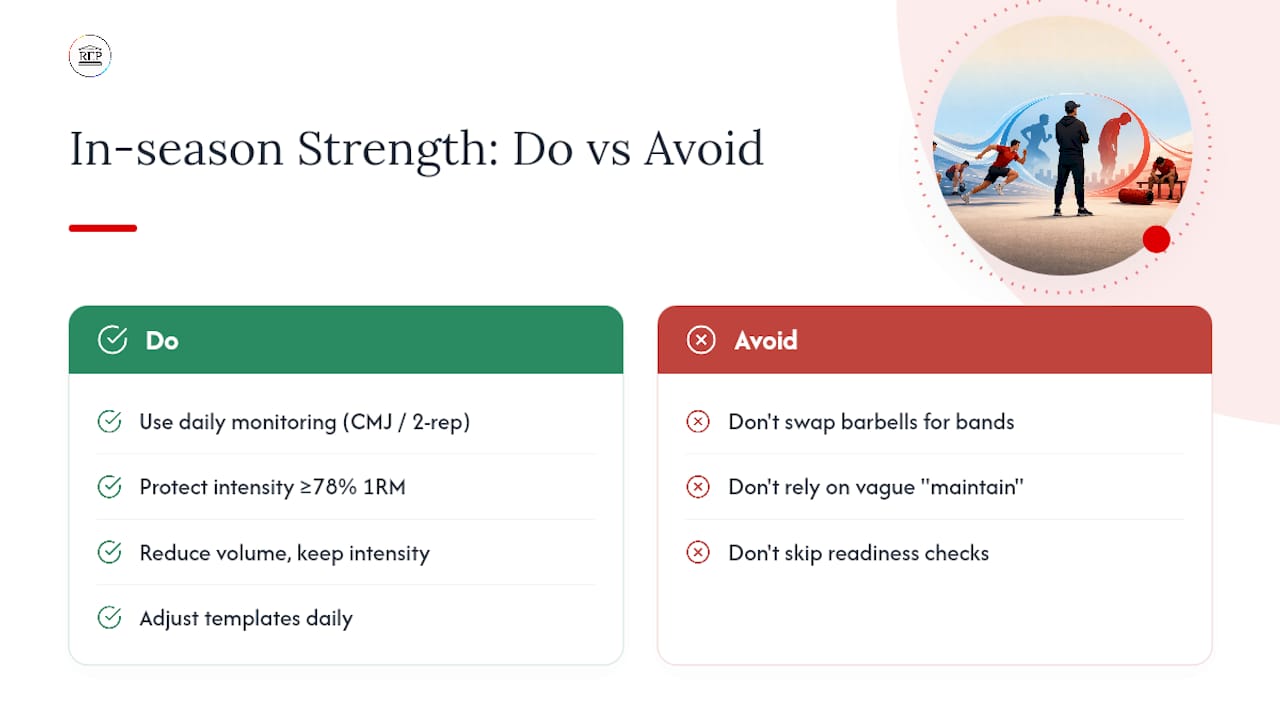
The conventional wisdom of "just maintain what you can" is technically correct but dangerously vague. Maintenance without a target intensity and a monitoring system isn't a plan. It's a hope. Real maintenance means protecting loads at 78% of one-rep max or higher while trimming sets, not swapping barbells for band work because it feels safer.
If there's one thing to prioritize first, it's this: build the monitoring habit before you build the perfect template. A CMJ check or a two-rep velocity test takes 90 seconds and tells you more about today's session than any spreadsheet built in July. Templates are replaceable. The discipline to adjust them daily is what actually keeps athletes on the field.
— Coach Justin
Ready To Put A Real In-Season Plan In Place?
You've got the framework: preserve intensity, trim volume, monitor daily, and adjust before fatigue turns into an injury. Applying that framework consistently across a full season, while juggling practice schedules, travel, and game-day fatigue, is where most self-coached plans fall apart.

REP Philosophy builds that consistency in for you. A custom six-week written program gives you the exact session structure, load targets, and autoregulation cues from this article, mapped onto your actual competition calendar instead of a generic template. If you'd rather train on your own schedule, the virtual on-demand exercise library walks you through every lift with guided video demos, so technique never degrades when fatigue creeps in late in the season. Local athletes can also train in person at the 4S Ranch performance center, where sessions are built around the same maintenance-first principles covered above. Book a session or start your custom program today, and keep your strength where it belongs: available for every game that matters.
Sources
- Effect of in-season strength training on injury rates — PMC
- Importance of an In-Season Strength Training Program — NSCA
- In-Season Strength Training for Athletes | PoinT GO Research