
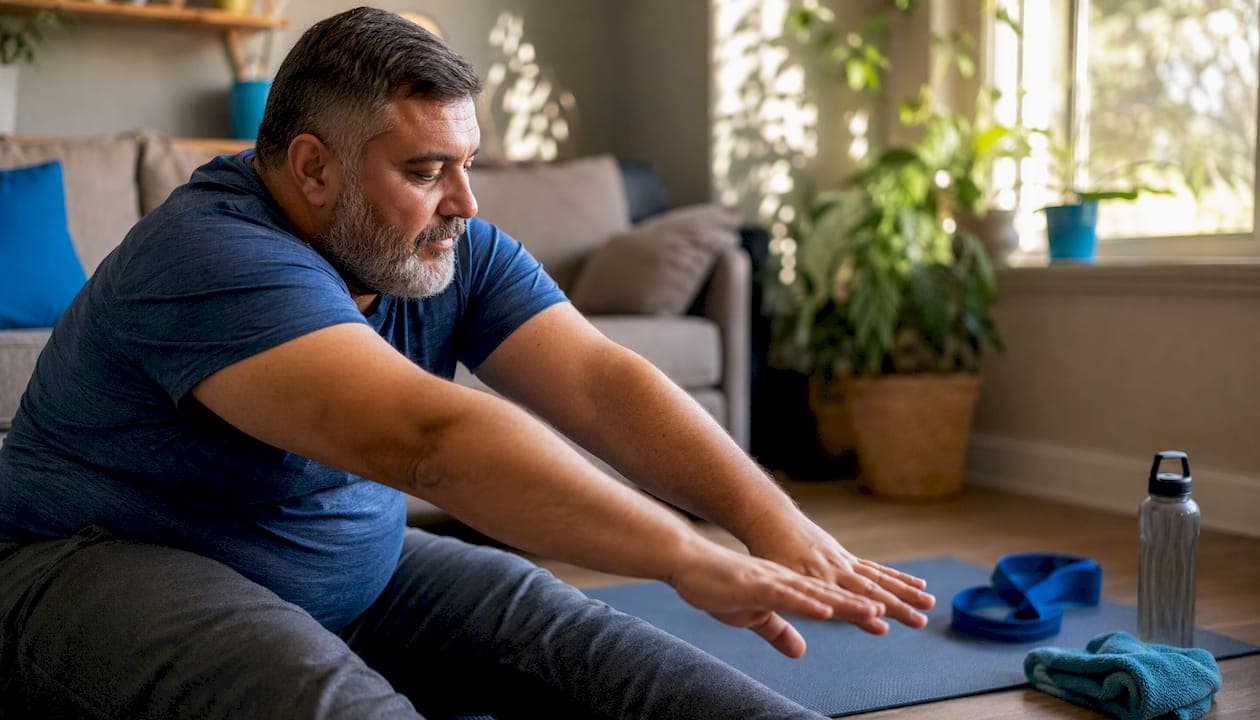
Here's the one sentence that matters: start with 5 to 10 minute "movement snacks" of low-impact activity most days, add two short strength sessions each week, and let that combination grow toward the CDC's target of 150 minutes of moderate activity plus two strength days a week. That's it. That's the whole strategy behind every successful long-term habit I've seen take root.
You don't need new shoes, a gym membership, or a Monday to start. You need today, ten minutes, and one of two moves: a walk around the block, or a set of chair stand-ups from your kitchen table. The NIDDK is explicit about this: beginners should start slowly, even five minutes at a time, and build from there. Small and repeatable beats ambitious and abandoned, every single time.
Before you move, run through this quick safety check:
- Pause and call your doctor if you feel chest pain, shortness of breath at rest, or dizziness during movement.
- Get medical clearance first if you have uncontrolled high blood pressure, diagnosed heart disease, or recent surgery.
- Stop immediately for sudden joint swelling, sharp new pain, or pain in one leg that wasn't there before.
- If none of these apply, you're clear to start today with gentle, low-impact movement.
Adherence research points to what's called the tripartite model: your routine has to be safe, effective, and genuinely enjoyable, or you'll quit no matter how good the plan looks on paper. Keep that framework in your back pocket. It shows up again and again in this guide.
Key Takeaways
Building a lasting workout habit as an overweight adult comes down to starting small, protecting your joints, and progressing one variable at a time toward 150 weekly minutes.
| Point | Details |
|---|---|
| Start with movement snacks | Begin with 5 to 10 minute low-impact sessions most days instead of one long workout. |
| Protect your joints first | Choose water workouts, recumbent cycling, or chair-based moves to reduce impact. |
| Add two strength sessions weekly | Use sit-to-stands, wall push-ups, and band rows for 1 to 3 sets of 8 to 15 reps. |
| Track minutes, not pounds | Log sessions and minutes exercised rather than obsessing over the scale early on. |
| Get support when you need it | A single Repphilosophy training session or the virtual exercise library can speed up safe form learning. |
Table of Contents
- How Do You Build a Workout Habit When You're Overweight?
- What Medical Checks and Red Flags Should You Watch For?
- Which Low-Impact Exercises Work Best for Beginners?
- Why Does Strength Training Matter, and How Do You Start?
- What Actually Makes a Workout Habit Stick?
- How Do You Solve the Barriers That Usually Stop People?
- How Do You Track Progress Without Obsessing Over the Scale?
- What Does a 4-Week Starter Plan Look Like?
- When Should You Bring in a Professional?
- What I've Learned Training Overweight Beginners
- How Repphilosophy Can Help You Start Safely
- Sources
How Do You Build a Workout Habit When You're Overweight?
You build it the same way you'd build any habit that sticks: small, frequent repetitions that don't ask too much of your willpower on any single day. The mistake most people make isn't laziness. It's ambition. They commit to an hour-long gym session five days a week, feel wrecked by day three, and quit by week two.
The better approach for an overweight adult starting out is to lower the barrier to entry until it's almost silly how easy the first step is. Five minutes of walking. One set of wall push-ups. A ten-minute water workout. You're not trying to transform your fitness in week one. You're trying to prove to your own brain that exercise is something you actually do, not something you plan to do someday.
Regular movement delivers benefits that show up faster than most people expect, and they matter more for overweight adults specifically:
- Cardiovascular health improves within weeks as your heart and lungs adapt to consistent, moderate demand.
- Blood sugar control gets measurably better with regular activity, even before any change on the scale.
- Joint mobility and function improve, which reduces daily pain and makes stairs, groceries, and yard work easier.
- Mood and energy shift noticeably, often within the first two to three weeks of consistent movement.
- Functional independence builds over time, meaning you can do more of daily life without assistance or discomfort.
The Physical Activity Guidelines set 150 minutes of moderate aerobic activity a week plus two days of muscle-strengthening work as the long-term target, but that number is meant as a destination, not a starting line. Most beginners who succeed reach it gradually over several weeks rather than attempting it in week one. Expect early wins to look like better stamina climbing stairs or less soreness after a walk within two to four weeks, not dramatic before-and-after photos.
What Medical Checks and Red Flags Should You Watch For?
Most overweight adults can start light activity like walking or water workouts without a doctor's visit first. But certain conditions and symptoms change that answer, and it's worth five minutes of your time to check before you begin.
Talk to a healthcare provider before starting if you have any of these:
- Diagnosed heart disease, chest pain with exertion, or a history of heart attack.
- Uncontrolled high blood pressure or diabetes.
- Recent surgery, especially involving joints, the abdomen, or the chest.
- Severe joint pain, known cartilage damage, or a history of falls related to balance.
- Any symptom that concerns you and hasn't been evaluated yet.
Stop exercising and seek immediate care if you experience chest pain, sudden shortness of breath, fainting or near-fainting, new and severe joint swelling, or sudden pain in one leg (which can signal a blood clot). Sports-medicine sources are consistent on one point: doing too much too soon causes injuries that end programs before they start. Your job isn't to push through. It's to protect the habit by protecting your joints.
Joint protection basics that matter most for overweight beginners:
- Choose water workouts when possible. Water supports body weight and dramatically reduces impact on knees and hips.
- Pick a recumbent bike over an upright one if your knees or lower back are sensitive.
- Wear supportive, well-fitted shoes with cushioning. Worn-out sneakers are a common, invisible source of joint stress.
- Exercise on softer surfaces (a track, grass, or a treadmill) rather than concrete when walking is your main activity.
- Learn correct form for any strength move before adding load. Bad form under fatigue is where most injuries start.
Pro Tip: Book a short primary-care visit specifically to ask about exercise. Bring one question: "Given my health history, what activities should I avoid, and what's safe to start with this week?" A focused ten-minute conversation beats a vague worry you never resolve.
Consistency, not intensity, is what turns a workout into a habit. The people who succeed aren't the ones who suffered the most in week one. They're the ones who showed up again in week two.
Which Low-Impact Exercises Work Best for Beginners?
Walking remains the most accessible entry point for almost every overweight adult, and it doesn't require a single piece of equipment beyond decent shoes. Try "movement snacks," five to ten minute walks scattered through your day, after breakfast, after dinner, during a phone call, instead of one long session you have to schedule around. Three ten-minute walking bouts provide benefits comparable to one continuous session of similar total duration, which matters enormously if a single 30-minute block feels impossible to find.
Beyond walking, here's a practical menu of options, each with a way to make it easier or harder:
- Water aerobics or pool walking. No swimming skill required. Shallow-water walking or a structured water aerobics class removes almost all joint impact while still building cardiovascular fitness. Make it harder by moving into deeper water or adding resistance gloves.
- Recumbent cycling. The seated, reclined position takes pressure off the lower back and knees compared to an upright bike. Start at 5 minutes, add a minute or two each week.
- Chair-based movement. Seated marching, arm circles, and seated leg extensions work well for anyone with balance concerns or very low current fitness. Progress by adding light hand weights or standing for portions of the routine.
- Elliptical training. Lower impact than running while still elevating heart rate. Start at low resistance and short duration, then increase either variable, not both at once.
- Gentle yoga or tai chi. Both improve balance and flexibility, which matters for fall prevention and joint health. Modified or chair-based versions exist for those with limited mobility.
- Dancing at home. A Harvard Health review of activity patterns found dancing and other genuinely enjoyable higher-intensity activities were linked to better long-term weight maintenance, likely because people actually kept doing them.
The pacing question comes up constantly: should you do one continuous session or break it up? For beginners, broken-up bouts work just as well and are often easier to sustain. Ten minutes after each meal adds up to 30 minutes without ever feeling like "a workout." Pair a stationary bike with your evening TV show, and you've solved the boredom problem and the scheduling problem in one move.
Why Does Strength Training Matter, and How Do You Start?
Strength training isn't optional for overweight adults working on their fitness. It protects the joints that carry extra load every day, supports metabolic health, and rebuilds the functional strength that makes daily tasks, carrying groceries, getting up from the floor, climbing stairs, noticeably easier. Skipping it in favor of cardio alone leaves an entire pillar of health on the table.
You don't need a barbell or a gym membership to start. Five movements cover the basics:
- Sit-to-stand from a chair. Builds leg and glute strength while doubling as balance practice. Cue: chest up, weight in your heels, stand without using your hands if you can.
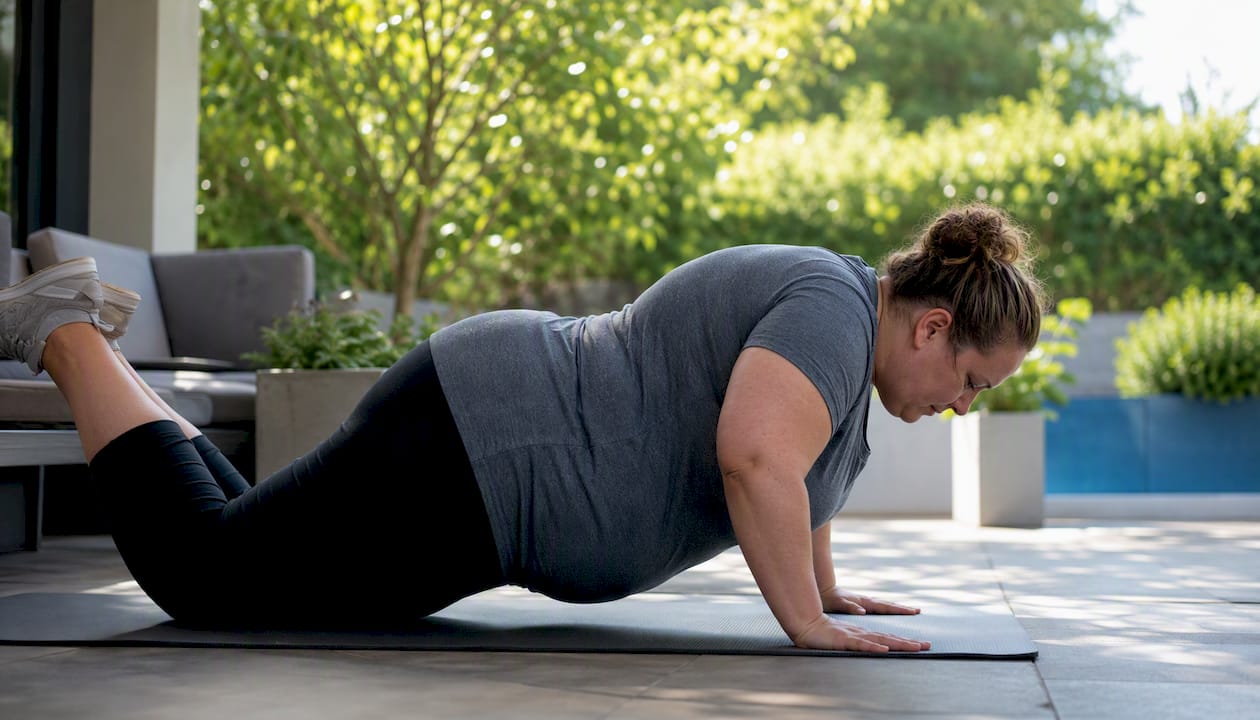
- Wall push-up. A joint-friendly entry point for chest and arm strength before floor push-ups become realistic. Cue: hands shoulder-width apart, lower slowly, keep your body in a straight line.
- Band row. Builds upper-back strength that counteracts the forward slump of sitting all day. Cue: pull elbows back and squeeze shoulder blades together.
- Glute bridge. Strengthens the hips and lower back without any impact on the knees. Cue: press through your heels, squeeze at the top, lower with control.
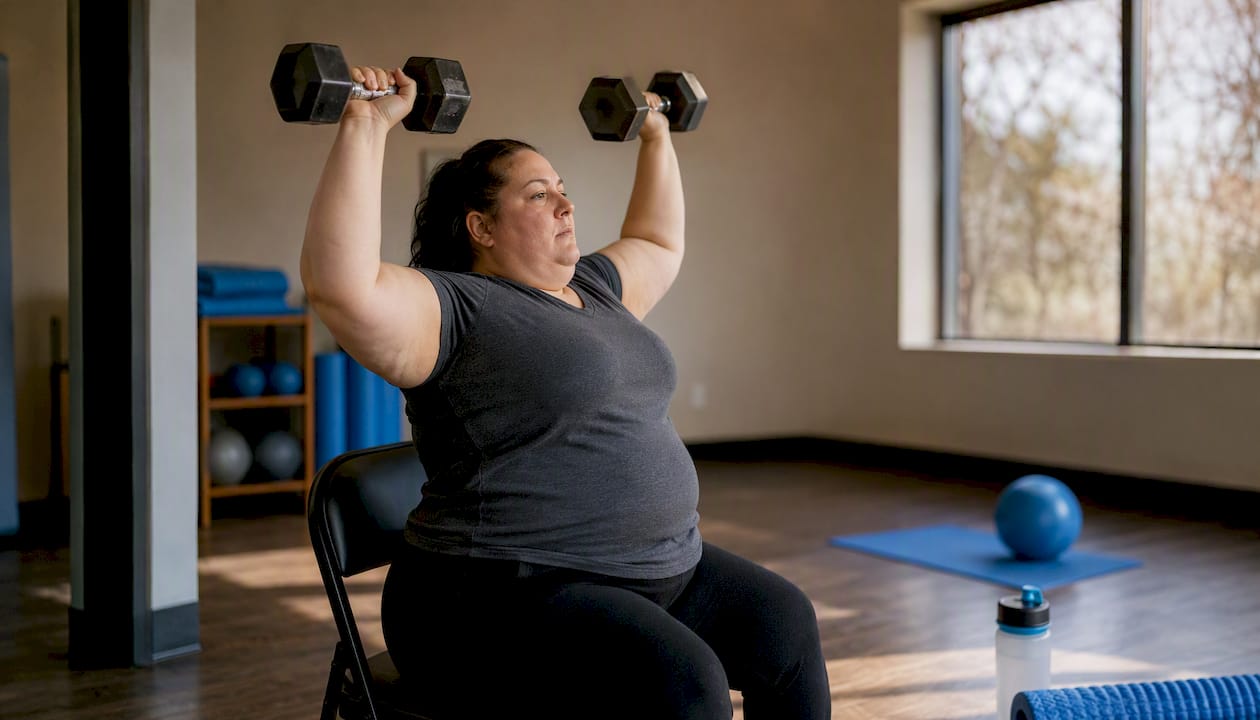
- Seated overhead press. Builds shoulder strength safely, with the chair providing back support and stability. Cue: press straight up, avoid arching your lower back.
For beginners, one to three sets of 8 to 15 reps per exercise, two nonconsecutive days a week, is a sound starting structure and an ideal place to begin according to the Basic Strength Training Step by Step for Beginners – htktrainingblog. Use just your body weight or a light resistance band until the form feels automatic, then add load gradually. Rest 60 to 90 seconds between sets, and rest at least one full day between strength sessions to let muscles recover.
Pro Tip: Learn form before you learn load. Watch a short video demonstration, do a single session with a trainer, or slow your rep tempo way down (a 3-second lowering phase on each movement) so you can feel exactly what proper form should feel like. Repphilosophy's beginner-friendly strength training guide breaks each of these movements down step by step if you want visual cues to follow.
What Actually Makes a Workout Habit Stick?
Here's the sequence that turns "I'm trying to exercise more" into "I work out on Tuesdays and Thursdays without thinking about it":
- Set a micro-goal. Not "get fit." Something absurdly small: "Walk for 10 minutes after dinner, four days this week."
- Schedule it like an appointment. Pick the same time slot each day rather than "whenever I find time." A fixed time removes the daily decision-making that drains motivation.
- Track it simply. A checkmark on a calendar or a note in your phone is enough. You're building evidence that you follow through, not building a spreadsheet.
- Reward completion. Something small and immediate, not food-based: a hot shower, ten minutes of a show you like, calling a friend.
- Review and adjust every two weeks. If a workout felt miserable, swap it. If it felt easy, add a minute or a rep.
This sequence mirrors the tripartite model mentioned earlier: it has to be safe (small enough not to injure you), effective (consistent enough to build real fitness), and enjoyable (or you'll stop, no matter how good it is for you).
A few tactics make each step easier to execute:
- Habit stacking. Attach the new habit to an existing one: "After I brush my teeth, I do five minutes of chair squats."
- Implementation intentions. Decide the exact when and where in advance: "I walk at 7:00 AM around my block," not "I'll walk sometime in the morning."
- Chronotype alignment. Research on exercise timing suggests matching your workout to when you naturally have more energy, morning or evening, improves the odds you'll stick with it. Fighting your own body clock adds friction you don't need.
- Social accountability. Tell a friend your plan, or better, do it with them. Repphilosophy's buddy training memberships exist specifically because shared accountability keeps people showing up.
- Environment design. Put your shoes by the door. Leave a resistance band on the couch. Visible cues reduce the mental effort of getting started.
Run two-week experiments rather than committing to anything forever. Try water aerobics for two weeks. If you dread it, swap to recumbent cycling. How an activity makes you feel while you're doing it, what researchers call affective valence, predicts whether you'll keep doing it far better than how many calories it burns. For tracking and accountability, a simple paper log, a phone reminder app, or a structured resource like Repphilosophy's virtual exercise library can all work. Pick whichever one you'll actually use.
How Do You Solve the Barriers That Usually Stop People?
Almost every overweight adult who quits an exercise routine quits because of one of a handful of predictable problems, not because they lack willpower. Naming the barrier and having a ready fix removes most of its power.
| Barrier | Practical fix |
|---|---|
| No time | Break activity into 5 to 10 minute movement snacks throughout the day instead of one long session. |
| Embarrassment about gym settings | Start at home with video-guided workouts or choose off-peak hours at a pool or studio. |
| Joint pain | Switch to water workouts, recumbent cycling, or chair-based strength movements to remove impact. |
| Limited mobility | Use seated or supported versions of exercises and progress at your own pace, not a program's default pace. |
| Bad weather | Keep an indoor backup: stationary bike, stairs, or a living-room bodyweight circuit. |
| Limited money for equipment | Bodyweight moves, resistance bands, and walking require little to no financial investment. |
A few more fixes worth knowing about: many community centers and YMCAs run low-cost pool programs specifically designed for beginners, and free video libraries exist for chair-based and beginner strength workouts if a gym setting feels intimidating right now.
Gear matters more than people expect. Ill-fitting shoes cause knee and hip pain that gets blamed on the workout instead of the footwear. Prioritize:
- Shoes fitted specifically for your foot shape and gait, not just whatever's on sale.
- Moisture-wicking layers if sweating and chafing have been a barrier before.
- Supportive insoles if you're on your feet for extended walks.
How Do You Track Progress Without Obsessing Over the Scale?
Weight is a slow, noisy metric that hides real progress. Track these instead, because they change faster and tell you the truth about whether your habit is working:
- Minutes exercised per week, moving toward that 150-minute target.
- Sessions completed, a simple count that shows consistency, not intensity.
- Distance walked, using your phone or a basic pedometer.
- Perceived exertion, a 1-to-10 scale of how hard a session felt.
- Functional markers, like climbing a flight of stairs without stopping, or the number of strength reps completed with good form.
Progress a beginner routine one variable at a time, and change it only every one to three weeks: increase time, increase intensity, or increase frequency, never all three simultaneously. This is the single biggest injury-prevention rule in beginner programming, and it's the one people ignore most often when motivation is high.
Timeline expectations, grounded in what actually happens for most beginners: improved stamina and easier breathing during activity typically show up within 2 to 4 weeks. Noticeable strength and mobility gains take 4 to 8 weeks. Weight changes vary enormously between individuals and depend heavily on nutrition, so don't use the scale as your only scoreboard in the early going.
One more distinction that matters: normal muscle soreness (dull, symmetric, fades within 48 to 72 hours) is a sign of adaptation. Sharp, one-sided, or worsening pain is a signal to back off and reassess, not push through.
What Does a 4-Week Starter Plan Look Like?
A sample structure like this mixes walking, two short strength sessions, and built-in recovery, following the same pattern that effective beginner programs tend to use, with gradual, repeatable progress over raw intensity.
Modify freely. If knee or lower-back pain is a factor, swap walking for pool-based movement and use chair versions of the strength moves. If balance is a concern, do every strength move seated or with a wall or sturdy chair for support.
This plan exists to build the habit first, not to produce rapid weight loss. Rushing the timeline to chase faster results is exactly what leads to the injuries that end programs early. A single session with a coach, or working through Repphilosophy's progressive fitness programming guide, can help you learn correct form faster than trial and error alone, especially for the strength movements where technique matters most.
When Should You Bring in a Professional?
Some situations call for more than a self-guided plan, and recognizing them early protects both your safety and your motivation. Get a referral to a physician or physical therapist if you experience chest pain during activity, have uncontrolled diabetes, notice persistent joint swelling that doesn't resolve with rest, are recovering from surgery, or have significant balance problems that raise fall risk.
When you do see a clinician or physical therapist, a short, targeted list of questions gets you more value from a limited appointment:
- "Given my health history, which activities should I avoid completely?"
- "Are there red-flag symptoms specific to my condition that I should watch for?"
- "Would a supervised program or physical therapy referral make sense for me right now?"
If you're working with a personal trainer instead, ask:
- "Can you check my form on these specific movements before I add more weight or reps?"
- "What does my progression look like over the next four to six weeks?"
- "How many sessions would you recommend before I'm confident training on my own?"
What I've Learned Training Overweight Beginners
The biggest misconception I run into is that people think they need to earn the right to call themselves "someone who works out" by suffering through an intense session first. That's backward. The people who build lasting habits are the ones who make the first month almost embarrassingly easy, then let consistency compound over time.
I've watched clients who started with five-minute chair workouts end up doing full strength sessions within two months, not because I pushed intensity early, but because we protected their joints and their confidence long enough for the habit to take root. Safety and enjoyment aren't the soft, secondary parts of a fitness plan. They're the entire mechanism that makes the hard part, staying consistent, possible at all.
If you take one thing from this article, let it be this: your first two weeks of exercise should feel almost too easy. That's not a failure of effort. That's the plan working exactly as it should. For more on how we structure early sessions for beginners, our personal training benefits guide covers what that looks like in practice.
How Repphilosophy Can Help You Start Safely
Reading a plan and following it alone are two different things, and that gap is where most people either stall out or get hurt trying to figure out form on their own. Repphilosophy closes that gap without requiring a long-term commitment before you know it's the right fit.
If you want a low-pressure way to test the waters, start with the on-demand exercise library, which gives you guided videos for exactly the joint-friendly movements covered in this guide, so you can see correct form instead of guessing at it. Prefer in-person guidance from day one? A single training session at our 4S Ranch location lets a coach check your form, build you a starter plan around your specific joints and limitations, and answer the safety questions this article can't fully cover for your individual case. Buddy training memberships are also available if social accountability is what usually keeps you consistent. Book the session or grab library access today and take that first ten-minute step with real support behind it.
Sources
- Physical Activity Guidelines for Adults — CDC
- Staying Active at Any Size - NIDDK
- Safe Workouts When You're Overweight - WebMD
- Six activities can help obese people lose weight and keep it off — Harvard Health
- Chronotype and exercise timing — PMC
This article offers general fitness information and isn't a substitute for personalized medical advice. Confirm any new exercise plan with your doctor if you have underlying health conditions or concerns.
This article is general information, not a substitute for advice from a qualified doctor. Consult a qualified healthcare professional about your own circumstances before acting on anything here.