

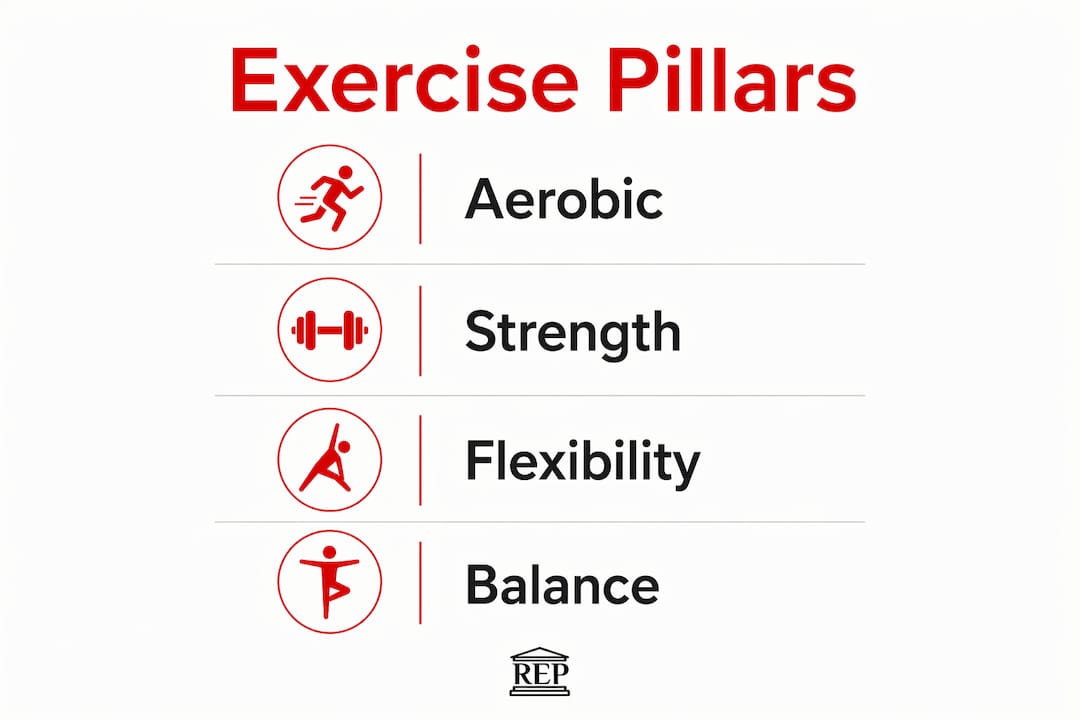
Safe effective workouts are routines that build fitness and protect your body by combining balanced exercise types with proper technique and gradual progression. Whether you are a parent squeezing in a 20-minute session before school drop-off, a professional with back-to-back meetings, or a complete beginner, the same core principles apply. The American College of Sports Medicine (ACSM) and Harvard Health both confirm that four exercise pillars form the foundation of any injury-free training program: aerobic activity, strength, flexibility, and balance. Getting these right does not require a gym membership or hours of free time. It requires a plan you can actually stick to.
What are the essential types of exercises for safe effective workouts?
Balanced exercise programs include four pillars: aerobic, strength, stretching, and balance. Each one serves a distinct purpose, and skipping any of them creates gaps that raise your injury risk over time.
Aerobic exercise
Aerobic activity is the foundation of cardiovascular health. Walking and swimming deliver real cardiovascular benefits with low injury risk, making them suitable for nearly every fitness level. A brisk 30-minute walk three times a week is a legitimate starting point. You do not need to run a 5K to see results.

Strength training
Resistance training builds the muscle strength that keeps your joints stable and your metabolism active. Healthy adults should train all major muscle groups at least twice weekly to improve strength and function. That finding comes from an analysis of over 30,000 participants across 137 systematic reviews. Two focused sessions per week is a realistic, evidence-backed target.
Flexibility exercises
Muscles naturally shorten with age, which tightens joints and limits movement. Stretching reduces injury risk by maintaining the length and mobility your muscles need to perform well. Adding yoga to your routine is one of the most practical ways to cover this pillar. A guide on how to add yoga to your fitness routine walks through exactly how to do that without overhauling your schedule.
Balance training
Balance training improves stability and reduces fall risk, especially as balance declines with age. Simple moves like single-leg stands or heel-to-toe walks take under five minutes and require no equipment. Do not underestimate this pillar. It is the one most people skip and the one that matters most for long-term independence.
How to structure a workout plan that is safe and effective
The ACSM baseline recommendation is 150 minutes of moderate aerobic activity weekly, plus two resistance training sessions. That sounds like a lot until you break it down. Five 30-minute walks plus two 20-minute strength sessions per week gets you there.
Here is a simple weekly structure that works for busy adults and beginners:
- Monday: 30-minute brisk walk or low-impact cardio
- Tuesday: Full-body strength session (20–30 minutes)
- Wednesday: 30-minute walk or light activity
- Thursday: Full-body strength session (20–30 minutes)
- Friday: 30-minute aerobic activity of your choice
- Saturday: Flexibility and balance work (15–20 minutes)
- Sunday: Rest or gentle movement
Shorter, frequent sessions are just as effective as longer workouts for busy people. Three 10-minute walks deliver the same cardiovascular benefit as one 30-minute walk. That flexibility removes the biggest excuse most people use to skip exercise entirely.
Progressive overload is the principle that keeps your workouts effective over time. Gradually increasing resistance as your strength improves is critical for safe gains. Start light, master the movement, then add load. Jumping ahead too fast is how most beginners get hurt.
Pro Tip: Pick exercises you genuinely enjoy and that fit your location. If you hate the gym, train at home. If you find solo workouts boring, try a group class or bring a friend. Adherence beats perfection every time.
What are the safest exercises and techniques to minimize injury risk?
Injury prevention starts before you pick up a single weight. These practices protect you at every fitness level:
- Warm up first. Five to ten minutes of light movement prepares your joints and raises your muscle temperature before any real load.
- Start with bodyweight or light weights. Beginners should lift weights they can comfortably handle for 12–15 reps per set. A single set to fatigue is often enough for early strength gains.
- Control the eccentric phase. The eccentric (muscle-lengthening) phase of each rep, the lowering portion, provides the strongest stimulus for muscle growth when performed slowly. Most people rush this part and leave the best gains on the table.
- Rest between sessions. Muscles grow during recovery, not during the workout itself. At least one rest day between strength sessions protects against overtraining.
- Listen to your body. Pain is a signal, not a challenge. Stopping a painful exercise and modifying form or intensity prevents injuries far more effectively than pushing through discomfort.
Ignoring pain and pushing through discomfort is the leading cause of preventable workout injuries. Adapting your exercises and load is not weakness. It is the smartest thing you can do for long-term progress.
Pro Tip: If a standard push-up hurts your wrists, try an incline push-up against a wall or bench. Every exercise has a modification. The goal is to find the version that challenges you without causing pain.
For a deeper look at safe exercise selection and load management, Repphilosophy's beginner strength guide covers the specifics in plain language.
How to customize safe exercise routines for different lifestyles and goals
No two people have the same schedule, body, or goal. A balanced workout plan needs to flex around your life, not the other way around.
Here is how different groups can adapt their approach:
- Parents with limited time: Split workouts into two 15-minute blocks, one in the morning and one in the evening. Bodyweight circuits require no equipment and can be done at home while kids nap or play.
- Busy professionals: Schedule workouts like meetings. Three 30-minute sessions per week is enough to build real fitness. Walking meetings and lunchtime movement count toward your aerobic total.
- Beginners: Focus on mastering basic movement patterns first: squat, hinge, push, pull, and carry. Submaximal effort with proper frequency yields significant strength gains while keeping injury risk low.
- Those focused on weight loss: Combine aerobic sessions with resistance training. Muscle tissue burns more calories at rest than fat tissue, so building strength supports fat loss over time.
- Those focused on endurance: Gradually increase aerobic session duration by no more than 10% per week. This rate of progression protects tendons and joints from overuse.
| Goal | Recommended focus | Session frequency |
|---|---|---|
| General health | Mix of all four pillars | 4–5 days/week |
| Strength building | Resistance training priority | 3–4 days/week |
| Weight management | Aerobic plus resistance | 4–5 days/week |
| Flexibility and mobility | Stretching and balance | Daily, 10–20 min |
| Endurance | Progressive aerobic work | 3–5 days/week |
Rest and recovery are not optional. Muscles repair and grow stronger during rest, not during exercise. Skipping recovery days does not speed up progress. It slows it down and raises your injury risk. Consistency over weeks and months produces results. One perfect week does not.
Common mistakes that undermine workout safety and effectiveness
Most workout setbacks come from a handful of predictable errors. Knowing them in advance saves you weeks of lost progress.
- The "no pain, no gain" trap. Soreness after a new workout is normal. Sharp pain during a movement is not. Pushing through real pain causes injuries that sideline you for weeks.
- Skipping the warm-up. Cold muscles tear more easily. A five-minute warm-up is not wasted time. It is injury insurance.
- Overcomplicating the program. Simplifying routines to focus on major muscle groups with basic pushing and pulling movements improves long-term adherence and reduces overtraining. A program you follow consistently beats a perfect program you abandon after two weeks.
- Ignoring pain signals. Modifying an exercise when something hurts is not giving up. It is the correct response.
- Setting unrealistic goals. Expecting visible results in two weeks leads to frustration and quitting. Strength and body composition changes take 6–8 weeks of consistent effort to become visible.
Pro Tip: Track your workouts in a simple notebook or phone app. Recording sets, reps, and how you felt that day gives you real data to adjust your plan and keeps you motivated when progress feels slow.
For a full-body strength framework that avoids these pitfalls, Repphilosophy's training guide lays out a clear, repeatable structure.
Key takeaways
Safe, effective fitness programs combine four exercise pillars, consistent frequency, and gradual progression to build lasting health without injury.
| Point | Details |
|---|---|
| Four pillars are non-negotiable | Aerobic, strength, flexibility, and balance each serve a distinct role in injury-free training. |
| 150 minutes weekly is the baseline | Break aerobic activity into shorter daily sessions if a full block does not fit your schedule. |
| Strength train at least twice a week | Target all major muscle groups with manageable loads and controlled movement. |
| Progressive overload drives safe gains | Increase resistance gradually only after you have mastered form at the current load. |
| Consistency beats complexity | A simple routine you follow every week outperforms a perfect program you abandon. |
What I have learned coaching real people through safe workouts
The most common thing I see derail people is not a lack of effort. It is a lack of patience. Someone starts strong, feels sore after week one, decides they are "doing it wrong," and quits. That soreness was actually a sign the workout was working.
What I have found after years of coaching is that the people who make the most progress are not the ones with the most elaborate programs. They are the ones who show up consistently with a simple, repeatable routine. The best resistance training program is the one you will actually do, not the one that looks most impressive on paper.
I also push back hard on the idea that you need to feel destroyed after every session to make progress. That mentality leads to overtraining, burnout, and injury. A workout that leaves you tired but functional is a good workout. One that leaves you unable to walk for three days is a warning sign, not a badge of honor.
The other thing I tell every client: integrate movement into your day rather than treating it as a separate chore. Walk to a coffee shop instead of driving. Take the stairs. Do ten bodyweight squats while your coffee brews. These micro-sessions add up and build the habit that makes formal workouts feel natural rather than forced.
If you are unsure where to start or feel like you have been spinning your wheels, get professional guidance. A good coach does not just write a program. They watch how you move, adjust for your life, and keep you accountable when motivation dips. That is what makes the difference between a six-week phase and a lifelong habit.
— Coach Justin
How Repphilosophy supports your fitness goals
Ready to put these principles into practice with real guidance behind you? Repphilosophy offers personalized coaching options built for every schedule and fitness level, from one-on-one sessions to group classes and virtual training you can access from anywhere.

Whether you are a complete beginner, a busy parent in 4S Ranch, or someone returning to fitness after a break, Repphilosophy's structured workout programs give you expert guidance without the guesswork. The bring-a-buddy memberships and group classes make training social and affordable. Youth sports performance training gives younger athletes a safe, challenging environment to grow. Your next step is simple: pick the option that fits your life and get started.
FAQ
What are safe effective workouts?
Safe effective workouts are balanced exercise routines that improve fitness while minimizing injury risk through proper technique, gradual progression, and a mix of aerobic, strength, flexibility, and balance training.
How many days a week should beginners exercise?
Beginners should aim for 4–5 days of activity per week, including at least two resistance training sessions and 150 minutes of moderate aerobic activity spread across the week.
Can I get results from short workouts?
Yes. Shorter, frequent sessions are just as effective as longer workouts for most fitness goals. Three 10-minute walks deliver the same cardiovascular benefit as one 30-minute walk.
How do I avoid injury when starting a new workout routine?
Start with light weights or bodyweight exercises, warm up before every session, control the lowering phase of each movement, and stop any exercise that causes sharp pain.
Is HIIT safe for beginners?
High-Intensity Interval Training can be safe and effective when introduced gradually. Starting with one session per week and building from there allows your body to adapt without overloading your recovery capacity.