

What is progressive fitness programming, and why does it work?
Progressive fitness programming, also known as progressive overload, is the practice of gradually increasing the demands you place on your body so your muscles are always working a little harder than they did before. Think of it as a conversation between you and your body: you ask for a little more each week, and your body responds by getting stronger, more resilient, and more capable.
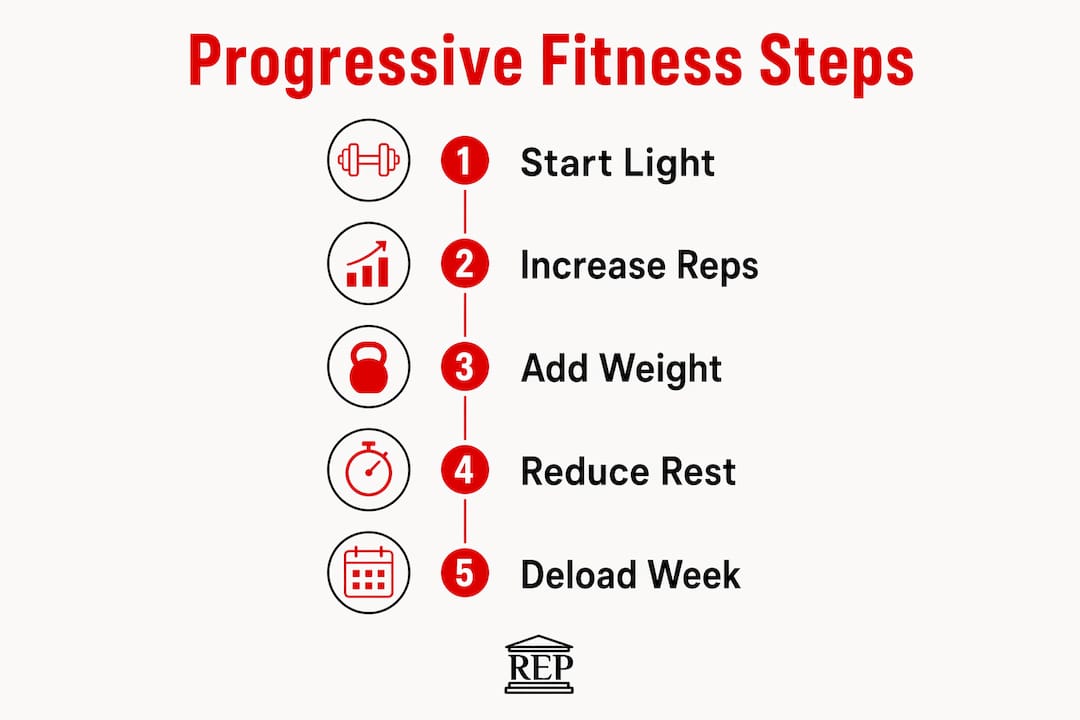
The core idea is simple. Your muscles adapt to whatever stress you put them under. Once they adapt, that stress no longer challenges them, and progress stalls. Progressive fitness training solves this by systematically raising the bar, whether that means adding weight to the bar, squeezing out an extra rep, or shortening your rest periods.
Here are the key variables you can manipulate to keep your workouts moving forward:
- Weight/load: Increase the amount you lift over time.
- Repetitions: Add more reps within the same set.
- Sets: Perform an additional set of an exercise.
- Frequency: Train a muscle group more often per week.
- Intensity: Push closer to your maximum effort on a given exercise.
- Rest periods: Reduce the time you rest between sets to increase metabolic demand.
- Tempo: Slow down the eccentric (lowering) phase to increase time under tension.
You do not need to change all of these at once. In fact, the most effective approach is usually to pick one variable and nudge it forward, then let your body catch up before adjusting another. That steady, intentional rhythm is what separates a well-designed progressive exercise program from random workouts that leave you spinning your wheels.
Table of Contents
- Why progressive training delivers results that random workouts never will
- How to stay safe while pushing your limits
- Practical ways to increase workout intensity over time
- A 12-week beginner progressive fitness programming schedule
- How tracking your workouts makes every session count
- Repphilosophy makes progressive programming personal for you
- Key Takeaways
Why progressive training delivers results that random workouts never will
The benefits of progressive training go well beyond just getting stronger. When you follow a structured program that consistently challenges your body, you set off a chain of adaptations that touch nearly every aspect of your physical health.
Here is what you can genuinely expect when you commit to a progressive fitness program:
- Muscle hypertrophy: Progressively challenging your muscles creates microscopic damage that your body repairs and reinforces, leading to muscle growth and strength over time.
- Increased strength: As you add load incrementally, your nervous system becomes more efficient at recruiting muscle fibers, making you functionally stronger.
- Improved endurance: Gradually increasing workout volume or duration trains your cardiovascular system and muscular endurance simultaneously.
- Stronger joints and connective tissue: Tendons and ligaments adapt alongside muscles, reducing your long-term injury risk when progression is gradual.
- Better energy levels: Regular, progressively challenging exercise improves mitochondrial density, which translates to more sustained energy throughout your day.
- Plateau prevention: Because you are always introducing a new stimulus, your body never fully adapts and stalls. That constant challenge keeps progress moving.
- Reduced workout boredom: Knowing you have a target to hit each session gives every workout a clear purpose. That sense of direction keeps motivation high.
- Enhanced coordination and body awareness: Learning to control heavier loads or more complex movements sharpens your neuromuscular coordination over time.
Small but consistent increases in workout variables accumulate into significant results. Small but consistent increases in workout variables accumulate into significant results. For example, incremental improvements every session can lead to substantial strength and muscle gains over a year. That is not magic; that is the math of progressive fitness training working exactly as designed.
How to stay safe while pushing your limits
Here is the honest truth: progressive overload is one of the most effective training tools available, and it is also one of the most misused. Pushing too hard, too fast is the single most common mistake beginners make, and it is the fastest route to an injury that sets you back weeks or months.
The risks of improper progression include:
- Overtraining syndrome: Accumulated fatigue without adequate recovery leads to declining performance, persistent soreness, and mood disruption.
- Muscle strains and tears: Jumping load increases too aggressively overwhelms muscle fibers before they have had time to reinforce.
- Stress fractures: Rapid increases in running volume or impact training can stress bones faster than they can remodel.
- Joint inflammation: Tendons and ligaments adapt more slowly than muscles, so loading them too quickly causes inflammation and chronic pain.
- Burnout: Mental fatigue from training that always feels too hard erodes motivation and leads to quitting altogether.
Safe progression follows a straightforward guideline: increases should not exceed roughly 10% per week in load or volume. If you squatted 100 pounds this week, 110 pounds next week is a reasonable ceiling. Beyond that, you are outpacing your body's ability to adapt.
Equally important is the advice from sports medicine professionals to change only one training variable at a time. Adding weight, increasing reps, and cutting rest periods in the same week is a recipe for overtraining. Isolate one change, let your body respond, then consider the next adjustment.

Learn to distinguish between productive discomfort and warning pain. Muscle fatigue and a burning sensation during a set are normal. Sharp, joint-specific, or persistent pain after a session is a signal to back off and assess.
Pro Tip: Plan periodic deload weeks where you reduce your training volume substantially. Muscles grow during recovery, not during the workout itself. A planned lighter week is not a step backward; it is what makes the next block of training possible.
Practical ways to increase workout intensity over time
Progressive overload techniques do not require a complicated system. You have several practical tools at your disposal, and rotating through them keeps your training fresh while continuously challenging your muscles.
Here are the most effective methods, with concrete examples:
- Add weight: The most direct method. Once you can complete all prescribed reps with good form, add a small increment of weight appropriate to your training level.
- Increase reps: Keep the weight the same and aim for one or two additional reps per set. When you hit the top of your rep range consistently, it is time to add load.
- Add a set: Move from three sets to four sets of an exercise. This increases total volume without changing the intensity per set.
- Extend workout duration: Add five to ten minutes to a cardio session or an extra exercise to a circuit.
- Reduce rest periods: Shortening rest from 90 seconds to 60 seconds increases cardiovascular demand and metabolic stress without changing the load.
- Manipulate tempo: Slow the lowering phase of a movement (e.g., a four-second descent on a squat) to increase time under tension and muscle recruitment.
- Increase training frequency: Move from training a muscle group once per week to twice per week, allowing for more total volume spread across sessions.
The table below shows how a beginner might apply progressive overload to a single exercise, the goblet squat, across four weeks:
| Week | Weight | Sets | Reps | Rest Period |
|---|---|---|---|---|
| Week 1 | 5 pounds | 3 | — | 90 seconds |
| Week 1 | 5 pounds | 3 | 10 | 90 seconds |
| Week 3 | 5 pounds | 3 | — | 90 seconds |
| Week 4 | 5 pounds | 3 | 10 | 60 seconds |
Notice that only one variable changes at a time. Reps go up before weight increases, and rest periods tighten only after the new load is established. That is progressive fitness programming in action, methodical and intentional.
A 12-week beginner progressive fitness programming schedule
This plan is designed for someone new to structured training or returning after a long break. It follows a three-day-per-week full-body format, which gives each muscle group enough frequency to grow while allowing adequate recovery between sessions. You can run it on Monday, Wednesday, and Friday, or any three non-consecutive days that fit your schedule.
The structure follows four three-week blocks, each one slightly more demanding than the last. For beginner progressive programming, increasing weight or reps slowly across 12 weeks with planned recovery phases supports steady, sustainable gains.
| Block | Weeks | Focus | Sets x Reps | Progression Target |
|---|---|---|---|---|
| Block 1 | 1–3 | Movement patterns and form | 3 x — | Master technique; add 1 rep/week if form holds |
| Block 1 | 4–6 | Volume increase | 3 x 10 | Increase weight by 5 lbs when 3 x 10 is clean |
| Block 3 | 3 to 4 | Load increase | 4 x — | Add one set; increase weight every two weeks |
| Block 4 | 10–12 | Strength consolidation | 4 x 10 | Push load; deload in Week 12 |
Exercises per session (rotate through these each workout):
- Squat variation: Goblet squat (Weeks 1–6), barbell back squat or dumbbell front squat (Weeks 7–12)
- Hip hinge: Romanian deadlift or kettlebell deadlift
- Push: Dumbbell bench press or push-up progression
- Pull: Dumbbell row or lat pulldown
- Core: Plank hold (progress duration) or dead bug
A few guidelines for running this plan effectively:
- Start lighter than you think you need to. Week 1 should feel manageable, not maximal.
- Log every session. Write down the weight, sets, reps, and how the workout felt.
- Week 12 is your deload. Drop volume by roughly half and focus on movement quality.
- If you miss a session, do not try to make it up. Just pick up where you left off.
- If an exercise causes joint pain (not muscle fatigue), swap it for a lower-impact variation. For beginner-friendly strength training, modifying movements is smart, not weak.
How tracking your workouts makes every session count
Here is something most beginners overlook: without a record of what you did last week, you are essentially guessing. And guessing is the enemy of progress. Tracking performance through logging weights, reps, and effort is what transforms a collection of workouts into an actual progressive program.

The good news is that tracking does not need to be complicated. A simple notebook works beautifully. So does the notes app on your phone, or a dedicated fitness app like Strong or Hevy. What matters is that you record the exercise name, the weight used, the number of sets and reps completed, and a brief note on how the session felt (easy, moderate, hard).
That data becomes your feedback loop. When you look back and see that you have hit 3 x 10 at the same weight for two consecutive weeks, you know it is time to add load. When you notice that your performance dropped after a stressful week of poor sleep, you have the context to adjust rather than push through and risk injury.
Expert guidance consistently points to changing one variable at a time as the key to both safety and clarity. If you increase weight and add a set in the same session, and your performance suffers, you will not know which change caused the problem. Isolating variables gives you clean data and smarter decisions.
Adaptive programming takes this one step further. Rather than following a rigid plan regardless of how you feel, you adjust based on what your log tells you. A week of high stress, poor sleep, or unusual soreness might call for a lighter session rather than a scheduled load increase. That kind of responsiveness is what separates a thoughtful program from a cookie-cutter routine.
Pro Tip: At the end of each week, spend two minutes reviewing your log. Ask yourself: Did I hit my targets? Did anything feel off? What is the one variable I will adjust next week? That brief weekly check-in is one of the most powerful habits in strength training for all levels.
Repphilosophy makes progressive programming personal for you
Designing your own progressive fitness program is absolutely possible, and this guide gives you the foundation to do it. But if you want the process to be faster, safer, and genuinely tailored to your body and goals, working with a coach changes everything.
At Repphilosophy, based in 4S Ranch, San Diego, every client gets a bespoke plan built around where they are right now and where they want to go. Whether you are picking up a weight for the first time or returning after a long break, the programming is designed to progress you at the right pace, not a generic one. Group classes, buddy training memberships, and virtual personal training options mean you can find a format that fits your schedule and your budget, without sacrificing the structure that makes progressive training actually work.
Ready to put a real plan behind your effort? Start your training with Repphilosophy and experience what it feels like when every session has a purpose.
Key Takeaways
Progressive fitness programming works because it gives your muscles a reason to keep adapting, through gradual, intentional increases in load, volume, or intensity, backed by consistent tracking and adequate recovery.
| Point | Details |
|---|---|
| Core principle | Gradually increase one training variable at a time to keep muscles adapting and avoid plateaus. |
| Safe progression rate | Increases should not exceed roughly 10% per week in load or volume to minimize injury risk. |
| Recovery is non-negotiable | Plan periodic deload weeks; muscles grow during rest, not during the workout. |
| Track everything | Log weights, reps, and effort after every session to make informed, data-guided adjustments. |
| Repphilosophy | Offers bespoke progressive programming in 4S Ranch with group, buddy, and virtual training options. |