
Structured, adult-led exercise gives children measurable advantages across physical fitness, brain development, and social skills that free play alone does not reliably deliver. That is the short answer. The longer one is that CDC guidelines, WHO recommendations, and a growing body of peer-reviewed research all point to the same conclusion: when children move with intention and guidance, they build stronger bodies, sharper minds, and more resilient characters. One practical framing you can keep in your back pocket is the 60-60-60 approach — at least 60 minutes of structured physical activity, 60 or more minutes of active free play, and no more than 60 minutes of sedentary time in a single stretch.
- Structured programs improve cardiorespiratory fitness, muscular strength, and motor-skill competence beyond what unstructured play produces.
- Regular physical activity supports executive function, attention, and academic readiness in school-age children.
- Group-based structured exercise builds teamwork, emotional regulation, and confidence alongside physical fitness.
- CDC guidelines recommend at least 60 minutes of moderate-to-vigorous activity daily for children ages 6–17.
Key Takeaways
Structured, adult-led exercise builds physical fitness, sharpens executive function, and develops social-emotional skills in children in ways that free play alone cannot reliably replicate.
| Point | Details |
|---|---|
| Daily activity target | Children ages 6–17 need at least 60 minutes of moderate-to-vigorous activity every day, per CDC guidelines. |
| Structure vs. free play | Structured programs deliver skill progression, motor competence, and engagement for children who otherwise stay sedentary during free play. |
| Brain and school benefits | Regular physical activity improves executive function, attention, and classroom performance, according to CDC research. |
| Program selection | Ask about coach credentials, age-appropriate curriculum, staff-to-child ratio, and how the program handles failure before enrolling. |
| Repphilosophy | Youth sports performance training, small-group memberships, and virtual coaching are available in 4S Ranch, San Diego, with a single-session trial to start. |
Table of Contents
- What does "structured exercise" actually mean for kids?
- Physical benefits of structured exercise every parent should know
- How structured activity sharpens your child's brain
- Social and emotional skills children build in structured programs
- Age-based activity guidelines and what they mean for your child
- Why structured exercise adds value that free play cannot replicate
- How to choose a structured exercise program that is right for your child
- Starter activities and sample weekly plans by age group
- A coach's perspective on what actually moves the needle for kids
- Repphilosophy's youth training programs in San Diego
- Sources
What does "structured exercise" actually mean for kids?
Structured exercise is adult-led, planned physical activity with clear objectives and a progression model. Think coached group classes, guided movement sessions, mini-skill drills, or organized sports practice. The adult in the room sets the goal, sequences the activities, and adjusts difficulty as children improve. That intentionality is what separates it from free play.
Unstructured play, by contrast, is child-directed. Playground time, backyard games, and imaginative outdoor play are all valuable, but they do not guarantee exposure to the full range of movement patterns a child needs. A child who loves to swing will get great shoulder mobility but may never practice lateral shuffling, jumping mechanics, or throwing patterns unless someone guides them there.
Here is a quick way to tell the two apart:
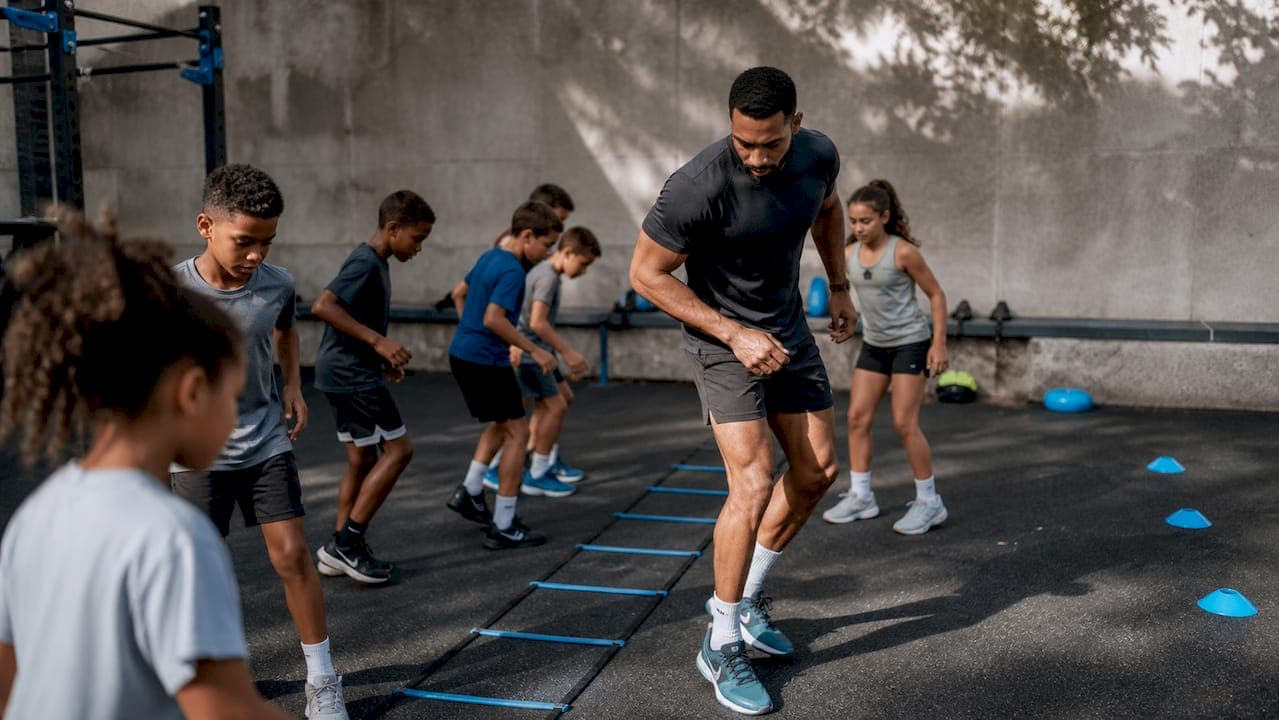
- Structured: A coach leads a group through agility ladder drills, a bean-bag tossing circuit, or a guided obstacle course with clear start-and-finish cues.
- Unstructured: Kids choose their own games on the playground, with no adult directing the movement.
- Structured: A youth fitness class with warm-up, skill work, conditioning, and cool-down built into a 45-minute session.
- Unstructured: Free swim time at the pool where children splash and play however they like.
Both matter. But research on structured versus unstructured activity shows that children who prefer sedentary options often stay sedentary during free play. Coached, accountable environments increase actual movement for those kids. Structure is not about drilling children into exhaustion. As Bright Futures guidance notes, it means varied, intentional practice that exposes children to diverse movement patterns, reducing overuse injuries while building adaptable skills.
Physical benefits of structured exercise every parent should know
The body adapts to the demands placed on it. When children participate in regular, structured physical activity, those adaptations are measurable and meaningful.
Cardiorespiratory fitness improves when children sustain aerobic effort over time. Running games, jump rope, swimming, and cycling all qualify. A stronger cardiovascular system means a healthier heart, better lung capacity, and more energy for everything else in a child's day.
Muscular strength and bone density respond to resistance and impact. Bodyweight exercises, climbing, and jumping all count. Bone-strengthening activities are especially important during childhood because peak bone mass is largely established before adulthood, making early investment in bone health one of the highest-return habits a child can build.
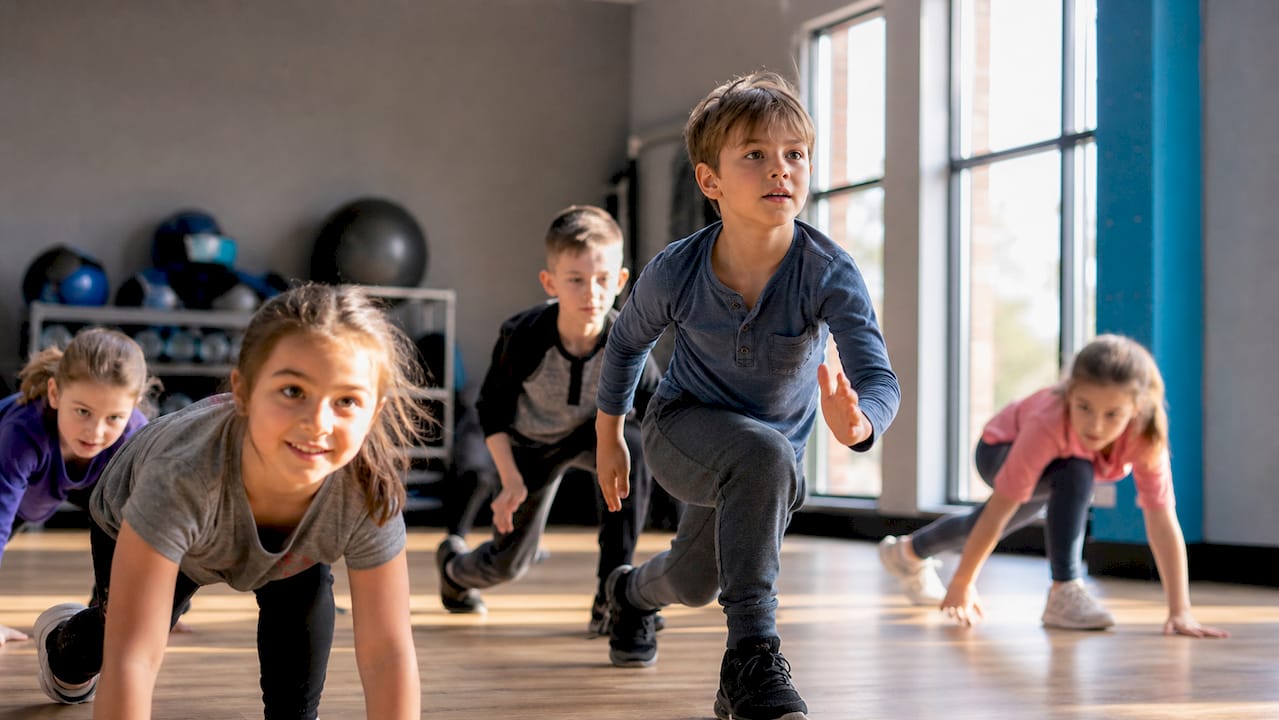
Motor-skill competence is perhaps the most underappreciated physical benefit. A 2024 peer-reviewed study on youth athletic development found that structured programs significantly improve muscular strength, cardiorespiratory fitness, and motor-skill competence compared to unstructured activity alone. Children who master foundational movement skills, such as catching, kicking, balancing, and jumping, carry those skills into adolescence and adulthood, making them far more likely to stay active long-term.
Obesity prevention is a downstream benefit of all of the above. Regular movement burns calories, builds metabolically active muscle tissue, and establishes healthy habits early.
Guideline snapshot: The CDC recommends children ages 6–17 get at least 60 minutes of moderate-to-vigorous physical activity every day. Muscle-strengthening and bone-strengthening activities should each happen at least 3 days per week within that 60 minutes.
- Aerobic activity: running, swimming, cycling, active games
- Muscle-strengthening: climbing, gymnastics, bodyweight exercises
- Bone-strengthening: jumping rope, running, basketball, gymnastics
How structured activity sharpens your child's brain
Physical activity and brain development are more tightly linked than most parents realize. CDC research confirms that regular physical activity improves children's executive function, attention, and classroom performance. Executive function covers the mental skills children use to plan, focus, remember instructions, and manage impulses. These are the exact skills teachers rely on for a productive classroom.
The mechanism is not mysterious. Aerobic exercise increases blood flow to the prefrontal cortex, the region responsible for decision-making and attention control. Goal-oriented structured activities, like following a coach's sequence of drills, also demand working memory and self-regulation in real time. Children are essentially training their brains while they train their bodies.
What does this look like practically?
- A child who attends a structured movement class twice a week may find it easier to sit still and focus during reading time.
- Structured sport practice, which requires listening to instructions, waiting for turns, and executing multi-step skills, directly exercises the same cognitive circuits that academic tasks demand.
- Aerobic bouts before school or during a lunch break have been shown to improve afternoon attention spans.
The NCBI review on physical activity and motor-skill development reinforces this, linking mastery of fundamental motor skills to broader cognitive and social development. Children who feel physically competent are more confident in learning environments generally.
Social and emotional skills children build in structured programs
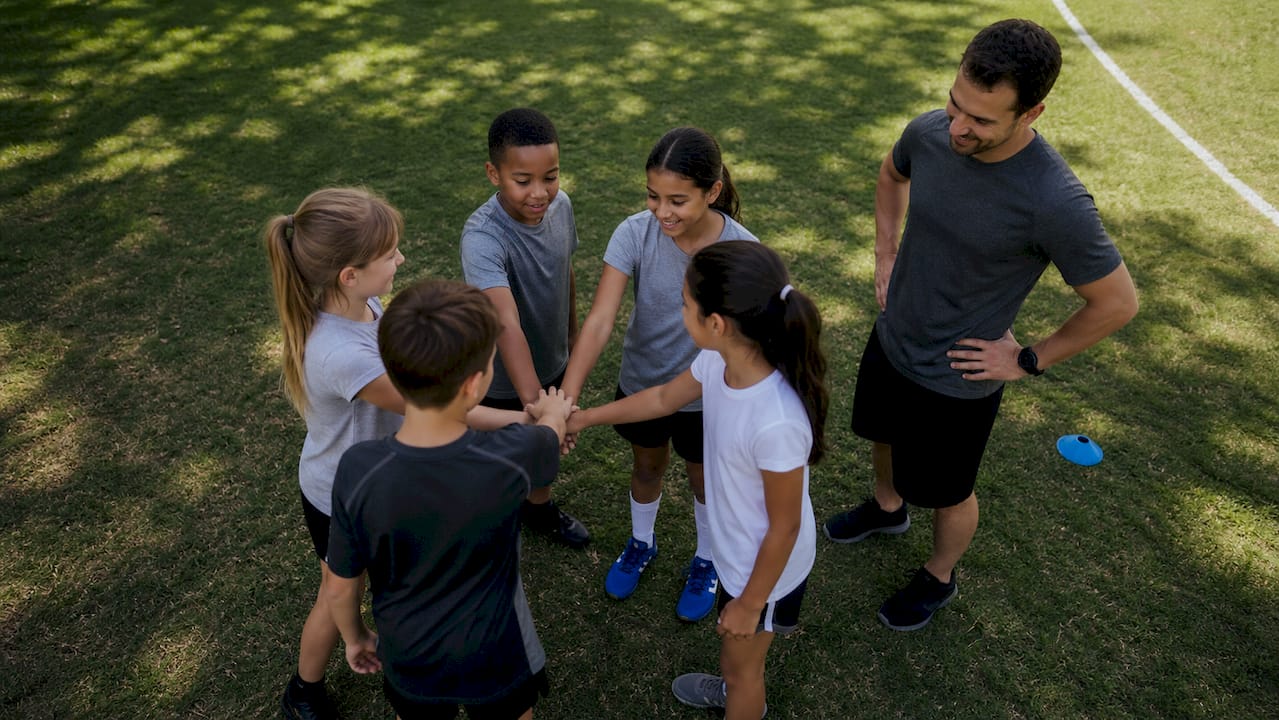
A coached group session is never just about fitness. Every time a child follows a coach's direction, waits for a teammate, celebrates someone else's success, or pushes through a hard drill, they are building social and emotional muscle alongside physical muscle.
Structured group programs teach skills that free play often leaves to chance:
- Teamwork and cooperation: Children learn to work toward a shared goal, adjust their behavior for the group, and communicate under mild pressure.
- Emotional regulation: Losing a relay race, missing a catch, or struggling with a new skill all require managing frustration. A good coach turns those moments into teachable ones.
- Resilience: Repeated exposure to manageable challenge, with adult support, builds the confidence to try again after failure.
- Following directions: Listening to and executing multi-step instructions is a skill that transfers directly to school and family life.
- Turn-taking and patience: Structured drills with rotation build tolerance for waiting, a skill that is genuinely hard for young children.
Nemours KidsHealth notes that structured group training combines physical conditioning with social-emotional learning, with coaching environments teaching cooperation, resilience, and communication alongside fitness benefits. The mental-health gains are real too: regular exercise is linked to improved mood, reduced symptoms of anxiety and depression, and better sleep quality in children. These are not small side effects. They are reasons on their own to prioritize structured movement in your child's week.
Organized youth sports offer a particularly rich environment for character development. Research on junior golf programs shows how structured sport settings teach sportsmanship and life skills that extend well beyond the field or course.
Age-based activity guidelines and what they mean for your child
The right type and amount of activity shifts as children grow. Public-health authorities give clear, age-stratified guidance that you can use as a planning baseline.
| Age Group | Daily Activity Goal | Recommended Types | Quick Examples |
|---|---|---|---|
| Preschool (3–5) | Active throughout the day | Varied movement, light structured play | Obstacle courses, follow-the-leader, dancing, bean-bag games |
| School-age (6–17) | 60 min moderate-to-vigorous | Aerobic + muscle + bone strengthening | Running games, gymnastics, jump rope, climbing |
| Tweens/Teens (12–17) | 60 min moderate-to-vigorous | Aerobic + muscle + bone strengthening (3x/week each) | Team sports, resistance training, swimming, cycling |
The WHO physical activity fact sheet emphasizes that any activity is better than none, and that varied regimens mixing aerobic, resistance, and skill-based work produce the greatest developmental benefits while reducing long-term disease risk.
A few practical ways to fit activity into a busy day:
- Break the 60 minutes into two or three shorter sessions if a single block is not realistic.
- Count active commuting: walking or biking to school adds up fast.
- Use after-school time intentionally: a 20-minute structured movement session before homework can improve focus for the study session that follows.
- Limit continuous sedentary stretches to no more than 60 minutes at a time, then build in a movement break.
Pro Tip: For preschoolers, the goal is not a formal workout. It is simply keeping them moving with variety throughout the day. Structured activities for this age can be as short as 10–15 minutes and as playful as a guided animal-walk circuit around the living room.
Why structured exercise adds value that free play cannot replicate
Free play is irreplaceable for creativity, autonomy, and joy. No one is arguing against it. But the research is clear that structured programs deliver outcomes free play cannot guarantee on its own.
The NCBI review on motor-skill development found that children who do not acquire fundamental motor skills are more likely to withdraw from physical activity as they get older. Mastery of those skills, things like throwing, catching, jumping, and balancing, is strongly linked to higher activity levels through adolescence. Structured practice is the most reliable way to build that competency because it deliberately sequences skill exposure and provides corrective feedback.
There is also the activity-decline problem. Structured youth athletic development programs help counteract that decline by building habit, community, and competence before the drop-off window arrives.
Think of structured practice as building a movement toolbox. Every new skill a child learns, a proper landing, a controlled deceleration, a coordinated throw, adds a tool they can draw on for the rest of their life. Free play lets children use the tools they already have. Structured training gives them new ones.
Pro Tip: Look for programs that emphasize sports performance coaching over early specialization. Children who sample multiple movement patterns before age 12 tend to stay active longer and suffer fewer overuse injuries than those who specialize in a single sport too early.
How to choose a structured exercise program that is right for your child
Not all programs are created equal. Here is a step-by-step checklist to help you vet any structured exercise option before you commit.
- Ask about coach credentials. Look for certifications from recognized bodies such as NSCA, NASM, or IYCA. Certified trainers understand child development and age-appropriate loading, which matters enormously for safety.
- Check the curriculum for age-appropriateness. A good program for a 7-year-old looks nothing like one for a 14-year-old. Ask how the program progresses and how it adapts to individual ability levels.
- Evaluate the staff-to-child ratio. Smaller ratios mean more feedback and safer supervision. For young children, a ratio above 1:8 starts to compromise quality.
- Look for variety, not specialization. Programs that expose children to multiple movement patterns, locomotor, manipulative, and stability skills, build broader physical literacy than single-sport programs at young ages.
- Ask how they handle struggle and failure. The answer tells you everything about the coaching culture. You want coaches who use setbacks as teaching moments, not sources of shame.
- Clarify session frequency and length. Two to three structured sessions per week of 30–60 minutes each is a solid starting point for most school-age children, combined with daily unstructured active play.
Red flags to watch for:
- Pain that persists beyond 48 hours after a session
- A child who dreads going to practice consistently (not just occasionally)
- Coaches who prioritize winning over skill development at young ages
- Programs that push early single-sport specialization before age 12
- No visible warm-up or cool-down in sessions
For a deeper look at what to ask before enrolling, the youth fitness program checklist covers the key questions in detail. Budget-friendly options include community recreation centers, school-based programs, and small-group training memberships, which spread the cost of expert coaching across several families.
Starter activities and sample weekly plans by age group
Getting started does not require a gym membership or expensive equipment. Here are age-specific activities and two sample weekly plans you can adapt right away.
Preschool (ages 3–5)
- Animal walks: Bear crawls, crab walks, and frog jumps build full-body coordination and core strength.
- Follow-the-leader: Simple, fun, and naturally structured around an adult's movements.
- Bean-bag toss circuits: Develop throwing mechanics and hand-eye coordination.
- Guided obstacle courses: Combine crawling, jumping, and balancing in a playful sequence.
Early elementary (ages 6–9)
- Jump rope: Builds cardiorespiratory fitness, rhythm, and coordination simultaneously.
- Relay races with skill components: Combine running with catching, throwing, or balancing.
- Bodyweight circuits: Squats, push-ups, and jumping jacks in a timed, coached format.
- Beginner agility drills: Ladder drills and cone courses that improve footwork and reaction time.
Late elementary and adolescent (ages 10–17)
- Youth speed and agility classes: Structured sessions that develop athleticism transferable to any sport. A parent's guide to youth speed and agility classes explains what to expect from these programs.
- Resistance training with bodyweight or light loads: Squats, lunges, push-ups, and rows build strength safely when coached correctly.
- Team sport practice: Soccer, basketball, volleyball, and similar sports combine aerobic conditioning with social skill-building.
- Swimming or cycling: Low-impact aerobic options that are easy on growing joints.
Sample weekly plan: low commitment (2 structured sessions)
Sample weekly plan: moderate commitment (3 structured sessions)
| Day | Activity | Duration |
|---|---|---|
| Monday | Youth fitness class or agility session | 45 min |
| Wednesday | Bodyweight circuit at home with parent guidance | 30 min |
| Saturday | Organized sport practice or group class | 45–60 min |
| Daily | Active free play, walking, or biking | 30+ min |
Pro Tip: Progression matters more than intensity. Start with two structured sessions per week and add a third only when your child is consistently enthusiastic and recovering well. Keeping it fun is the single most powerful retention strategy you have.
For more ideas on building a well-rounded activity plan, the kids activity planning guide offers practical templates families can adapt to any schedule or budget.
A coach's perspective on what actually moves the needle for kids
Here is what I have seen working with young athletes in San Diego: the parents who get the best results are not the ones who push hardest. They are the ones who stay consistent and keep it fun.
At Repphilosophy, our youth sports performance program at the 4S Ranch facility is built around one core belief: every child deserves developmentally appropriate movement that challenges them without overwhelming them. We vary the drills, rotate the skills, and make sure every session ends with a kid feeling capable, not defeated. That is not a soft approach. It is the approach the research supports, and it is what keeps children coming back week after week, year after year.
The mistake I see most often is parents confusing intensity with effectiveness. A child who leaves every session exhausted and dreading the next one is not building fitness. They are building avoidance. The goal is to build a child who loves to move, because that child will still be moving at 25, 35, and 45.
Repphilosophy's youth training programs in San Diego
If you are ready to give your child the structured movement foundation they deserve, Repphilosophy offers several paths to get started, right here in 4S Ranch, San Diego.

Our youth sports performance program at WayALife Athletics delivers coached, developmentally appropriate training in a safe, energetic environment. Small-group and buddy training memberships keep costs accessible while maintaining the quality of expert coaching. Families who prefer flexibility can access our on-demand virtual exercise library for guided home sessions that fit any schedule. Not sure where to start? A single-session personal training trial lets your child experience structured coaching firsthand, with no long-term commitment required. Browse all available programs and memberships at the Repphilosophy shop and find the option that fits your family's goals and schedule.
Sources
The following primary sources and peer-reviewed references were used throughout this article. Each covers a distinct aspect of child physical activity so you can go deeper on the areas most relevant to your family.
- CDC — Health benefits of physical activity for children
- WHO — Physical activity fact sheet
- NCBI — Physical activity, physical education, and motor-skill development (Educating the Student Body)
This article is general information, not a substitute for advice from a qualified doctor. Consult a qualified healthcare professional about your own circumstances before acting on anything here.