

Fitness progress tracking is the deliberate, repeatable recording of a small set of metrics that show whether your training, nutrition, and recovery are producing the changes you want. It is not about obsessing over numbers every morning. It is about building a clear, honest picture of where you started, where you are now, and what needs to shift next. To kick things off: pick 3 core metrics that match your goal, record your baseline this week, and schedule a brief weekly review.
Two things happen when you track consistently. First, you stop guessing. Second, you stop quitting. Those two outcomes alone are worth the five minutes it takes to log a workout.
Table of Contents
- What fitness progress tracking really is and why it matters
- The five pillars of fitness progress: what you should actually measure
- How to measure each pillar: methods, tools, and what they actually tell you
- How to track progress without obsessing over numbers
- How often to check each metric: a simple tracking schedule
- Common tracking mistakes and how to avoid them
- What to do with your data: interpreting trends and adjusting your program
- A copyable one-month starter tracking template
- Key Takeaways
- Why tracking clients changes everything I see as a coach
- Repphilosophy makes tracking personal, not complicated
- Further reading and useful sources
What fitness progress tracking really is and why it matters
Most people confuse activity tracking with fitness progress tracking, and that confusion costs them months of wasted effort. Activity tracking counts steps, calories burned, and minutes of movement. Fitness progress tracking goes deeper: it measures whether your body is actually changing in the direction you want, whether your performance is improving, and whether your recovery is holding up.

The Cleveland Clinic notes that the primary value of tracking is building self-awareness, the kind that lets you link daily habits to real health outcomes and make sustained adjustments instead of guessing. That self-awareness is what separates people who stick with a program from those who drift away after six weeks.
The core benefits of tracking your fitness progress are:
- Accountability: A written record makes it harder to rationalize skipping sessions.
- Objective feedback: Numbers reveal what your memory distorts. You genuinely cannot remember exact details of past workouts.
- Motivation: Seeing a trend line move in the right direction can help maintain consistency.
- Plateau detection: When progress stalls, data helps identify when it stalled and what needs adjustment.
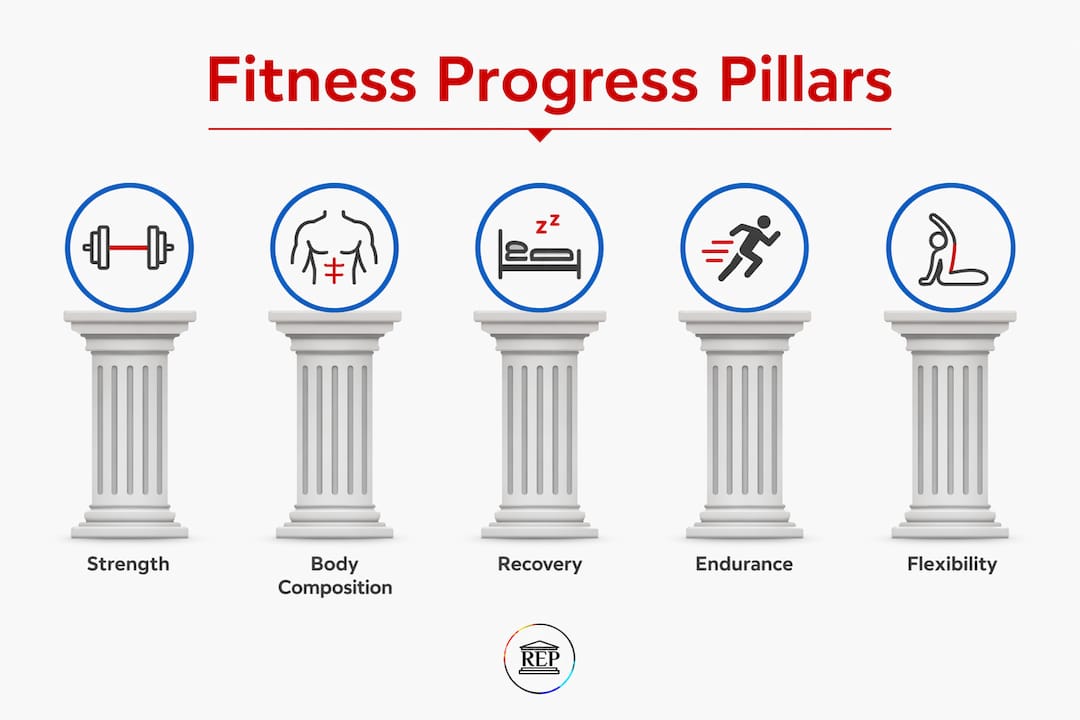
The five pillars of fitness progress: what you should actually measure
Not every metric matters for every goal. A runner training for a 5K needs different data than someone focused on fat loss. Here are the five pillars most coaches use, with a measurement example for each:
- Body composition — Track waist circumference in inches or body weight trend over four weeks. This tells you whether your ratio of fat to lean mass is shifting.
- Strength and performance — Log your top set on a key lift: weight × reps (e.g., squat: 185 lb × 5). This is the clearest signal that your program is working.
- Endurance and capacity — Record a benchmark like a one-mile run time, a 500-meter row, or resting heart rate. Improvement here shows your cardiovascular system is adapting.
- Adherence and consistency — Count completed sessions per week versus planned sessions. Consistency is the single biggest predictor of long-term results.
- Subjective well-being — Rate your energy, mood, and sleep quality on a simple 1–10 scale each morning. This catches overtraining and life-stress interference before they derail your program.
Match your pillar choice to your primary goal. Strength athletes should weight pillars 2 and 4 most heavily. Fat-loss clients need pillars 1, 4, and 5. Endurance athletes live in pillar 3. When you personalize your fitness approach this way, every metric you log earns its place.
How to measure each pillar: methods, tools, and what they actually tell you
Choosing the right measurement method matters as much as choosing the right metric. Here is a comparison of the most common options:
| Method | Accuracy | Cost | Convenience | Invasiveness | Recommended Frequency |
|---|---|---|---|---|---|
| Scale (body weight) | Low for composition | Free | Very high | None | Daily (use weekly average) |
| Tape measure | Moderate | Under $5 | High | None | Weekly |
| Progress photos | Qualitative | Free | High | Low | Every 2–4 weeks |
| BIA smart scale | Moderate for trends | — | High | None | Weekly |
| DEXA scan | Gold standard | — | Low | Low radiation | Every 3 months |
| Workout log (reps/weight) | High for performance | Free | High | None | Every session |
| Heart rate monitor / HRV | High for recovery | — | Moderate | None | Daily or weekly |
| GPS / power meter | High for endurance | — | Moderate | None | Each cardio session |
DEXA is the gold standard for body-composition measurement. Consumer BIA scales can misestimate lean mass by roughly 3–8%, but they are consistent enough to track trends over time. For most beginners, a tape measure, a workout log, and a basic scale cover everything needed in the first three months.
Scale pros and cons:
- ✓ Free, instant, easy to repeat
- ✓ Reliable trend data when averaged weekly
- ✗ Swings 2–4 pounds daily from hydration, sodium, and glycogen alone
- ✗ Cannot distinguish fat loss from muscle gain
Workout log pros and cons:
- ✓ Directly measures what your training is producing
- ✓ Requires no equipment beyond a notebook or app
- ✗ Only as useful as the consistency with which you fill it in
Pro Tip: Weigh yourself at the same time each morning, after using the bathroom and before eating. Then act only on the weekly average, not any single reading.
How to track progress without obsessing over numbers
Numbers are powerful, but they are not the whole story. Some of the most meaningful signals of fitness progress are qualitative, and leaning on them can actually reduce the anxiety that causes people to abandon tracking altogether.
Non-numeric signals worth paying attention to:
- How your clothes fit: A pair of jeans that felt tight three weeks ago is real-world body-composition data.
- Energy and mood: Consistent training usually produces a noticeable lift in daily energy within two to four weeks.
- Workout ease: When a weight that used to feel heavy now feels manageable, that is strength adaptation in action.
- Mobility and movement quality: Can you reach further in a hip hinge? Does your shoulder feel less restricted overhead? These are progress signals.
- Consistency milestones: Completing four consecutive weeks of planned sessions is worth noting. Behavioral change is progress.
Pro Tip: For progress photos, shoot at the same time of day (morning, fasted), in the same lighting, wearing the same clothing, from the same three angles: front, side, and back. The consistency of the conditions matters more than the quality of the camera.
One safeguard worth naming: if you notice that checking metrics is triggering anxiety, disrupting meals, or becoming the emotional centerpiece of your day, pause numeric tracking and speak with a qualified professional. Tracking is a tool for clarity, not a source of stress. The same applies if you experience sudden, unexplained weight loss, persistent pain, or any injury signal that does not resolve with rest.

How often to check each metric: a simple tracking schedule
Checking everything every day creates noise. Checking nothing for months means you miss the signal. The table below maps common metrics to a practical cadence.
| Metric | Frequency | Best Time | Key Caveat |
|---|---|---|---|
| Body weight | Daily | Morning, fasted | Act on weekly average only |
| Waist / hip circumference | Weekly | Morning, fasted | Consistent tape placement matters |
| Progress photos | Every 2–4 weeks | Morning, same conditions | Lighting and angle must be identical |
| Workout performance (reps/weight) | Every session | During training | Log immediately, not from memory |
| Resting heart rate / HRV | Daily or weekly | Morning, before rising | Stress and sleep affect readings |
| Subjective well-being (1–10) | Daily | Morning | Trend over weekly averages, not single days |
| Endurance benchmark | Monthly | Fresh, rested | Same course/conditions each time |
| DEXA / lab tests | Every 3 months | Structured phase end | Schedule around training blocks |
Hydration, glycogen stores, the menstrual cycle, and recent sodium intake all create short-term fluctuations that have nothing to do with fat or muscle change. The fix is simple: use weekly averages rather than reacting to any single reading, and always measure under the same conditions.
A weekly 15–20 minute review session is enough for most people. Pull your numbers, look at the trend, and ask one question: is this moving in the right direction? If yes, stay the course. If not, identify the one variable most likely to be the cause.
Common tracking mistakes and how to avoid them
The most common tracking errors are not about the tools. They are about how people interpret and react to data.
- Relying on a single metric. The scale alone is the most common culprit. Experts consistently advise treating weight as one signal among many. A "mixed portfolio" of indicators gives you a far more accurate picture than any single number.
- Inconsistent measurement timing. Weighing yourself after dinner one day and before breakfast the next produces data that is not comparable. Same time, same conditions, every time.
- Metric saturation. Tracking 12 different things creates analysis paralysis. A dashboard of 3–5 primary metrics plus two or three wellness indicators is enough for most people.
- Reacting to short-term noise. A bad week on the scale does not mean your program is failing. Wait for 3–4 weeks of consistent data before making any program changes.
- Skipping the review. Logging data you never look at is just record-keeping. The value is in the weekly review, where you turn numbers into decisions.
The emotional management piece is straightforward: treat your data the way a scientist treats an experiment. One data point is not a conclusion. A trend over four weeks is.
What to do with your data: interpreting trends and adjusting your program
Data without a decision rule is just noise. The feedback loop that makes tracking genuinely useful looks like this: measure a metric, identify the trend over 3–4 weeks, adjust one variable, then re-measure.
Changing one variable at a time is the key. If you increase training volume and change your nutrition simultaneously, you will never know which adjustment produced the result.
Here are practical decision rules:
- Performance is improving but body composition is not changing: Give it two more weeks. Performance gains often precede visible composition changes by 2–4 weeks. Adding reps or weight to a lift is a leading indicator that your body is adapting.
- Body weight is trending up and strength is not improving: Review nutrition first, then training volume.
- Subjective well-being scores are dropping week over week: Reduce training intensity or volume before changing anything else. Chronic fatigue is a recovery problem, not a motivation problem.
- No metric is moving after four weeks: This is the moment to seek a coach's input. A fresh set of eyes on your program and your data will almost always find the variable you missed.
Adaptive training is built on exactly this loop: track, interpret, adjust, repeat. The goal is not perfection. It is a program that responds to what your body is actually doing.
A copyable one-month starter tracking template
Here is a simple weekly tracker you can copy into a notebook, spreadsheet, or notes app. Fill in the fields that match your chosen 3–5 metrics.
Four-week plan:
- Week 1: Establish your baseline. Record every metric once under consistent conditions. Do not change anything about your training or nutrition yet. This week is purely about getting honest starting numbers.
- Week 2: Log every session. Note how the weights feel, not just the numbers. Add a one-line note on energy and sleep each morning.
- Week 3: Run your first weekly review. Compare week 2 averages to week 1. Look for any metric moving in the wrong direction and note it without reacting yet.
- Week 4: Identify one trend. Is performance improving? Is body weight trending the right way? Make one small adjustment if needed, and document what you changed and why.
A Repphilosophy coach uses the first month of data to set priorities: which pillar needs the most attention, which metric is the most reliable leading indicator for your specific goal, and where the biggest gap between effort and result currently sits. You can explore progressive programming principles to understand how coaches use this data to build your next training block.
Key Takeaways
Fitness progress tracking works when you measure the right things consistently, review them weekly, and adjust one variable at a time based on 3–4 weeks of real trend data.
| Point | Details |
|---|---|
| Track 3–5 metrics, not everything | A small dashboard prevents analysis paralysis and keeps weekly reviews manageable. |
| Use weekly averages for body weight | Daily scale weight can swing 2–4 pounds from hydration alone; trends matter, single readings do not. |
| Performance leads composition | Strength gains often precede visible body changes by 2–4 weeks, so log your top sets every session. |
| Wait 3–4 weeks before adjusting | Short-term noise is not a signal; act only on consistent trends to avoid changing the wrong variable. |
| Repphilosophy builds your baseline | A Repphilosophy coach sets up your metric dashboard, records your baseline, and adjusts your program from real data. |
Why tracking clients changes everything I see as a coach
Most people come to me with a feeling, not a fact. They feel like they are not making progress. They feel like they are eating well. They feel like they are working hard enough. Feelings are real, but they are not data, and data is what actually tells us what to change.
The moment a client starts logging their top sets and their weekly weight average, the conversation shifts. Instead of "I don't know why I'm not losing weight," we have something concrete to look at together. One client I worked with was convinced their program had stopped working. When we pulled four weeks of logged data, their squat had gone up 15 pounds and their weekly weight average had dropped. The scale on any given morning had been bouncing around, which felt discouraging, but the trend was clear and positive. That is the difference tracking makes.
What I look for in the first month is not transformation. I am looking for the leading indicators: is performance moving? Is adherence holding? Is subjective energy stable or declining? Those three signals tell me almost everything I need to know about whether to push harder, pull back, or change the program entirely. The number on the scale is usually the last thing I check.
My honest opinion: most people track too much or too little, and both extremes produce the same result, which is frustration. The sweet spot is a small, consistent dashboard reviewed once a week with a clear decision rule attached to each metric. That is a skill, and like any skill, it gets easier with practice and better with a good coach standing beside you.
Repphilosophy makes tracking personal, not complicated
If you have read this far, you already know more about measuring fitness success than most people who have been training for years. The next step is putting it into practice, and that is exactly where Repphilosophy comes in.

At Repphilosophy, based in 4S Ranch, San Diego, every new client starts with a baseline session: we record your starting metrics, build your personal 3–5 metric dashboard, and set your first four-week targets. You get a clear picture of where you are and a specific plan for where you are going, whether you train in person, join a small group or buddy session, or work with us virtually through our on-demand coaching. No guesswork, no generic programs.
Ready to get your baseline locked in? Book a single training session and walk away with your starting numbers, your metric dashboard, and a coach who knows how to read the data with you.
Further reading and useful sources
The following sources informed this article. Each one is worth bookmarking if you want to go deeper on any specific topic.
- Cleveland Clinic: Do Fitness Trackers Really Help? — Explains the behavioral science behind why tracking builds self-awareness and supports long-term habit change.
- Harvard Health: Do Fitness Trackers Help People Move More? — Reviews aggregate data on wearable use and physical activity outcomes; useful for understanding what activity trackers can and cannot do.
- National Fitness Authority: Tracking and Measuring Fitness Progress — Practical guidance on measurement timing, daily weight fluctuation, and how to use weekly averages correctly.
- FitFixLife: 5 Metrics That Actually Matter — Covers DEXA vs. BIA accuracy, the leading-indicator concept, and the most common tracking mistakes coaches see.
- Spy-Fitness: What Is Performance Tracking and Why Does It Matter? — Frames tracking as a feedback loop and explains how to use workout volume and top sets as primary performance signals.
- GearUpToFit: Metrics, Weekly Reviews, and Goal Tracking — Covers the 3–5 metric dashboard approach and the research supporting multi-metric tracking for long-term adherence.
- PrettyProgress: How to Track Fitness Progress — Practical workflow guide for building a small dashboard, running a weekly review, and setting decision rules for program adjustments.
- Sutter Health: 4 Health Benefits of Fitness Trackers — Accessible overview of how wearable technology supports goal-setting, recovery monitoring, and personalized fitness feedback.