
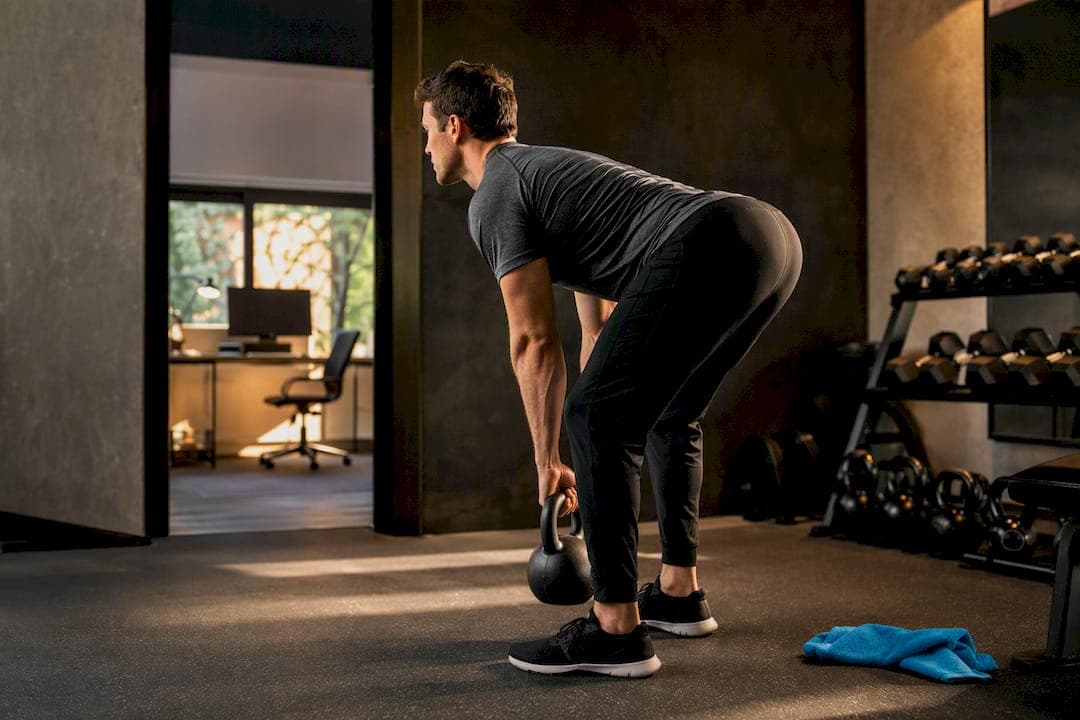
The fastest, most reliable way for desk workers to get stronger and undo sitting-related weakness is a structured resistance program 2 to 3 times per week paired with short desk micro-sessions. Start today with one discreet move, like a 20-second glute squeeze or a desk plank, and lock in a 30 to 45 minute strength session before the week ends. Research backs both halves of this equation for people who sit most of the day.
TL;DR:
- Resistance training 2 to 3 times per week significantly improves shoulder and back extensor strength, with large effect sizes observed in recent studies.
- Prioritizing posterior chain and pulling movements, especially face pulls and rows, better reverses muscle imbalances caused by prolonged sitting.
- Simple desk-friendly exercises like glute squeezes, chair squats, and seated leg extensions can accumulate meaningful strength benefits throughout the day.
- Structuring a 3-day program around core weaknesses takes about 40 to 50 minutes per session and can be adapted for home, office, or travel.
- Consistency is key; micro-sessions, accountability, and proper ergonomic setup support sustained strength gains despite a full work schedule.
Table of Contents
- Why Strength Training Matters for Desk Workers
- The Muscle Imbalances Sitting Creates (And What to Fix First)
- Desk-Friendly Strength Exercises You Can Actually Do at Work
- A 3-Day Strength Program Built Around Desk Weaknesses
- Fitting Strength Training Into a Full-Time Desk Schedule
- Safety, Progression, and When to Get Coaching Support
- Ergonomic Adjustments That Make Strength Training Stick
- Where Mobility and Flexibility Fit Into the Picture
- Nutrition to Support Muscle Maintenance When You Sit All Day
- Common Barriers to Strength Training and How to Get Past Them
- The Repphilosophy Perspective on Training Desk Workers
- How Repphilosophy Can Help You Train Around a Full Workday
- Sources
Why Strength Training Matters for Desk Workers
Sitting for prolonged periods doesn't just make you sore. It systematically weakens the muscles you need for good posture, and the fix isn't stretching. It's loading those muscles until they get strong again.
A 2025 systematic review and meta-analysis that looked at resistance training in sedentary office workers found significant strength gains in two areas that matter most for desk posture: shoulder strength and back extensor strength. These aren't small effects, either. The researchers reported a standardized mean difference of 4.13 for shoulder strength and 2.98 for back extensor strength, both considered large effect sizes in exercise science.
By the Numbers: Sedentary office workers who followed structured resistance programs showed dramatic improvements in shoulder and back extensor strength (SMD 4.13 and 2.98, respectively), according to the 2025 meta-analysis.
What does that translate to at your desk? Less afternoon stiffness. Fewer trips to grab ibuprofen from the break room. A spine that holds itself upright without you thinking about it, and enough baseline energy that you're not dragging by 3 p.m.
The CDC's physical activity guidelines call for 150 minutes of moderate aerobic activity weekly, plus muscle-strengthening work. That's useful context, but frequency matters more than hitting a magic number. Regularly performing resistance sessions multiple times per week tends to be more effective than infrequent, longer workouts.
The Muscle Imbalances Sitting Creates (And What to Fix First)
Extended periods of sitting create predictable patterns of muscle weakness commonly observed in desk workers.
- Weak glutes and posterior chain: sitting turns off the muscles that should be stabilizing your hips and spine.
- Tight, shortened hip flexors: from staying folded at 90 degrees for most of the day.
- Rounded thoracic spine: the upper back curves forward toward the keyboard.
- Underactive upper-back and pulling muscles: rhomboids and rear delts go quiet while chest muscles tighten.
The programming fix is straightforward: prioritize posterior chain and pulling movements over pushing ones. A rough 2:1 ratio of pulling to pushing work, rows and face pulls against every bench press or push-up, helps counteract that forward-rounded posture instead of reinforcing it. Loaded, full range-of-motion exercise is what actually reverses these adaptations. Passive stretching feels good for ten minutes, but it doesn't build the strength needed to hold a better position for the other 23 hours and 50 minutes of your day.
Pro Tip: If you only have time for one accessory movement this week, make it a face pull or a band row. It directly targets the muscles that stop your shoulders from rolling forward.
Desk-Friendly Strength Exercises You Can Actually Do at Work
These moves work as accessory volume between your real training sessions. They're not a replacement for structured resistance work, but they add up when you stack them through the day.
- Glute isometrics. Squeeze both glutes hard while seated, hold for 10 to 20 seconds, release, repeat for 10 reps. Completely invisible, works anywhere, targets the muscle group sitting shuts off fastest.
- Desk incline plank or push-up. Place hands on your desk edge, walk feet back until your body forms a straight line, hold a plank for 20 to 30 seconds or perform 8 to 12 incline push-ups. Progress by lowering the incline (use a lower surface) or adding a pause at the bottom.
- Seated leg extension. Sitting tall, extend one leg straight out and hold for 3 seconds before lowering. Do 12 to 15 reps per side. Add a resistance band around your ankle once bodyweight feels easy.
- Chair squats. Stand up from your chair without using your hands, pause, sit back down with control. Ten to 15 reps builds real quad and glute strength. Progress to a slower 3-second lowering phase, then to a full stand without touching the seat.
- Chair calf raises. Holding the desk for balance, rise onto your toes and hold for 2 seconds, then lower slowly. Fifteen to 20 reps improves lower-leg circulation, which matters after hours of sitting.
- Standing oblique twists. Stand with feet shoulder-width apart and rotate your torso side to side, arms loose. Twenty total reps wakes up the core without anyone noticing.
- Standing hip hinge. Hands on hips, push your hips back while keeping a soft knee bend, then return to standing. Ten reps reinforces the hinge pattern you'll load heavier in the gym.
Glute isometrics, seated leg extensions, and oblique twists are fully privacy-friendly. You can do them mid-call without anyone noticing. The plank, push-up, and chair squat need a bit more space and are better saved for an empty conference room or a closed office door.
Pro Tip: Set a recurring calendar reminder labeled "movement" instead of naming the exercise. It's a small trick, but it keeps the habit private and removes the friction of deciding what to do each time.
A 3-Day Strength Program Built Around Desk Weaknesses
This template targets the posterior chain, pulling strength, and hip mobility that suffer most from sitting. Each session runs 40 to 50 minutes including warm-up.
Warm-up (5 to 7 minutes, every session): hip circles, cat-cow stretches, band pull-aparts, and a bodyweight squat to hinge flow.
Day 1: Posterior Chain Focus
- Romanian deadlifts: 3 sets of 8 to 10
- Chest-supported rows: 3 sets of 10 to 12
- Goblet squats: 3 sets of 10
- Plank hold: 3 sets of 30 seconds
- Finisher: farmer's carry, 2 rounds of 40 feet
Day 2: Pull Emphasis and Hips
- Hip thrusts: 3 sets of 10 to 12
- Lat pulldowns or band pull-downs: 3 sets of 10
- Face pulls: 3 sets of 15
- Split squats: 3 sets of 8 per leg
- Finisher: suitcase carry, 2 rounds of 40 feet per side
Day 3: Full-Body Strength
- Deadlift or kettlebell swing: 3 sets of 6 to 8
- Seated cable or band rows: 3 sets of 12
- Overhead press: 3 sets of 8
- Step-ups: 3 sets of 10 per leg
- Finisher: dead-bug or bird-dog, 2 sets of 10 per side
Increase repetitions first before adding weight. Once you can complete all sets and reps with good form consistently, gradually increase load. Coaching templates commonly recommend 8 to 12 week evaluation windows before reassessing the whole program, which gives your body enough time to adapt without you second-guessing every session.
No gym access? Resistance bands and a single adjustable kettlebell cover nearly every movement above. Repphilosophy's guide on resistance training modalities breaks down which equipment substitutes work best for each exercise pattern if you're building a home setup from scratch.
Fitting Strength Training Into a Full-Time Desk Schedule
You don't need a spare hour hiding somewhere in your calendar. You need a system that works with the schedule you already have.
- Stack micro-sessions onto existing habits. Pair a set of glute squeezes with every video call, or a set of chair squats with every coffee refill.
- Repeat a 3-minute movement window every 90 to 120 minutes. Keep each one under 5 minutes and rotate which body region you hit, since short, repeated bouts add up across a full workday better than one long session most people never get around to starting.
- Use lunch strategically. Twenty minutes is enough for a real strength circuit if you skip the browsing and go straight to the movement.
- Recruit a buddy for accountability. A coworker who checks in at 10 a.m. and 2 p.m. does more for consistency than any app reminder.
Open-plan office? Lean on the privacy-friendly moves from the list above. Hybrid or remote? You have the whole home as your gym, so use it. Traveling managers should keep a resistance band in their bag. It weighs nothing and covers most of the Day 2 pulling work from the template.
Pro Tip: Attach your micro-session to something you already do every single day, like refilling your water bottle, so you never have to remember it as a separate task.
Safety, Progression, and When to Get Coaching Support
Technique first, weight second. That order never flips, no matter how experienced you get.
Start with loads you can control through the entire range of motion, and build from there. A common progression rule is to add reps before you add weight. Once every set hits the top of your rep range with good form for two consecutive sessions, a small load increase is appropriate, followed by another stretch of consistent training before you push further.
Watch for three technique breakdowns that show up constantly in desk workers new to strength training:
Lumbar rounding on hinge movements, shoulders creeping up toward the ears during rows and presses, and knees collapsing inward on squats are the three form breakdowns we watch for most closely. Catch these early, and the rest of the program takes care of itself.
Stop and get a professional assessment if you notice sharp joint pain, numbness or tingling down an arm or leg, or pain that lingers well past 48 hours. That's not normal training soreness, and pushing through it usually makes things worse, not better.
This is exactly where guided coaching earns its keep. Coach Justin and the Repphilosophy team build programs around real adherence, not ideal-world assumptions about your schedule. Whether you train in person or follow along through virtual coaching, the biggest difference a coach makes isn't the exercise selection. It's catching the small form errors before they become the reason you get hurt and quit.
Ergonomic Adjustments That Make Strength Training Stick
A strength program fights an uphill battle against a workstation that's actively working against your posture for eight hours a day.
Start with monitor height. The top of your screen should sit at or slightly below eye level, so you're not tilting your head down and reinforcing the same forward-neck posture your training is trying to fix. Your elbows should rest at roughly 90 degrees at the keyboard, with your feet flat on the floor or a footrest, not dangling or crossed.
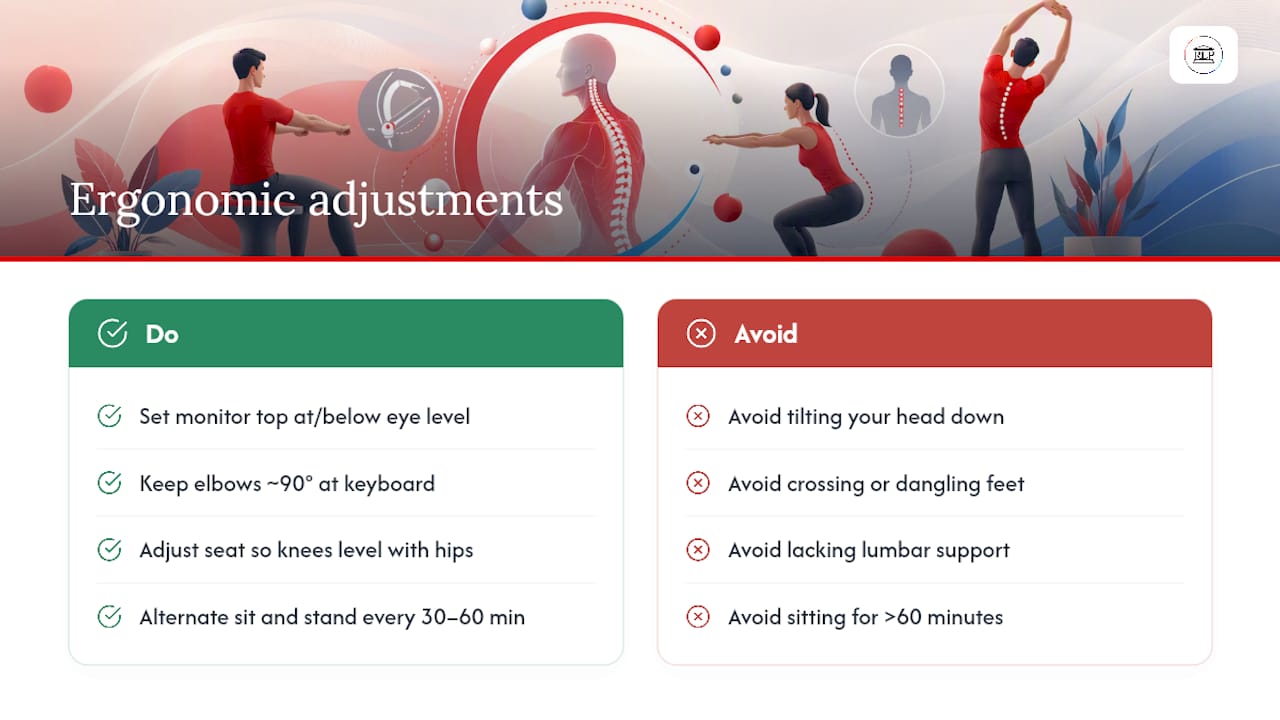
Chair setup matters more than most people assume. Lumbar support that actually contacts your lower back reduces the tendency to slump, and a seat height that keeps your knees level with your hips takes pressure off the same hip flexors your training is trying to loosen up. If you have access to a sit-stand desk, alternating positions every 30 to 60 minutes reduces the total load on any one posture.
Footwear plays a role too, especially if you're doing standing work or loaded carries near your desk. Supportive, stable footwear improves alignment during those micro-session movements, which matters more than it sounds like it should when you're doing a hip hinge in dress shoes.
None of this replaces the strength work. It just removes the friction that undoes it between sessions.
Where Mobility and Flexibility Fit Into the Picture
Mobility work isn't a separate program. It's the on-ramp that makes your strength sessions more effective and your desk hours more comfortable.
A short mobility routine, 5 to 15 minutes, performed daily or several times a week, keeps hips, thoracic spine, and shoulders moving well enough to load properly during actual training. Hip flexor stretches counter the seated position directly. Thoracic rotations and cat-cow sequences restore the upper-back extension that rounds forward at a keyboard. Both are worth doing before your strength sessions and on rest days.
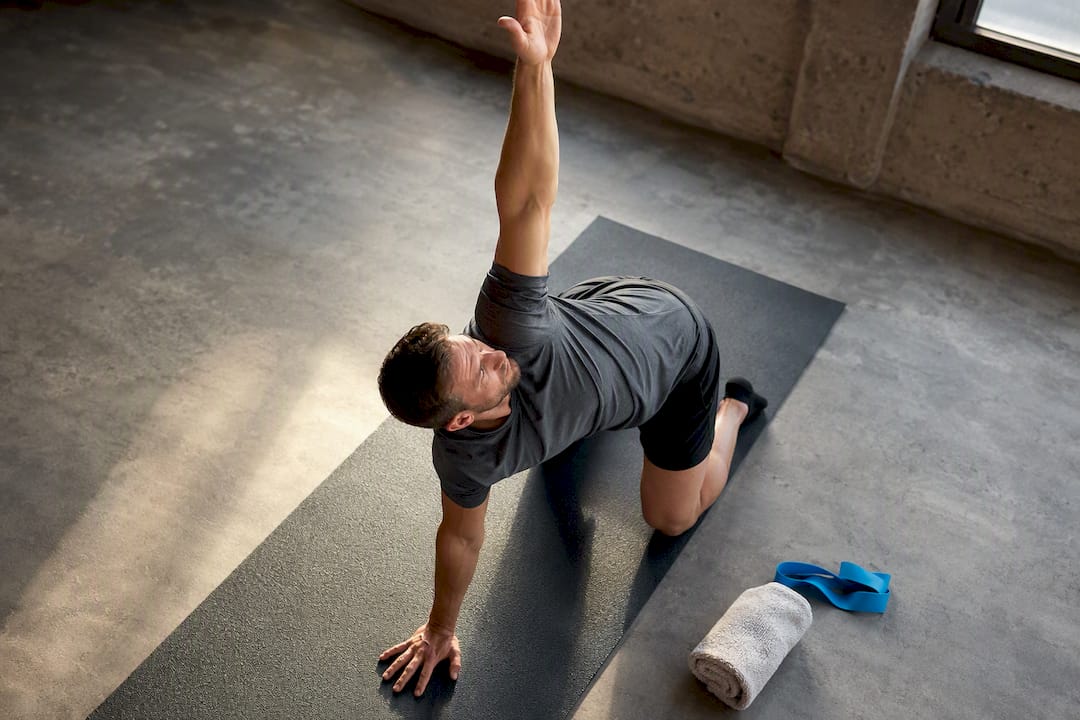
Where mobility falls short on its own is durability. Stretching a tight hip flexor gives you a temporary window of better range of motion, but nothing about static stretching builds the strength to hold that position under load or fatigue. That's the gap resistance training closes. Think of mobility as opening the door and strength training as what keeps it open. Use both, but don't mistake one for a substitute for the other.
Nutrition to Support Muscle Maintenance When You Sit All Day
Muscle doesn't just respond to the sets and reps you do. It responds to what you feed it afterward, and sedentary schedules make that easier to get wrong.
Protein intake matters most. Spreading protein across three or four meals, rather than loading it all at dinner, gives your body a steadier supply of the amino acids muscle repair depends on. Desk workers often under-eat protein at breakfast and lunch, then overcorrect with a heavy dinner that doesn't do much for a muscle group that trained eight hours earlier.
Hydration deserves more attention than it usually gets. Mild dehydration shows up as fatigue and reduced strength output long before it registers as thirst, and a sedentary day filled with coffee doesn't help. Keep a water bottle within reach and refill it on a schedule instead of waiting to feel thirsty.
Total calorie intake matters too. Sedentary jobs burn fewer calories than active ones, so the same eating pattern that worked in a more physical role can quietly add body fat if it's not adjusted. That doesn't mean cutting drastically. It means eating in a way that matches your actual activity level, with enough protein to support the muscle you're building in the gym.
Common Barriers to Strength Training and How to Get Past Them
Every desk worker who has tried to start a strength routine has run into some version of the same handful of obstacles.
"I don't have time." This is usually a scheduling problem, not a time problem. A 30-minute session three times a week is 90 minutes total, less time than most people spend scrolling on a lunch break over the same span.
"I don't know what to do." Uncertainty kills consistency faster than laziness ever does. Following a set template, like the 3-day program above, removes the guesswork that causes people to quit in week two.
"I'm embarrassed to exercise at my desk." Stick to the privacy-friendly moves in public spaces and save the plank or chair squat for when you have a bit more privacy. Nobody needs to know you're training.
"I get sore and give up." Some soreness is normal in the first few weeks. Sharp or lingering pain past 48 hours is not, and that's the line worth paying attention to.
"I plateau and lose motivation." This is where structured progression rules matter. Following an 8 to 12 week evaluation cycle instead of judging progress week to week keeps frustration from derailing a program that's actually working.
The Repphilosophy Perspective on Training Desk Workers
Here's what I've come to believe after watching so many office-based clients try to fix sitting-related weakness on their own: the exercises are rarely the problem. The schedule is.
Most desk workers who quit a strength program didn't quit because the movements were wrong. They quit because the program assumed a life with more open hours than they actually have. That's why Repphilosophy builds around small-group and bring-a-buddy training memberships. Consistency improves dramatically when someone else is expecting you to show up, and it costs less than one-on-one coaching while keeping the accountability intact.
For clients who can't make it in person, our virtual coaching library gives remote and hybrid workers the same programming structure without requiring a commute.
If you're reading this and recognizing your own desk job in every paragraph, the next step is simple: pick a start date this week, not next month.
— Coach Justin
How Repphilosophy Can Help You Train Around a Full Workday
Repphilosophy is built for exactly the schedule conflicts this guide just walked through, not a gym routine designed for people with three free hours a day. Whether you're in San Diego or training remotely, there's a format that fits your calendar instead of fighting it.
If your job keeps you at a desk but traveling isn't an option, the virtual exercise library gives you the same 3-day programming structure from this guide, with video demonstrations for every movement, so you're never guessing at form on the Romanian deadlift or the chest-supported row. Prefer in-person coaching? A focused 30-minute training session fits into a lunch break without eating your whole afternoon, and it puts a coach's eyes on your form from day one, which matters most in those first few weeks of loading new movement patterns. Coaching isn't required to get results from this program, but it consistently shortens the distance between starting and seeing real strength gains. Book a session or browse the full range of coaching options on the Repphilosophy shop and pick the format that matches how your week actually looks.
Sources
- Resistance Exercise Training on Musculoskeletal, Metabolic and Psychological Health in Sedentary Office Workers - Systematic Review and Meta-analysis
- Physical Activity: Why It's Important
- Resistance training and musculoskeletal health
- Work out while you work: 10 strength-building office exercises