

The fastest way to stay accountable during weight-loss training is a daily, low-friction reporting habit paired with scheduled reviews with an external partner — a friend, a group, or a coach. Aim for the evidence-based pace of 1–2 lb per week, and know that sharing your goals with a partner is associated with about 33% higher odds of success in weight-loss programs. Repphilosophy Coaching builds that structure directly into every session, so you're never figuring it out alone.
Your 4-step starting checklist:
- Set one small daily report (a photo, a single-line note, or a quick text to your partner)
- Schedule a weekly check-in on your calendar right now
- Pick one tracking method: an app like Lose It!, weekly photos, or a tape measure
- Decide how you'll reward each milestone (a new workout outfit, a rest day, a movie night)
Table of Contents
- Seven strategies to stay accountable in weight loss training
- How to set realistic goals that fit your training program
- Which tracking methods actually show your progress?
- Buddies, groups, and coaches: which accountability type fits you?
- How to embed accountability into your daily routine automatically
- How to recover from setbacks without letting them derail you
- How Repphilosophy builds accountability into every program
- Key Takeaways
- What actually works: a coach's honest perspective
- Repphilosophy coaching: built-in accountability from session one
- Useful sources and further reading
Seven strategies to stay accountable in weight loss training
Accountability isn't a personality trait. It's a system. Pick one or two of these to start — stacking all seven at once is a fast track to burnout.
-
Daily micro-reporting. A single text, photo, or one-line note sent to a partner creates a tight feedback loop that outperforms high-effort weekly check-ins. Consistency beats intensity every time. Implementation: set a recurring phone alarm for the same time each day, right after a meal or workout.
-
Habit anchoring. Attach your accountability ritual to something you already do — logging your food immediately after your morning coffee, or snapping a progress photo right before your post-workout shower. The existing behavior becomes the trigger.
-
Public commitment. Telling a friend, posting a goal in a group chat, or signing up for a 10-week challenge raises the social stakes in a healthy way. Sharing a goal makes it feel real to your brain, which changes how seriously you treat your own intentions.
-
Accountability partner. One person who checks in on you regularly is often more effective than a full group. Find someone with a similar goal, agree on a reporting cadence (daily text, weekly call), and be specific about what you'll share.
-
Scheduled check-ins. Put a 15-minute weekly review on your calendar. Review your numbers, note what worked, and adjust one thing. Vague intentions to "check in sometime" almost never happen.
-
Non-food milestone rewards. Celebrate hitting a two-week streak or a new personal record with something that supports your lifestyle — new gear, a massage, a rest day with zero guilt. Non-food rewards prevent the "I earned a cheat week" spiral.
-
Gamification. Apps like Lose It! let you track streaks, hit daily targets, and visualize progress over time. Self-regulation apps produced about 1.85 kg (~4.1 lb) greater weight loss over six months compared with controls in pooled analyses. That said, a paper journal or a simple photo folder works just as well if you prefer low-tech.
Pro Tip: Accountability should reveal patterns, not punish you. If you missed three days of logging, the goal isn't to feel bad — it's to notice what triggered the gap and fix one thing. Judgment-free reporting is what keeps people honest.
How to set realistic goals that fit your training program
Vague goals produce vague results. "Lose weight" is not a goal — it's a wish. Here's how to make it concrete enough to actually review with a partner or coach.
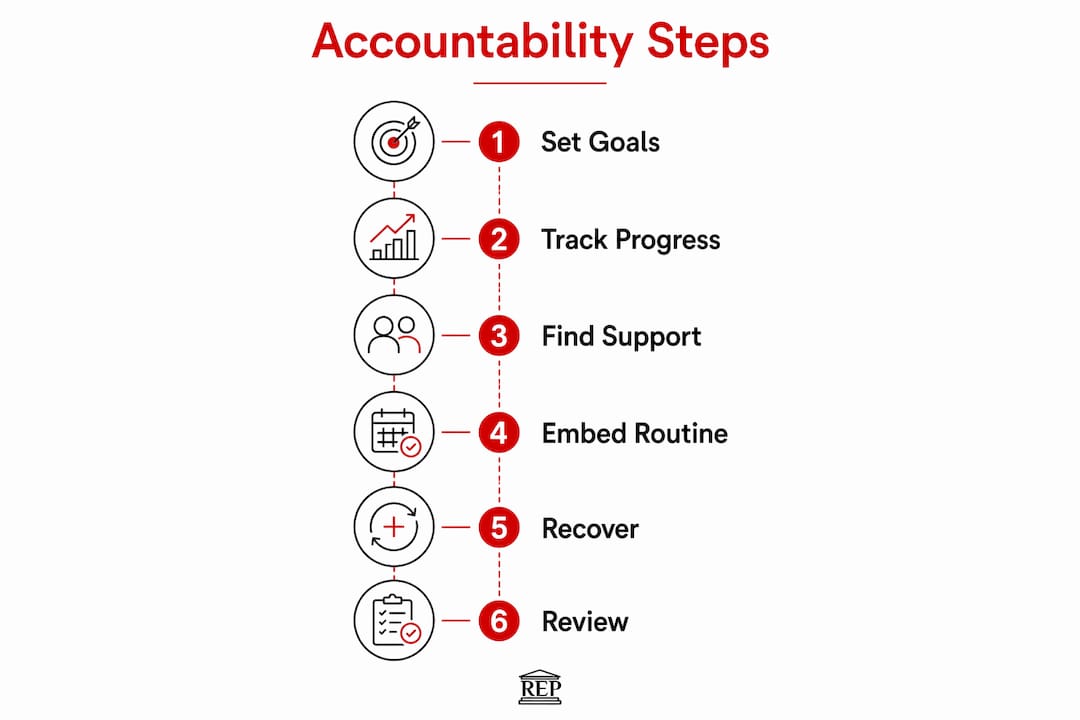
Start with a behavior-based weekly target built around the 1–2 lb/week guideline, then translate that into the daily actions that produce it: training sessions per week, a protein target, a daily step count. The number on the scale is the outcome; the behaviors are what you control.
SMART framing makes this practical in a training context:
| SMART Element | Training Example |
|---|---|
| Specific | "Train 4 days/week, hit protein daily target" |
| Measurable | Track sessions in Lose It! or a paper log |
| Achievable | a steady, manageable loss over several weeks |
| Relevant | Tied to a race, event, or personal milestone |
| Timebound | 12-week program with a mid-point review at week 6 |
Break the 12-week goal into three 4-week blocks. Review at each checkpoint: if you're ahead of pace, stay the course; if progress has stalled, adjust one variable (calories, training frequency, sleep) rather than overhauling everything at once. Setting weight loss goals that are specific and timebound gives you and your accountability partner something concrete to review every single week.
A quick decision check for goal aggressiveness: if you're consistently tired, losing strength, or dreading workouts, the deficit is too steep. Scale back to the lower end of the 1–2 lb/week range and prioritize sustainability.
Which tracking methods actually show your progress?
No single method tells the whole story. The scale measures one thing; a tape measure catches body composition shifts the scale misses; photos show what numbers can't. Use at least two methods together.

| Method | Ideal Frequency | Effort | Best Use Case | Accuracy Tip |
|---|---|---|---|---|
| Scale weight | Daily or weekly | Low | Trend tracking over time | Same time of day, same clothing |
| Tape measure | Every 2 weeks | Low | Body composition changes | Same landmarks, relaxed posture |
| Progress photos | Weekly | Low | Visual motivation, body shape | Same lighting, same outfit, same angle |
| Food log / app | Daily | Medium | Calorie and macro awareness | Log before eating, not after |
| Lose It! app | Daily | Low–Medium | Calorie tracking + streaks | Sync with a fitness tracker for accuracy |
A suggested weekly measurement schedule:
- Monday morning: weigh in (same time, before eating)
- Monday morning: snap a front and side photo
- Every other Monday: tape measure (waist, hips, chest, thighs)
- Daily: log food in Lose It! or a paper journal
Keeping a daily food record is consistently associated with greater weight loss in program studies — the act of logging itself increases awareness and reduces mindless eating. For privacy-conscious readers, a paper journal or a local-only notes app works just as well as a cloud-based platform. The role of weekly weigh-ins and regular measurement reviews is to spot trends, not to judge a single day's number.
Non-scale victories — like lifting heavier, sleeping better, or fitting into a smaller size — belong in your tracking system too. They sustain motivation through the inevitable weeks when the scale doesn't move.
Buddies, groups, and coaches: which accountability type fits you?
Accountability layers work like this: self-monitoring is the foundation, one partner adds leverage, a group adds social pressure, and a professional coach adds structure and technical expertise. Each layer multiplies motivation, but internal drive has to be the base — external pressure alone fades when life gets busy.
The three main types:
- Peer buddy: Free, flexible, emotionally supportive. Best when you need someone to check in with daily and share the struggle. Works well for people who are self-directed but need a witness. Finding a training partner with a similar schedule and goal makes the relationship sustainable.
- Small group or class: Group personal training combines social accountability with professional coaching and tends to be more affordable than one-on-one sessions. The shared energy of a class raises adherence for many people. Group fitness classes at Repphilosophy are built around exactly this dynamic.
- Professional coach or trainer: Highest structure, personalized programming, and behavior-change coaching alongside exercise. Typical cost for personal training in the U.S. ranges widely depending on location, session length, and format (individual vs. buddy vs. small group). Repphilosophy's buddy memberships and group options bring that cost down significantly.
Questions to ask before you commit to a coach or group:
- How do you handle a week when I miss sessions or go off-plan?
- What does your check-in process look like between sessions?
- How do you track and review my progress over time?
- What's the minimum commitment, and what happens if my schedule changes?
Choose based on how much structure you genuinely need, your budget, and whether you want someone to also coach your nutrition and mindset — not just your workouts.

How to embed accountability into your daily routine automatically
The goal is to make accountability so low-friction that skipping it feels stranger than doing it. That's what tiny-habit design does.
- Anchor your report to an existing behavior. Right after you brush your teeth at night, send your daily check-in text. Right after your last rep in the gym, log your session. The existing habit becomes the cue.
- Set up your environment the night before. Lay out your workout clothes, put your food journal on the kitchen counter, and charge your phone next to your scale. Reducing friction at the decision point is more reliable than relying on motivation.
- Automate your prompts. Use recurring calendar invites for your weekly review. Set a daily app reminder in Lose It! at the same time each day. A scheduled prompt removes the mental load of remembering.
- Use a single low-effort daily ritual. One photo, one text, one line in a notes app. Daily, low-friction reporting builds a feedback loop that complex systems can't match, because it actually gets done.
- Review your environment monthly. What's making accountability harder? A cluttered gym bag, a missing charger, a partner who stopped responding? Fix the friction point, not your willpower.
Pro Tip: If you miss a day of reporting, don't try to catch up — just restart the next morning. A single missed check-in is noise. A week of skipping is a signal to simplify the system, not to quit.
How to recover from setbacks without letting them derail you
Plateaus happen. So do bad weeks, social events that blow your plan, and stretches where motivation disappears entirely. The goal isn't to avoid setbacks — it's to shorten the recovery window.
Common pitfalls and one-sentence fixes:
- Plateau: Adjust one variable (add 1,000 steps, reduce 100 calories, add one training day) rather than overhauling everything at once.
- All-or-nothing thinking: A missed workout doesn't cancel the week — one imperfect day followed by a good one is still progress.
- Social triggers: Plan your response to a dinner out or a holiday weekend in advance; a decision made under pressure is almost always worse than one made calmly beforehand.
A 3-step recovery protocol:
- Acknowledge (same day): Name what happened without judgment. "I skipped three sessions this week because work was overwhelming" is data, not a verdict.
- Adjust (within 24 hours): Make one small correction — not a full restart. Add a 20-minute walk, prep one meal, send your accountability text.
- Restart (next morning): Take the smallest possible next step. One session, one logged meal, one check-in. Momentum rebuilds from tiny actions.
Shame-based accountability backfires because it makes people avoid reporting rather than report honestly. Frame every check-in as pattern discovery: "What does this week's data tell me?" is a far more useful question than "Why did I fail again?" With a partner or coach, language like "Here's what happened and here's what I'm adjusting" keeps the conversation honest without triggering defensiveness.
How Repphilosophy builds accountability into every program
Repphilosophy offers in-person personal training in 4S Ranch, San Diego, buddy training memberships, small group classes, youth sports performance programs, and virtual personal training with an on-demand exercise library. Accountability isn't an add-on here — it's built into the structure of every program from day one.
What a first month with Repphilosophy looks like:
- Week 1: Baseline assessment (weight, measurements, photos, movement screen), goal-setting session, and first training sessions
- Weeks 2–4: Weekly check-ins reviewing progress metrics, adjusting micro-goals, and building the reporting habit
- Ongoing: Scheduled reviews every 4 weeks to assess progress and recalibrate targets
Coach Justin's approach to weight loss coaching is grounded in the same evidence this article covers: daily reporting, behavior-based goals, and a judgment-free review process. The personal training benefits go well beyond exercise prescription — they include the kind of structured accountability that most people can't build on their own.
Pricing varies by program format (individual, buddy, group, or virtual). Reach out directly or visit the shop to get current rates and availability.
Key Takeaways
Staying accountable in weight-loss training comes down to one thing: a daily, low-friction reporting habit reviewed weekly with an external partner or coach, sustained at the evidence-based pace of losing a small, steady amount of weight per week.
| Point | Details |
|---|---|
| Daily micro-report | One text, photo, or note per day builds a feedback loop that weekly check-ins can't match. |
| Partner sharing | Sharing goals and weekly progress with a partner increases odds of success by about 33%. |
| Realistic pace | Aim for a steady, manageable pace over several weeks; adjust one variable when progress stalls. |
| Combine tracking methods | Pair weekly weigh-ins with progress photos and a food log for a complete picture of progress. |
| Repphilosophy | Repphilosophy structures accountability into every program from day one, with baseline measures, weekly reviews, and in-person or virtual coaching options in 4S Ranch. |
What actually works: a coach's honest perspective
Most people come in thinking accountability is about discipline. What I've seen consistently is that it's actually about design. The clients who make steady, lasting progress aren't the most motivated ones in the room — they're the ones with the simplest systems.
The biggest early mistake I see is over-engineering the tracking. Someone downloads four apps, commits to daily weigh-ins AND macro tracking AND a training log AND a weekly reflection journal, and by week three they've abandoned all of it because the overhead got too heavy. One method, done daily, beats four methods done occasionally. Every time.
What reliably outlasts motivation is a low-friction daily ritual attached to something the person already does. The accountability partner who gets a text every night after dinner. The photo taken in the same spot every Monday morning. The weekly calendar invite that doesn't move. These aren't glamorous systems, but they're the ones still running at week twelve.
The other pattern worth naming: the clients who recover fastest from setbacks are the ones who've been taught to treat their data as information, not as a report card. When a rough week shows up in the numbers, the question is "what does this tell me?" not "what does this say about me?" That reframe is often the difference between a two-day reset and a two-month spiral.
If you're self-directed and just need a witness, a buddy works. If you need structure, technical guidance, and someone to adjust your program when life changes, that's when a coach earns every dollar.
Repphilosophy coaching: built-in accountability from session one
Accountability is the hardest part of weight-loss training to build alone — and it's the first thing Repphilosophy puts in place for every client.

Whether you train in person at 4S Ranch, bring a friend on a buddy membership, join a group class, or work through the virtual exercise library from anywhere in the country, the structure is the same: baseline measures, weekly reviews, and a coach who adjusts your program when life gets in the way. You're not handed a plan and left to figure it out.
What you get from day one:
- A baseline assessment (weight, measurements, photos) so progress is measurable from the start
- Weekly check-ins with clear metrics and honest feedback
- Personalized programming that evolves as you do
- Local in-person access at 4S Ranch or fully virtual options for flexibility
Ready to put a real system behind your training? Book a trial session and see what structured, coach-led accountability feels like in practice. Pricing is transparent and available directly through the booking page.
Useful sources and further reading
- How weight loss accountability can help you achieve your goals — covers the behavioral science behind partner sharing, goal-setting, and non-food rewards; source for the 1–2 lb/week guideline and the partner success-rate finding.
- 10 ways to stay accountable on weight loss journeys — source for the 33% partner success-rate statistic and the 1.85 kg app-use finding.
- How to stay accountable for weight loss (without relying on willpower) — strongest evidence for daily micro-reporting and tiny-habit design over high-effort weekly interventions.
- Why accountability is the key to fitness and weight loss motivation — explains layered accountability (self, partner, group, public) and why internal motivation must anchor external systems.
- NASM Group Personal Training Specialization — professional framework for group coaching, social accountability, and cost-effective training formats.
- Weekly Weigh-Ins: Your Fitness Tracking Game Plan — practical cadence and method guidance for weigh-ins and progress reviews; source for the Repphilosophy onboarding protocol.
- PubMed: Self-monitoring in weight loss — peer-reviewed evidence on self-monitoring frequency and weight-loss outcomes.
- Mayo Clinic: Weight loss plateau — authoritative guidance on plateau management and realistic rate-of-loss expectations.
- How to set weight loss goals that actually stick — Repphilosophy's practical guide to SMART goal-setting and weekly target-setting within a training program.
This article is general information, not medical or professional advice. Confirm any health, nutrition, or exercise approach with a qualified professional for your specific situation.