
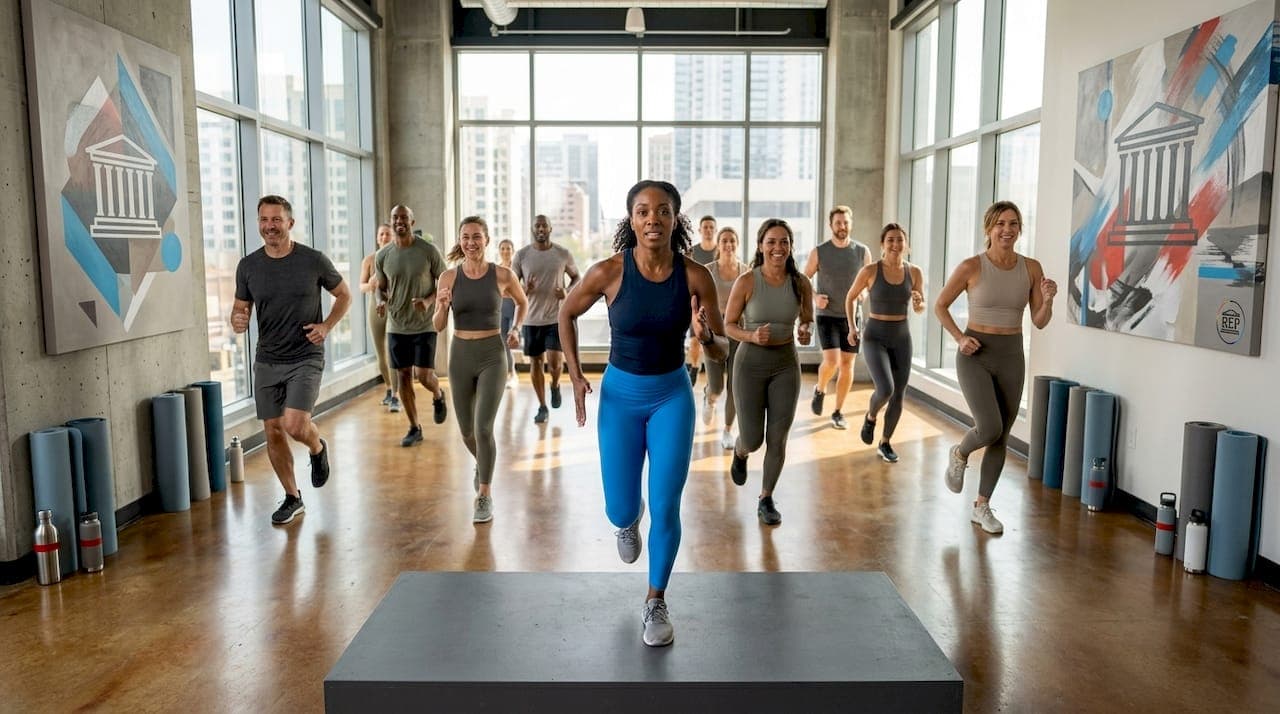
Group fitness classes are structured exercise sessions led by a certified instructor where participants train together toward shared health goals, including fat loss. These classes combine formats like HIIT, circuit training, resistance work, and dance cardio to create calorie deficits while preserving muscle mass. What makes them uniquely powerful for weight loss is not just the workout itself. It is the social environment, peer accountability, and expert-led structure that keep you showing up week after week. Understanding how group fitness classes work for weight loss means understanding why consistency, not perfection, drives real results.
How group fitness classes weight loss explained through social dynamics
Group fitness classes work for weight loss partly because of a well-documented psychological mechanism: people push harder, stay longer, and return more often when they train alongside others. A 2026 meta-analysis covering 71 studies and 31,607 participants found that group-based physical activity produces similar or slightly better health and functional outcomes compared to individual approaches. The effect is strongest when classes use what researchers call “true group” design.
True groups are not just people exercising in the same room. They share scheduled goals, receive instructor-led feedback, build team identity, and hold each other accountable. Structured group dynamics with instructor-led goals enhance engagement and functional health outcomes far more than casual group exercise formats. This distinction matters when you are choosing a class.
Here is what separates a high-impact group class from a forgettable one:
-
Shared goals: Every participant knows the session objective, whether it is completing a circuit, hitting a rep target, or finishing a timed challenge.
-
Peer modeling: Watching others perform movements correctly builds your own confidence and technique.
-
Instructor feedback: Real-time corrections and encouragement from a coach keep effort levels high.
-
Team identity: Knowing your classmates by name and feeling part of a crew increases the social cost of skipping.
Pro Tip: Before signing up for any group class, ask the instructor how they track progress and whether participants set shared goals. A class with structured accountability will outperform one that simply fills a room with people moving.
If you want to understand how a training partner amplifies your consistency even further, the same social psychology principles apply.
What role does resistance training play in group fitness for fat loss?
Cardio burns calories during a session. Resistance training changes what your body does with calories around the clock. That distinction is why the best group fitness programs for weight loss include structured resistance work, not just high-rep cardio circuits.
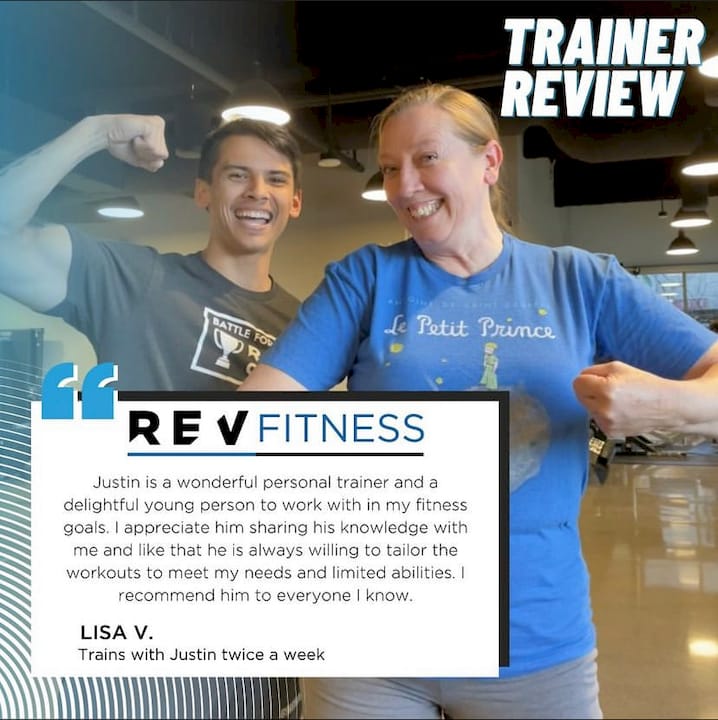
The 2026 ACSM resistance training guidelines make this clear: training all major muscle groups at least twice per week matters more than chasing a perfect program. Consistency at that frequency builds and preserves lean muscle, which raises your resting metabolic rate and makes fat loss more durable over time. As Stuart M. Phillips, PhD, FACSM, stated in the ACSM 2026 update, “The best resistance training program is the one you adhere to consistently.” That is not a motivational quote. It is a clinical finding.
Common resistance exercises you will find in well-designed group classes include:
-
Compound lifts: Squats, deadlifts, and rows that recruit multiple muscle groups simultaneously.
-
Bodyweight progressions: Push-ups, lunges, and planks scaled to participant fitness level.
-
Dumbbell or kettlebell circuits: Moderate loads with controlled tempo to maximize time under tension.
-
Resistance band work: Accessible for beginners and effective for joint-friendly loading.
Cardio-only classes create a calorie deficit in the short term, but they do not protect muscle mass during a weight loss phase. Losing muscle slows your metabolism and makes it harder to maintain results. Resistance training in group classes is a durable fat-loss multiplier, supporting muscle retention while cardio creates the energy deficit you need.
Pro Tip: If your current group class is cardio-heavy, add one or two resistance-focused sessions per week. You do not need a complex program. Two full-body sessions hitting squats, hinges, pushes, and pulls will cover the ACSM minimum and protect your results.
Which class formats and program structures work best for weight loss?
Not all group fitness formats deliver equal results for fat loss. The format you choose should match your current fitness level, your schedule, and your ability to sustain effort over months, not just weeks.
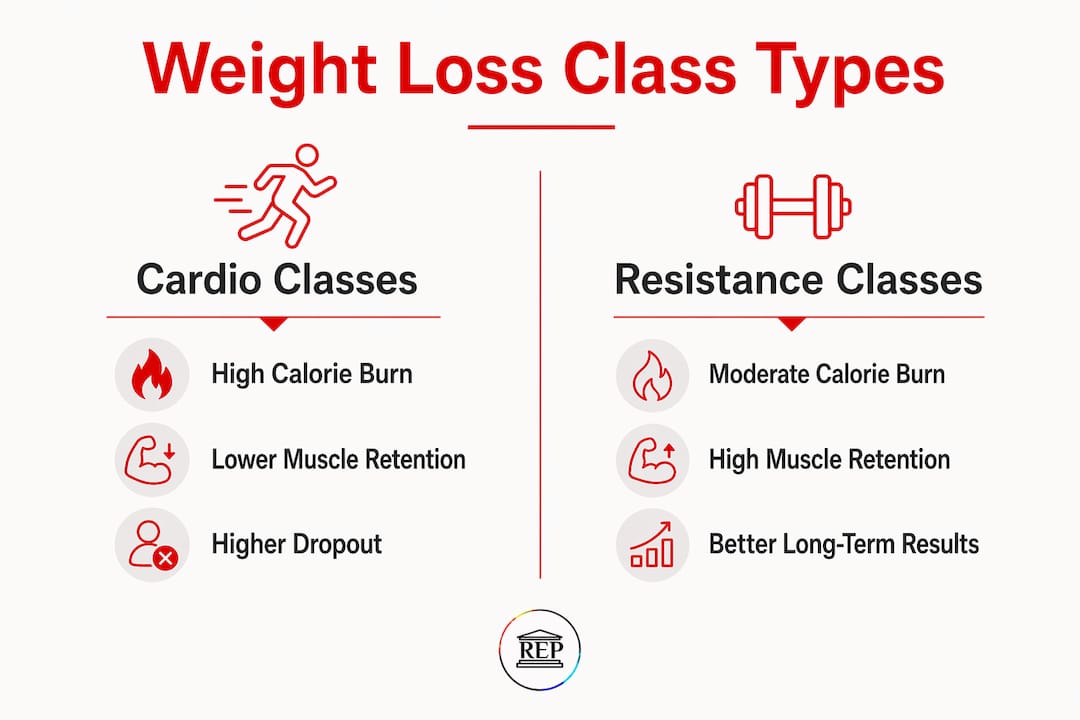
Here is a comparison of the most common group class types and how they stack up for weight loss:
| Class format | Calorie burn | Muscle retention | Beginner-friendly | Dropout risk |
|---|---|---|---|---|
| HIIT | High | Moderate | Low to moderate | Higher without pacing |
| Circuit training | High | High | Moderate | Low with good coaching |
| Dance cardio (e.g., Zumba) | Moderate | Low | High | Low |
| Small group sports | Moderate to high | Moderate | Moderate | Low with team structure |
| Strength-focused group | Moderate | Very high | Moderate | Low |
For HIIT protocols specifically, the format alternates short bursts of maximum effort with recovery periods, creating a significant calorie burn and an afterburn effect that continues post-session. Circuit training combines resistance and cardio elements, making it the most balanced option for body composition.
Program structure matters as much as format. Two to three sessions per week gives your body enough stimulus to change while allowing recovery. Gradual progression, starting at manageable intensity and increasing load or duration over weeks, prevents the burnout that kills adherence. The UK-based MAN v FAT football club demonstrated this beautifully: 74 men lost a combined 71 stone using weekly football sessions, team competition, and weigh-ins. The format was sport, not a gym class, but the structure was identical to what makes any group program work.
Pro Tip: If you are new to group classes, start with circuit training or small group strength sessions rather than pure HIIT. Build your aerobic base and movement confidence first. HIIT is most effective when you can actually sustain the high-intensity intervals, and that takes a few weeks of foundation work.
For women between 30 and 50 preparing for more intense training, this evidence-based guide covers how to ramp up safely without overloading your recovery.
What challenges cause people to drop out of weight loss group classes?
Here is the uncomfortable truth about group fitness for weight loss: the people who need it most are statistically the most likely to quit. A 2026 prospective cohort study with 12-month retention of 51.7% found that male sex, BMI of 25 or above, and weight loss as the primary goal all predict shorter participation in supervised small-group exercise programs. Weight-loss-focused motivation can paradoxically increase dropout risk unless matched with gradual pacing and supportive onboarding.
Why does this happen? When weight loss is your only goal, every session becomes a test you can pass or fail. If the scale does not move fast enough, motivation collapses. The fix is not more willpower. It is better program design and smarter onboarding.
Here are the most effective strategies for staying in the game:
-
Set process goals alongside outcome goals. Commit to attending three sessions per week regardless of what the scale says. Attendance is the behavior. Fat loss is the result.
-
Start below your maximum effort. A fitness coach who lost 30kg documented how gradual cardio progression, not hardcore sessions, drove her results. Starting manageable prevents the soreness and fatigue that derail beginners in weeks two and three.
-
Choose classes with strong instructor onboarding. The first four weeks are the highest dropout window. Instructors who check in with new participants, modify movements, and celebrate small wins dramatically improve retention.
-
Track non-scale victories. Strength gains, improved endurance, better sleep, and reduced resting heart rate are all signs the program is working, even before the scale reflects it.
-
Build social ties within the class. Knowing your classmates by name is one of the strongest predictors of continued attendance. Introduce yourself. Show up consistently. The social investment becomes its own motivation.
Pro Tip: If you have tried group classes before and quit within the first month, the problem was almost certainly pacing, not your commitment. Find a class that explicitly ramps intensity over the first four to six weeks rather than throwing you into maximum effort from day one.
Key takeaways
Group fitness classes drive weight loss through a combination of social accountability, structured resistance training, and consistent attendance, not through any single workout format.
| Point | Details |
|---|---|
| True group design outperforms casual classes | Classes with shared goals, instructor feedback, and team identity produce better outcomes per the 2026 Nature meta-analysis. |
| Resistance training is non-negotiable | Training major muscle groups twice weekly preserves muscle and sustains fat loss beyond what cardio alone achieves. |
| Format choice affects adherence | Circuit training and small group strength sessions carry lower dropout risk than pure HIIT for beginners. |
| Weight-loss goals increase dropout risk | Participants focused solely on the scale quit sooner; process goals and gradual pacing improve retention significantly. |
| Onboarding determines long-term success | The first four weeks are the highest-risk dropout window; strong instructor support during this period is the most important program feature. |
What I have learned coaching group fitness for real results
I want to be direct with you about something most fitness content glosses over. The group class format is not magic. I have seen people attend three sessions a week for two months and make almost no progress, and I have seen others transform their body composition in the same timeframe doing the same workouts. The difference is almost never effort during the session. It is what happens in the design of the program and the culture of the room.
The classes that consistently produce results at Repphilosophy are the ones where participants know each other’s names by week two. That sounds soft, but the data backs it up. When you feel seen and expected, you show up. When you show up consistently, the physiology takes care of itself.
What I have also learned is that most people underestimate resistance training and overestimate cardio for fat loss. Cardio feels productive because you sweat and your heart rate spikes. But two full-body resistance sessions per week, done consistently for three months, will change your body composition more durably than five cardio classes. I build every group program around that principle.
The other thing I push back on is the idea that you need to feel destroyed after every session to make progress. Gradual progression is not a compromise. It is the strategy. The people who stay in the program long enough to see real change are the ones who started at 70% effort and built from there, not the ones who went all-out in week one and burned out by week three.
If you are weighing your options between group training and individual coaching, this comparison of personal training vs gym membership might help you decide what structure fits your life right now.
— Coach Justin
Ready to take your first stride with Repphilosophy?
At Repphilosophy, we build group fitness experiences designed around the principles that actually produce results: structured resistance work, real accountability, and pacing that keeps you in the program long enough to see change. Whether you are in 4S Ranch and want to train in person, or you prefer the flexibility of virtual coaching, there is a format built for where you are right now.
Our coaching and program options include group classes, bring-a-buddy memberships, and virtual coaching memberships that give you access to structured workouts you can follow on your schedule. If you want to experience what a well-designed group program feels like, explore our virtual coaching memberships and get started with a plan that grows with you.
FAQ
Can group fitness classes really help you lose weight?
Yes. Group fitness classes support weight loss by combining calorie-burning workouts with social accountability and consistent attendance. A 2026 meta-analysis of 71 studies found group-based physical activity produces similar or better health outcomes than individual exercise, especially in structured “true group” formats.
How many times per week should you attend group fitness classes for weight loss?
Two to three sessions per week is the evidence-supported frequency for meaningful fat loss and muscle preservation. The 2026 ACSM guidelines confirm that training major muscle groups at least twice weekly is more impactful than any complex programming approach.
What is the best type of group fitness class for losing weight?
Circuit training and small group strength sessions offer the best combination of calorie burn and muscle retention for weight loss. Pure HIIT classes are effective but carry a higher dropout risk for beginners without proper pacing and onboarding.
Why do people quit weight loss group fitness programs so quickly?
The 2026 Frontiers in Public Health cohort study found that participants with weight loss as their primary goal, along with males and those with BMI at or above 25, are most likely to drop out early. Programs that use gradual intensity progression and strong instructor onboarding in the first four weeks significantly improve retention.
Do you need to combine diet with group fitness classes to lose weight?
Fat loss requires a calorie deficit, and exercise alone rarely creates a large enough deficit without dietary awareness. Group fitness classes accelerate results by increasing energy expenditure, but pairing consistent attendance with mindful eating produces the most durable outcomes.