
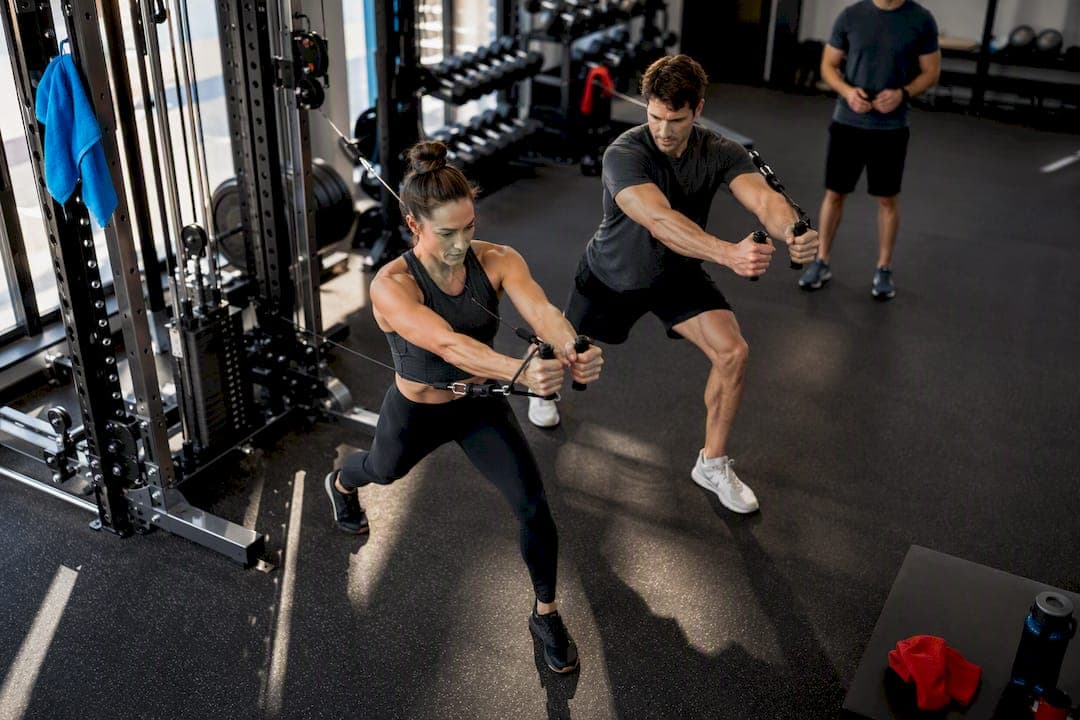
Yes, training with a partner or in a small, coach-led group reliably boosts enjoyment, consistency, and often workout intensity. The science points to three levers — social accountability, self-efficacy, and a documented team-effort boost called the Köhler effect. You can access all three through in-person buddy sessions, small-group classes, or virtual coaching, including options offered locally by a personal training business in the area.
TL;DR:
- Partner training increases motivation and adherence, especially when partners set specific shared goals and schedule regular check-ins.
- The Köhler effect encourages effort growth when working alongside a slightly more capable partner, but large skill gaps may reduce motivation.
- In-person coaching offers better technique correction and safety oversight, while virtual training provides flexibility and affordability for busy schedules.
- Compatibility factors such as similar goals, overlapping schedules, and commitment levels are essential to maintain long-term consistency.
- Structured accountability from a coach or specific plan significantly enhances the likelihood of sustained exercise habits over unplanned, casual sessions.
Table of Contents
- Partner Training Benefits: Mood, Adherence, Effort, and Safety
- The Behavioral Science Behind Why Partner Training Works
- Choosing the Right Partner Training Format for Your Life
- How to Find a Training Partner and Build a Plan That Sticks
- Keeping Partner Training Consistent: Scheduling, Tracking, and Safety
- Why Accountability Is the Real Engine Behind Partner Training
- Common Challenges in Partner Training and How to Fix Them
- Coach Justin's Take on Making Partner Training Actually Work
- Get Started With Buddy Training at Rep Philosophy
- Sources
- FAQ
Partner Training Benefits: Mood, Adherence, Effort, and Safety
Working out with someone else changes how a workout feels before it changes how your body performs. A study tracking 95 young adults found that on days they exercised with a partner, they reported higher positive mood and relationship satisfaction than on solo training days. That single finding explains why so many people stick with partner sessions long after solo workout plans fall apart.
Adherence improves for a related, but separate reason. The NIH highlights social support as a key driver of both starting and maintaining an exercise habit, largely because partners help with planning and follow-through when motivation dips. The CDC backs this up, naming buddy systems and group programs among the most effective evidence-based strategies for getting sedentary adults moving and keeping them there.
Effort tends to rise too, but conditionally. Research on the Köhler effect shows that when someone trains alongside a partner whose performance matters to a shared outcome, especially a partner who is moderately more capable, effort and persistence increase measurably. This effect fades if the skill gap is too wide.
Safety benefits come from a third source entirely: coaching. A trainer watching two people move side by side can catch form breakdowns in real time, something video-only formats cannot replicate.
Most partner pairs notice mood and motivation shifts within one to two weeks, with consistency and strength gains showing up over four to eight weeks of steady sessions.
- Mood and relationship satisfaction improve on shared training days
- Adherence rises through accountability and shared planning
- Effort can increase when paired with a moderately stronger partner
- Coach supervision catches technique issues before they become injuries
Quick fact: Dyadic (partner-based) exercise interventions produce a small but real positive effect on activity levels compared with training alone, and that effect grows substantially when both partners share a specific, target-oriented goal, according to a systematic review of dyadic physical activity interventions.
The Behavioral Science Behind Why Partner Training Works
Partner training is not just more fun. It works because it activates specific psychological mechanisms that solo training simply cannot trigger.
The enabling hypothesis explains part of it: receiving emotional support from a partner predicts stronger self-efficacy, better self-monitoring, and more consistent action planning, which then drive higher exercise behavior. An eight-week intervention study found that participants who received emotional support from a companion showed measurably better self-regulation than those training alone.
Dyadic-intervention research adds a crucial nuance: casual gym buddies with vague intentions see minimal benefit. Pairs who commit to a concrete, shared, target-oriented goal see meaningfully larger effects on activity levels than pairs who just show up together without a plan.
Then there's the Köhler effect, rooted in indispensability: when your effort is visibly necessary to a shared result, you push harder, especially when working alongside someone slightly more capable than you. The catch is competence gaps. Too wide a gap and the weaker partner disengages instead of rising to the challenge.
Here's how to put this to work:
- Write down one specific, shared goal together, not just "get fit"
- Schedule a short check-in every session to review progress
- Pick a partner close to your fitness level, not dramatically ahead or behind
- Rotate who sets the pace so both people feel indispensable
Pro Tip: Put your shared goal on your phone's calendar as a recurring event title, not just a reminder. Seeing it every session reinforces the "we agreed to this together" feeling that drives adherence.
Choosing the Right Partner Training Format for Your Life
Not every partner format delivers the same experience, and picking the wrong one for your schedule is the fastest way to abandon the habit.
- In-person paired sessions. This format offers the closest supervision, ideal for correcting technique in real time and safely pairing people with different fitness levels under one coach's eyes.
- Small-group classes. These trade some individual attention for cost efficiency and a built-in sense of community. The structured progression of a group class also reduces the guesswork of programming your own workouts.
- Virtual buddy training with a video library. This format wins on flexibility and price, letting you and a partner train on your own schedules using shared programming. It demands more intentional communication since there's no coach in the room to keep both people accountable in the moment.
The decision comes down to two questions: how much hands-on coaching do you actually need, and how much scheduling flexibility do you require? A parent juggling school pickups and a demanding job often leans toward virtual buddy training for the freedom it offers. Someone recovering from an old injury or new to structured lifting usually benefits more from in-person supervision, at least until form and confidence are solid.
How to Find a Training Partner and Build a Plan That Sticks
Finding the right partner matters more than finding any partner. A mismatched pair with different goals or wildly different commitment levels often quits within weeks.
Start close to home: friends, family members, or a spouse are the most common starting points, and research on middle-aged and older adults shows that support from friends and partners correlates with meaningfully higher activity levels than going it alone. If no one in your circle fits, ask your local studio about buddy-training programs or strike up a conversation with someone in your regular group class.
Before committing, run through a quick compatibility check:
- Do your schedules overlap at least twice a week?
- Are your goals similar enough to train toward together (strength, weight loss, general fitness)?
- Are there any injuries or health conditions the other person should know about?
- Is your commitment level roughly matched?
Once matched, write a simple shared agreement: a specific goal ("attend three 45-minute sessions weekly for eight weeks"), a fixed meeting time, and a rule for canceling with enough notice to reschedule rather than skip. If one partner consistently no-shows or turns every session into unhealthy competition, address it directly and early. Small friction ignored tends to end partnerships within a month.
Pro Tip: If you're not sure where to look, studio-based partner matching can pair you with someone at a similar level and commitment, skipping the trial and error of asking around.
Keeping Partner Training Consistent: Scheduling, Tracking, and Safety
Systems beat willpower every time two schedules have to align. A few operational habits keep partner training running for months instead of weeks.
- Anchor your sessions. Pick recurring time blocks (Tuesday and Thursday at 6:00 PM, for example) and treat them like any other fixed appointment, with a backup day built in for the inevitable conflict.
- Track something simple. Session count, a quick perceived-exertion rating, and a one-line check-in note are enough. Complicated tracking systems get abandoned faster than the workouts themselves. Steady accountability tracking habits are what separate people who train for a month from people who train for a year.
- Bring in a coach for mixed-ability pairs. A trainer can scale loads and reps individually within the same session, so both partners do the same movement pattern at their own appropriate intensity.
- Run a safety check every session. A short warm-up, clear regressions for tired or sore days, and an honest read on pain versus normal fatigue prevent most injuries before they start.
Parents pairing with youth athletes should keep intensity age-appropriate and lean on a coach for technique cues rather than assuming a teenager can self-correct form. If pain persists beyond normal soreness, a physical therapist or chiropractor can rule out injury before it becomes a bigger setback.
Why Accountability Is the Real Engine Behind Partner Training
Accountability is the mechanism that quietly does most of the work in partner training. It's not about willpower. It's about someone else expecting you to show up.
The NIH points to this directly: people who make an activity plan with a partner are far more likely to follow through on that commitment than people who plan solo. That's because a training partner does more than share the workout. They validate your progress, help troubleshoot excuses, and share the mental load of figuring out what to do next.
This is also why coach-led buddy sessions tend to outperform casual arrangements. Coaching behaviors that support autonomy, competence, and connection between training partners have been linked to stronger long-term adherence than unstructured partner workouts. A coach in the room doesn't just correct form. They reinforce the accountability loop by noticing when someone is off pace and asking why.
The practical takeaway is that accountability needs structure to survive. A vague plan to "work out together sometime" rarely produces results. A recurring slot, a shared goal, and someone (partner or coach) who notices when you miss a session, that combination is what turns intention into a habit that lasts past the first few weeks.

Common Challenges in Partner Training and How to Fix Them
Partner training fails for predictable reasons, and most of them have straightforward fixes.
Mismatched commitment levels top the list. One partner treats sessions as optional; the other treats them as fixed appointments. Fix this upfront by agreeing on a minimum weekly commitment before you start, not after the first missed session.
Scheduling conflicts are the second most common issue, especially for parents balancing work and family logistics. A fixed anchor time with one backup day, rather than a loose "we'll figure it out" arrangement, solves most of this before it becomes friction.
Unhealthy competitiveness can turn a supportive partnership toxic, particularly when one person progresses faster. The Köhler effect research is clear that competence gaps need to stay moderate. If one partner is pulling dramatically ahead, rotate roles or bring in a coach to individualize the pace rather than letting comparison sour the relationship.
Communication breakdowns show up most in virtual formats, where there's no coach in the room to notice tension. A brief pre-session check-in and post-session recap, even two minutes long, replaces a lot of the accountability that's automatic in person.
Finally, some goals genuinely diverge over time. If one partner wants to train for a race and the other wants general health, that's not a failure of the partnership. It's a signal to renegotiate the shared goal or shift to a format, like a coach-led personalized program, that can flex to both.

Coach Justin's Take on Making Partner Training Actually Work
The biggest mistake I see with partner training isn't picking the wrong partner. It's skipping the conversation about what "success" looks like before the first session even happens. Two people can show up consistently for weeks and still drift apart if one is chasing a number on the scale and the other just wants to feel stronger picking up their kids.
Buddy memberships, small-group training, and virtual coaching programs exist because accountability works best when it's structured, not accidental. A coach in the room (or checking in virtually) keeps both people progressing at the pace that's right for them.
That said, partner training isn't always the right call. If you're managing an injury or your goals are wildly different from anyone you know, one-on-one coaching usually serves you better.
— Coach Justin
Get Started With Buddy Training at Rep Philosophy
Some personal training services provide coaching, accountability, and partner formats that fit busy schedules. If you and a friend, spouse, or fellow parent want hands-on coaching, the 60-minute and 30-minute Personal Training Memberships and small-group training sessions give you coach supervision without the price tag of exclusive one-on-one work.

If your schedule is the bigger obstacle, the Exercise Video Library Membership runs $12.50 per month and lets you and a partner train on your own time with shared programming. Prefer live coaching without leaving home? Virtual Coaching Sessions put a real coach on the call with you both. Some providers offer youth performance training options for young athletes.
Ready to try it? Book a personal training trial session with your partner this week and see how a coached first session feels before committing to a membership.
Sources
- Get active together | NIH News in Health
- Review of dyadic physical activity interventions (systematic review & meta-analysis)
- Enhancing aerobic exercise with a virtual exercise buddy (Köhler effect study)
- CDC: Social supports for physical activity
FAQ
Does Partner Training Actually Improve Results?
Yes. Studies show partner-based exercise increases positive mood, adherence, and in some cases effort compared to training alone, especially when both people share a specific, target-oriented goal.
How Long Does It Take to See Benefits From Training With a Partner?
Most people notice mood and motivation improvements within one to two weeks, while consistency and strength gains typically build over four to eight weeks of regular sessions. Sticking to a fixed schedule speeds this up considerably.
What's the Difference Between In-Person and Virtual Partner Training?
In-person paired sessions give you real-time coaching and technique correction, while virtual buddy training trades some supervision for flexibility and lower cost. Rep Philosophy offers both, including an Exercise Video Library Membership at $12.50 per month for flexible virtual training.
How Much Does Partner Training Cost at Rep Philosophy?
Small-group training and the 60-minute and 30-minute Personal Training Memberships are available with pricing listed directly on the Rep Philosophy site. The Exercise Video Library Membership is priced at $12.50 per month for on-demand access.
What If My Training Partner and I Have Different Fitness Levels?
A moderate gap can actually help, since research on the Köhler effect shows a slightly stronger partner can boost effort and persistence in the less advanced partner. A coach can also scale loads individually within the same session so both people train safely at their own intensity.