
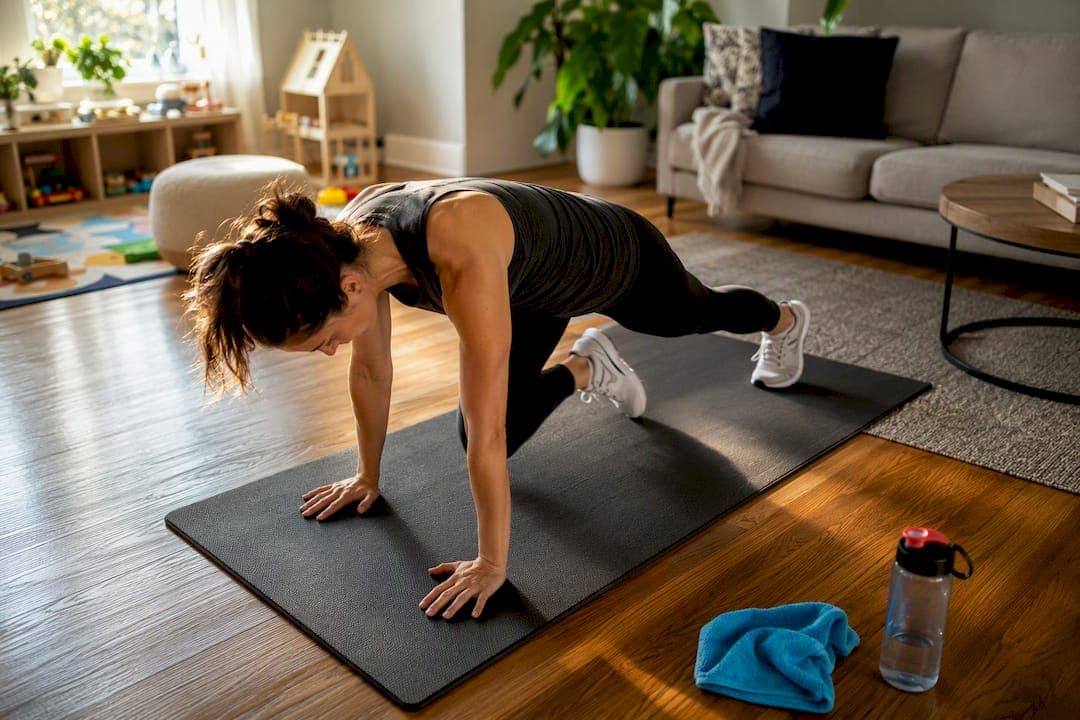
You can maintain real fitness as a busy parent with brief daily micro-workouts plus 2 to 3 structured 20 to 30 minute sessions each week. Think 4 to 7 minute bursts on your busiest days, 10 to 15 minute circuits when you have a little more room, and full 20 to 30 minute sessions twice or three times weekly. Stack those together consistently, and you get measurable strength and endurance gains without ever needing a spare hour.
TL;DR:
- Micro-workouts totaling around 20 to 30 minutes per week can produce measurable strength and endurance gains without requiring a full hour of exercise daily.
- Combining short sessions before kids wake, during naps, or split between morning and evening creates consistent training habits within busy schedules.
- No equipment is necessary, as household substitutes and bodyweight exercises suffice, with minimal investment for simple gear like a backpack or sturdy chair.
- Progression relies on small, deliberate increases, and proper recovery practices are crucial to avoid injury and maintain sustainability.
- Habit stacking, decision pre-planning, and accountability methods help parents integrate micro-workouts into unpredictable family routines.
Table of Contents
- Five Busy Parent Workouts You Can Start Today
- How Do You Fit Workouts Into a Packed Parenting Schedule?
- Family Workout Ideas That Turn Exercise Into Playtime
- What Equipment Do You Actually Need?
- Training Safely When Every Session Is a Short Burst
- Coach Justin's Take on Training Around Family Chaos
- Why Tiny, Repeatable Habits Beat the Occasional Big Workout
- Ready for a Workout Plan That Fits Your Actual Life?
- Where This Guidance Comes From
- Sources
Five Busy Parent Workouts You Can Start Today
You don't need a gym membership to see progress. You need a handful of go-to templates you can pull out depending on how much time the day actually hands you.
1. The 5-minute full-body micro-workout. No equipment required: short intervals of squats, push-ups (knee or full), glute bridges, mountain climbers, and plank holds, with brief rests between moves. Run it twice if you have 10 minutes instead of 5. Easier version: drop to 20-second work intervals. Harder version: add a jump into the squat.
2. The 7-minute HICT circuit. This is the classic high-intensity circuit training format: 12 exercises, 30 seconds of work, 10 seconds of rest, no repeats. Washington Post's coverage of family workout routines highlights this exact structure as one of the most time-efficient conditioning tools available to people with unpredictable schedules. Keep form strict through fatigue; if your lower back rounds during the last few intervals, that's your cue to scale intensity next time.
3. The 10 to 15 minute home strength circuit. Pair a push (push-ups), a pull (rows using a table edge or band), a squat variation, and a hinge (hip thrust or deadlift pattern) into 3 rounds of 10 to 12 reps. Progress by adding a fourth round before you add weight.
4. The 20 to 30 minute strength-and-cardio session. Run this 2 to 3 times weekly: 5-minute warmup, 15 to 20 minutes alternating strength supersets with 60-second cardio bursts (jump rope, high knees, stair climbs), 5-minute cooldown. This format keeps your heart rate elevated while still building real strength.
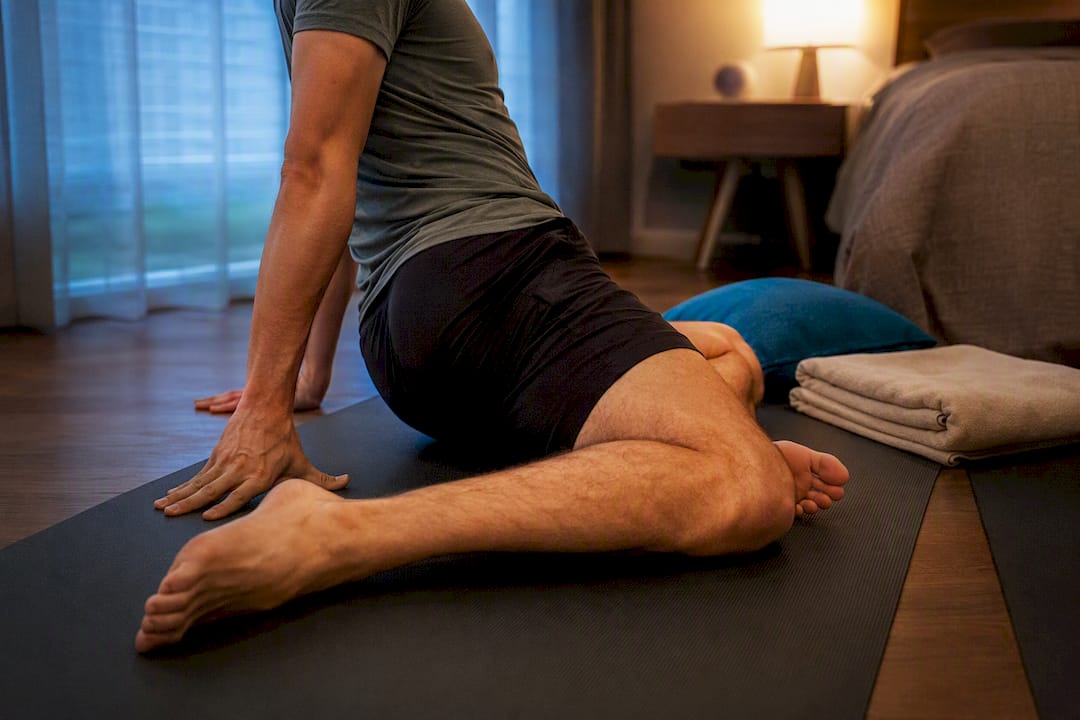
5. The 10-minute evening mobility routine. Hip flexor stretches, thoracic rotations, hamstring floss, and 90/90 hip switches, holding each for 30 to 45 seconds. This one matters more than parents give it credit for.
Pro Tip: Keep a printed or bookmarked version of each template on your phone. The biggest killer of a micro-workout isn't lack of time. It's the 90 seconds you spend trying to remember what to do.
How Do You Fit Workouts Into a Packed Parenting Schedule?
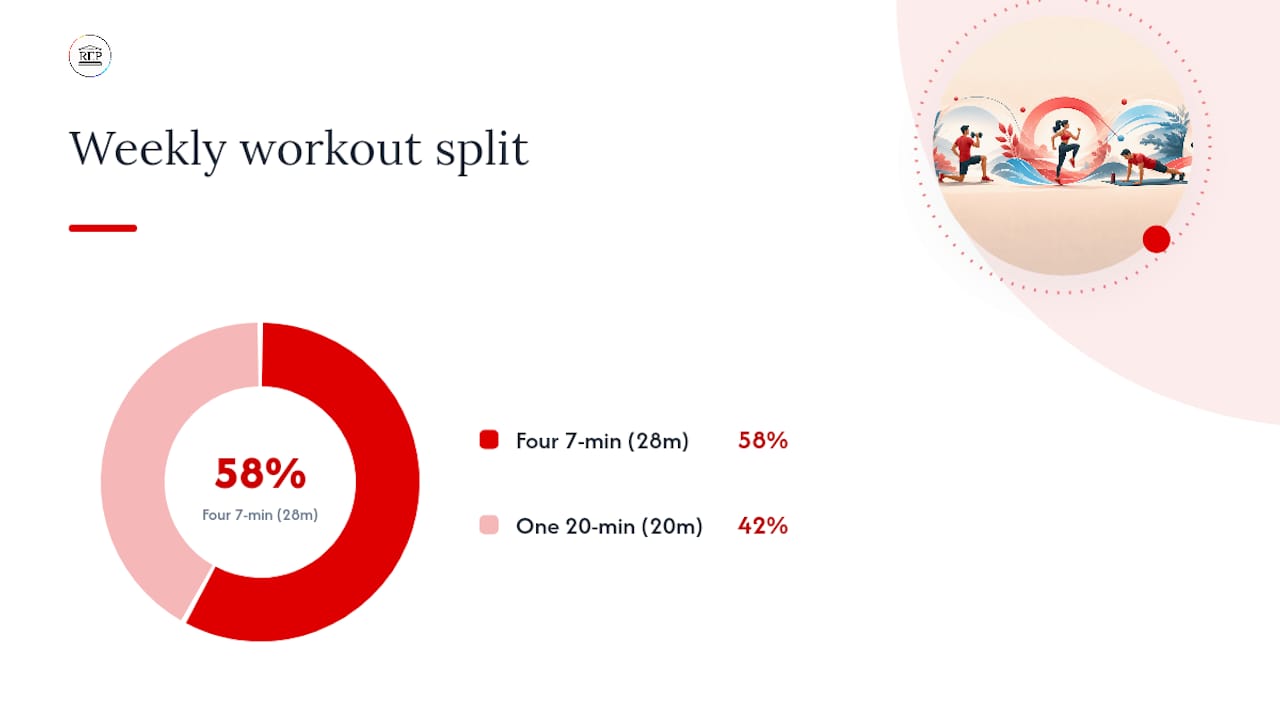
Stop measuring success by daily minutes and start measuring it by weekly totals. Four 7-minute sessions and one 20-minute session add up to nearly an hour of focused training, and that weekly framing takes the pressure off any single day that goes sideways.
Three windows tend to work best for parents: before the kids wake up, during a nap or quiet-time block, and split sessions where you knock out 10 minutes in the morning and 10 more after bedtime. None of these require a perfect hour. They require a repeatable slot you defend the same way you defend a pediatrician appointment.
A few habit tools make this easier to sustain:
- Habit stack it. Attach the workout to something already automatic, like right after you start the coffee maker.
- Use the one-decision rule. Decide the night before which template you're doing, so morning-you has zero decisions left to make.
- Keep gear visible. A mat left out in the living room gets used far more than one stored in a closet.
- Calendar-block it like a meeting. Treat the slot as non-negotiable, not aspirational.
Pro Tip: Pair up with another parent for quick accountability check-ins, or rotate through an on-demand video library on the days you're training solo. Either option removes the "what do I even do today" hesitation that kills momentum.
Family Workout Ideas That Turn Exercise Into Playtime
Two templates make this simple. The play-based circuit turns squats into "monster stomps," lunges into "giant steps," and planks into a "bridge the alligators can't cross" game, run in 4 to 5 rounds with a stopwatch your kid controls. The partner strength template has you do sit-ups while a school-age child holds your feet, or squats while holding a toddler safely at chest height for added resistance.
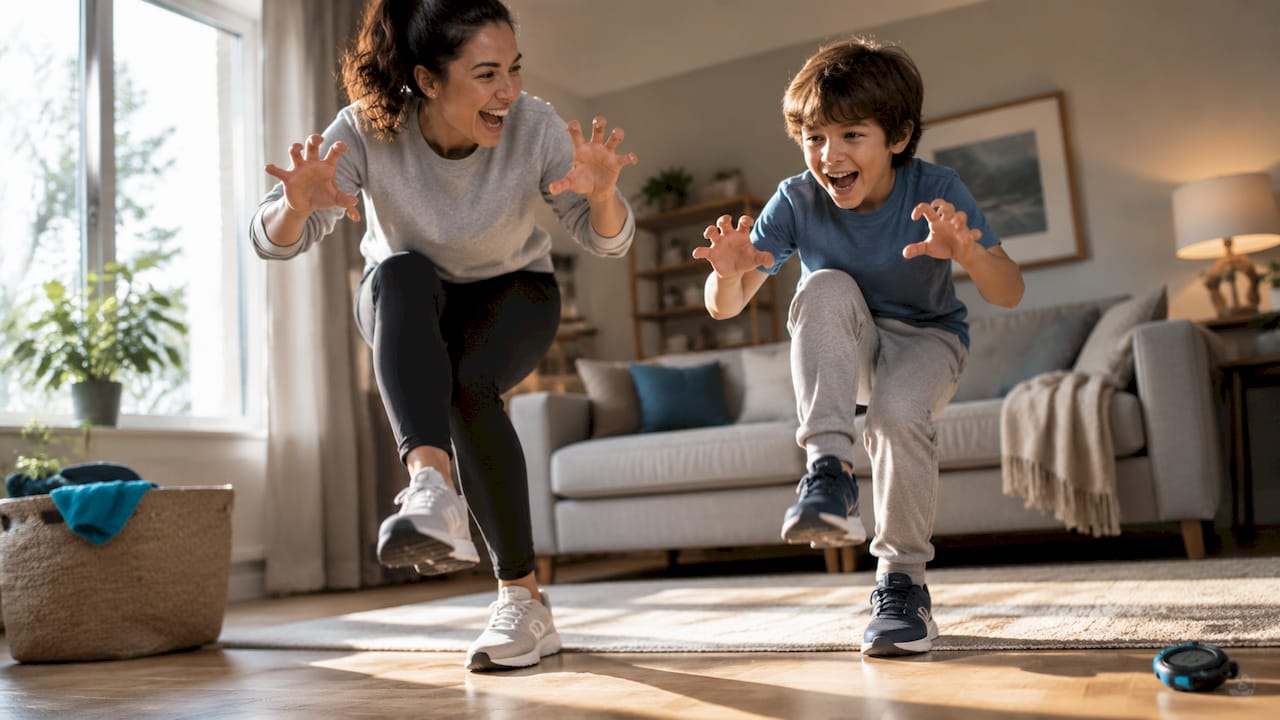
A few notes on making it work: use imagination and short challenges rather than reps and sets for kids under 6, and add timers or small rewards (extra story before bed, choosing dinner) for kids old enough to compete against a clock. Toddlers need constant supervision and lighter loads; school-age kids can handle actual timed intervals and simple competitions.
The Washington Post's reporting on family exercise found that involving children in short circuits increases both enjoyment and adherence, which matters because kids who watch parents move regularly are more likely to build the same habit themselves. That's not a minor side benefit. It's the whole point of doing this in front of them at all.
What Equipment Do You Actually Need?
Almost none, but a small investment pays off fast.
Household substitutes work fine in a pinch:
- Backpack loaded with books instead of a weighted vest
- Sturdy chair or coffee table edge for rows and step-ups
- Towel on hardwood floors for sliding lunges
Skip anything with wheels, wobble, or sharp edges for substitutes, and never use glass-based furniture as a support point. Before buying anything, run through a quick checklist: how much time do you realistically have per session, how much floor space is available, what's your budget, and does anyone else in the family need to use the same gear. Store equipment somewhere visible, not in a garage bin you'll forget exists.
Training Safely When Every Session Is a Short Burst
Progress in micro-workouts comes from small, deliberate increases: one more round, two more reps per set, or a slightly heavier load, not all three at once. Soreness 24 to 48 hours after a new movement pattern is normal delayed-onset muscle soreness. Sharp pain during a movement, or joint pain that lingers past 72 hours, is not, and that's your signal to stop and modify rather than push through.
Recovery basics matter more when sessions are short and frequent: prioritize sleep, stay hydrated, and don't skip the mobility work. Current activity guidelines confirm that shorter bouts of movement spread across the week still meet meaningful activity targets, which is exactly why consistency beats intensity for most parents. Postpartum parents and anyone managing an injury or chronic condition should get clearance from a medical professional before progressing intensity.
Coach Justin's Take on Training Around Family Chaos
A coaching approach can be effective when built around the belief that consistency beats heroics. REP Philosophy's Virtual Personal Trainer Videos exist because most parents don't need more motivation, they need a workout that's already decided for them. Try this 7-day micro-protocol: five days of 7-minute HICT circuits, one 20-minute strength session, one full rest day.
Why Tiny, Repeatable Habits Beat the Occasional Big Workout
I've seen the pattern play out the same way over and over: parents who chase one perfect 90-minute gym session a week burn out fast, while parents who commit to five unglamorous 7-minute sessions build a habit that survives sick days, work deadlines, and school pickups. One client-adjacent pattern that keeps showing up is simple: the parents who stick with it are the ones who schedule the next micro-workout before they finish the current one. Do that right now. Put ten minutes on tomorrow's calendar.
— Coach Justin
Ready for a Workout Plan That Fits Your Actual Life?
If you can carve out 30 minutes and drive to 4S Ranch, in-person 30-minute personal training gets you focused coaching without the wasted time of a typical hour-long gym session. If your week is too unpredictable for a fixed appointment, the on-demand video library gives you guided micro-workouts and full sessions you can start the moment your kid finally falls asleep, no scheduling required.

Not sure which fits better? If your biggest obstacle is remembering what to do, start virtual. If your biggest obstacle is accountability, book in-person. Either way, REP Philosophy's personal training packages are built around real family schedules, not gym-rat routines you'll never sustain. For families exploring youth athletic development alongside their own training, WayALife Athletics covers structured sports performance programs in the same location. Browse the full range of options at REP Philosophy's shop and pick one thing to try this week.
Where This Guidance Comes From
- Washington Post — Family Workout Coverage
- Harvard Health — The Dangers of Sitting
- DojoTrack — Talking to Your Child's Martial Arts Instructor