
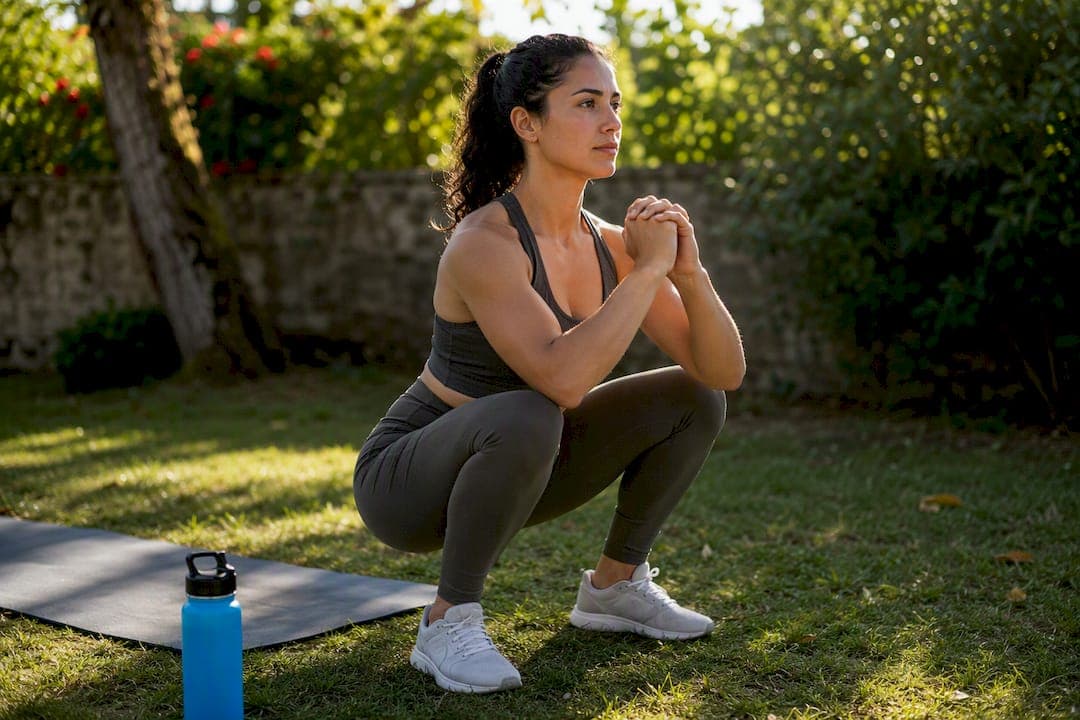
The main types of functional fitness exercises fall into ten movement patterns: squat, hinge, lunge, push, pull, carry, rotation, single-leg/balance, core bracing, and mobility work, and each one trains a movement you already rely on every single day. These aren't fancy gym moves designed to look impressive. They're the building blocks behind standing up from a chair, lifting a laundry basket, and catching yourself when you stumble on a curb.
Here's a taste of what's ahead:
- Bodyweight squat — trains the pattern behind sitting and standing
- Kettlebell swing — builds the hip power behind lifting and bending
- Farmer's carry — strengthens your grip and core for hauling groceries or kids
I'll walk you through categorized examples for every pattern, show you how to scale each one up or down, and hand you three complete sample workouts you can start using this week.
Key Takeaways
Functional fitness works because it trains the ten movement patterns your body already relies on for standing, bending, lifting, carrying, and staying balanced every single day.
| Point | Details |
|---|---|
| Ten core patterns | Squat, hinge, lunge, push, pull, carry, rotation, single-leg/balance, core bracing, and mobility cover nearly every daily movement. |
| Regress before you load | Master a bodyweight or chair-supported version of each pattern before adding weight or complexity. |
| Programming frequency | Most people benefit from 2 to 3 full-body functional sessions per week, per general coaching consensus. |
| Older adults get outsized benefits | Practicing sit-to-stand, bending/lifting, and carrying directly supports daily independence. |
| Get coached, not just informed | Repphilosophy offers in-person and virtual coaching in 4S Ranch to assess your movement and build regressions or progressions around it. |
Table of Contents
- What Are the Main Types of Functional Fitness Exercises?
- Three Sample Workouts You Can Start This Week
- How to Choose the Right Exercises and Train Safely
- Modifications for Older Adults, Beginners, and Busy Schedules
- Why I Build Every Program Around These Ten Patterns
- Get Coached Through These Movements, Not Just Handed a List
- Frequently Asked Questions
- Sources
What Are the Main Types of Functional Fitness Exercises?
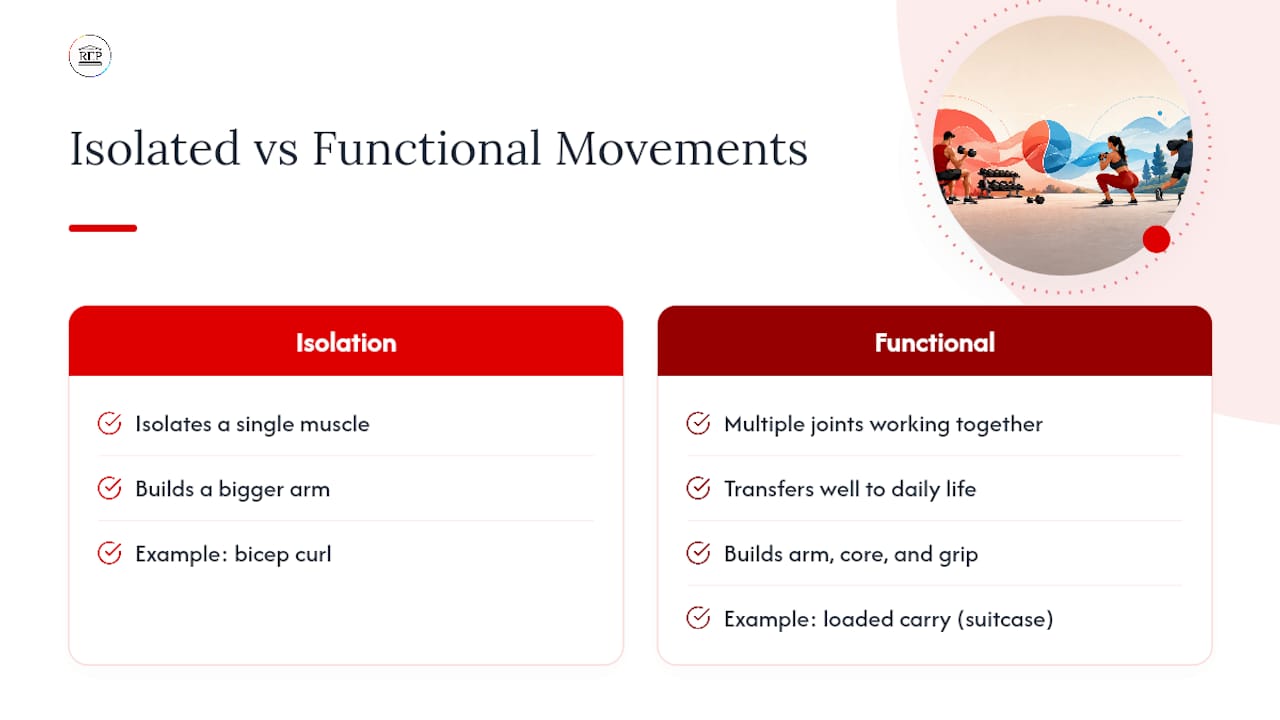
Functional strength training centers on exercises that mirror what your body actually does outside the gym: standing, sitting, bending, pushing, pulling, rotating, and carrying. According to the Cleveland Clinic, these movements typically involve multiple joints working together rather than isolating a single muscle, which is exactly why they transfer so well to daily life. A bicep curl builds a bigger arm. A loaded carry builds an arm, a core, and a grip that can actually hold a heavy suitcase overhead-bin height without your shoulder screaming.
Let's break down each movement pattern and give you exercises you can try today.
Squat: the sit-to-stand pattern
Every time you lower into a chair, get off the toilet, or pick something up off the floor with bent knees, you're squatting. Losing this pattern is one of the fastest ways older adults lose independence.
Bodyweight squat. Stand with feet shoulder-width apart, push your hips back like you're reaching for a chair behind you, then drive through your heels to stand. Watch for knees caving inward and heels lifting off the ground. Regress it by squatting to an actual chair seat and tapping down. Progress it by holding a dumbbell at your chest (a goblet squat) or slowing the descent to a 4-second count. Aim for 2 to 3 sets of 10 to 15 reps.
Box or chair squat. This is the training-wheels version of the squat and one of the best entry points for anyone rebuilding confidence in their knees or hips. Sit down under control, pause briefly, then stand back up without using your hands. Once that feels easy, remove the pause and add a slight jump at the top for a power progression.
Hinge: the bending and lifting pattern
The hip hinge is the single most misunderstood movement in the gym, and it's also the pattern that saves your lower back when you pick up a heavy box the right way instead of rounding over it.
Kettlebell deadlift. Stand over the kettlebell, push your hips backward while keeping your shins mostly vertical, grip the handle, and stand up by driving your hips forward. Your back should stay flat throughout, not rounded. Beginners should start with a light dumbbell or even just a broomstick to groove the pattern. More advanced lifters can move to a barbell deadlift or single-leg Romanian deadlift for added balance demand. Work in the 2 to 4 sets of 6 to 10 rep range.
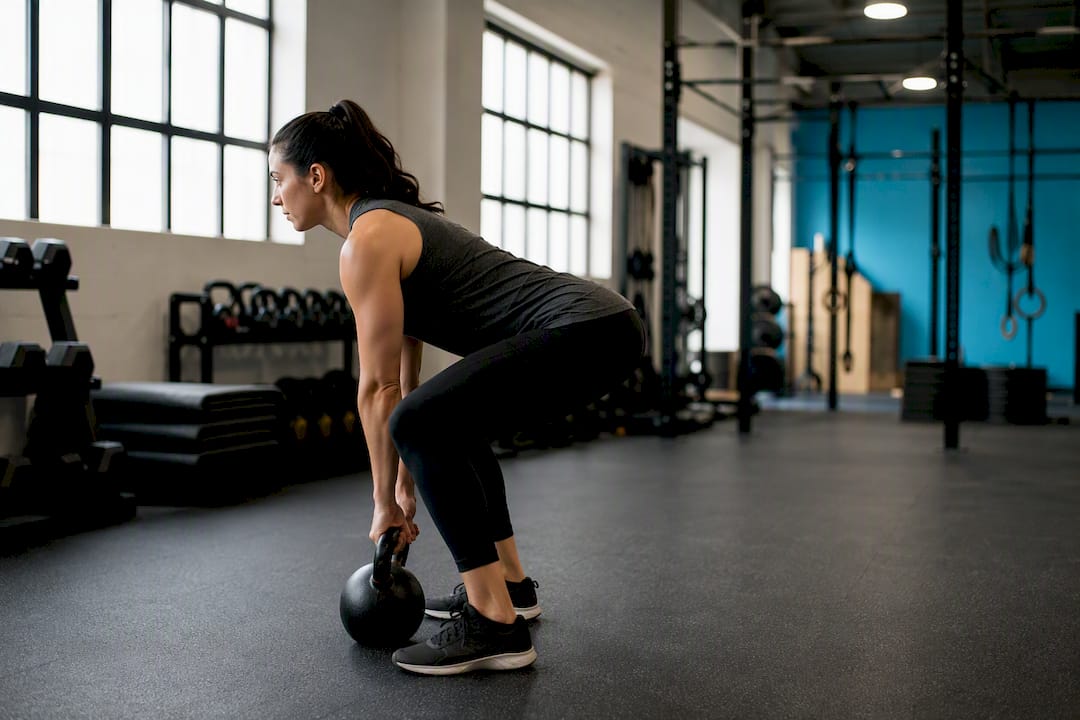
Kettlebell swing. This one deserves its own spotlight because it teaches explosive hip power better than almost anything else. Hike the kettlebell back between your legs, then snap your hips forward to drive it up to chest height, letting the arms stay relatively passive. Harvard Health highlights a close cousin of this move, the kettlebell high pull, as one of three essential functional exercises for older adults because it trains the bending-and-lifting pattern under control. Start with a light kettlebell and a shortened range if you're new to it; progress by increasing weight or moving to a heavier single-arm swing.
Pro Tip: Cue "hips back, chest proud" before every hinge rep. If a client's back rounds before their hips even start moving, that's the form checkpoint that matters more than the weight on the bar.
Lunge: the walking and stepping pattern
Lunges train each leg independently, which matters because real life rarely loads both legs evenly. Walking upstairs, stepping over a curb, and recovering from a stumble all live here.
Forward lunge. Step forward, drop your back knee toward the floor, and push through the front heel to return to standing. Keep your front knee tracking over your ankle rather than caving inward. Regress it to a stationary split squat where you don't step, just lower and rise in place. Progress by adding dumbbells or elevating the back foot on a bench for a rear-foot-elevated split squat. Two to 3 sets of 8 to 12 reps per leg is plenty to start.
Step-up. Using a sturdy step or low bench, drive up through one leg until you're standing fully on top, then lower back down with control. This one translates directly to stairs, curbs, and getting in and out of a truck bed. Start with a lower step height and work up to knee-height as strength improves.
Push: pressing things away from your body
Pushing a door open, lifting a suitcase into an overhead bin, or pressing yourself up off the floor all rely on this pattern.
Push-up. Hands under shoulders, body in a straight line from head to heels, lower your chest toward the floor and press back up. Sagging hips are the most common fault. Regress by performing the push-up against a wall or an elevated surface like a countertop; progress by lowering to the floor or elevating the feet. Shoot for 2 to 4 sets of 6 to 12 reps.
Overhead press. Press a dumbbell or kettlebell from shoulder height straight overhead without arching your lower back. Start seated for more stability, then progress to standing once your core can control the position.
Pull: the opposing pattern that protects your posture
Most people push far more than they pull in daily life, which is exactly why rounded shoulders and a stiff upper back become so common. Pulling exercises correct that imbalance.
Bent-over row. Hinge forward slightly, hold a dumbbell in each hand, and pull your elbows back so the weight travels toward your ribs. Keep your neck neutral instead of craning it forward. Beginners can row one arm at a time while supporting themselves on a bench; more advanced trainees can add a resistance band or heavier load.
Inverted row or band pull-apart. If you have access to a suspension trainer or sturdy bar, the inverted row (body angled underneath, pulling your chest to the bar) is a fantastic scalable pulling exercise. Without equipment, a simple band pull-apart at shoulder height still trains the same upper-back muscles that keep your posture upright at a desk all day.
Carry: loaded walking for grip and core
Carrying groceries, moving furniture, or hauling a toddler on one hip are all loaded carries in disguise, and they're one of the most underused tools in general fitness programming.
Farmer's carry. Hold a heavy dumbbell or kettlebell in each hand and walk a set distance or for a set time, keeping your shoulders pulled back and torso upright. This move builds grip strength that research on grip diagnostics links closely to broader markers of physical capability. Regress it with lighter weights or a shorter distance; progress with heavier loads, longer distances, or a single-arm suitcase carry that forces your core to resist tipping sideways. Try 2 to 3 sets of 30 to 40 seconds or 40 to 60 feet.
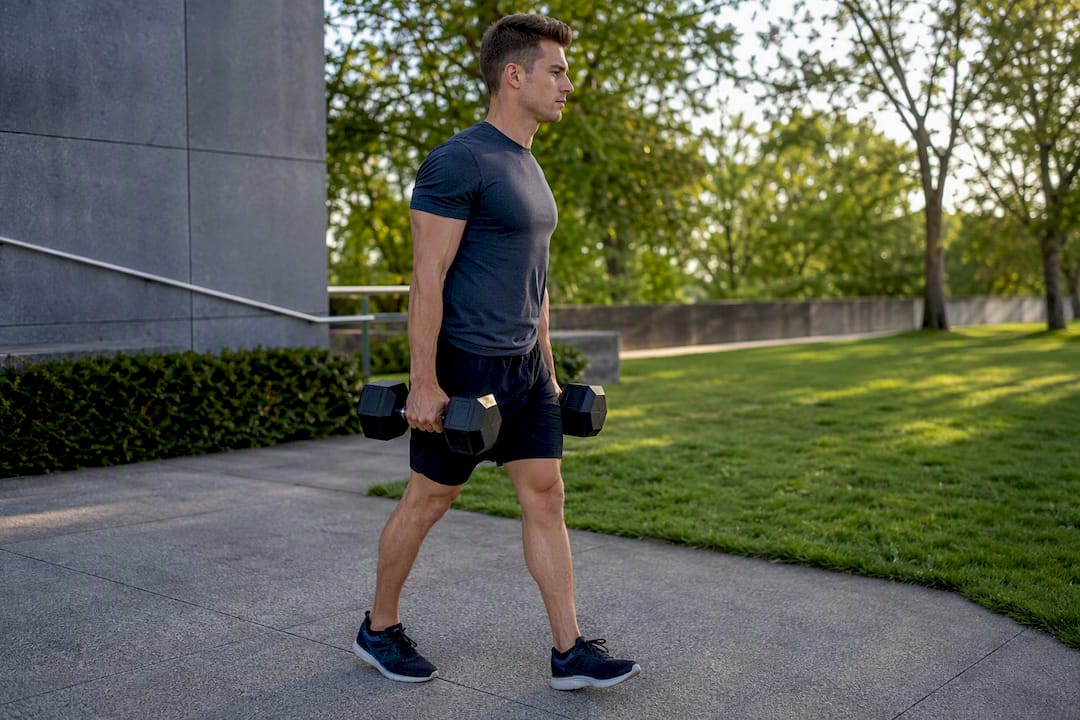
Overhead carry. Hold a light weight overhead with a locked-out arm while walking a short distance, switching arms halfway. This adds a shoulder stability challenge on top of the core demand.
Rotation and anti-rotation: twisting and resisting the twist
Reaching across your body, swinging a golf club, or simply turning to grab something off a back seat all involve rotation. Just as important is anti-rotation, which is your core's ability to resist an unwanted twist.
Pallof press. Anchor a resistance band at chest height, hold the handle at your sternum, and press it straight out in front of you without letting your torso rotate toward the anchor point. This is one of the best anti-rotation drills because the resistance is constantly trying to twist you and your job is to stay square. Two to 3 sets of 8 to 12 reps per side works well.
Wood chop. Using a cable, band, or medicine ball, rotate from a high position near one shoulder down and across to the opposite hip, pivoting your back foot as you go. Keep the movement coming from your torso and hips rather than just your arms.
Single-leg and balance: staying upright and steady
Balance training doesn't get the attention it deserves until someone has a near-fall, and by then it's playing catch-up. According to NASM, functional training generally favors free-motion, compound movements precisely because they force your body to stabilize itself the way real life demands.
Single-leg stance. Stand on one foot near a wall or counter for support, holding for 20 to 30 seconds per side. It sounds almost too simple, but it's a genuine test and builder of ankle and hip stability. Progress by closing your eyes, standing on an unstable surface like a pillow, or holding light weights.
Single-leg Romanian deadlift. Standing on one leg, hinge forward while extending the opposite leg back for counterbalance, then return to standing. This combines the hinge pattern with a serious balance demand and is one of the better bridges between basic strength work and true functional carryover.
Core and bracing: the pattern underneath every other pattern
Nearly every functional exercise depends on a stable core, which is different from having visible abs. Bracing means creating tension through your midsection to protect your spine under load.
Dead bug. Lying on your back, arms reaching toward the ceiling and knees bent at 90 degrees, slowly lower one arm and the opposite leg toward the floor while keeping your lower back pressed into the ground. This teaches core control without spinal flexion, which is safer for most backs than crunches.
Plank. Hold a straight-line position on your forearms and toes, squeezing your glutes and bracing your abs like you're about to take a punch. Regress it to a knee plank; progress it by lifting one foot slightly off the ground.
Mobility: the pattern that lets the others work
Mobility work isn't a separate category so much as the oil that keeps the other patterns running smoothly. Tight hips make hinging and squatting harder; a stiff thoracic spine limits your rotation and overhead press.
Hip flexor stretch. Kneel in a half-lunge position and gently press your hips forward until you feel a stretch along the front of the rear hip. Hold for 20 to 30 seconds per side.
Thoracic rotation (open book). Lying on your side with knees bent, rotate your top arm across your body and toward the floor behind you, opening your chest toward the ceiling. This directly supports the rotation and overhead pressing patterns above.
Three Sample Workouts You Can Start This Week
Programming matters as much as the exercises themselves. The NASM approach to functional training favors compound, free-motion movements arranged into balanced circuits, and that's the model behind each workout below.
Beginner circuit (about 20 minutes). Perform each move for 30 seconds, rest 30 seconds, and complete 2 rounds: chair squat, wall push-up, band pull-apart, single-leg stance (each side), dead bug.
Intermediate session (about 35 minutes). This one mixes strength work with movement quality. Warm up for 5 minutes, then complete 3 rounds of: goblet squat (10 reps), kettlebell swing (12 reps), bent-over row (10 reps per side), farmer's carry (40 seconds), Pallof press (10 reps per side), resting 60 to 90 seconds between rounds. Add weight or reps every two weeks as the circuit starts feeling manageable.
Older-adult / daily functional routine (about 15 minutes). Focus stays on balance, sit-to-stand strength, and short carries: stationary split squat (8 reps per side), single-leg stance near a counter (20 seconds per side), short farmer's carry (20 to 30 feet), seated overhead press with light weights (10 reps). Keep tempo slow and controlled, and always have a stable surface nearby for balance support.
| Workout Component | Time Estimate | Intensity |
|---|---|---|
| Beginner circuit | 20 minutes | Low |
| Intermediate strength/carry circuit | 35 minutes | Medium to high |
| Older-adult daily routine | 15 minutes | Low |
| Optional conditioning finisher (walk, bike, rower) | 10 minutes | Low to medium |
That optional conditioning finisher isn't filler. Mayo Clinic notes that aerobic conditioning builds the endurance needed for repeated daily tasks and supports recovery between strength sessions, which is exactly why a short walk or bike ride pairs well with any of these circuits.
How to Choose the Right Exercises and Train Safely
Picking the right functional exercise variations starts with an honest look at four things: your goals, your current movement limitations, the equipment you have access to, and how much time you can realistically commit each week. Someone recovering from a knee issue needs a very different starting point than someone training for a weekend hiking trip.
Run through this checklist before you start any new functional routine:
- Identify your primary goal (independence, sport, general strength, injury prevention).
- Note any current pain, recent surgery, or joint limitations.
- List the equipment you actually have (bodyweight only, dumbbells, kettlebells, bands).
- Decide how many days per week you can realistically train.
- Get medical clearance if you have a cardiovascular condition, recent injury, or haven't exercised in a long time.
Form mistakes tend to repeat themselves across categories. Watch for these common ones:
- Knees caving inward during squats and lunges instead of tracking over the toes.
- A rounded lower back during hinges and deadlifts instead of a flat, neutral spine.
- Shrugged shoulders creeping toward the ears during carries and presses.
- Holding your breath through an entire set instead of exhaling on exertion.
On programming, peer-reviewed research summarized in PMC supports multi-joint functional training for improving mobility and functional performance across a wide range of populations, and most coaches build from there with 2 to 3 full-body sessions per week as a starting frequency. Progress by adjusting one variable at a time: add load before you add complexity, and add complexity before you add speed.
Pro Tip: If a movement causes sharp, localized pain (not the general burn of effort), stop immediately. Dull muscle fatigue is normal; joint pain, dizziness, or chest tightness are signals to see a physical therapist or your doctor before continuing.
Anyone with uncontrolled dizziness, a recent surgery, or a diagnosed heart condition should get individualized guidance rather than following a generic program, functional or otherwise.
Modifications for Older Adults, Beginners, and Busy Schedules
Nobody should feel locked out of functional training because a standard exercise looks intimidating on paper. Every move above has a doable entry point.
For older adults, the sit-to-stand from a firm chair replaces the bodyweight squat, wall push-ups replace floor push-ups, and a chair-supported split squat replaces the standard lunge. Harvard Health specifically calls out getting up and down, bending and lifting, and carrying as the three movement categories worth prioritizing for older adults, since they map directly onto daily independence. A moderate number of slow, controlled repetitions with adequate rest between sets is a reasonable starting point.
For beginners of any age, starting light and mastering the pattern before adding load is the standard, sensible approach echoed across most beginner training guides. There's no rush to load a kettlebell swing if the hip hinge itself still feels awkward.
Stronger trainees push the other direction: add single-leg variations, increase carry distance or load, and expand range of motion on hinges and squats. Combining a balance challenge with light loading, like a single-arm farmer's carry, builds real-world stability that a machine exercise simply can't replicate.
For busy schedules, a 10 to 15 minute circuit hitting one squat variation, one hinge or carry, one push, and one pull covers most of the essential patterns in a single short session. If you only have time for two exercises, prioritize a hinge and a carry. They deliver the most daily-life carryover per minute invested.
- Older adults: sit-to-stand, wall push-up, chair-supported split squat, short carry.
- Beginners: bodyweight-only versions of each pattern, full range before adding load.
- Busy schedules: 10 to 15 minute circuits prioritizing hinge and carry patterns.
- Stronger trainees: single-leg loading, longer carries, expanded range of motion.
Pro Tip: Pair a balance move with a light loaded carry rather than doing them separately. A short single-arm farmer's carry while consciously keeping your torso level trains stability and strength in the same rep.
Why I Build Every Program Around These Ten Patterns
I don't program by muscle group, and I never have. When a client tells me their goal is "getting stronger," what they usually mean is they want to carry their own suitcase, get off the floor without using their hands, or keep up with their kids without their lower back barking at them the next day. That's a movement problem, not a muscle problem, and it's why these ten patterns sit at the center of everything I build.
What surprises most new clients is how much a stronger sit-to-stand pattern changes their confidence in unrelated situations, like hiking downhill or getting up from a low couch without bracing on the armrest. That's the real payoff of functional training, and it shows up faster than most people expect.
My focus stays on adaptive programming, meaning the regression or progression fits the person in front of me, not a one-size template. That matters just as much for a busy parent squeezing in 15 minutes as it does for an older adult rebuilding confidence after a fall. Speaking of which, here's how to put this into practice with some actual support behind you.
Get Coached Through These Movements, Not Just Handed a List
Reading about the squat, hinge, and carry patterns is one thing. Having someone watch your first rep and catch the knee cave or the rounded back before it becomes a habit is another thing entirely, and it's where Repphilosophy fills the gap that a workout article never can. Based in 4S Ranch, Repphilosophy offers in-person personal training, small-group and buddy memberships for a lower cost per session, youth sports performance programs, and virtual personal training with a full on-demand exercise library for anyone training from home.
A first session typically starts with an honest movement assessment: how your squat, hinge, and balance actually look right now, followed by regressions or progressions built around what your body needs instead of a generic template. If you're local to 4S Ranch and want a hands-on start, book a personal training trial session to get coached through your first real functional workout. Prefer to train on your own schedule? The on-demand exercise library gives you guided video access to build these patterns at home, at your pace.
Frequently Asked Questions
What are the main types of functional fitness exercises? The main types of functional fitness exercises are organized around ten movement patterns: squat, hinge, lunge, push, pull, carry, rotation, single-leg/balance, core bracing, and mobility. Each pattern mirrors a specific everyday task, from standing up out of a chair to carrying groceries.
How do I start functional fitness training as a complete beginner? Start with bodyweight versions of each movement pattern, like a chair squat, wall push-up, and dead bug, and focus entirely on form before adding any load. Most beginner guides recommend two to three sessions per week, gradually adding weight only once the pattern feels controlled and pain-free.
What are some simple examples of functional exercises I can do at home? Bodyweight squats, push-ups against a counter, band pull-aparts, farmer's carries using grocery bags, and a single-leg balance drill near a wall all require little to no equipment and cover several movement patterns at once.
How often should I do functional training each week? Two to three full-body sessions per week is a reasonable starting frequency for most people, allowing at least one rest or light-activity day between sessions to recover.
Are functional fitness exercises safe for older adults? Yes, when properly regressed. Sit-to-stand squats, chair-supported split squats, and short carries are specifically highlighted for older adults because they build the strength and balance needed for daily independence, though anyone with a recent injury or cardiovascular condition should get medical clearance first.
Sources
- Getting Started With Functional Strength Training
- Three moves for functional fitness - Harvard Health
- PMC article (functional movement / exercise evidence)
- Functional Training: Compound Workouts for Fitness
- Aerobic exercise - Mayo Clinic