
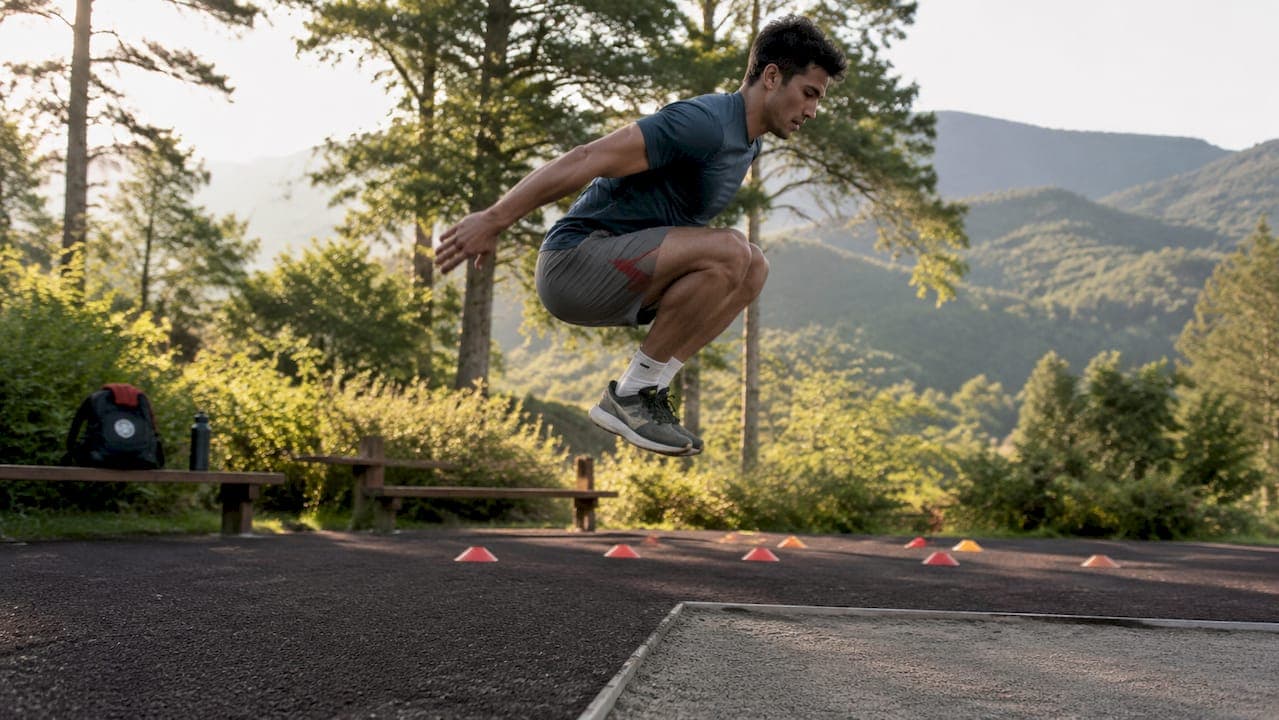
The max broad jump, formally known as the standing long jump, measures your horizontal explosive power by combining strength, speed, and technique in a single movement. It is one of the most direct tests of athletic ability used in sports science and performance evaluation. College male athletes typically jump 230–260 cm, while untrained adult men average 180–215 cm. At the elite end, Byron Jones set the NFL Combine world record at 373 cm in 2015. Whether you are chasing a personal best or preparing for a combine, understanding what drives distance is the first step toward real improvement.
What determines your max broad jump distance?
Takeoff velocity is the single biggest factor in how far you jump. Elite male athletes reach takeoff velocities of 4.2–4.5 m/s, while recreational males average 3.0–3.5 m/s. That gap explains most of the distance difference between a good athlete and a great one.
Jump distance depends more on mechanical efficiency and takeoff velocity than raw strength alone. An athlete who moves well and applies force quickly will consistently out-jump a stronger athlete with poor mechanics. This is why technique refinement pays off faster than adding weight to your squat.
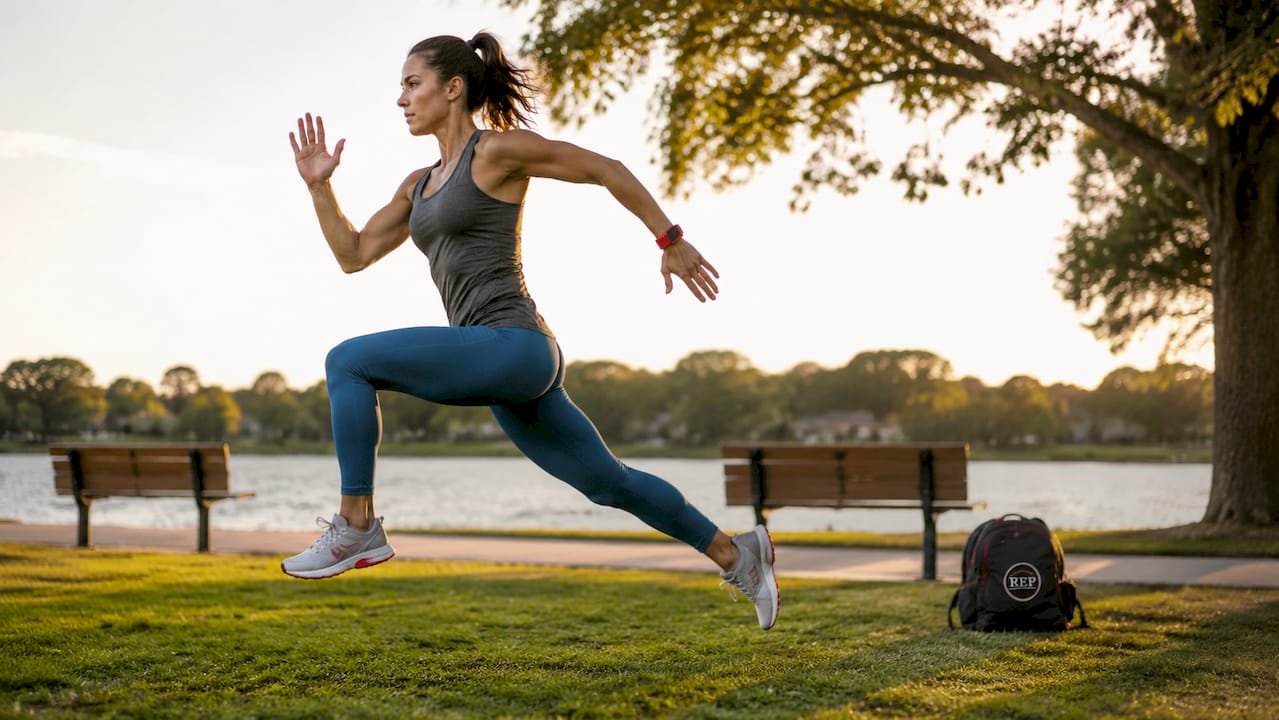
The broad jump also has a strong connection to sprint performance. Sprint acceleration correlates with the standing long jump at r=0.70–0.87, making it a reliable proxy for field speed. Coaches at every level use it to screen athletes for explosive capacity, which is why understanding your numbers matters for sports performance development.
How to nail your broad jump technique
Proper technique follows a clear sequence. Each phase builds on the last, and skipping any one of them costs you distance.
- Set your stance. Stand with feet shoulder-width apart, toes just behind the takeoff line. Bend your knees to roughly 90 degrees and load your hips back.
- Drive your arms. Swing both arms back, then forward explosively as you leave the ground. Proper arm swing increases jump distance by 10–15% compared to no arm swing.
- Achieve triple extension. Push through your hips, knees, and ankles simultaneously at takeoff. This triple extension of hips, knees, and ankles produces maximal force and is the mechanical foundation of every great jump.
- Hit the right angle. The optimal takeoff angle is 35–42 degrees, not the theoretical 45 degrees. Biomechanical constraints during explosive horizontal extension make a flatter trajectory more effective for most athletes.
- Stick the landing. Reach your legs forward and absorb the impact in a balanced squat. Landing behind your heels invalidates the attempt, so practice a controlled finish every time.
Pro Tip: Film your jumps from the side. A slow-motion review reveals takeoff angle and arm timing errors that you cannot feel in real time.
The most common technical mistake is excessive forward lean at takeoff. Leaning too far forward drops your angle below the effective range and reduces horizontal distance. Keep your chest up through the drive phase and let your hips lead the movement.
How to measure broad jump performance correctly
Accurate measurement requires consistent conditions every time you test. Small changes in surface, footwear, or warm-up routine can shift your results by several centimeters, making progress hard to track.
The standard protocol calls for 3 maximal attempts with 60–90 seconds of rest between each. Record the best of the three attempts. A tape measure from the takeoff line to the nearest point of contact at landing gives you the official distance. Jump mats and inertial measurement unit (IMU) sensors add data on takeoff velocity, angle, and rate of force development, which helps coaches pinpoint what to fix.
Pro Tip: Always test at the same time of day and after the same warm-up. Consistency in warm-up and measurement conditions is the only way to make valid comparisons over time.
Use the table below to benchmark your current performance:
| Category | Males (cm) | Females (cm) |
|---|---|---|
| Untrained adults | 180–215 | 120–150 |
| College athletes | 230–260 | 170–200 |
| Elite athletes | 335+ | 250+ |
| NFL Combine record | 373 | N/A |
Beyond raw distance, track symmetry between your left and right leg. Asymmetry above 12% in takeoff impulse increases injury risk and reduces lateral movement performance. Monitoring both legs separately during single-leg broad jump tests gives you a clear picture of imbalances to address.
What training actually improves your broad jump?
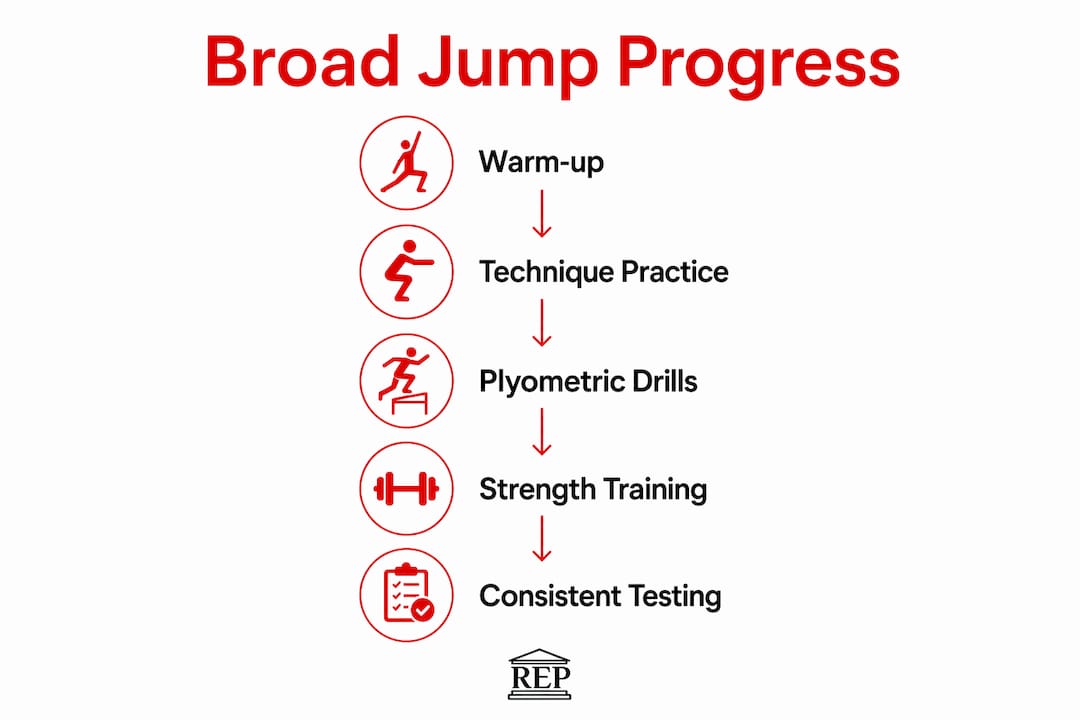
The most effective broad jump training combines horizontal plyometrics with targeted strength work. Neither alone produces the same result as both together.
Horizontal plyometrics
Horizontal plyometrics train the exact movement pattern of the broad jump. Bounding, broad jump repeats, and hurdle hops all develop the reactive strength and ground contact efficiency that translate directly to distance. Minimizing ground contact time in consecutive broad jumps builds horizontal reactive strength, which is the key quality for performance improvement.
Use full recovery between sets to keep quality high. Rest 90–120 seconds between 3–4 sets of 4–6 reps of horizontal plyometrics. Fatigue kills power output, and tired jumps reinforce poor mechanics.
Strength training priorities
- Squats and trap bar deadlifts. These build the quad and glute strength that powers triple extension at takeoff. Focus on full range of motion and controlled descent.
- Romanian deadlifts. Posterior chain strength directly supports hip drive at takeoff. Weak hamstrings and glutes are a common limiter in athletes who plateau.
- Olympic lifts. Power cleans and hang cleans develop rate of force development, which is the ability to apply strength quickly. This quality matters more than peak strength for jump distance.
- Single-leg work. Bulgarian split squats and single-leg Romanian deadlifts correct the asymmetries that limit distance and raise injury risk.
Pro Tip: Progress from standing broad jumps to bounding to depth jumps over 6–8 weeks. Jumping straight to advanced variations before mastering the basic pattern leads to poor mechanics under load.
Recovery and mobility are not optional extras. Tight hip flexors and limited ankle dorsiflexion both restrict your takeoff angle and reduce triple extension. Spend 10 minutes after every session on hip flexor stretches and ankle mobility work. Athletes who treat recovery as part of training consistently outperform those who skip it. For a deeper look at the mental side of recovery, mental reprogramming for athletes is worth reading.
Common mistakes that cap your broad jump progress
Most athletes plateau not because they lack strength but because they repeat the same technical errors in every session. Identifying the specific flaw is faster than adding more volume.
- Excessive forward lean at takeoff. This drops your angle below 35 degrees and sends force into the ground rather than forward. Fix it by cueing "chest up, hips through" at the moment of extension.
- Inconsistent knee angle. A ±5% fluctuation in knee joint angle causes a 2.46% change in jump distance. Small inconsistencies in your setup position compound into significant distance losses across attempts.
- Restricted arm swing. Keeping your arms tight or swinging only one arm reduces momentum transfer. Both arms must swing back fully and drive forward together at takeoff.
- Landing behind your heels. Falling back on landing not only invalidates the attempt but signals that your leg reach and landing control need work. Practice landing in a stable squat with your weight centered over your midfoot.
- Ignoring asymmetry. If one leg consistently produces less force than the other, your jump will drift sideways and lose distance. Single-leg testing every 4 weeks catches this early.
Pushing for more distance before fixing these errors is counterproductive. One clean, technically sound jump teaches your nervous system more than ten sloppy attempts. Athletes who focus on quality over quantity in each session see faster gains and fewer setbacks. For young athletes building these skills early, youth speed and agility training addresses these same movement fundamentals in a structured environment.
Key Takeaways
The max broad jump improves fastest when athletes prioritize takeoff velocity, triple extension mechanics, and consistent horizontal plyometric training over raw strength alone.
| Point | Details |
|---|---|
| Takeoff velocity drives distance | Elite athletes reach 4.2–4.5 m/s; closing that gap requires plyometrics and power training. |
| Optimal angle is 35–42 degrees | Aiming for the theoretical 45 degrees reduces distance due to biomechanical constraints. |
| Arm swing adds 10–15% distance | Both arms must swing fully back and drive forward together at every takeoff. |
| Rest between sets matters | Use 90–120 seconds of rest between plyometric sets to maintain power output and clean mechanics. |
| Track symmetry, not just distance | Asymmetry above 12% in takeoff impulse raises injury risk and limits lateral performance. |
Why technique beats strength every time
I have trained athletes at every level, from high school kids chasing a college offer to adults who just want to feel athletic again. The pattern I see most often is this: athletes spend months adding weight to their lifts and wonder why their broad jump barely moves. The answer is almost always mechanics, not muscle.
The athletes who make the biggest jumps in distance, often 20–30 cm in a single training block, are the ones who commit to fixing one technical flaw at a time. A cue as simple as "drive your arms" or "push the floor away" can unlock distance that months of squatting never did. Strength is the foundation, but mechanics are the multiplier.
Quality over quantity applies here more than anywhere else in athletic training. I would rather see an athlete take three perfect jumps and stop than grind through ten sloppy ones. Fatigue corrupts the pattern, and a corrupted pattern practiced repeatedly becomes a habit. The nervous system learns what you repeat, so make what you repeat worth learning.
Mental focus matters too. The athletes who treat each attempt as a performance, not just a practice rep, consistently jump farther. Set up deliberately, breathe, and commit fully to every single jump. That mindset, combined with the right training structure, is what separates athletes who plateau from those who keep improving.
— Coach Justin
Train with Repphilosophy and jump farther
If you are ready to put these principles into practice with expert guidance behind you, Repphilosophy is built for exactly that. Based in 4S Ranch, the WayALife Athletics sports performance center offers in-person coaching focused on explosive power, jump mechanics, and real athletic development in a challenging and supportive environment.

Not local? Repphilosophy's virtual personal training library gives you on-demand access to technique coaching and power-focused workouts you can run anywhere. Group classes, buddy training memberships, and youth sports performance programs round out the options, so there is a fit for every athlete and every budget. Your next personal best is closer than you think.
FAQ
What is the average broad jump distance for adults?
Untrained adult men average 180–215 cm, while untrained adult women average 120–150 cm. College male athletes typically reach 230–260 cm.
What is the world record for the standing broad jump?
Byron Jones set the NFL Combine record at 373 cm in 2015. Elite-level performance is generally defined as 335 cm or more for men.
How many attempts should I take when testing my broad jump?
The standard protocol is 3 maximal attempts with 60–90 seconds of rest between each. Record the best distance from the three attempts.
Does arm swing really make a difference in broad jump distance?
Yes. Proper arm swing increases jump distance by 10–15% compared to jumping with no arm swing. Both arms must swing back fully and drive forward together at takeoff.
How do I know if leg asymmetry is hurting my broad jump?
Test each leg separately with a single-leg broad jump. Asymmetry above 12% in takeoff impulse raises injury risk and reduces performance. Address imbalances with single-leg strength exercises like Bulgarian split squats.