

Personal training generally produces faster, more targeted fat-loss results for people with specific limitations, injury history, or complex programming needs. Group fitness classes, on the other hand, tend to win on cost, community, and long-term adherence. For most people, the honest answer is somewhere in between.
Here is the short version before we dig in:
- Choose personal training if you have injuries, mobility restrictions, a metabolic condition, or you want the fastest possible progress with nutrition coaching built in.
- Choose group classes if you are budget-conscious, motivated by community energy, and need consistent weekly movement to build the habit first.
- Combine both if you want the best balance of targeted progression, conditioning, and sustainable behavior change — this hybrid approach is what most experienced coaches recommend.
Repphilosophy in 4S Ranch, San Diego offers all three paths: one-on-one personal training, small-group and buddy training memberships, group fitness classes, and virtual coaching with a full exercise library.
Table of Contents
- How do group classes and personal training compare for weight loss?
- Why personal training accelerates fat loss for many clients
- Why group classes help you lose weight and keep it off
- What does personal training actually cost, and is it worth it?
- What does the research actually say about weight loss outcomes?
- Which option is right for you? A quick decision guide
- How to build a hybrid weekly plan that actually works
- What should you do next?
- Key Takeaways
- The format debate misses the real question
- Repphilosophy can meet you wherever you are starting from
- Useful sources for further reading
How do group classes and personal training compare for weight loss?
| Dimension | Personal Training | Group Classes |
|---|---|---|
| Effectiveness for weight loss | Faster early progress with individualized programming | Comparable long-term outcomes when paired with nutrition |
| Cost (U.S. monthly range) | $200 per month (2–3 sessions/week) | $30–$150/month (unlimited classes at most studios) |
| Personalization | High: custom program, exercise selection, progressions | Low: same workout for everyone in the room |
| Accountability | Built-in: scheduled 1-on-1 sessions with a coach | Moderate: social pressure from the group, but no individual check-in |
| Injury risk / form coaching | Low: real-time correction every session | Higher: instructor cannot watch everyone closely |
| Time efficiency | High: every minute serves your specific goal | Moderate: class format may include work that does not match your needs |
| Nutrition integration | Often included or available as an add-on | Rarely included; depends on the studio |
A few quick clarifications on cost:
- Personal training in San Diego and other major metro areas tends to run at the higher end of those ranges. Affordable options in the Poway area do exist, especially through small-group and buddy training formats.
- Group class memberships at boutique studios (cycling, HIIT, barre) often cost $100–$150/month, while gym-included classes can be as low as $30–$50/month.
Why personal training accelerates fat loss for many clients
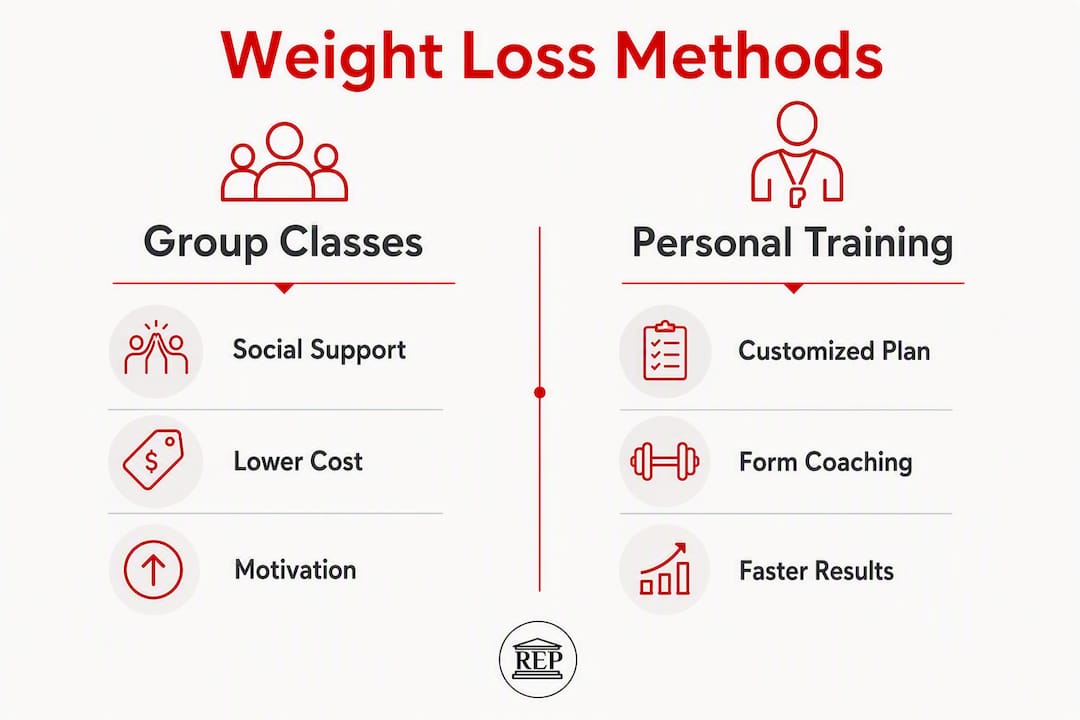
Personalized programming is the core reason personal training tends to deliver faster results. When a coach designs your program around your body, your history, and your goals, every session moves the needle in the right direction rather than just burning calories.
The key advantages that directly support fat loss:
- Custom exercise prescription: Your trainer selects movements that match your current capacity, so you progress without plateauing.
- Progressive overload, managed: A coach tracks your loads, reps, and recovery week to week, which is the primary driver of body-composition change over time.
- Form correction in real time: Poor mechanics waste effort and raise injury risk. Direct coaching fixes this immediately, keeping you training consistently.
- Nutrition and lifestyle integration: Many personal trainers include basic nutrition guidance or work alongside a registered dietitian, which research consistently shows is a critical multiplier for fat loss.
- Adaptations for limitations: Post-surgery, chronic pain, or mobility restrictions require exercise modifications that a group class instructor simply cannot provide for one person in a room of twenty.
Statistic callout: Personal training typically delivers faster and more targeted weight-loss results because it tailors exercise selection, optimizes recovery, and reduces injury risk through hands-on form correction — advantages that compound over an 8–12 week program.
Where this matters most: someone returning from a knee injury cannot safely follow the same squat progression as a healthy 28-year-old. A person with hypothyroidism may need a different caloric deficit strategy. These are the situations where one-on-one coaching pays for itself.

Why group classes help you lose weight and keep it off
Group fitness has a real and underappreciated advantage: it makes showing up feel good. That sounds simple, but social reinforcement and co-regulation are among the strongest behavioral levers for long-term adherence, and adherence is what actually produces weight loss over months, not weeks.
The practical benefits for fat loss:
- Community accountability: When your Tuesday morning bootcamp crew expects you, you show up. That social pull is more reliable than willpower alone.
- Higher perceived intensity: Research on group dynamics consistently shows people push harder in a group setting than they do alone, which means more calories burned per session.
- Lower cost per session: At $30–$150/month for unlimited classes, the cost barrier to frequent training drops significantly.
- Structured conditioning formats: HIIT, strength-circuit, bootcamp, and group strength classes all produce meaningful calorie burn and cardiovascular adaptation when attended consistently.
The best class types for fat loss tend to be HIIT, metabolic conditioning circuits, and group strength sessions. Yoga and barre have their place in recovery and mobility, but they are not the primary drivers of a caloric deficit. For a deeper look at which class formats support fat loss, the format and intensity matter as much as the frequency.
Where group classes fall short: no one is watching your deadlift form. No one is adjusting your program when you stop progressing. And if you have a specific limitation, you are largely on your own to modify. For beginners or anyone with physical complexity, that gap is real.
What does personal training actually cost, and is it worth it?
Personal training in the U.S. generally costs several tens to a few hundred dollars per session for one-on-one coaching, with monthly costs varying based on session frequency and market.
Group class memberships are dramatically cheaper: $30–$150/month at most studios, with boutique formats like cycling or HIIT studios often landing at $100–$150/month for unlimited access.
The cost drivers worth understanding:
- Trainer credentials and specialization: A certified strength and conditioning specialist or a coach with clinical experience commands a higher rate, and for good reason.
- Session length and frequency: 60-minute sessions cost more than 30-minute ones; three sessions per week costs more than one.
- Bundled nutrition coaching: When nutrition guidance is included, the per-session value increases substantially.
- Group size: Small-group and buddy training options cut the per-person cost while preserving most of the coaching quality.
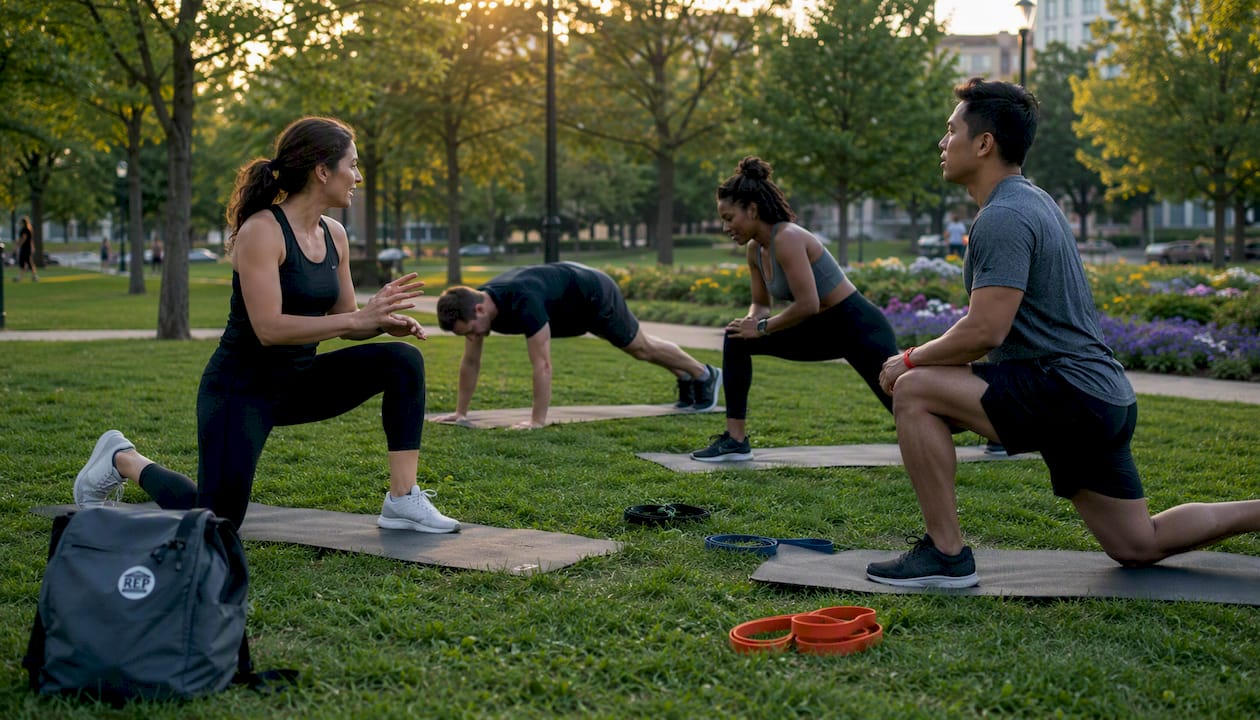
Small-group or buddy training hits a genuine sweet spot: the cost per person drops significantly compared to one-on-one sessions, yet a coach is still watching your form, tracking your progress, and adjusting your program. For budget-conscious clients who still want professional oversight, this is often the smartest starting point. Repphilosophy's buddy training memberships are built exactly around this model.
Pro Tip: Before committing to a monthly package, ask about saving money on a personal training membership through trial sessions, referral discounts, or small-group formats. A single trial session tells you more about fit than any amount of research.
What does the research actually say about weight loss outcomes?
The evidence here is more nuanced than most fitness articles admit. A systematic review and meta-analysis comparing group versus one-to-one multi-component lifestyle interventions found that group formats were favored for weight loss at 12 months, with a pooled mean difference of approximately −1.9 kg (95% CI −1.3 to −2.6) and a relative risk of 1.58 for achieving ≥5% weight loss compared to one-to-one delivery. That is a meaningful finding, but it comes with an important caveat.
Statistic callout: The pooled advantage for group programs in that meta-analysis applied specifically to multi-component interventions combining dietary counseling, physical activity, and behavior-change strategies — not to standard group fitness classes alone.
A separate meta-analysis of 71 studies found that group-based and individual approaches often produce comparable outcomes across physical activity and health measures, with effect sizes varying widely depending on intervention content. The takeaway: format matters less than the quality and completeness of the program.
Pro Tip: When reading "group vs individual" studies, look for whether the group program used true group-dynamics strategies (shared goals, team identity, structured peer feedback). Programs that apply these principles consistently outperform standard classes. The delivery format is secondary to the program design.
Realistic timelines for measurable fat loss:
- 8 weeks: Most people see early body-composition shifts (reduced bloating, some fat loss, improved energy) when training 3–4 times per week with a caloric deficit. Scale weight may not reflect this yet.
- 12 weeks: With consistent training and nutrition, a clinically meaningful loss of 5% or more of body weight is achievable. This is the benchmark used in most randomized trials.
- Nutrition is the multiplier. No training format outperforms a poor diet. The role of nutrition in weight-loss coaching is consistently the strongest predictor of outcomes across every study format.
Which option is right for you? A quick decision guide
The format that produces the best results is the one you will actually stick with. Adherence strategy consistently outperforms theoretical format advantages in the research. With that in mind, here is a practical decision framework:
Choose personal training if you:
- Have an injury, chronic pain, or mobility limitation that requires modified programming
- Are a complete beginner who feels intimidated by group settings
- Have a specific timeline (wedding, event, medical goal) and need the fastest possible progress
- Want nutrition coaching integrated into your program
- Have tried group classes and stopped attending within 6 weeks
Choose group classes if you:
- Are generally healthy with no significant physical limitations
- Are motivated by community energy and social accountability
- Have a tight budget and need maximum frequency for minimum cost
- Already have a solid movement foundation and want conditioning variety
Choose a hybrid if you:
- Want targeted strength progression AND high-intensity conditioning
- Can commit to 4–5 sessions per week across both formats
- Are past the beginner stage and want to prevent plateaus
A few diagnostic questions worth asking yourself before you decide:
- Do I have any injuries or physical limitations that need individualized attention?
- Have I struggled with consistency in the past, and if so, was it a motivation problem or a scheduling problem?
- What is my realistic monthly budget for training?
- Do I prefer working alone with a coach, or does a room full of people energize me?
Pro Tip: Try both formats for two to four weeks before committing to a long-term plan. Track attendance, energy levels, and how you feel after each session. The format you actually show up for consistently is the right one, regardless of what any study says.
How to build a hybrid weekly plan that actually works
A hybrid approach often gives the best balance of speed, cost-efficiency, and long-term adherence. Here is a practical coach-recommended weekly structure:
-
Monday: Personal training session (45–60 min) — Focus on compound strength movements (squat, hinge, press, pull). Your trainer sets loads, tracks progression, and corrects form. This is your primary body-composition driver.
-
Tuesday: Group conditioning class (45–60 min) — HIIT, bootcamp, or metabolic circuit. High calorie burn, community energy, and cardiovascular adaptation. Choose a format that complements, not duplicates, your strength work.
-
Wednesday: Active recovery or rest — Light walking, mobility work, or yoga. Recovery is where adaptation happens.
-
Thursday: Personal training session (45–60 min) — Upper/lower split or full-body depending on your program. Your trainer adjusts based on how Monday went.
-
Friday: Group conditioning class (45–60 min) — Same format as Tuesday, or a different modality (strength circuit, cycling) to add variety without overlap.
-
Saturday: Optional third PT session or independent training — If budget allows, a third coached session accelerates progress. Otherwise, use the exercise library for a self-directed session.
-
Sunday: Rest — Non-negotiable. Consistent sleep and recovery are as important as any training session.
Practical coaching notes for making this work:
- Tell your trainer which group classes you are attending so they can program around your recovery needs.
- Pick group classes that do not repeat the same primary movements as your PT sessions (avoid two heavy squat days back to back).
- Track progress with simple markers: weekly photos, a key lift weight, waist measurement, and energy levels. Scale weight alone is a poor indicator at 8 weeks.
Pro Tip: Schedule all sessions at the start of each week, not the day before. Treat them like appointments. The research on staying accountable in weight-loss training consistently shows that pre-scheduled sessions have significantly higher attendance rates than flexible, "I'll go when I feel like it" plans.
What should you do next?
Personal training wins for speed and precision. Group classes win for cost and community. A hybrid wins for most people who want both. The right answer depends on your body, your budget, and your history with consistency.
Here is how to act on that:
- If you have injuries or specific goals: Book a single trial PT session to get an assessment and a starting program. Bring a list of your limitations, your current activity level, and your weight-loss goal.
- If you want community and conditioning: Attend a first group class drop-in. Most studios offer a free or low-cost first class. Show up five minutes early and introduce yourself to the instructor.
- If you want the hybrid approach: Start with two PT sessions per week for the first four weeks to build your foundation, then layer in one to two group classes as your capacity grows.
Repphilosophy in 4S Ranch offers all of these entry points, including buddy training memberships that give you coached sessions at a lower per-person cost. For readers who want to explore the full range of options, the decision does not have to be permanent. Try, measure, and adjust.
Key Takeaways
Personal training produces faster, more targeted fat loss for people with complex needs, while group classes support adherence and conditioning at a lower cost — and a hybrid of both often delivers the best long-term results.
| Point | Details |
|---|---|
| Personal training wins on precision | Individualized programming, form coaching, and nutrition integration accelerate fat loss for people with injuries or specific goals. |
| Group classes win on adherence | Social reinforcement and lower cost make consistent attendance more achievable for many people. |
| Research favors multi-component programs | A meta-analysis found group multi-component programs produced a pooled mean difference of approximately −1.9 kg over 12 months versus one-to-one delivery. |
| Nutrition is the real multiplier | No training format outperforms a poor diet; nutrition integration is the strongest predictor of weight-loss outcomes across all formats. |
| Repphilosophy offers all three paths | Personal training, buddy/small-group memberships, and group classes in 4S Ranch let you start with one format and build toward a hybrid. |
The format debate misses the real question
There is a version of this conversation that gets stuck on "which burns more calories" or "which study showed better results." That framing misses what actually determines whether someone loses weight and keeps it off.
The clients who make the most progress are not always the ones in the most expensive program. They are the ones who show up consistently, communicate honestly with their coach, and treat nutrition as part of the plan rather than a separate problem. A perfectly designed personal training program fails if you cancel sessions when life gets busy. A group class membership is worthless if you stop going after week three because the format does not suit you.
What I have observed coaching clients in both formats is that the hybrid model works so well precisely because it covers both failure modes. The PT sessions create structure and accountability that keep the program moving forward. The group classes create a social environment that makes exercise feel like something you want to do, not something you have to do. Neither format alone solves both problems for most people.
One thing that often gets overlooked: the first four weeks of any new program are the hardest, regardless of format. Beginners who start with personal training get through that window with less frustration because someone is managing the difficulty curve for them. That early experience shapes whether someone becomes a person who exercises or someone who "tried it once." If you are on the fence, that is the strongest argument for starting with at least a few coached sessions before deciding anything.
Repphilosophy can meet you wherever you are starting from
Whether you have decided on personal training, group classes, or a hybrid, the next step does not have to be complicated. Repphilosophy in 4S Ranch, San Diego offers a full range of options designed to fit different budgets, goals, and schedules.
Start with a single 60-minute personal training trial session and get a real assessment of where you are and what your program should look like. If cost is a priority, the buddy training membership gives you coached sessions at a lower per-person rate without sacrificing the oversight that makes training safe and effective. Prefer to train on your own schedule? The virtual exercise library gives you structured, coach-designed workouts you can follow anywhere. Every program at Repphilosophy starts with an assessment, so you are never guessing about where to begin. Ready to take that first step? Book your trial session and let's build a plan that actually fits your life.
Useful sources for further reading
- Individual versus group-based interventions: a systematic review and meta-analysis — A 71-study meta-analysis examining physical activity, functional, and psychosocial outcomes across group and individual intervention formats; essential reading for understanding when group dynamics produce measurable advantages.
- Group versus one-to-one multi-component lifestyle interventions for weight management — The primary systematic review comparing group and one-to-one multi-component programs for weight loss at 12 months, including the pooled −1.9 kg finding cited in this article.
- Why Group Fitness Feels So Good — A Psychology Today piece on the social reinforcement and co-regulation mechanisms that make group exercise psychologically effective for adherence.
- Benefits of exercise classes and groups — Baylor College of Medicine's overview of the physical and mental health benefits of group exercise, including mood regulation and motivational effects.