
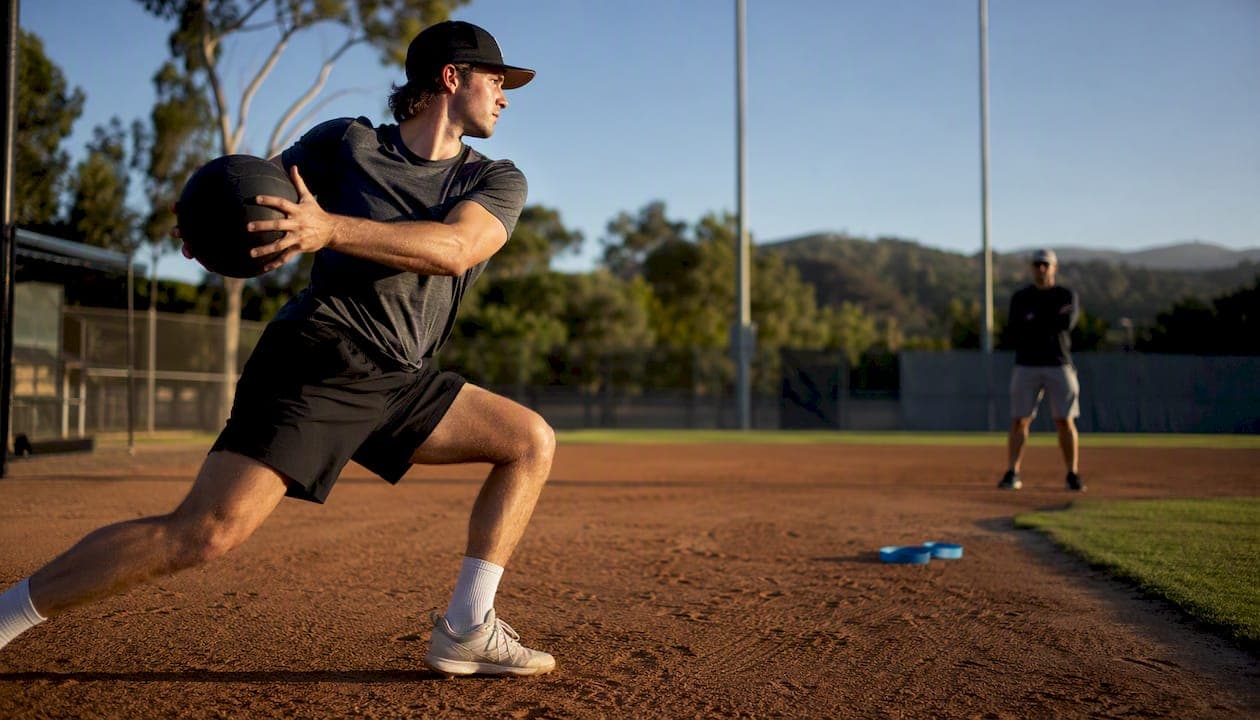
Baseball strength and conditioning improves bat speed, throwing velocity, sprint speed, and durability, but only when the plan respects the calendar. The fastest way to get started is a season-aware structure: build strength and power in the off-season with multiple sessions each week, convert that strength into speed heading into pre-season, then maintain gains in-season with limited focused sessions. Coaches surveyed for a landmark MLB strength and conditioning practices study and programs like REP Philosophy's tryout protocol both point to the same conclusion: structure beats intensity for intensity's sake.
TL;DR:
- Building rotational power through medicine ball throws directly correlates with bat speed and exit velocity improvements.
- During the off-season, players should focus on high-volume strength training, then shift to power conversion with lower volume and higher intent pre-season.
- In-season training must be short, high-intensity, and focused on maintenance, with sessions capped at 30 to 45 minutes and frequency reduced to one or two per week.
- Emphasizing posterior chain exercises, rotational work, and anti-rotation core stability better transfers to field performance than traditional linear lifting.
- Prioritizing mobility and arm care daily, along with proper recovery like sleep and nutrition, significantly reduces injury risk during the season.
Table of Contents
- What Is Baseball Strength and Conditioning?
- How Should Training Change by Season?
- Which Exercises Actually Transfer to the Field?
- What Do Sample Weekly Programs Look Like?
- How Do Mobility and Arm Care Prevent Injury?
- How Do You Periodize and Track Progress?
- What Makes REP Philosophy's Approach Different?
- What Injuries Should Baseball Players Guard Against?
- How Should Youth Athletes Train Differently?
- What Equipment Do You Actually Need?
- How Does Recovery Fit Into the Program?
- Why Does Mental Focus Matter as Much as Physical Training?
- A Coach's Take on What Actually Moves the Needle
- Train Smarter With REP Philosophy
- Sources
- FAQ
What Is Baseball Strength and Conditioning?
Baseball strength and conditioning is training designed around the specific physical demands of hitting, throwing, and sprinting rather than generic gym work. It blends strength training for baseball (squats, hinges, presses) with rotational power development, short sprint work, and arm care, all sequenced to peak at the right moments in the season.
The distinction matters because baseball is not football or track. A player needs force that transfers through rotation, not just raw bar-loaded strength, and a throwing arm that survives 20 or more starts or a full summer of relief appearances. That's why the outcomes below drive exercise choice more than any generic "get stronger" goal.
Outcomes that matter most
- Bat speed and exit velocity rise with rotational power and hip-shoulder separation, not just grip strength or arm strength.
- Throwing velocity depends heavily on trunk rotation power, according to a peer-reviewed review of offseason baseball programming, which found rotational force production to be one of the largest contributors to velocity gains.
- Sprint speed on the bases and in the field responds to posterior chain strength and rate of force development, meaning how fast you produce force, not just how much.
- Durability shows up as fewer soft-tissue strains and shoulder or elbow flare-ups when programming respects arm-care frequency and off-season loading.
Pro Tip: If you can only track one number all year, track medicine ball rotational throw distance. It's one of the closest gym-based proxies for bat speed you'll find, and it takes five minutes to test.
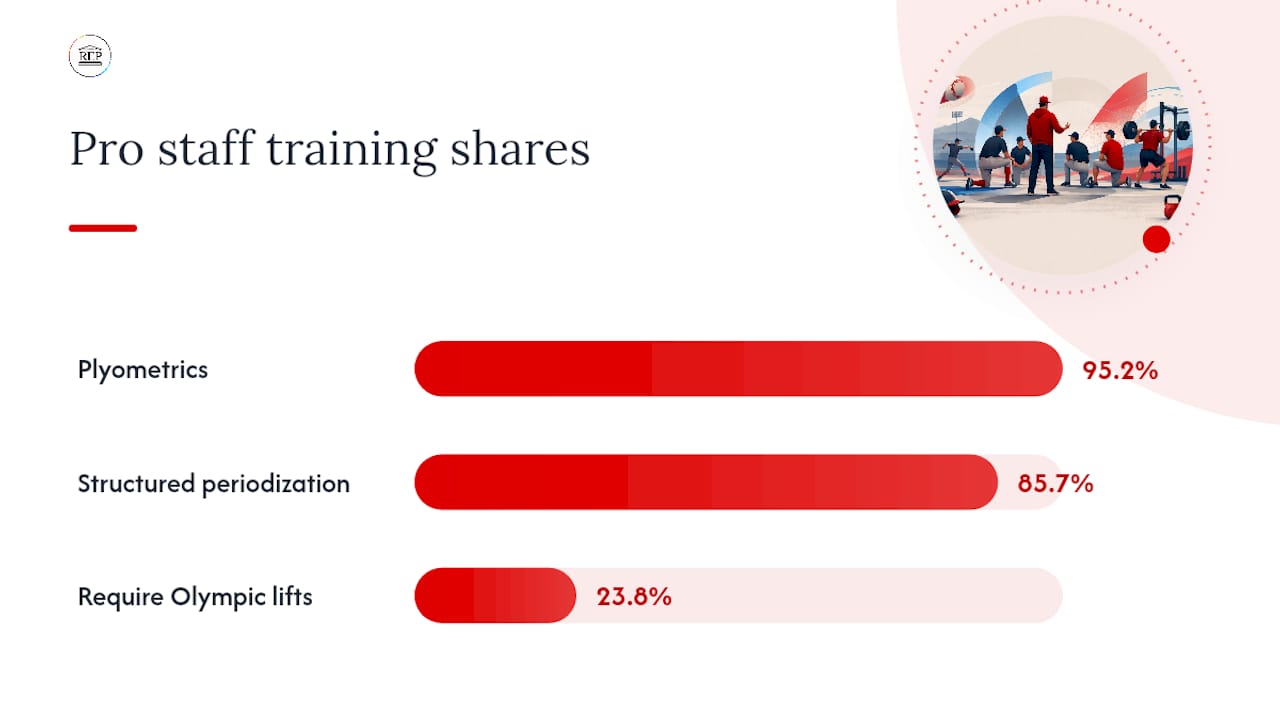
The same MLB survey found that 95.2% of professional strength staffs use plyometrics and 85.7% follow a structured periodization model, while only 23.8% required Olympic-style lifts. That's a meaningful signal: explosive, rotational, ground-based training carries more weight at the highest level than barbell cleans and snatches ever did.
How Should Training Change by Season?
Training volume, intensity, and exercise selection should shift in three distinct phases: off-season, pre-season, and in-season. Treating all three the same is the single most common programming mistake coaches and players make.
- Off-season (typically 8 to 12 weeks). This is where you build the raw material. Sessions run three to four times a week, focused on strength (trap bar deadlifts, split squats), general power (jumps, throws), and correcting imbalances from the previous season. Volume is highest here because competitive demands are lowest.
- Pre-season (roughly 4 to 6 weeks before games start). The goal shifts from building strength to converting it into usable power. Plyometrics and medicine ball work increase, total volume drops, and intent on every rep goes up. This is also where a taper matters. REP Philosophy's 6 to 8 week tryout conditioning plan uses a 72-hour taper before a tryout or opening day, cutting volume sharply while keeping intensity high so players show up fresh, not fried.
- In-season (the competitive months). This is maintenance, not development. Sessions shrink to one or two per week, capped around 30 to 45 minutes, according to coaching guidance from Eric Cressey's in-season programming approach. Research on strength retention suggests you can hold most off-season gains with as little as two quality sessions weekly, as long as intensity stays high even as volume drops.
The mistake most teams make in-season is chasing volume because players "feel fine." Fatigue compounds quietly over a 100+ game season, and a program that doesn't back off eventually shows up as a strained oblique or a dead arm in August.
Which Exercises Actually Transfer to the Field?
Not every exercise deserves a spot in a baseball program. The ones that matter share one trait: they train force in the same planes and patterns the sport demands.
- Posterior chain work. Trap bar deadlifts and hip-hinge variations build the horizontal force production that drives sprint speed and pitching mechanics alike.
- Rotational power. Medicine ball rotational throws, like the scoop toss, train the same hip-to-shoulder sequencing that produces bat speed. One analysis found rotational throw velocity correlates strongly with bat speed in a baseball-specific strength workout, making it one of the better gym-based predictors available.
- Anti-rotation core work. Pallof presses and anti-rotation holds teach the core to resist unwanted rotation, which protects the spine during max-effort swings and throws.
- Upper-body balance. Baseball players pull far more than they push in competition, so programming should mirror that with a 2:1 or even 3:1 pulling-to-pushing ratio using face pulls and band pull-aparts to protect the shoulder.
- Unilateral work. Single-leg RDLs and Bulgarian split squats expose and correct the left-right asymmetries that come from years of throwing and hitting from one side.
Pro Tip: Skip the temptation to program baseball like it's a linear power sport. A review of offseason baseball demands found that copying football-style heavy linear lifting misses the frontal and transverse plane work pitchers and hitters actually need.
What Do Sample Weekly Programs Look Like?
A program only earns its keep if it's usable on a Tuesday afternoon with limited equipment and limited time. Here is how the off-season and in-season structures differ in practice.
Off-season template (3 sessions/week):
- Day 1: Trap bar deadlift, single-leg RDL, medicine ball rotational throws, core anti-rotation work, sprint mechanics drills.
- Day 2: Upper-body pull emphasis (rows, face pulls, band pull-aparts), split squats, rotational med-ball scoop tosses, light conditioning.
- Day 3: Full-body power circuit (jumps, throws, sled pushes), posterior chain accessory work, mobility flow.
In-season template (1 to 2 sessions/week):
- Session A (30 to 35 minutes): Trap bar deadlift or goblet squat for 2 to 3 sets at moderate load, one rotational power movement, arm-care circuit, mobility flow. Keep loads high enough to maintain strength but cut total sets by roughly half compared to off-season.
- Session B, if a second slot exists: Upper-body pulling work, single-leg stability drill, brief plyometric touch (a handful of low-volume jumps), and a cooldown mobility sequence.
A sample in-season session might run: trap bar deadlift, 3 sets of 3 reps at a challenging but controlled weight; single-arm row, 3 sets of 8; med-ball rotational throw, 3 sets of 5 per side; band external rotation, 2 sets of 15; finishing with 10 minutes of hip and thoracic mobility work. Total time: about 35 minutes, which matches the in-season maintenance approach most coaches recommend.
How Do Mobility and Arm Care Prevent Injury?
Mobility and arm care aren't optional add-ons. They're the difference between a durable season and a midsummer trip to see a specialist.
The eccentric stress of throwing and swinging repeatedly tightens the same tissues over and over. Thoracic spine rotation, hip internal rotation, and ankle dorsiflexion tend to degrade first, which is why they deserve daily attention rather than an occasional stretch before games.
- Pre-session: a 5 to 10 minute soft-tissue and mobility flow targeting the thoracic spine, hips, and ankles.
- Post-session: a brief cooldown focused on the same areas, since range of motion lost after high-intensity work rarely restores itself overnight.
- Arm care: external rotation and rhythmic stabilization drills twice a week, based on Eric Cressey's in-season arm-care guidance, which cautions against daily high-volume cuff circuits that can actually irritate the shoulder rather than protect it.
Pro Tip: If a player mentions consistent ankle stiffness that limits their fielding stance, don't ignore it. Improving foot and ankle mobility often resolves knee and hip compensation patterns that show up higher in the chain.
Persistent joint pain, a sharp pinch during throwing, or numbness down the arm are red flags that call for a medical evaluation, not another mobility drill.
How Do You Periodize and Track Progress?
Periodization simply means organizing training into phases with different goals rather than doing the same workout year-round. Most baseball programs move through four phases: reconditioning (2 to 3 weeks to rebuild movement quality after the season ends), accumulative strength (4 to 6 weeks of heavier loading), conversion to power (4 to 6 weeks shifting toward speed and rotational work), and peaking or tapering (1 to 2 weeks before tryouts or opening day).
Testing doesn't need a lab. Three low-burden tests tell you almost everything you need to know:
- Medicine ball rotational throw distance, tracked every 3 to 4 weeks as a proxy for rotational power and bat speed potential.
- Vertical or broad jump, a fast way to flag whether lower-body power is trending up or stalling.
- 10 to 30 yard sprint times, occasionally paired with a throw-velocity check when a radar gun is available.
The rule for interpreting these numbers in-season is simple: if power output holds steady or improves, keep intensity where it is and only trim volume. The MLB coaches survey found periodized programming standard practice among 85.7% of professional staffs, a strong signal that unstructured, same-every-week training leaves performance on the table.
What Makes REP Philosophy's Approach Different?
REP Philosophy builds its baseball programming around the same evidence base covered here, translated into templates real players can follow. At WayALife Athletics, our 4S Ranch performance center, youth and high school athletes train through structured off-season, pre-season, and in-season phases rather than a one-size-fits-all workout.
- The 6 to 8 week tryout conditioning plan uses a 72-hour taper so athletes peak, not crash, on tryout day.
- In-season guidance keeps sessions short and intensity high, mirroring the maintenance research covered above.
- Programming draws on plyometric training principles and explosive power development rather than borrowed football templates.
What Injuries Should Baseball Players Guard Against?
The most common injuries in baseball cluster around the throwing shoulder, elbow, and hamstrings, and most of them are conditioning problems as much as they are mechanical ones.
Ulnar collateral ligament strain, the injury behind Tommy John surgery, tops the list for pitchers and often traces back to cumulative pitch counts combined with insufficient off-season strength work. Rotator cuff and labrum irritation follow a similar pattern: repetitive overhead stress without balanced pulling strength or adequate rest between outings.
Hamstring strains show up constantly among position players who sprint from a dead stop to full speed with little warmup, particularly early in the season when sprint capacity hasn't caught up to game intensity. Oblique strains, common among hitters and pitchers alike, usually stem from rotational power that outpaces core stability. This is exactly why anti-rotation training earns a permanent spot in the program rather than an occasional add-on.
Prevention comes down to three levers: respecting the pulling-to-pushing ratio to keep the shoulder balanced, building posterior chain strength before asking the body to sprint at full speed, and never skipping the arm-care work just because the season is grinding on.
How Should Youth Athletes Train Differently?
Younger players need the same principles applied with a much lighter touch and a much bigger emphasis on movement quality over load.
Kids and early-teen athletes should prioritize bodyweight strength, coordination, and general athleticism before adding significant external load. A 12-year-old doesn't need a barbell program; they need to learn how to hinge, squat, and decelerate properly first. Pitch count limits matter more than any lifting program at this age, since growth plates in the shoulder and elbow are more vulnerable to repetitive stress than adult joints.
Strength training can begin safely in the young-teen years when supervised properly, with a focus on bodyweight and light-load technique work rather than max-effort lifting. Volume should stay conservative: two to three short sessions a week, 30 minutes or less, is plenty for a developing athlete. Rotational power work, like light medicine ball throws, can be introduced early since it reinforces athletic movement patterns without heavy joint loading.
The biggest safety mistake with youth players isn't too little training. It's specialization too early, meaning year-round baseball with no off-season and no cross-training. A structured program that includes a genuine off-season, even a short one, protects growing joints far better than twelve months of games and showcases back to back.
What Equipment Do You Actually Need?
Effective baseball strength and conditioning does not require an elaborate facility. It requires a handful of specific tools used consistently.
A trap bar (or a standard barbell as a substitute), a set of medicine balls in varying weights for rotational throws, resistance bands for arm-care work, and open turf or a sprint lane for speed work cover most of what a program needs. A place to throw against a wall for medicine ball scoop tosses matters more than a full weight room. Access to a radar gun is a nice bonus for tracking throw and exit velocity, but it's optional, not essential, for the core program.
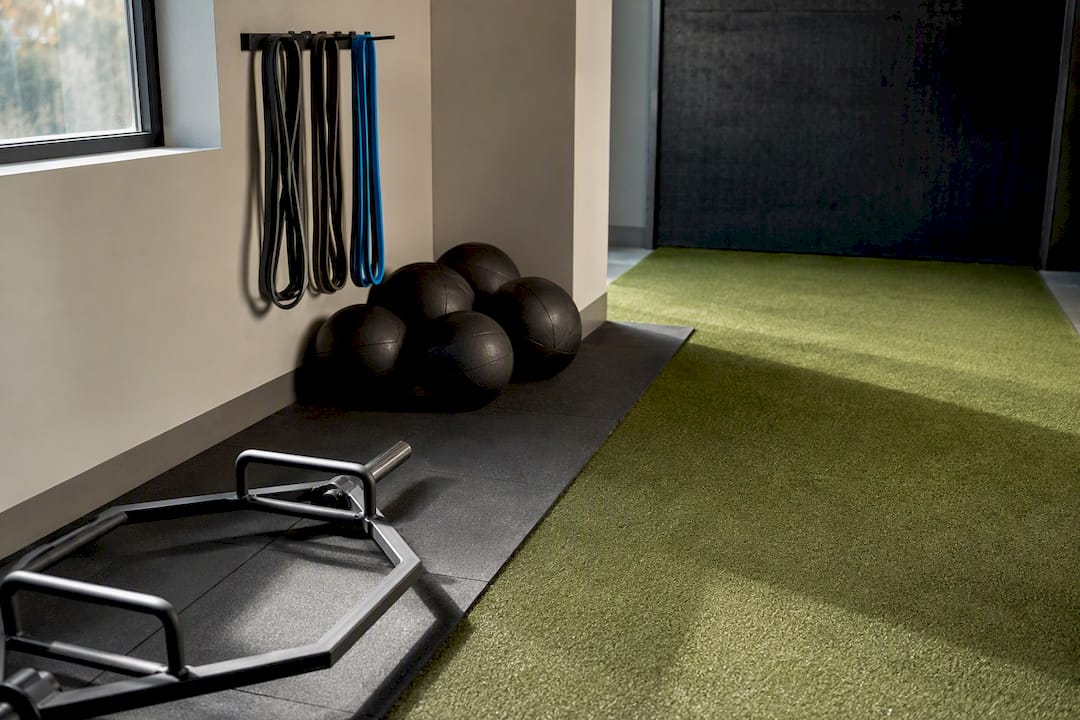
What matters more than equipment inventory is space to move athletically: room to sprint, room to throw a med-ball without hitting a rack, and a surface that won't beat up a joint doing repeated jumps. A cramped commercial gym with only machines and dumbbells makes baseball-specific training much harder to execute well, regardless of how much iron is on the floor.
How Does Recovery Fit Into the Program?
Training only works if the body actually adapts to it, and adaptation happens during recovery, not during the workout itself.
Sleep is the single most underrated performance lever in youth and amateur baseball. Chronic short sleep during a long season blunts strength gains, slows reaction time, and raises injury risk, yet it's the first thing that gets sacrificed to travel schedules and late games. Prioritizing 8 or more hours during heavy training blocks matters as much as any exercise in the program.
Nutrition doesn't need to be complicated for most amateur players. Adequate protein intake to support muscle repair, enough total calories to match the demands of a long season, and consistent hydration cover the fundamentals. Players who show up to double headers under fed and dehydrated will feel it in bat speed and sprint times before anything else shows up on a stat sheet.
Active recovery, light movement like walking, easy swimming, or a mobility flow on off days, keeps blood flow moving without adding fatigue. It beats total inactivity, which tends to leave joints stiffer, not fresher. Combined with the mobility work covered earlier, active recovery days are where a lot of the season's durability gets built quietly, session after session.
Why Does Mental Focus Matter as Much as Physical Training?
Physical conditioning creates the capacity for performance, but mental conditioning determines whether that capacity shows up when it counts.
Baseball's start stop rhythm, long stretches of standing punctuated by a few seconds of maximum effort, demands a specific kind of focus that differs from continuous sports like soccer or basketball. Players who struggle to reset between pitches or at bats often see their physical conditioning gains undercut by mental fatigue and lapses in concentration late in games.
Routines help here more than willpower does. A consistent pre-pitch or pre-at-bat routine gives the brain a repeatable cue to refocus, reducing the mental drain of staying "on" for an entire three-hour game. Visualization, even a few minutes of mentally rehearsing an at-bat or a defensive sequence, has become a standard tool among higher-level programs because it reinforces the same neural patterns as physical repetition without the physical fatigue.
Confidence built through physical preparation feeds directly into mental performance. A player who has tested their sprint times, tracked their medicine ball throw distance, and watched their numbers improve over an off-season walks into the batter's box with a different mindset than one who hasn't. That's part of why the testing protocols covered earlier matter beyond just program adjustment. They give players tangible proof their work is paying off.
A Coach's Take on What Actually Moves the Needle
Less is more in-season. That's the rule most amateur programs get backwards, piling on volume because the schedule feels demanding, when the schedule itself is already the stimulus. Prioritize mobility and posterior chain strength over adding new exercises, and favor medicine ball rotational work over daily cuff circuits that do more irritating than protecting. Cap sessions at 30 to 45 minutes, hold to one or two per week once games start, and if a player's rotational throw distance or jump numbers start sliding, that's your cue to back off before an injury forces the issue.
— Coach Justin
Train Smarter With REP Philosophy
Generic gym programs treat every athlete the same. REP Philosophy builds baseball-specific programming around your season, whether that means a structured off-season build at our WayALife Athletics performance center in 4S Ranch, a spot in our tryout conditioning plan, or virtual coaching if you're training remotely.
Our WayALife Athletics center offers in-person assessments and youth sports performance training designed around the seasonal framework covered in this guide, not a one-size-fits-all workout card. If travel or scheduling makes in-person coaching tough, our on-demand virtual exercise library gives you custom programming and video coaching you can follow from anywhere. Ready to find out where your training stands? Book a personal training assessment and get a plan built around your position, your season, and your actual test numbers, not a generic template pulled off the internet.
Sources
- Strength and conditioning practices of Major League Baseball strength and conditioning coaches
- Offseason training recommendations for baseball players (peer-reviewed review)
- In-Season Baseball Strength and Conditioning: Part 1 — Eric Cressey
FAQ
What Is the 3-3-3 Rule in the Gym?
The 3-3-3 rule isn't a standard baseball conditioning framework; definitions vary widely depending on the source, so treat any specific claim about it with caution and stick to season-based programming principles instead.
How Far Should a 14-Year-Old Be Able to Hit a Baseball?
Hitting distance varies enormously by physical development, bat speed, and swing mechanics, so there is no single benchmark number that applies fairly across all players. Tracking a player's own medicine ball rotational throw distance and bat speed over time is a more useful progress marker than comparing to a generic distance target.
What Muscles Help You Hit a Baseball Harder?
Bat speed comes primarily from rotational power generated through the hips, obliques, and upper back, not from arm strength alone. Training the posterior chain and anti-rotation core stability, as covered in the exercise selection above, builds the force transfer that actually drives harder contact.
Do MLB Teams Have Strength and Conditioning Coaches?
Yes. Every MLB organization employs dedicated strength and conditioning staff, and a survey of these coaches found 95.2% use plyometrics and 85.7% follow structured periodization models in their programming.
How Often Should Players Train During the Season?
One to two sessions per week is typically enough to maintain off-season strength gains, provided intensity stays high even as total volume drops, according to in-season programming guidance from Eric Cressey.