
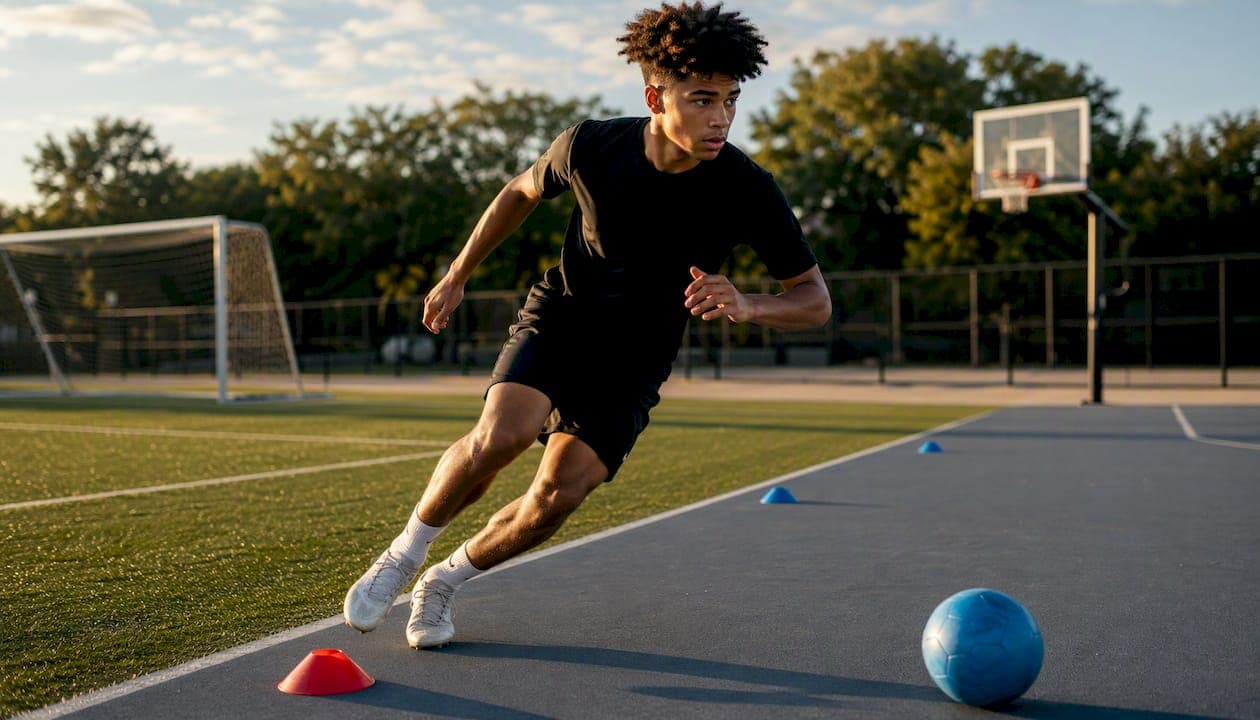
Here at Repphilosophy, "youth sport specialization" means coached, sport-specific performance training, not year-round single-sport intensity. The move that matters most is choosing a progressive, individualized program built on long-term athletic development, or LTAD principles, led by qualified coaches who prioritize movement skill and safety. That standard comes from the NSCA, the CDC's HEADS UP program, and what Coach Justin at Repphilosophy sees every week working with young athletes in 4S Ranch.
TL;DR:
- Proper youth sports training should prioritize movement skills and gradual loading over early sport-specific drills or heavy weights.
- Coaches must have pediatric-specific certifications, low coach-to-athlete ratios, and clear concussion protocols to ensure safety and effective development.
- Avoid high-volume, year-round training that can lead to burnout and overuse injuries; recovery, sleep, and mood are critical indicators of readiness.
- Multisport participation enhances overall athletic development, reduces injury risk, and supports social and psychological growth.
- Monitoring individual progress, motivation, and physical readiness is essential before considering sport specialization, which should happen only when developmentally appropriate.
Table of Contents
- What Does a Quality Youth Sport-Specific Program Actually Include?
- How Do You Choose the Right Coach or Program for Your Child?
- Why Concussion Protocols and Age-Appropriate Strength Training Go Together
- The Real Risks of Pushing Kids Too Hard, Too Early
- How Constant Competition Affects a Young Athlete's Mind
- Why Multisport Participation Still Makes Sense for Most Kids
- What Do Medical and Sports Organizations Actually Recommend?
- How Do You Know If Your Child Is Ready to Specialize?
- Coach Justin's Perspective: Building Programs That Respect the Long Game
- Ready to Start Safe, Sport-Specific Training?
- Sources
- FAQ
What Does a Quality Youth Sport-Specific Program Actually Include?
A well-built program does not start with heavy weights or sport-specific drills. It starts with movement.
Coaches spend real time on how a young athlete lands, decelerates, and balances before loading anything onto a bar or asking for a max-effort sprint. The NSCA's LTAD framework treats these movement basics as the foundation everything else gets built on, and skipping them to chase early performance gains is one of the most common mistakes we see in youth training.
Strength training has a place here too, and earlier than many parents expect. The American Academy of Pediatrics notes that many kids can begin basic resistance work around ages 7 to 8 when they're developmentally ready, using light loads, higher reps, and a few sessions per week. The goal at that stage is technique, not weight on the bar.
Speed and agility work gets introduced gradually and blended with sport skills rather than treated as a separate, isolated block. Research on youth resistance training backs this up: combining strength work with plyometrics and movement-skill training tends to produce better performance gains than either one alone, while also lowering injury risk.
A program worth paying for should visibly include:
- Dynamic warm-ups scaled to the athlete's age and sport
- Equipment sized correctly for smaller bodies, not adult gear scaled down
- Progressive loading that increases in small, monitored steps
- Hydration breaks and graded exposure on hot days
- Clear technique cues before any speed or intensity is added
Delivery format matters as much as content. A one-on-one session works well for a kid needing focused technical correction. Small-group or bring-a-buddy training suits athletes who thrive on friendly competition. Virtual coaching with a video library fills the gaps between in-person sessions, especially for families juggling multiple kids' schedules.
Pro Tip: Ask any program to walk you through a single week of programming for a child your kid's age. If they can't explain how strength, movement skill, and recovery fit together, that's a program still figuring itself out.
How Do You Choose the Right Coach or Program for Your Child?
Not every "performance training" sign on a gym door means the same thing. Vetting a program takes about ten minutes of direct questions, and it saves you from months of wasted money or, worse, an injury.
Start with the coach's credentials. Ask whether they hold a certification through the NSCA, have completed CDC HEADS UP concussion training, and understand pediatric-specific programming. Supervision ratio matters too: research on youth strength training points out that most serious injuries happen in unsupervised settings, so a low coach-to-child ratio that supports good supervision is a reasonable benchmark to ask about.
Here's a practical checklist to run through before you commit:
- Individualized progression. Does the plan adjust based on your child's readiness, or does everyone do the same workout regardless of age or ability?
- Recovery monitoring. Does the coach track how your child responds to training, not just their test scores?
- Concussion policy. Is there a written removal-from-play and return-to-play process?
- Facility and equipment. Is gear sized for kids, and is the space clean and well maintained?
- Emergency procedures. Does staff hold current first-aid and CPR certification?
- Season awareness. Does programming shift between off-season development and in-season maintenance, or does intensity stay maxed out year-round?
Watch for red flags: promises of rapid elite results, unsupervised heavy lifting, or a schedule that never lets up regardless of the competitive season. The NSCA's own position is blunt about this: both under-preparation and excessive volume cause problems, and a program that can't explain how it monitors tolerance and recovery is guessing, not coaching.
Why Concussion Protocols and Age-Appropriate Strength Training Go Together
Safety isn't a single checklist item. It's a culture, and it shows up in two places every parent should scrutinize: head injury response and strength training supervision.
The CDC's HEADS UP guidance requires a specific culture, not just a poster on the wall. Athletes need to feel safe reporting symptoms, coaches need training to recognize signs and remove a suspected concussion from play immediately, and return-to-play decisions need to follow medical guidance rather than a parent's or coach's gut call. A program with great drills but a "shake it off" attitude toward head knocks is not a safe program, no matter how good the cones look.
On the strength side, the American Academy of Pediatrics recommends a technique-first approach: supervised sessions, two to three times a week, with load increasing gradually only after form is solid. This isn't about limiting kids. It's about building strength that actually transfers to their sport instead of building bad habits that show up later as injuries.
Before enrolling your child anywhere, confirm:
- Coaches have completed HEADS UP training
- Staff hold current CPR and first-aid certification
- Equipment fits your child's size, not a generic adult standard
- The coach-to-child ratio stays reasonable for real supervision
Pro Tip: If a coach can't describe their concussion removal protocol in one clear sentence, ask again before your child's next session. This isn't a detail to assume.
Rest matters just as much as the workout itself. Sleep, scheduled rest days, and limits on high-contact repetition all factor into whether a young athlete's body can actually absorb the training instead of just accumulating fatigue.
The Real Risks of Pushing Kids Too Hard, Too Early
Burnout and overuse injuries are the two consequences that show up most often when young athletes train the same movements at high volume without breaks. Overuse injuries, like stress fractures and tendon irritation, develop slowly through repetitive strain rather than a single bad landing or collision. That makes them easy to miss until a child is already sidelined.
Burnout looks different from an injury but does just as much damage. It shows up as declining motivation, dread before practice, and a kid who used to beg to go to the field now finding excuses to skip it. Once that shift happens, reversing it takes far longer than preventing it in the first place.
Both problems trace back to the same root cause: training volume and intensity that outpace a child's physical and psychological ability to recover. A program that never varies intensity, never schedules a lighter week, and treats every session like a tryout is setting a kid up for one of these outcomes eventually.
The fix isn't complicated, even if it takes discipline to follow. Coaches need to track how an athlete responds to training over weeks and months, not just whether they hit a new personal best in Tuesday's session. Recovery, sleep, and mood all factor into whether a young body and mind can handle what's being asked of them. A program that treats rest as part of training, rather than something to squeeze out to fit more repetitions, is protecting your child in a way that doesn't show up on a stopwatch.
How Constant Competition Affects a Young Athlete's Mind
Physical strain gets most of the attention, but the psychological weight of youth sports deserves just as much scrutiny. Kids who feel their entire identity and social standing tied to one sport carry a different kind of pressure than a kid who plays for fun.
That pressure often comes from well-meaning places: a coach pushing for results, a parent hoping for a scholarship down the line, or a peer group where performance determines who sits where at lunch. None of those pressures are dramatic on their own. Stacked together over months, they can turn a game a kid used to love into something that feels like an obligation.
Social development matters too. Kids who spend all their athletic hours with the same narrow group of teammates miss out on the broader friendships and social skills that come from mixing with different teams, coaches, and sports environments. That narrowing can quietly shrink a child's world at exactly the age when it should be expanding.
The upside is that this is one of the easier problems to catch early, if you're watching for it. A child who talks about their sport with energy and curiosity is in a different place than one who talks about it with obligation or dread. Coaches who ask about a kid's week, not just their stats, tend to catch the shift before it becomes a bigger problem. That's not a small thing. It's often the difference between a kid who plays through high school and one who quits by age 13.
Why Multisport Participation Still Makes Sense for Most Kids
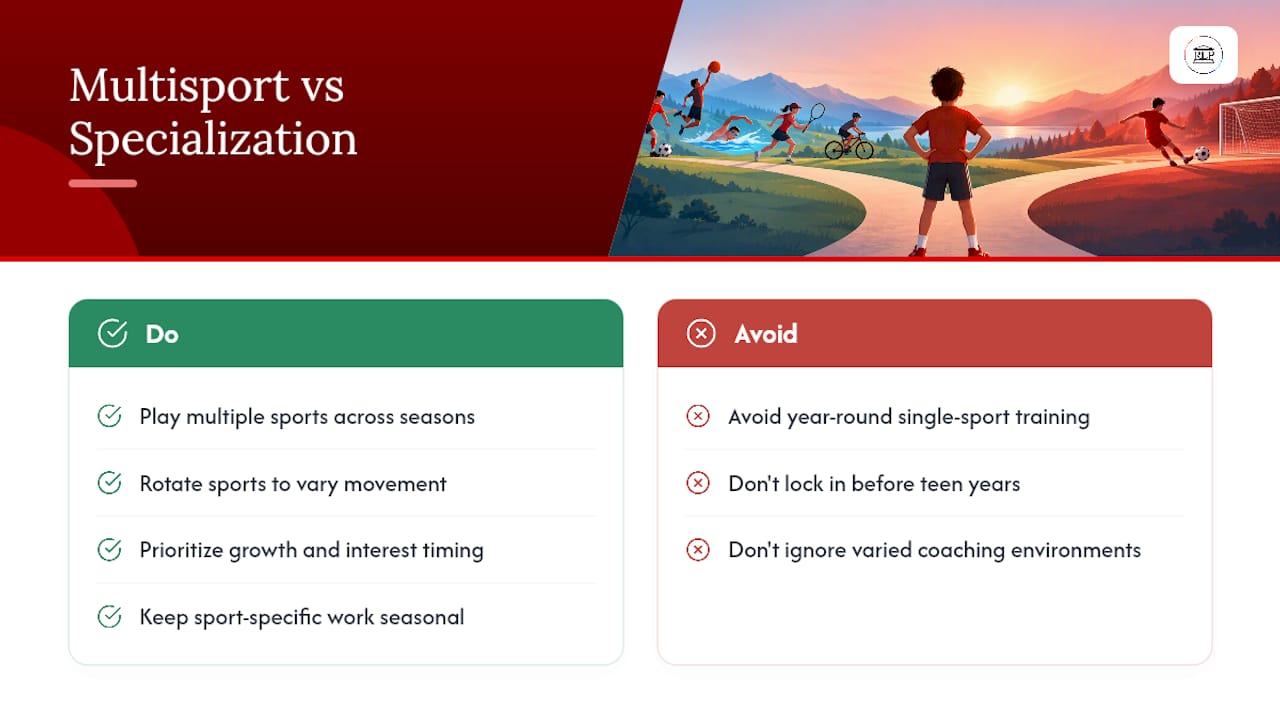
Playing more than one sport is not a compromise or a delay tactic. For most young athletes, it's the better long-term strategy.
Different sports load the body in different ways. A kid who plays soccer in the fall, basketball in the winter, and swims in the summer develops a broader base of movement skills than one running the same drills on the same surface for twelve months straight. That variety spreads out repetitive stress instead of concentrating it on the same joints and tendons year-round, which lowers the overuse-injury risk discussed earlier.
Multisport kids also get more chances to find the sport that actually fits their body and interests, rather than locking in early based on whatever felt most exciting at age eight. Interests change. Bodies change. A kid who's the fastest on the field at ten years old isn't guaranteed to hold that advantage at fifteen, and playing multiple sports keeps more doors open while that develops.
There's a social benefit too. Different teams mean different coaches, teammates, and environments, which builds a wider circle of friendships and role models than staying inside one tight-knit group all year.
None of this means specialization is off the table forever. It means the timeline usually should follow the athlete's growth and interest, not a competitive calendar pushing for early commitment. A sport-specific training program can still sharpen skills in a primary sport while leaving room for other seasons and other sports, which is exactly the kind of balance a good coach should be building into the plan.
What Do Medical and Sports Organizations Actually Recommend?
The organizations that study youth athletic development consistently point toward patience over urgency. The NSCA's LTAD position statement frames athletic growth as a multi-year process built on movement quality, foundational strength, and individualized progression, not a race to specialize before a certain age.
That guidance extends into strength training specifically. The American Academy of Pediatrics supports supervised resistance training for kids, starting with light loads and technique-focused sessions two to three times a week, expanding gradually as the athlete matures. Neither organization treats early single-sport intensity as necessary for long-term success. Both treat gradual, monitored progression as the safer and more effective path.
The common thread across this guidance is monitoring over milestones. Rather than pushing a child toward a fixed benchmark by a fixed age, the recommended approach tracks how an individual athlete responds to training load, recovers between sessions, and develops movement competency over time. That's a very different model from "more reps now equals better results later," and it's the model a legitimate youth performance program should be built around.
How Do You Know If Your Child Is Ready to Specialize?
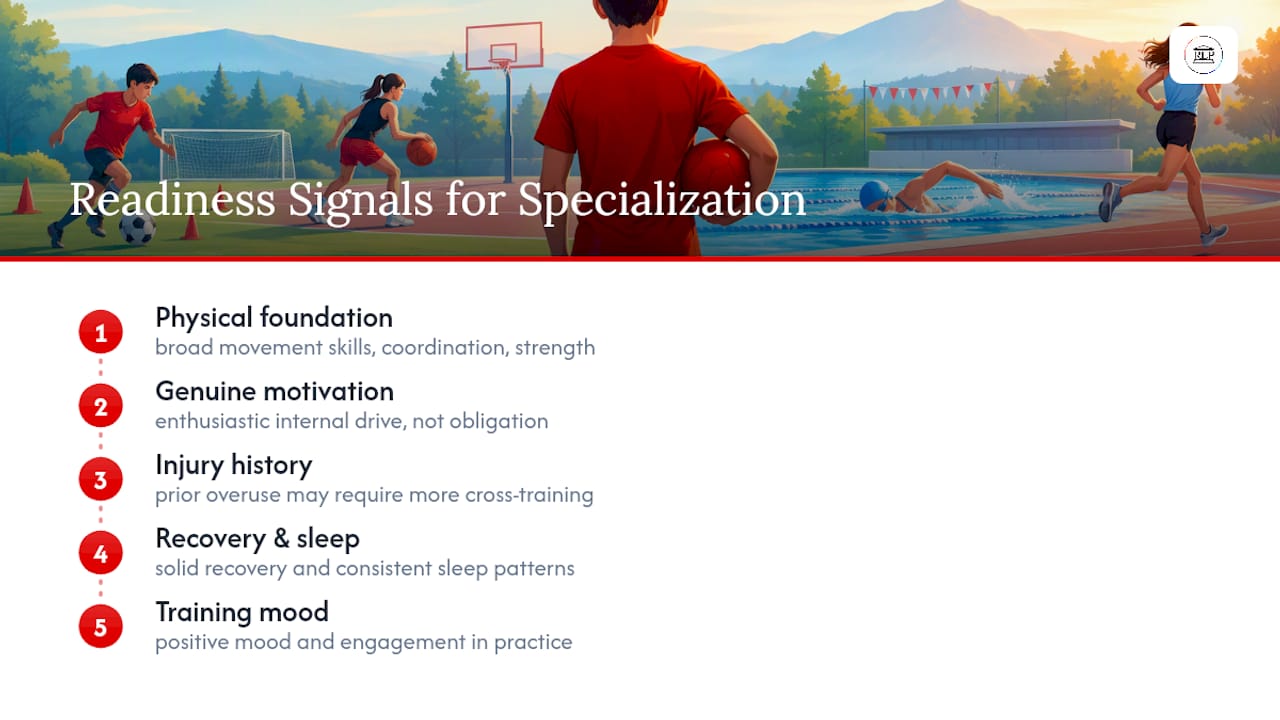
Timing depends more on the individual kid than on a calendar age. A few signals tend to matter more than others.
Physical readiness comes first. A child who has built a solid base of general movement skills, coordination, and strength across multiple activities is in a better position to specialize than one who jumped straight into one sport without that foundation. Growth spurts and puberty timing vary widely, and a coach who understands LTAD principles adjusts training around where a kid actually is developmentally, not just their age on paper.
Motivation matters just as much. A child who genuinely wants to focus on one sport, who talks about it with enthusiasm rather than obligation, is showing a different kind of readiness than one following a parent's or coach's push. That internal drive tends to sustain kids through the harder training that comes with more focused work.
Injury history is worth weighing honestly too. A kid who's already dealt with overuse issues from repetitive movement patterns may need more cross-training variety before narrowing focus further, not less.
Finally, look at how the athlete handles current training load. If recovery is solid, sleep is consistent, and mood around practice stays positive, that's a good sign the current volume fits. If any of those are slipping, that's a cue to hold off on adding more specialized volume, regardless of what age or grade level suggests is "normal."
Coach Justin's Perspective: Building Programs That Respect the Long Game
Every program Repphilosophy runs for young athletes starts from the same place: LTAD principles applied individually, not a fixed curriculum stamped onto every kid who walks in. That looks different depending on format, whether it's in-person small-group training, bring-a-buddy sessions, or virtual coaching paired with the video library for at-home work between sessions.
Sport-specific training works best when it's layered on top of solid movement fundamentals, not substituted for them. Our youth soccer strength guide walks through what that actually looks like week to week for one sport, and it's a useful read if you want to see the principles in practice rather than in theory.
Coach Justin is experienced in youth athletic development and applies these principles individually to each athlete. The approach doesn't change based on which format a family chooses. It changes based on what the kid in front of us actually needs.
— Coach Justin
Ready to Start Safe, Sport-Specific Training?
Repphilosophy is the direct route to the kind of program this article recommends: LTAD-informed, individually progressed, and built around actual safety checks instead of guesswork. If your family wants coached, sport-specific development without committing to a rigid single-sport calendar, that's exactly the gap Repphilosophy fills for families in 4S Ranch.

The right fit depends on your schedule and your kid's needs. A 60-minute or 30-minute personal training membership works well for an athlete who needs focused, individualized attention. Bring-a-buddy and small-group training suit kids who train better with a friend alongside them. For families managing multiple schedules or wanting supplemental work between sessions, the exercise video library membership runs $12.50 per month, and virtual coaching sessions offer custom programming without needing to be on-site.
First contact starts with an evaluation: a movement screen, a look at training history, and a safety check before anything gets programmed. If you want to see how a session feels before committing to a membership, book a personal training trial and get a firsthand look at how Repphilosophy structures a first evaluation for a young athlete.
Sources
For deeper reading beyond this guide, the NSCA's LTAD position statement and its youth resistance training position cover program design in depth. The CDC's HEADS UP training explains concussion protocols coaches should complete, and HealthyChildren.org offers pediatric-specific strength training guidance. For sports-medicine context on injury recovery, Stride Foot & Ankle's injury guide is a useful clinical resource.
FAQ
What Age Should Kids Start Strength Training?
Many kids can begin basic, supervised resistance training around ages 7 to 8 when they're developmentally ready, according to HealthyChildren.org. The focus at that age is technique and light loads, not maximum weight.
How Do I Know If a Youth Program Follows LTAD Principles?
Ask whether the program adjusts based on your child's individual progression and recovery, rather than applying the same intensity to every athlete regardless of age or readiness. Programs following the NSCA's LTAD framework prioritize movement quality and foundational strength before advanced loading.
What Should I Ask a Coach About Concussion Safety?
Ask whether coaching staff have completed CDC HEADS UP training and what the specific process is for removing an athlete from play and clearing them to return. A program that can't answer clearly hasn't built a real safety culture yet.
Does Repphilosophy Offer Youth Sport-Specific Training?
Yes. Repphilosophy offers youth sports performance training through small-group and personal training memberships, bring-a-buddy options, and virtual coaching with access to an on-demand video library.
Is Multisport Participation Better Than Early Specialization?
For most young athletes, playing multiple sports builds a broader base of movement skills and lowers overuse-injury risk compared to year-round single-sport focus. Specialization can still make sense later, but the timing should follow the individual athlete's growth and interest, not a fixed age.