

Fitness habit formation is the process by which an exercise behavior shifts from a conscious decision into an automatic response triggered by stable cues. In plain terms, you stop asking yourself whether to work out and simply start doing it because a cue fires. The single most useful thing you can do right now: pick one tiny, repeatable action and attach it to something you already do every day. Research published in a PMC systematic review confirms that repetition in a stable context is what drives this shift, and the American Heart Association's movement habit guidance echoes the same principle: start small, choose a cue, and reinforce the behavior with a reward.
Table of Contents
- Why your brain turns exercise into an automatic behavior
- How the main habit models explain the process
- How long habit formation realistically takes
- Seven evidence-based tactics to create and sustain fitness habits
- Common obstacles and how to get past them
- How to tell your habit is actually forming
- When a coach genuinely speeds up habit formation
- Pitfalls that quietly kill fitness habits (and how to fix them)
- Key Takeaways
- The part most habit guides skip over
- Repphilosophy makes habit-focused training practical
- Primary sources and further reading
Why your brain turns exercise into an automatic behavior
Every time you repeat a movement in the same context, your brain strengthens the neural pathway connecting that context to the action. This is associative learning, and it is the engine behind physical activity automaticity. Over time, the behavior becomes represented in associative memory rather than in deliberate decision-making, which is why a seasoned runner laces up without much thought while a beginner has to negotiate with themselves every single morning.
Researchers draw a useful line between two types of habit:
- Instigation habit: the automatic decision to start exercising when a cue appears (e.g., seeing your gym bag by the door)
- Execution habit: the automatic performance of the activity itself once you have started
Building instigation habit tends to matter more for long-term maintenance. Once starting is automatic, the quality of the session usually follows. Context stability is what cements both: the same time, place, and trigger consistently fire the same response.
Pro Tip: Engineer your context before you need willpower. Lay out your workout clothes the night before, set a recurring phone alarm with a label like "5-minute walk," and let the environment decide for you.
How the main habit models explain the process
The habit loop
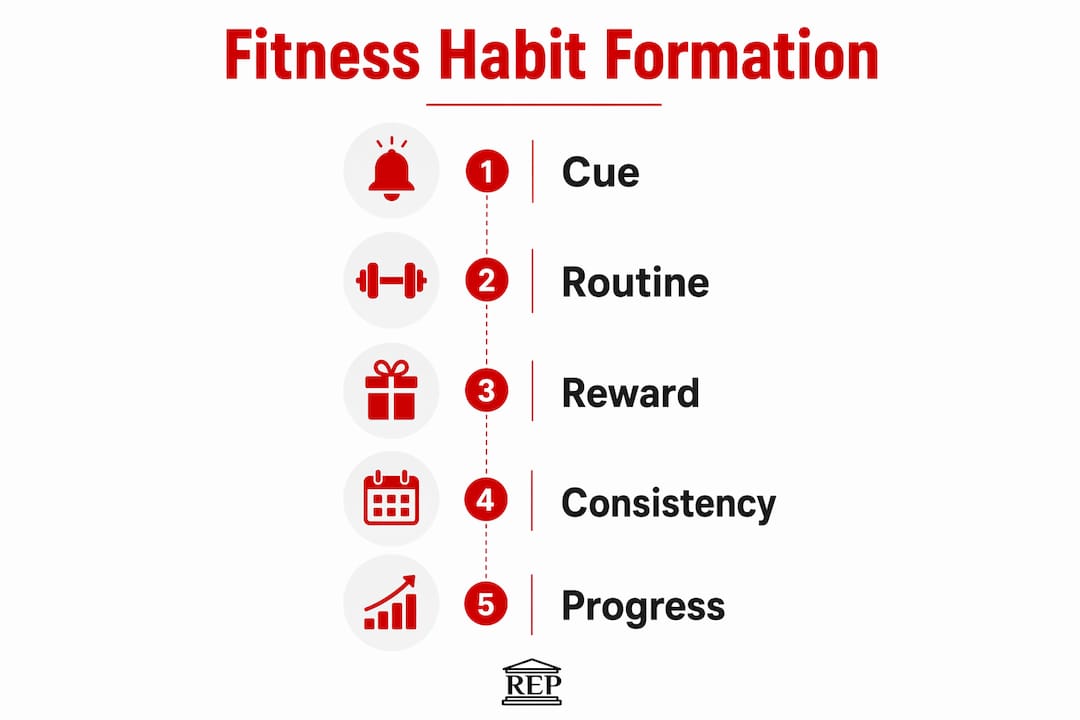
The most widely used framework is the three-part habit loop: cue → routine → reward. A stable cue (your alarm at 6 AM) triggers the routine (a 20-minute run), and a reward (a favorite playlist, a post-run smoothie) reinforces the loop. Repeat that cycle consistently and the cue alone eventually pulls the behavior forward without deliberate effort.
Stage-based models
Lally and Gardner's research describes habit formation in two broad phases. The preparatory phase covers the early weeks when you are consciously choosing your cue, designing the routine, and deciding on a reward. The performance phase is when repetition begins to reduce the mental effort required. Automaticity grows gradually across both phases, not in a sudden click.
Instigation vs. execution in practice
Picture two people. The first has a strong instigation habit: every weekday at 5:30 PM, seeing her gym bag triggers her to leave the office. She almost always shows up. The second has a strong execution habit but a weak instigation habit: once he is in the gym he trains hard, but getting himself there is a daily battle. Behavior science suggests investing in the first person's pattern. Automating the start is the highest-leverage move, and implementation intentions (clear "when-where-then" plans) are one of the best tools for doing it.
How long habit formation realistically takes
The honest answer is: longer than most people expect, and it varies widely. Lally et al.'s study found that automaticity averaged 66 days to develop, with a range of 18–254 days depending on the behavior, the person, and the consistency of the context. The popular "21-day rule" has no scientific basis.
A few scenarios put that range in perspective:
- A 5-minute daily walk after lunch — relatively simple, low effort, stable context. Closer to the 18–254 day range.
- Three weekly gym sessions before work — moderate complexity, schedule-dependent. Expect somewhere within the 18–254 day range before it feels automatic.
- A structured strength program with warm-up, lifting, and cool-down — high complexity, multiple execution steps. Could take longer, within the upper end of the 18–254 day range to feel truly effortless.
Key insight: Occasional missed days do not reset the clock. Research shows that skipping once or twice does not meaningfully derail habit formation, so long as you return to the routine promptly.
The factors that most reliably speed up the process are: high frequency (daily beats weekly), low behavior complexity, a stable and distinctive cue, and a genuinely satisfying reward. Individual differences are large, too. A tactic that builds habit quickly for one person may take twice as long for another, which is why flexible, personalized approaches outperform one-size-fits-all programs.
Seven evidence-based tactics to create and sustain fitness habits
The most effective approach combines multiple tactics rather than relying on any single one. Here is how to build a system that works even when motivation dips.
1. Set a tiny floor (minimum-viable session)
Commit to a session so short it feels almost embarrassing: 5–10 minutes. On busy or low-energy days, minimum-viable sessions protect the neural pathway and keep the streak alive. Most days you will do more once you start. The floor is a safety net, not a ceiling.
2. Use habit stacking and implementation intentions
Attach your new behavior to an existing anchor: "After I pour my morning coffee, I will do 10 minutes of movement." This is habit stacking. Pair it with an implementation intention ("On Monday, Wednesday, and Friday at 7 AM in my living room, I will do my workout") and the cue becomes nearly automatic.

3. Reframe your identity
Shifting from "I am trying to exercise more" to "I am someone who moves every day" changes the decision calculus. Identity-based framing makes skipping feel inconsistent with who you are, not just a missed task.
4. Design your environment
Put your gym bag by the front door. Keep resistance bands on the couch. Remove friction from starting and add friction to quitting. Environment design is one of the most underused levers in habit formation.
5. Track streaks and visible progress
A simple check mark on a calendar activates loss aversion: you do not want to break the chain. Tracking also corrects optimistic memory bias, giving you honest data about your actual consistency.
6. Build social support
A training partner or accountability group raises the cost of skipping. Finding a training partner is one of the most reliable ways to protect habit continuity through schedule disruptions and low-motivation stretches.

7. Design a meaningful reward
The reward does not have to be food. It can be a favorite podcast you only listen to during workouts, a post-session ritual, or simply logging the win. The key is that the reward follows the routine consistently and feels genuinely satisfying.
Motivation-based plan vs. system-based plan
| Dimension | Motivation-based plan | System-based plan |
|---|---|---|
| Trigger | Relies on feeling ready | Fixed cue fires automatically |
| Low-energy days | Often skipped | Tiny floor keeps the streak |
| Progress measure | How you feel | Cue-response consistency |
| Long-term outcome | Inconsistent | Habit becomes automatic |
| Failure response | Guilt and restart | Miss once, return next session |
Pro Tip: Protect the instigation, not the performance. Pre-schedule your sessions in your calendar as non-negotiable appointments. Automated cues remove the daily decision entirely, which is where most people lose the battle.
Common obstacles and how to get past them
Even well-designed habits hit roadblocks. Here is what typically derails people and what actually fixes it:
- Relying on motivation: Motivation fluctuates by design. The fix is to engineer context and systems so the cue fires regardless of how you feel. Lay out your gear, pre-book your session, and let the environment carry you.
- Schedule disruption: Travel, a new job, or a shift change can sever a cue-behavior link overnight. Re-anchor deliberately: identify a new stable trigger in the changed context and restart the repetition cycle from there.
- Boredom: Execution habits can weaken when the routine stops feeling rewarding. Rotate the activity while keeping the cue and time slot fixed. The instigation habit stays intact; only the content changes.
- Injury or recovery: A forced break is not a habit death sentence. Substitute a lower-intensity movement that fits the same cue slot (a short walk instead of a run) to preserve the neural pathway until you can return to full training.
- All-or-nothing thinking: Missing one session feels like failure, which triggers a full dropout. Counter this with the minimum-viable session rule: something always beats nothing, and the streak matters more than the session quality.
How to tell your habit is actually forming
Habit strength and fitness outcomes are not the same thing. You can have a strong initiation habit built around a 10-minute walk that produces minimal cardiovascular change, and a demanding training program that produces great fitness results but still requires daily willpower to start. Track both, separately.
| What to track | Why it matters | How often |
|---|---|---|
| Cue-response consistency | Shows whether the trigger is reliably firing the behavior | Daily (simple yes/no log) |
| Perceived automaticity | Measures how effortless starting feels (1–10 scale) | Weekly |
| Session completion rate | Reveals dropout patterns before they become full breaks | Weekly |
| Fitness outcomes (strength, endurance) | Confirms the program is producing physiological change | Monthly |
| Mood/energy after sessions | Reinforces the reward loop and flags burnout early | Weekly |
When to change tactics: if perceived automaticity has not improved after four weeks, your cue is probably too weak or too inconsistent. If you are missing more than two sessions per week, the behavior complexity may be too high. Drop to the minimum-viable session and rebuild from there. For personalized fitness tracking that adapts as your habit strengthens, having a structured system from the start makes a measurable difference.
When a coach genuinely speeds up habit formation
A good coach does more than prescribe exercises. For habit formation specifically, a coach customizes your cues, designs a minimum-viable session that fits your actual schedule, builds an accountability system, and troubleshoots when a context change breaks your routine.
Coaching tends to accelerate habit formation most in these situations:
- Complex or unpredictable schedules that make self-designed cues unreliable
- A history of starting and stopping exercise programs repeatedly
- Returning from injury, where re-anchoring the habit requires careful session design
- A desire to compress the timeline by getting the cue-routine-reward structure right from day one
If you are unsure whether you are at that point, the 9 signs you need a personal trainer checklist is a useful starting point. Repphilosophy's approach centers on building the initiation habit first, designing sessions that are genuinely completable, and adjusting the system as your life changes.
Pitfalls that quietly kill fitness habits (and how to fix them)
Most people do not fail because they lack discipline. They fail because of specific, correctable design errors.
Starting too big. Committing to a 90-minute gym session five days a week in week one is a recipe for dropout. The fix: start with a session so small it feels easy, then build gradually once the cue-response loop is established.
Vague cues. "I'll work out sometime tomorrow" is not a cue. It is a wish. A cue needs to be specific: a time, a place, or an existing behavior that reliably precedes the workout. Without specificity, the instigation habit never forms.
Skipping the reward. Many people treat the workout itself as the reward, which works on good days and fails on hard ones. Designing a small, consistent post-session reward (a specific playlist, a ritual, a logged check mark) keeps the loop reinforced during the weeks when the workout itself feels like a grind.
Changing too many variables at once. Switching your workout time, location, and exercise type simultaneously destroys context stability. If you need to change something, change one variable at a time and give the new cue at least two to three weeks to stabilize.
Measuring only outcomes, not habit strength. Stepping on the scale or checking your mile time every week while ignoring cue-response consistency gives you fitness data but no habit data. You can be getting fitter and still have a fragile habit that will collapse under the first schedule disruption. Track both.
Key Takeaways
Fitness habit formation succeeds when you automate the start of the behavior through stable cues, a tiny floor, and consistent repetition — not through willpower or motivation alone.
| Point | Details |
|---|---|
| Habit formation defined | Exercise shifts from a deliberate choice to an automatic cue-triggered response through repetition in stable contexts. |
| Best first action | Pair a minimum-viable session (5–10 minutes) with a fixed daily cue to protect the habit on hard days. |
| Realistic timeline | Automaticity averages 66 days with a broad range of 18–254 days; the 21-day rule has no scientific support. |
| Habit strength vs. fitness outcomes | Track cue-response consistency separately from fitness metrics — a strong habit can exist around low-intensity movement. |
| Repphilosophy's role | Repphilosophy builds the cue-routine-reward system around your schedule, offering personal training, group classes, and virtual sessions to support habit formation at every stage. |
The part most habit guides skip over
Here is something worth sitting with: the fitness industry sells outcomes, but what most people actually need is a reliable start. Every program promises results. Very few are designed around the question of how you get yourself to show up on a Tuesday when you are tired, busy, and not feeling it.
The instigation vs. execution distinction matters enormously here. Most training plans are built around execution: what exercises to do, how many sets, what intensity. Almost none of them are built around instigation: how to make the decision to start automatic. That gap is where most people fall out of their programs, not because the plan was wrong, but because the start was never automated.
The research is clear that individual variance in habit formation is large. What works for your training partner may take twice as long for you, or may not work at all. That is not a character flaw. It is a design problem. The solution is not more motivation. It is a better-engineered cue, a smaller floor, and a more honest tracking system. Build the start first. The rest tends to follow.
Repphilosophy makes habit-focused training practical
Building a fitness habit is one thing. Building one that fits your actual life, your schedule, and your current fitness level is another. Repphilosophy, based in 4S Ranch, is designed for exactly that gap. Whether you want in-person personal training, a bring-a-buddy membership, group classes, or a flexible on-demand exercise library you can use at home, every option is built around short, repeatable sessions that make showing up the easy choice.

The bring-a-buddy and group class formats add the social accountability layer that research consistently shows extends habit longevity. Virtual sessions give you a ready-made cue-plus-session in one package, which is especially useful in the early weeks when context stability matters most. If you want to test the fit before committing, a single personal training session in 4S Ranch lets you experience the habit-design approach firsthand.
Pro Tip: Use your first session as a minimum-viable session. Show up, do the work, and let the experience anchor the cue. You can scale from there.
Primary sources and further reading
These are the primary research sources and authoritative guides behind this article. If you want to go deeper on any section, the PMC systematic review and the Harvard Nutrition Source tips are the best starting points.
- PMC Systematic Review on Habit and Physical Activity — Peer-reviewed review of longitudinal studies examining how habit relates to physical activity behavior; covers instigation vs. execution habit distinction.
- Individual Variance in Habit Formation (MDPI) — Covers why habit formation timelines differ significantly between individuals and why personalization matters.
- Habit and Physical Activity: Theoretical Advances (ScienceDirect) — Academic review of habit theory applied to physical activity; explains automaticity and context-dependence.
- American Heart Association: Make Movement a Habit — Public health guidance on cue selection, starting small, and reward reinforcement.
- Harvard Nutrition Source: Making Exercise a Daily Habit — Ten practical tips from Harvard's nutrition researchers for building a consistent exercise routine.
- Determinants of Physical Activity Habit Formation (PMC/NIH) — NIH-indexed research on the specific factors that predict whether a physical activity habit will form and persist.