
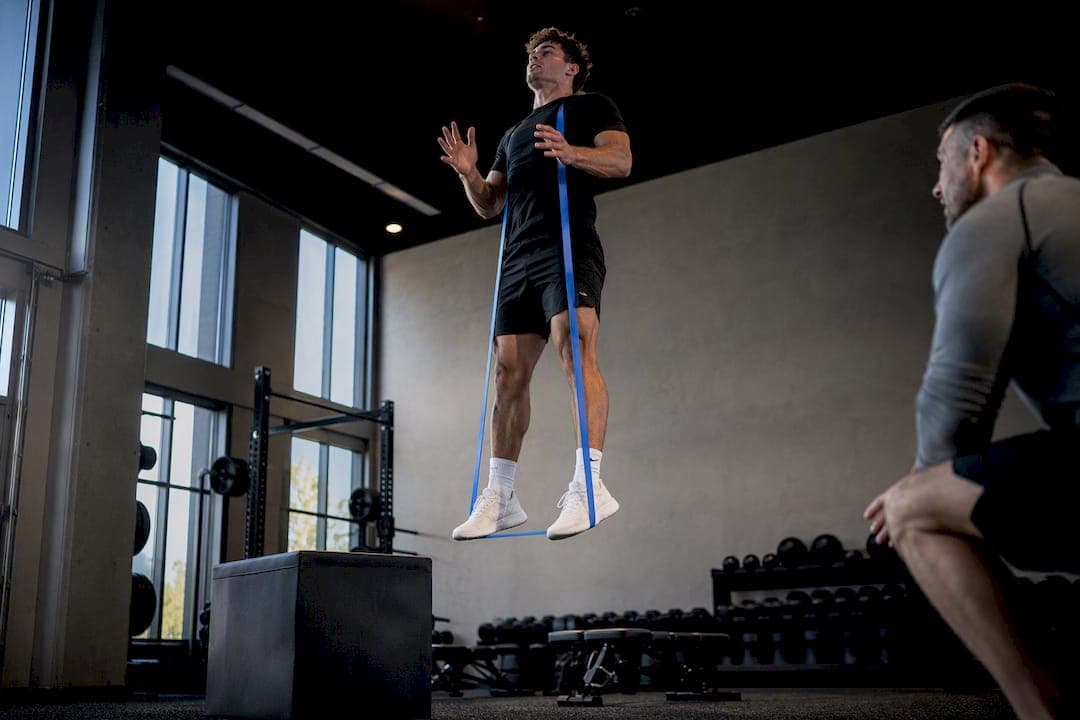
The single most effective way to raise your vertical is to build maximal strength first, train power on its own, then layer in progressive plyometrics. Skip straight to jumping drills and you'll plateau fast. Follow this sequence and research on plyometric programs shows gains of roughly 4.7% to 8.7% depending on how you test it, over a training period spanning several weeks to months. Quality always beats volume.
TL;DR:
- Building maximal strength through squats and deadlifts is essential before progressing to power and plyometric training.
- Proper sequencing involves strength first, then power exercises like loaded broad jumps, followed by plyometrics such as depth jumps.
- Rest and autoregulation are crucial; most athletes need 8 minutes or more between high-impact plyometric sets and should stop immediately if form or reaction drops.
- Gains in vertical jump typically range from 4.7% to 8.7% over several weeks to months, with more emphasis on strength than volume.
- Consistent mobility work, adequate recovery, and proper sequencing of training layers significantly influence progress and injury prevention.
Table of Contents
- What Makes Vertical Jump Training Actually Work?
- Which Exercises Build Each Layer of the Jump?
- How Do You Build a Weekly Vertical Jump Program?
- How Much Rest and Volume Do You Actually Need?
- How Do You Land Safely and Recover Between Sessions?
- How Do You Measure Real Vertical Jump Progress?
- Who's Behind This Vertical Jump Framework?
- What Should You Eat and How Should You Recover to Jump Higher?
- What Mobility Work Actually Helps Your Vertical Jump?
- What Mistakes Slow Down Vertical Jump Progress?
- How Do You Stay Motivated Through a Vertical Jump Program?
- What Actually Moves the Needle in Vertical Jump Training?
- Ready for a Coached Vertical Jump Program?
- Sources
- FAQ
What Makes Vertical Jump Training Actually Work?
Your vertical jump is the output of four systems working together, and vertical jump training only pays off when you build them in the right order.
Maximal strength comes first. If your quads, glutes, and hamstrings can't produce force against the ground, nothing downstream matters. Squats, deadlifts, and split squats build that base. Power training comes next, and it's a different skill from strength. It's the rate at which you express force, trained through jump squats and loaded jumps rather than slow, heavy grinds.
Plyometrics build on both. They train your stretch shortening cycle, the spring-like mechanism where your muscles and tendons absorb landing force and return it as upward force almost instantly. This is where lower-leg stiffness comes in: stiffer, more reactive tendons waste less energy on the ground, and that's trainable through pogos and depth jumps done consistently over programs running six to twenty-four weeks have shown consistent improvements.
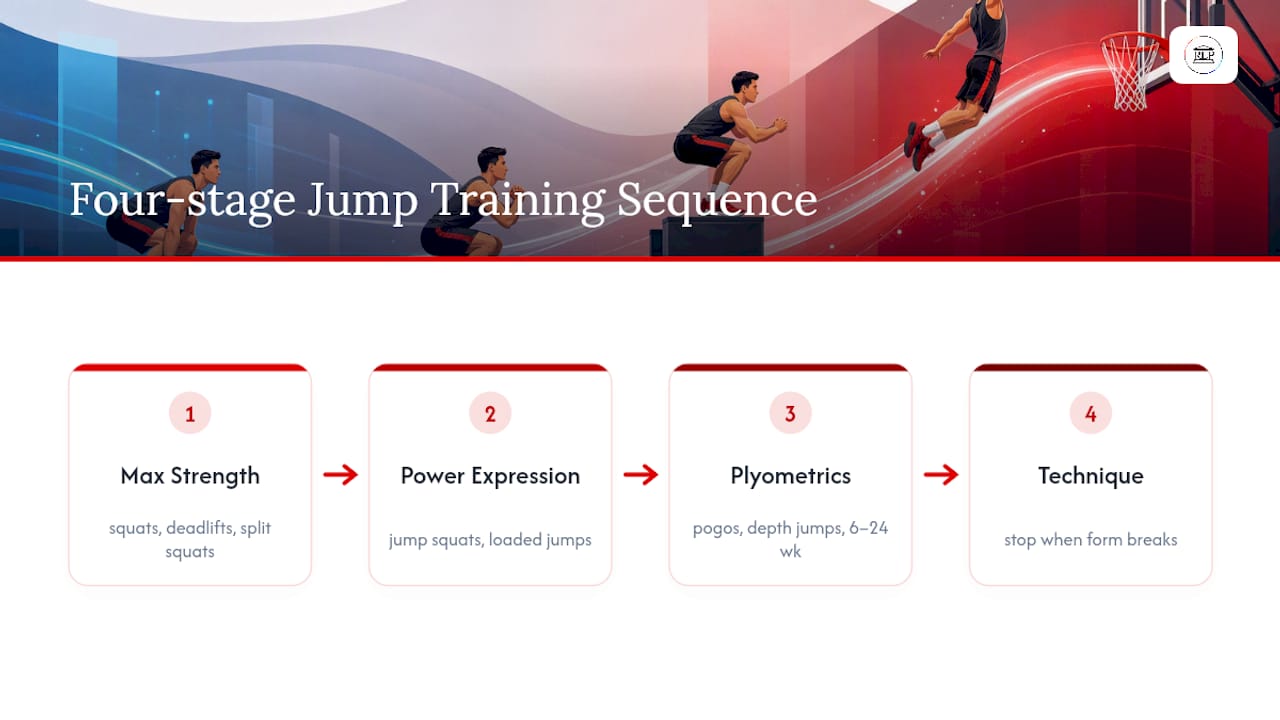
Technique ties it together. Watch your athletes closely, and the moment a jump gets sloppy, a knee caves in, a landing gets loud, or height starts dropping, that set is done. Pushing past that point trains bad patterns, not power.
Which Exercises Build Each Layer of the Jump?
Every athlete's plyometric training library should be organized by layer, not by whatever looks impressive on video. Here's how I'd stack it.
Strength layer (foundation, year-round):
- Back squat or trap-bar deadlift: 3 to 5 sets of 3 to 6 reps at 75 to 85% effort
- Bulgarian split squat: 3 sets of 6 to 8 reps per leg, controlled tempo
- Romanian deadlift: 3 sets of 6 to 8 reps, focused on hamstring and glute loading
Power layer (trained separately from heavy strength days):
- Loaded broad jumps with light bands or dumbbells: 4 to 6 sets of 3 reps, full recovery between
- Hang jumps from a hex bar: 4 sets of 3 reps, moving the bar as fast as possible
- Jump squats at 20 to 30% of your squat max: 4 sets of 4 to 5 reps
Plyometric layer (progressed by contact intensity):
- Beginner: pogos and ankle hops, 2 to 3 sets of 10 to 15 contacts
- Intermediate: two-leg tuck jumps and lateral bounds, 3 sets of 6 to 8
- Advanced: single-leg hops, box jumps, and depth jumps from 12 to 18 inches, 3 to 5 sets of 3 to 5 reps
Round it out with lateral and rotational jumps to build the multidirectional stiffness that basketball, volleyball, and field-sport athletes actually need on the court. If you're new to loaded jumps or have a history of knee pain, regress to bodyweight versions and get a coach's eyes on your landing before adding load.
Pro Tip: Band-resisted jumps often build power with less joint stress than heavy weighted vests or steep depth drops, especially when you're autoregulating volume by stopping a set the instant your pop drops.
How Do You Build a Weekly Vertical Jump Program?
A workable week runs two strength sessions and two power/plyometric sessions, never stacked back to back. Your legs need at least 48 hours between anything explosive and anything heavy.
Structure each session the same way: 10 minutes of dynamic warm-up and pogo hops, then your main strength or power work while you're freshest, then landing practice as a cooldown skill, never as a fatigue finisher.
Here's an 8-week block that scales to most sports:
- Weeks 1 to 2: Strength emphasis, light plyometric introduction (pogos, low box step-offs), establish baseline squat and jump numbers.
- Weeks 3 to 4: Add loaded jumps and broad jumps; strength volume holds steady while intensity climbs.
- Weeks 5 to 6: Introduce depth jumps and single-leg hops; retest your vertical to confirm you're trending up.
- Weeks 7 to 8: Peak power week, reduce strength volume by 20%, prioritize jump quality and full recovery, retest again.
If your schedule is tight, cut session length before you cut frequency. Two 30-minute focused sessions each week beat one long, sloppy one, and this same logic underpins most solid progressive programming approaches regardless of the goal.
How Much Rest and Volume Do You Actually Need?
Autoregulation is the rule that matters most here: stop a set the moment height, bar speed, or landing mechanics drop, even if you had more reps planned.
Rest intervals depend on what you're doing. Single power activations, like one loaded jump followed by a sprint, work well with 30 seconds to 4 minutes of rest. Complex plyometric work, especially depth jumps stacked with heavy strength work, often needs 8 minutes or more to let your nervous system recover between quality efforts.
For volume, most useful plyometric blocks land somewhere in the 400 to 1,700 total contacts range across a training cycle. If you're limping into session three feeling flat, or your jump height hasn't budged in two weeks, regress the drill or add a rest day before adding load.
How Do You Land Safely and Recover Between Sessions?
Landing mechanics are where most injuries happen, and where most athletes get lazy. Coach your athletes to land "soft but stiff," quiet on the ground, knees tracking over toes, hips sinking back rather than knees caving in. Teach this from a low box before anyone touches a depth jump.
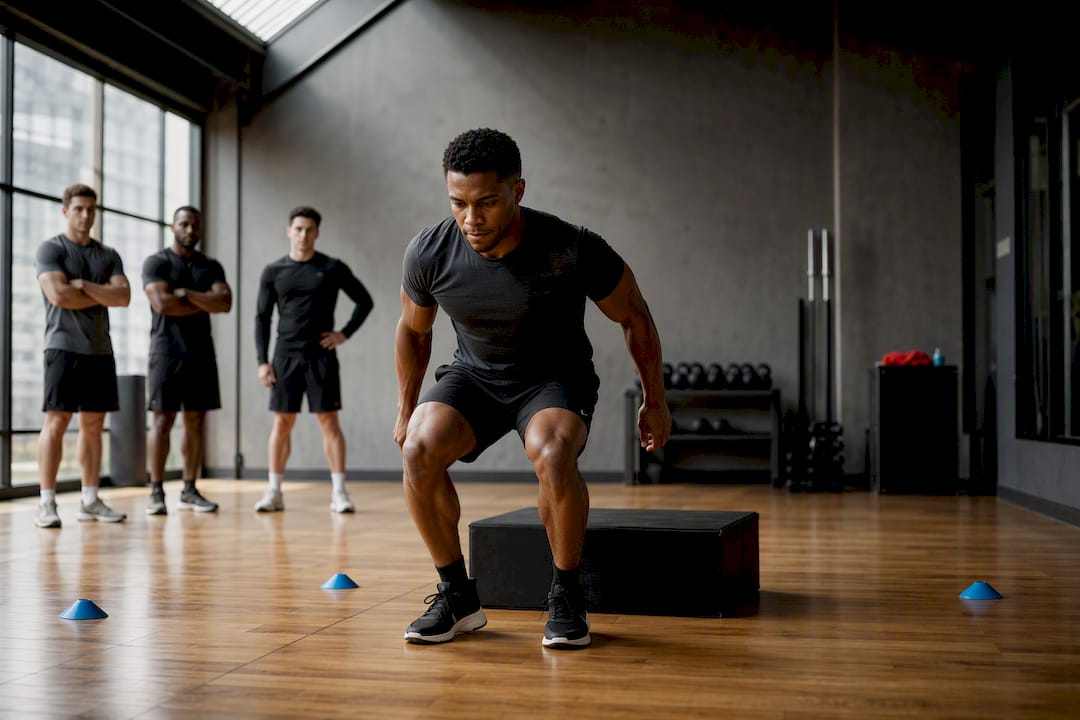
Tendon conditioning happens gradually. Pogos and progressive loading build the tissue tolerance that lets tendons absorb landing force without breaking down. Rushing this step is how shin splints and patellar tendinopathy start.
Recovery matters as much as the work itself. Give jump-heavy legs at least one full rest day between plyometric sessions, and treat persistent soreness, flat jumps, or joint aches as a signal to back off, not push through.
How Do You Measure Real Vertical Jump Progress?
Three tests give you a full picture: the countermovement jump (CMJ, jump with a dip before takeoff), the squat jump (SJ, jump from a static squat with no dip), and the countermovement jump with arm swing (CMJA). A jump mat or even a wall and chalk mark gets you usable numbers.
Meta-analysis data shows pooled improvements of 4.7% for SJ, 8.7% for CMJ, 7.5% for CMJA, and 4.7% for drop jumps after structured plyometric programs, which represent typical realistic improvements.
Set an 8 to 12 week goal tied to a specific number, retest with the same protocol each time, and track the trend, not any single session.
Who's Behind This Vertical Jump Framework?
This layered approach, strength to power to plyometrics to progressed jumps, comes from Coach Justin's practical programming work, detailed further in how to maximize your max vertical jump fast.
Repphilosophy builds this exact framework into its coaching, whether that's in-person sessions, small-group performance training, or the on-demand Exercise Video Library for athletes who want guided programming they can run on their own schedule.
What Should You Eat and How Should You Recover to Jump Higher?
Vertical jump training taxes your nervous system and muscle tissue harder than most conditioning work, so recovery inputs matter as much as the sets themselves.
Protein intake supports the muscle repair your legs need after heavy squat days and high-intensity plyometric sessions. Most athletes training this hard benefit from spreading protein across three to four meals rather than loading it all at dinner. Carbohydrates matter just as much, since your fast-twitch fibers run primarily on glycogen, and depleted glycogen stores are a major reason jump height drops off in the back half of a session.
Sleep is where the actual adaptation happens. Strength and power gains consolidate overnight, and athletes running short on sleep tend to show flatter jump numbers even when their training is well designed. Aim for consistent sleep timing over a single "perfect" night here and there.
Hydration affects tendon elasticity and reaction speed more than most athletes realize. Even mild dehydration can blunt the explosiveness you're trying to train. On rest days, light movement, walking, easy cycling, or mobility work, keeps blood flow moving through recovering tissue without adding fatigue on top of fatigue. Skipping recovery days entirely to "get more jumps in" almost always backfires by the third or fourth week of a block.
What Mobility Work Actually Helps Your Vertical Jump?
Mobility work for vertical jump training isn't about touching your toes. It's about giving your hips, ankles, and thoracic spine the range they need to load properly before you explode off the ground.
Ankle dorsiflexion is the one most athletes neglect. If your ankle can't flex forward, your body compensates by shifting load up into the knee, which limits how deep and how efficiently you can load into a jump. Banded ankle mobilizations and calf stretches, done consistently, open that range over a few weeks.
Hip mobility matters just as much, particularly hip flexor length. Tight hip flexors from sitting all day pull your pelvis out of position and blunt glute activation, which is one of your biggest power producers. Couch stretches and 90/90 hip switches, worked into your warm-up, address this directly.
Thoracic spine mobility affects your arm swing and overall trunk positioning during takeoff. A stiff upper back limits how much force your arm swing contributes to the jump, and that swing accounts for a meaningful chunk of your total height. Foam rolling followed by thoracic rotations before training sessions keeps that segment loose.
Do this mobility work as part of your warm-up, not as a separate 45-minute session you never get around to. Five to seven minutes of targeted work, done every session, beats an occasional long stretch routine you do once a month.
What Mistakes Slow Down Vertical Jump Progress?
The biggest mistake is skipping the strength base entirely and jumping straight into high-volume plyometrics because it feels more exciting. Without adequate strength, plyometric training has less force production to work with, and progress stalls quickly.
The second mistake is training through fatigue instead of stopping the set. If your landing gets louder, your knees start caving, or your jump height visibly drops, that's your body telling you the set is over. Grinding out three more reps trains poor mechanics into your nervous system, and that pattern is hard to unlearn.
Overloading volume too fast is another common trap. Athletes see a program calling for depth jumps and jump straight to high box heights without building the tendon tolerance to handle the landing forces. Progress the height and intensity gradually, over weeks, not days.
Neglecting single-leg work is a subtler mistake, especially for basketball and soccer athletes who take off from one leg constantly in competition. A program built entirely on double-leg jumps misses a huge piece of sport-specific transfer.
Finally, testing too often kills momentum. Retesting your vertical every few days instead of every 8 to 12 weeks gives you noisy, misleading data and can tempt you into changing a program before it's had time to work. Pick your test dates in advance and stick to them.
How Do You Stay Motivated Through a Vertical Jump Program?
Vertical jump gains build slowly, and that mismatch between effort and visible progress is where most athletes quit before the program has a chance to work.
Set process goals alongside your outcome goal. Instead of fixating only on "add three inches," track things you control directly: hitting every session, adding five pounds to your squat, or landing a depth jump quieter than last week. Process wins keep you engaged during the weeks when your jump test hasn't moved yet.
Training with a partner or in a small group changes adherence more than most athletes expect. Having someone else counting on you to show up, or simply someone to compete against on a broad jump, makes the difference between skipping a session and pushing through it.
Log your numbers. Seeing your squat climb from week 2 to week 6, even before your vertical test shows a change, gives you concrete proof the work is paying off, which matters when motivation dips.
Reframe the plateau weeks. Every athlete hits a stretch where nothing seems to move. That's usually when the underlying strength and tendon adaptations are still consolidating beneath the surface, right before a jump in testable performance.
What Actually Moves the Needle in Vertical Jump Training?
Most vertical jump advice online treats plyometrics like the whole story. It's not. Plyometrics are the finishing layer, not the foundation, and I'd argue the biggest gains most athletes leave on the table come from under-trained maximal strength, not under-trained hops.
Where conventional advice falls short is volume worship: more box jumps, more depth jumps, more contacts, as if jump height scales linearly with how many times you hit the ground. It doesn't. The research on rest intervals and plyometric complexity backs this up. Well-timed, high-quality work with proper recovery consistently outperforms high-volume grinding.
If you take one thing from this, prioritize your squat and posterior chain strength before you obsess over jump variations. Then layer in power work, then plyometrics, and let your tendons adapt at the pace they actually need. Athletes who respect that sequence get further than athletes who skip straight to the exciting part.
— Coach Justin
Ready for a Coached Vertical Jump Program?
Repphilosophy is the alternative to piecing together workouts from videos and hoping the sequencing works out. You get a coach watching your landing mechanics in real time, adjusting your loads when a set starts breaking down, and building your strength base before ever handing you a depth jump.

If you're in the San Diego area, the 60-minute Personal Training Membership or small-group performance training gives you hands-on coaching through every layer of this framework, strength, power, and plyometrics, with someone correcting your form before a bad habit sets in. Prefer to train on your own schedule? The Exercise Video Library Membership runs $12.50 per month and gives you coach-built programming and a full video exercise library you can follow from anywhere. Either way, book a session or start the library today, and let's build your vertical the right way.
Sources
- The aim of this study was to determine the precise effect of plyometric training (PT) on vertical jump height in healthy individuals. (meta-analysis)
- Meta-analysis on plyometric training complexity, volume, and rest intervals — effects on vertical jump and sprint performance.
FAQ
How Rare Is a 35-Inch Vertical Jump?
An exceptionally high vertical is well above what most trained athletes, including many college-level competitors, typically reach. Achieving this level usually requires years of layered strength, power, and plyometric training combined with favorable genetics for tendon stiffness and fast-twitch fiber ratio.
What Vertical Does a 5'9" Guy Need to Dunk?
A 5'9" athlete generally needs a standing reach plus vertical jump that clears the rim by a few inches, which usually means a vertical jump well above average depending on individual arm length and standing reach. Reaching that level takes sustained strength and plyometric training, not a few weeks of box jumps.
Can You Add 20 Inches to Your Vertical Jump?
For most trained athletes, adding 20 inches isn't realistic. Meta-analysis data on plyometric programs shows typical gains in the 4.7% to 8.7% range, which for most athletes translates to modest increases over a well-structured multi-month block, not very large jumps.
How Do You Get a 40-Inch Vertical Jump?
Reaching a 40-inch vertical requires an exceptional strength base, dedicated power training, and years of progressive plyometric work, and it's realistic only for a small percentage of highly trained athletes. Following a layered program like the strength to power to plyometrics sequence, with consistent testing and recovery, gives you the best realistic shot at approaching that range over time.