
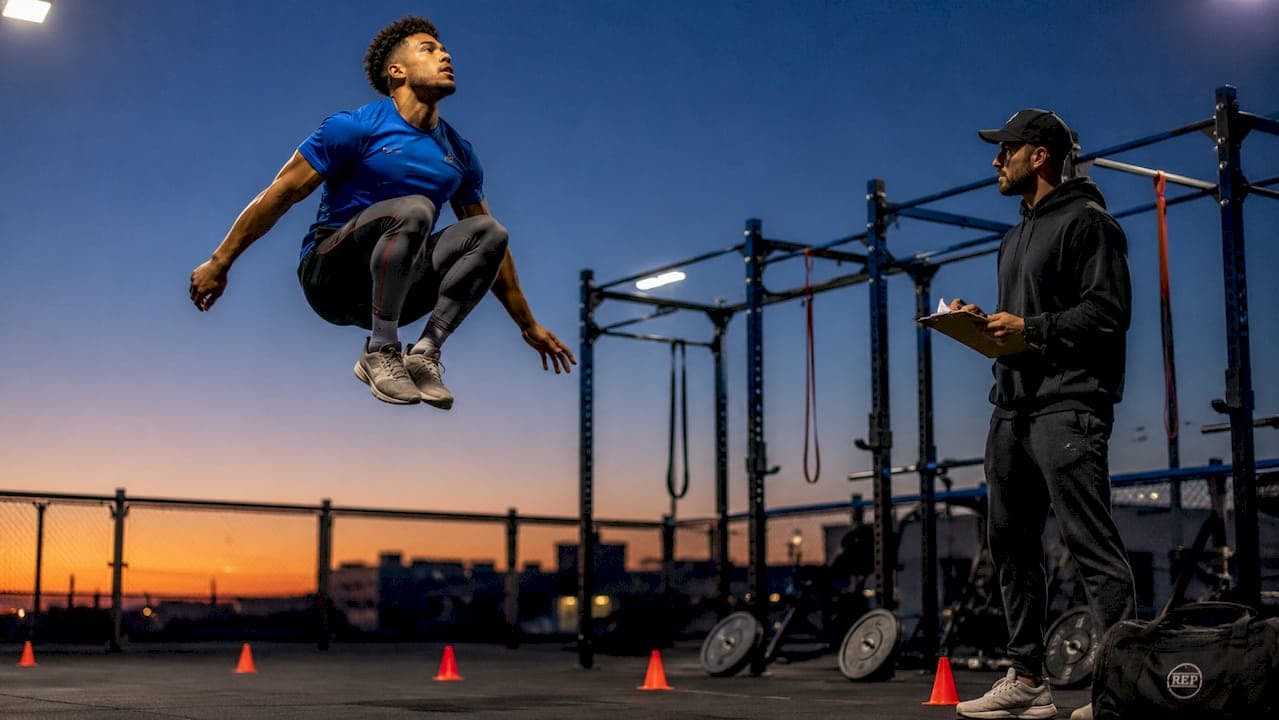
Your max vertical is defined as the highest point your body can jump from a standing or approach position, and it is the single most direct measure of lower-body explosive power in sport. Athletes in basketball, volleyball, football, and track all use it as a benchmark for athleticism. Average vertical jumps range from 40–55 cm for adult men and 30–40 cm for adult women, while elite jumpers reach 55–70 cm (men) and 44–58 cm (women). Knowing where you stand is the first step toward closing that gap.
What is a realistic max vertical improvement?
Most athletes can add meaningful height to their vertical leap with the right program. The question is how much, and how fast.
Targeted training produces real, measurable gains for athletes at every level. Beginners often see the fastest early progress because their neuromuscular system responds quickly to new movement demands. Sub-elite and recreational athletes can realistically expect to add several centimeters within a 12-week cycle when training is structured correctly.
Who benefits most from vertical leap training?
- Beginners and recreational athletes with untrained legs gain the most in the shortest time because any progressive overload triggers rapid adaptation.
- Sub-elite athletes who train consistently but lack a structured program often have significant untapped potential in their rate of force development.
- Youth athletes benefit from jump training for both performance and long-term bone and joint health.
- Adults of all fitness levels can improve neuromuscular efficiency and reduce injury risk through consistent vertical jump exercises.
One critical prerequisite stands out above all others. A back squat of 1.5× bodyweight is the key strength threshold. Athletes below that mark see greater gains by building maximal strength first, before adding heavy plyometric volume. Skipping this step is one of the most common reasons athletes plateau early.
Pro Tip: Test your standing vertical jump before starting any program. Use a wall and chalk, or a Vertec device if available. That baseline number is your most honest starting point.
What are the key phases of a vertical jump training program?
Effective vertical leap training follows three sequential phases. Each phase builds the physical quality that the next phase requires. Rushing through them is the fastest way to stall your progress.

| Phase | Primary Focus | Key Adaptation |
|---|---|---|
| Maximal Strength | Back squat, deadlift, heavy loading | Increased force production capacity |
| Rate of Force Development (RFD) | Speed-strength work, jump squats | Faster muscle recruitment and power output |
| Reactive Strength Index (RSI) | Depth jumps, short ground-contact drills | Stretch-shortening cycle efficiency |
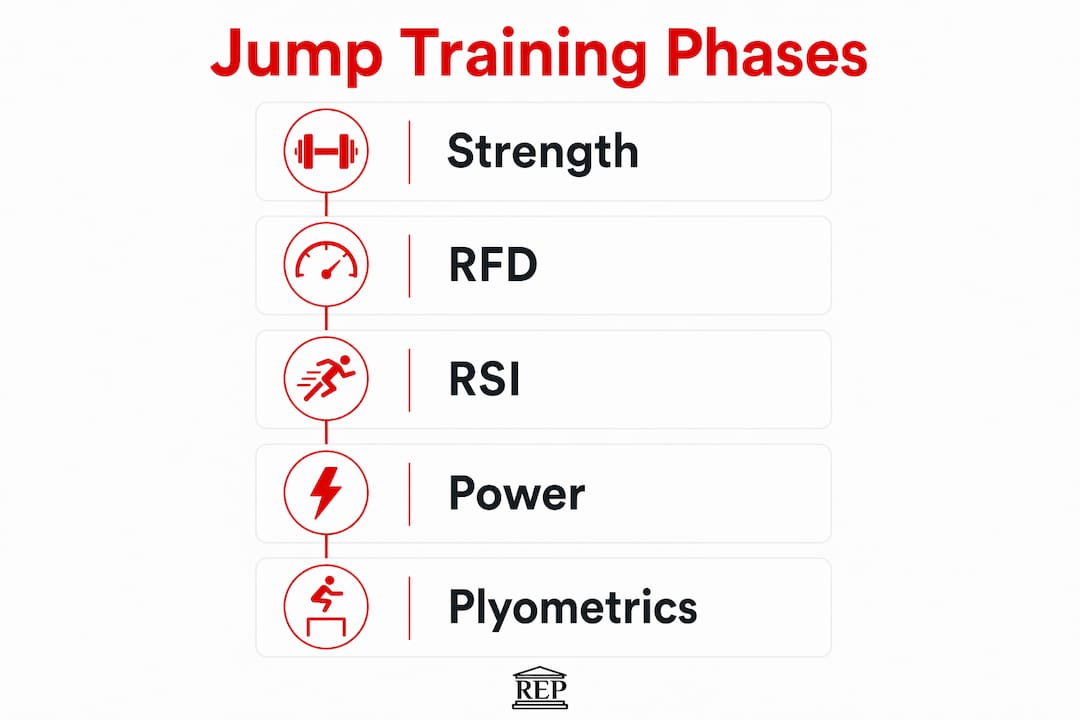
The maximal strength phase lays the foundation. You cannot express power you have not built. The RFD phase teaches your nervous system to apply that strength quickly. The RSI phase, which focuses on minimizing ground contact time, is where elite-level jumping lives. Elite athletes maintain an RSI above 2.5, a number that correlates directly with jump height and neuromuscular quality.
Combined strength and plyometric training produces an average of 4.7 cm greater jump increase than plyometrics alone over a 12-week program. That gap exists because strength training provides the raw force that plyometrics then teach the body to express explosively. You need both.
IMU sensors, small wearable devices that measure ground contact time and jump height objectively, are increasingly used by performance coaches to track progress through each phase. They remove the guesswork from plyometric progression and help prevent overtraining before it becomes a problem.
Pro Tip: Do not move from the strength phase to the RSI phase until your back squat consistently hits 1.5× your bodyweight. That number is not arbitrary. It is the threshold where plyometric training becomes most productive.
How to structure your exercises to increase vertical jump
A well-built program combines foundational strength work with progressive plyometrics. Here is how to structure a 12-week approach.
-
Weeks 1–4: Maximal strength foundation. Back squats, Romanian deadlifts, and Bulgarian split squats form the core. Aim for 3–5 sets of 3–6 reps at 80–90% of your one-rep max. The goal is raw force production, not conditioning.
-
Weeks 5–8: Rate of force development. Introduce box jumps, broad jumps, and jump squats with moderate loads. Keep reps low (3–5 per set) and focus on maximal intent on every rep. Speed of movement matters more than load here.
-
Weeks 9–12: Reactive strength and plyometric intensity. Add depth jumps and single-leg bounding. Ground contact time becomes your primary metric. Short, sharp contacts with maximum height output define this phase.
Plyometric sessions should be limited to 2–3 per week with at least 48 hours of recovery between sessions. The neurological demand of true plyometric work is high. More is not better here. More is often worse.
Contrast training, pairing a heavy strength exercise with a biomechanically similar explosive movement, is one of the most effective tools in this program. Post-activation potentiation (PAP) temporarily increases muscle contractile force, improving jump height acutely by 3–8%. A practical example: perform 3 heavy back squats at 85% of your max, rest 3–4 minutes, then execute 3 maximal box jumps. The nervous system is primed, and the jumps feel noticeably more powerful.
Nutrition supports every phase of this work. Protein intake of 1.6–2.2g per kilogram of bodyweight and 3–5g of creatine daily can enhance explosive power output by 5–10%. Carbohydrate timing around sessions also matters. Train with full glycogen stores, especially during the plyometric phases, when energy demand spikes.
Pro Tip: Pair your heaviest squat set with your jump set in the same session, not on separate days. The PAP effect is time-sensitive. You have roughly a 3–8 minute window after the heavy lift to capture the performance boost.
How do you measure progress and avoid common pitfalls?
Progress tracking separates athletes who improve from those who spin their wheels. Measurement also reveals problems before they become injuries.
- Measure jump height consistently. Use the same method every time, whether that is a wall touch, a Vertec, or a flight-time app. Inconsistent measurement produces meaningless data.
- Track RSI, not just height. A higher jump with longer ground contact time signals poor reactive strength. RSI tells you more about your actual athleticism than raw height alone.
- Watch for overtraining signals. Persistent soreness, declining jump performance, and disrupted sleep are the clearest signs that plyometric volume is too high.
- Reassess your strength baseline if you plateau. Athletes often stall because they moved to plyometric intensity before their squat strength was ready. Going back to the strength phase is not a step backward. It is the correct fix.
"Elite athletes often stop obsessing about exact jump inches and improve mechanics instead, leading to natural vertical gains." Shifting your attention from the number on the wall to the quality of your takeoff, arm swing, and hip extension produces better results than chasing centimeters directly. Movement quality is the real driver of long-term vertical improvement.
The most underrated measurement tool is video. Film your jumps from the side every two weeks. You will see mechanical improvements, or problems, that no number captures on its own.
Why does vertical jump training improve your overall athletic performance?
Improving your maximum vertical jump does far more than help you dunk or spike a ball. The physical qualities it develops transfer across nearly every sport and every stage of athletic life.
- Sprint speed and agility improve because the same hip extension power and ground-contact efficiency that drives jump height also drives acceleration and change of direction.
- Bone density and joint resilience increase with consistent plyometric loading, reducing long-term injury risk in the knees, hips, and ankles.
- Neuromuscular efficiency improves, meaning your body recruits muscle fibers faster and more completely, which benefits every athletic movement you perform.
- Injury risk drops as tendons, ligaments, and supporting muscles adapt to the demands of explosive loading over time.
Vertical jump training improves joint resilience, bone density, sprint speed, and agility, offering advantages that extend well beyond the court or field. These benefits apply to soccer players, football athletes, martial artists, and adults who simply want to move better and age with fewer physical limitations. Sports performance training built around vertical jump development is one of the most complete physical investments an athlete can make.
Key Takeaways
Building your maximum vertical jump requires a structured, phased approach that develops maximal strength before adding plyometric intensity, supported by proper nutrition and consistent progress tracking.
| Point | Details |
|---|---|
| Establish a strength baseline | Hit a back squat of 1.5× bodyweight before prioritizing plyometric volume. |
| Train in three sequential phases | Progress from maximal strength to rate of force development to reactive strength index. |
| Use contrast training | Pair heavy squats with explosive jumps to capture the PAP effect and boost jump height acutely. |
| Limit plyometric frequency | Cap sessions at 2–3 per week with 48 hours of recovery to prevent neurological overtraining. |
| Track RSI, not just height | Reactive Strength Index above 2.5 signals elite-level stretch-shortening cycle efficiency. |
What I've learned coaching athletes through vertical jump plateaus
The athletes who make the biggest gains are rarely the ones who train the hardest. They are the ones who train the most honestly.
I have worked with athletes who came in convinced they needed more box jumps when what they actually needed was six more weeks of heavy squatting. The ego wants to jump. The body needs to be ready to jump. That gap between what feels productive and what actually produces results is where most vertical jump programs fall apart.
The mindset shift I push every athlete toward is this: stop measuring your worth in inches off the ground. Start measuring the quality of your takeoff, the sharpness of your arm drive, and the speed of your ground contact. When those mechanics improve, the height follows. Focusing on movement quality rather than raw numbers is what separates athletes who keep improving from those who peak early and stay stuck.
I also want to be direct about recovery. Most athletes underestimate how demanding true plyometric training is on the nervous system. Two hard plyometric sessions per week, done with full intent and proper rest, will outperform five sloppy sessions every time. Protect your recovery the same way you protect your training.
The joy of watching an athlete clear a height they thought was impossible for them is one of the best parts of this work. That moment is available to you too, and it starts with honest, patient, structured effort.
— Coach Justin
Ready to build your vertical with Repphilosophy?
At Repphilosophy, we build training programs around exactly the kind of phased, evidence-based approach this article describes. Whether you are an athlete chasing a new personal best or a beginner building your foundation, there is a path here for you.

Our personal training packages are built to take you through every phase of vertical jump development, from maximal strength to reactive power, with coaching that keeps you progressing safely. Prefer to train on your own schedule? Our on-demand exercise library gives you structured jump and strength workouts you can follow anywhere. Athletes in the 4S Ranch area can also train in person at the WayALife Athletics sports performance center, where group classes and youth programs run in a safe, challenging environment built for real results.
FAQ
What is a good max vertical jump for an athlete?
A good vertical jump for a competitive male athlete is 40–52 cm, and 30–42 cm for women. Elite jumpers reach 55–70 cm (men) and 44–58 cm (women).
How long does it take to increase your vertical jump?
A structured 12-week program combining strength and plyometric training produces measurable gains, with combined training averaging 4.7 cm more improvement than plyometrics alone.
What exercises increase vertical jump the most?
Back squats, depth jumps, and contrast training pairs produce the greatest vertical jump gains by building maximal force and reactive strength simultaneously.
How often should I do vertical jump exercises?
Limit plyometric sessions to 2–3 per week with at least 48 hours of recovery between sessions to allow full neurological recovery and prevent overtraining.
Does nutrition affect vertical jump performance?
Protein intake of 1.6–2.2g per kilogram of bodyweight and 3–5g of creatine daily support explosive power output and muscle recovery during vertical leap training.