

Resistance bands build strength just as effectively as barbells and dumbbells when you program them right, and you don't need a full gym to prove it. Pick from three time-based templates depending on your day: a 20-minute express circuit, a 25-minute balanced session, or a 40-minute full strength block. Every version hits the same five patterns that matter most: squat, hinge, push, pull, and carry or core. That's the whole formula. Now let's get into how to actually run it.
TL;DR:
- Resistance band training is as effective as free weights for building strength when programs follow proper structure, including warm-up, sets, and progression.
- The three main templates (20-minute circuit, 25-minute balanced, 40-minute full strength) cater to different schedules and goals, emphasizing controlled reps and proper rest.
- Focus on five key movement patterns—squat, hinge, push, pull, and carry/core—to ensure comprehensive strength development and joint balance.
- Progression can be achieved by adding reps, slowing tempo, stacking bands, or increasing volume, without needing to buy heavier equipment.
- Training two to four times weekly, with at least 48 hours recovery between sessions, supports steady strength gains and habit formation.
Table of Contents
- Building Your Resistance Band Strength Routine: The Templates
- What Are the Best Band Exercises for Each Movement Pattern?
- What Resistance Bands Do You Actually Need?
- How Often Should You Train With Resistance Bands for Strength?
- Common Mistakes That Sabotage a Resistance Band Workout
- How Rep Philosophy Coaches Adapt Band Routines for Real Clients
- Why the Simplest Routine Is Usually the One That Sticks
- Ready for a Guided Resistance Band Program?
- Sources
- FAQ
Building Your Resistance Band Strength Routine: The Templates
A 2019 systematic review and meta-analysis compared elastic resistance training against conventional weights and found no meaningful difference in strength gains for either upper or lower body. That single finding changes how you should think about bands: they aren't a "backup plan" for when you’re away from the gym. They're a legitimate strength tool, full stop, as long as you treat the workout with the same structure you'd bring to a barbell session.
Structure is where most home band routines fall apart. People grab a band, do some curls, feel a burn, and call it a day. That's not a strength routine — that's fidgeting with elastic. A real resistance band strength routine needs a warm-up, a clear set and rep target, controlled rest, and a plan for making next week harder than this week. Here are three templates commonly used in resistance band training programs.
- The 20-minute express template. This is a circuit or EMOM-style session (every minute on the minute) that touches all five movement patterns once or twice through. You're moving fast between exercises with minimal rest, so intensity comes from pace and control rather than heavy resistance. This template is built for maintenance days or the weeks when your schedule is wrecked but you still want a training stimulus. Coach-created 20-minute band routines built around this exact five-move structure show up again and again in practical strength guides, and for good reason: it works when time is the limiting factor.
- The 25-minute balanced template. This is two to three rounds of five exercises, one for each pattern, with 30 to 45 seconds of rest between moves and a slightly longer break between rounds. This is a balanced session with enough volume to drive steady strength gains without demanding a huge time commitment.
- The 40-minute full strength template. Here you're doing three to four sets per exercise with 60 to 90 seconds of rest, working through each movement pattern with more total volume and heavier band tension. This is the session for when you actually want to push a strength ceiling, not just maintain one. Treat it like a real training day: warm up properly, control your tempo, and don't rush the last set just because the clock's ticking.
Every template opens with a 3 to 5 minute warm-up: light cardio to raise your heart rate, plus a few band-resisted movements at low tension to prep the joints you're about to load. Close with 2 to 5 minutes of static stretching or slow controlled breathing, especially through the hips and shoulders, where band work tends to accumulate tension.
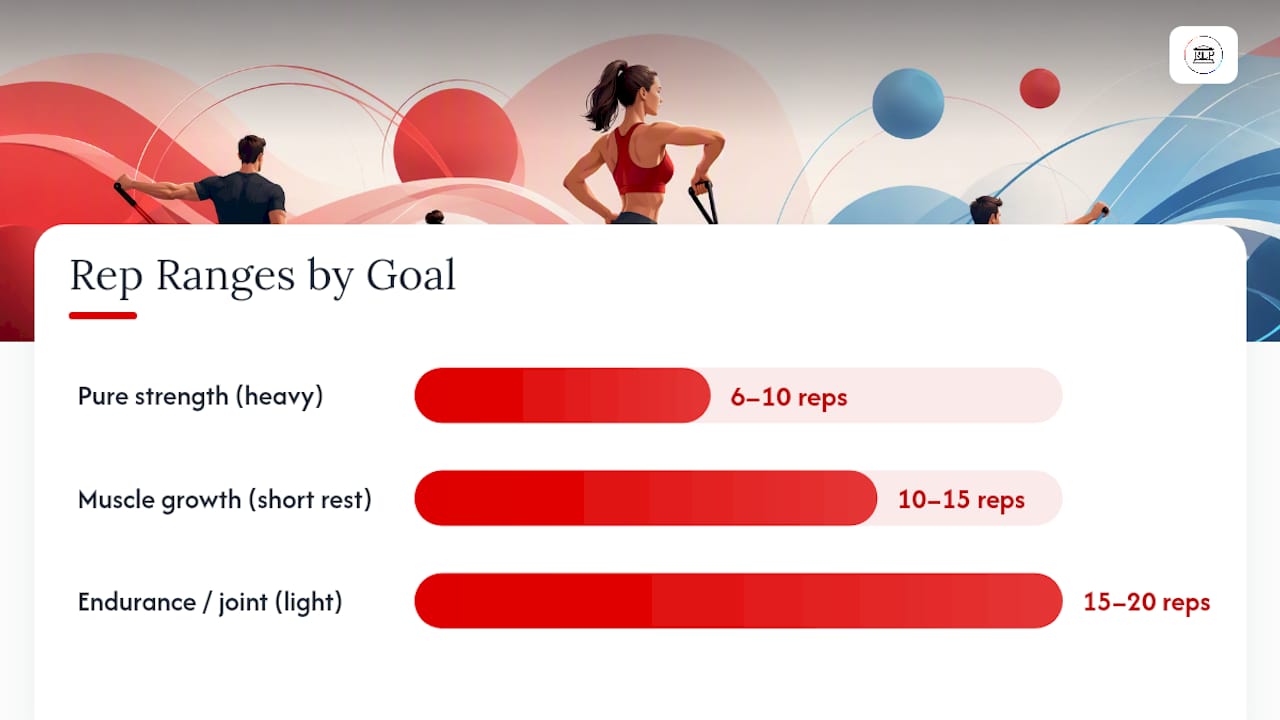
Your rep range should match your goal. If pure strength is the target, work in the 6 to 10 rep zone with a band tense enough that the last two reps genuinely challenge you. If you're chasing muscle growth and general conditioning, 10 to 15 reps with shorter rest works better. If endurance and joint health are the priority, which the Washington Post's low-impact band routine highlights well for older or deconditioned populations, stay in the 15 to 20 rep range with lighter tension throughout.
You can also structure any of these templates two ways: as a circuit (one set of each move, repeat the round) or as straight sets (finish all sets of squat before moving to hinge, and so on). Circuits keep your heart rate up and save time. Straight sets let you focus harder on progressive overload for each pattern. Neither is wrong. Pick the one that matches your energy that day.
What Are the Best Band Exercises for Each Movement Pattern?
A full-body band workout only works if it actually covers the joints and muscle groups that matter for daily strength: hips, knees, chest, back, and core. Guides across major outlets consistently organize band training around five key movement patterns, and that structure holds up because it forces balance. You can't overtrain push and skip pull. Here's the exercise bank we pull from for every template.
Squat pattern
- Banded squat: loop a mini band above your knees, feet shoulder-width, and press your knees out against the band as you sit back into the squat. This teaches knee tracking better than almost any coaching cue.
- Goblet-style band squat: hold a long band under both feet and pull the ends up to chest height, squatting against the tension. Gear note: a long flat band works better here than a loop. Regression: reduce depth to a quarter squat. Progression: shorten the band slack or add a pause at the bottom.
- Lateral squat: step out to the side against a loop band's resistance, keeping your chest up and weight in your heels. Great for hip stability that a straight-ahead squat doesn't train.
Hinge pattern
- Banded Romanian deadlift: stand on the band, hold the handles or ends at hip height, and push your hips back while keeping a soft knee bend. The cue that matters most: hinge from the hips, not the lower back.
- Good morning: band anchored under your feet, looped behind your neck or across your upper back, hinge forward with a flat spine. Regression: shrink the range of motion. Progression: slow the eccentric to three or four seconds.
- Single-leg hinge: same hip-hinge pattern on one leg, using a mini band for balance assistance if needed.
Push pattern
- Band chest press: anchor a long band behind you at chest height (a door anchor works well) and press forward, keeping your shoulder blades pulled down and back.
- Standing overhead press: stand on the band, press handles overhead, avoiding any lean back through the lower spine.
- Band-resisted push-up: loop the band across your upper back and under your hands for added resistance on a standard push-up. Gear note: handled bands make grip easier for pressing moves. Regression: elevate your hands on a surface. Progression: add a slow three-count lowering phase.
Pull pattern
- Standing or seated row: anchor the band at chest height, pull the handles to your ribs, squeezing your shoulder blades together at the end range.
- Band pull-aparts: hold a light loop band at shoulder height and pull it apart, focusing on scapular squeeze rather than arm strength.
- Band-assisted pull-up progression: loop a heavy long band over a pull-up bar and under one knee or foot for assistance. Regression: use a thicker band for more assist. Progression: move to a thinner band as you get stronger.
Carry and core
- Suitcase carry: hold one end of a band anchored to the floor and walk while resisting the pull to one side, bracing your core the whole way.
- Anti-rotation press (Pallof press): anchor a band at chest height, press it straight out from your chest, resisting the rotational pull. Breathe out on the press, in on the return.
- Banded plank variations: add a loop band around your ankles or wrists during a plank to challenge stability without adding load to the spine.
What Resistance Bands Do You Actually Need?
You don't need a drawer full of equipment. Three band types cover almost every exercise above.
- Loop mini bands are best for activation work and lower-body moves like lateral squats and pull-aparts, and they're the cheapest, most travel-friendly option.
- Long flat or tube bands with handles cover presses, rows, and hinge patterns where you need length to anchor at different heights.
- Handled bands make gripping easier during pressing and pulling moves, especially if you have any wrist sensitivity.
For resistance selection, don't overthink it: pick the band where your target rep range leaves you at a 7 or 8 out of 10 on perceived exertion by the last rep. If you're cruising through 15 reps with zero strain, the band's too light. If you're failing at rep 4 during a 10-rep set, drop down a level. A basic starter kit is three resistance levels, light, medium, and heavy, which covers nearly every exercise across all three time templates.
Pro Tip: Bands change resistance across the range of motion, meaning they feel lighter at the start of a rep and heaviest near full stretch. Slow down the last quarter of each rep instead of speeding through it. That's where most of the strength stimulus actually happens.
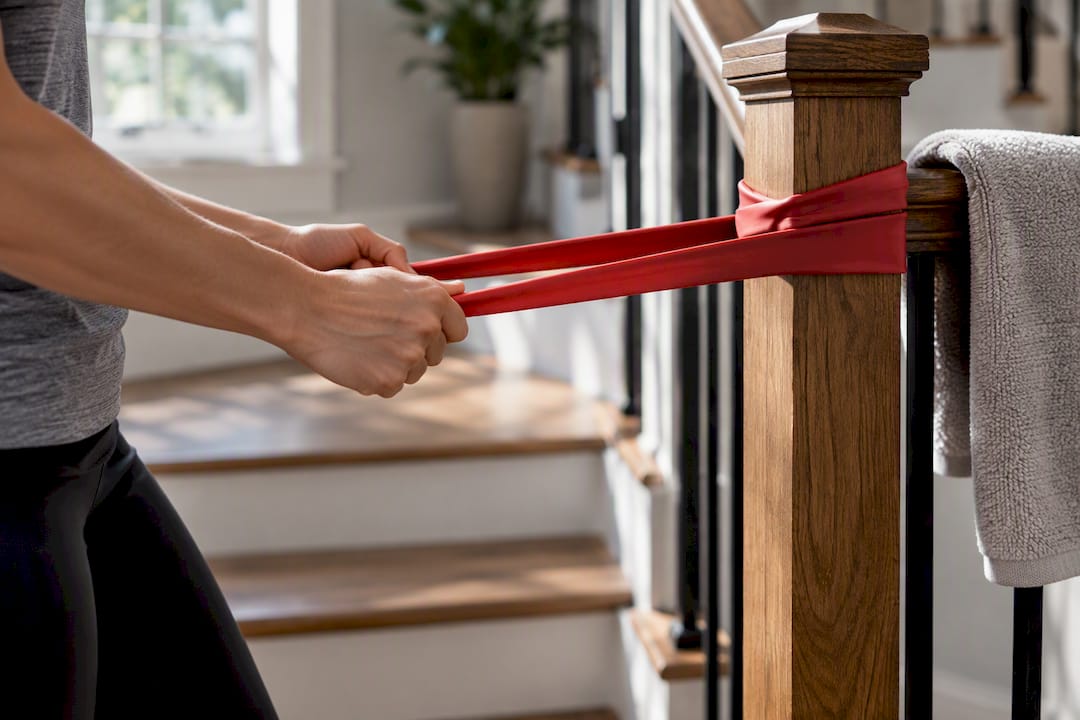
No door anchor? Loop the band around a sturdy table leg, a stair banister, or a heavy piece of furniture that won't slide. Always test the anchor with a light tug before loading it with real tension.
How Often Should You Train With Resistance Bands for Strength?
Cleveland Clinic recommends resistance training at least two days per week to see measurable strength improvements, and consistency matters more than intensity when you're building a habit. For most people building a resistance band strength routine from scratch, two to four sessions a week hits the sweet spot: two if you're brand new or juggling a packed schedule, four if you've built up some tolerance and want faster progress. Check out these effective workout routines for men to build muscle and strength for additional guidance.
Recovery isn't optional. Give the same muscle groups at least 48 hours before hitting them with heavy volume again, and don't sacrifice sleep to squeeze in an extra session. A tired body doesn't get stronger, it just gets tired.
Progressive overload with bands doesn't require buying heavier equipment every few weeks. You have several levers to pull instead:
- Add reps. If you finished last week's set with room to spare, add two or three reps before changing anything else.
- Slow the tempo. A three or four second lowering phase on any rep dramatically increases time under tension without touching the band.
- Reduce slack. Choke up on the band or stand closer to the anchor point to increase tension at the start of the movement.
- Stack bands. Loop a second band alongside the first for a jump in resistance that a single band can't provide.
- Add a set. Move from two sets to three once the current volume feels manageable.
- Trim rest. Cutting 10 to 15 seconds of rest between sets raises the conditioning demand of the same exercises.
A simple 4-week beginner progression might look like this: weeks 1 and 2 run the 20-minute template three times weekly at moderate tension, focusing on form. Weeks 3 and 4 shift to the 25-minute template, add one set per exercise, and reduce band slack slightly on your strongest lifts. That's how you turn a single workout into an actual program.
Common Mistakes That Sabotage a Resistance Band Workout
Before you start any session, run a quick check on your equipment. Inspect the band for small tears or thinning spots, especially near the handles, and replace anything that looks stretched out of shape. Anchor it at a height and location where it can't slip during a heavy pull.
- Slack in the band at the start of a rep. This kills tension exactly when your muscles are strongest. Fix it by choking up on the band before you begin.
- Rushing the reps. Fast, bouncy reps rely on momentum instead of muscle. Slow down, especially on the lowering phase.
- Gripping too hard on presses and rows. This creates unnecessary wrist and neck tension that has nothing to do with the target muscle. Relax your grip and let your shoulders do the work.
- Ignoring the hip hinge on RDLs and good mornings. Rounding the lower back to "reach lower" is a shortcut to irritation, not more range of motion.
If you're dealing with knee pain, favor partial-range squats and add glute activation work before loading the joint further. Low-back sensitivity calls for shortening the range on hinge movements and prioritizing a neutral spine over depth. Shoulder impingement responds better to rows and pull-aparts than to overhead pressing until the joint settles down.
Pro Tip: If a movement causes sharp or pinching pain anywhere, that's not a mobility issue to push through. Switch to the regression listed for that exercise and revisit the full version once the discomfort clears.
How Rep Philosophy Coaches Adapt Band Routines for Real Clients
Coach Justin's go-to cue set for the five staple band moves, squat, RDL, chest press, row, and Pallof press, starts in the same place every time: control the band, don't let the band control you. Most beginners rush the eccentric phase because bands don't have the same "falling weight" feedback a dumbbell gives you, so the first correction is almost always tempo.
This routine can be scaled across very different clients by adjusting regressions, range of motion, rest, emphasis on control, and speed based on individual needs.
A resistance band strength routine only works long term if the person doing it can actually recover from it and show up again next week. That's the real measure of a good program, not how hard one session feels.
— Coach Justin
Why the Simplest Routine Is Usually the One That Sticks
Accessibility beats intensity almost every time. A resistance band strength routine you can unroll in a hotel room or a living room removes every excuse that normally kills a training habit, and that alone makes it more valuable than a "perfect" program you only do twice a month. Mixing the 20-minute and 40-minute templates across a week keeps things interesting and prevents the kind of burnout that comes from grinding the same session on repeat. Progress isn't about finding the hardest workout. It's about finding the one you'll actually repeat.
Ready for a Guided Resistance Band Program?
Reading through five movement patterns and three time templates is one thing. Having someone watch your form, adjust your band tension, and tell you exactly when to progress is another. Personal training options include self-guided programs and virtual coaching that can fit various levels of support and schedules.
If you want a self-guided option you can start today, the Exercise Video Library Membership runs $12.50 a month and gives you a full catalog of coached movements, including band-based sessions, to build your own routine around. If you'd rather have a program built specifically around your goals and limitations, Virtual Coaching Sessions pair you directly with a coach for personalized progression. And if accountability is what keeps you consistent, our small-group training memberships let you train alongside others without covering the full cost of one-on-one sessions. Book a session or browse the current options on the Repphilosophy site and find the format that matches how you actually train.
Sources
For more on the science and programming behind band strength work, see the elastic resistance meta-analysis and Repphilosophy's full body strength guide.
- A 20-Minute Exercise Band Workout to Build Strength — New York Times
- 6 resistance band exercises for an easy workout you can do anywhere — Washington Post
- Should you try resistance bands for strength training — Cleveland Clinic
FAQ
Do resistance bands actually build strength?
Yes. A systematic review and meta-analysis found elastic resistance training produces strength gains comparable to conventional weights for both upper and lower body when programs are matched for volume and intensity. The band itself isn't the limiting factor. How you program it is.
What is the 3-3-3 rule for working out?
Definitions of the 3-3-3 rule vary across fitness content, and it isn't a standard reference point in the exercise science behind band training. Rather than guess at a version, focus on the programming principles this article covers: matched movement patterns, progressive overload, and consistent frequency.
Can I do strength training with just resistance bands?
Yes, bands alone can build meaningful strength across your whole body when you train all five movement patterns (squat, hinge, push, pull, carry/core) and progressively increase difficulty through tempo, band tension, or reduced slack. Many clients get a full resistance band strength routine done using nothing but a set of three bands.
How many times a day should you exercise with resistance bands?
One structured session per day is enough for strength goals, and most people do better with a rest day between sessions targeting the same muscle groups. Cleveland Clinic recommends training at least two days per week at minimum, with two to four sessions weekly being a common range for steady progress.