

Most people can safely lose 1–2 pounds per week by maintaining a daily calorie deficit of roughly 500–750 calories, and that single number is the foundation of every realistic weight loss timeline. Harvard Health and the CDC both anchor their guidance there, and for good reason: it's the rate at which your body loses primarily fat rather than muscle.
Here's what that looks like in practice:
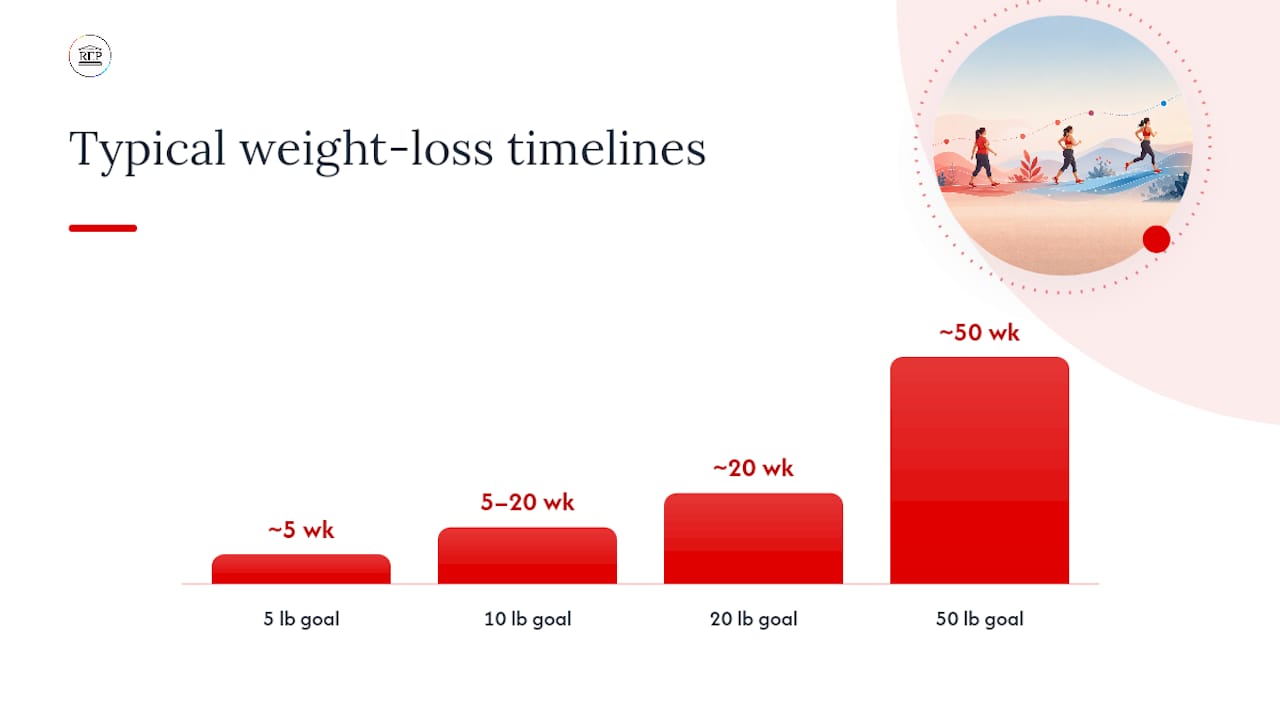
- 5 pounds: 3–10 weeks at 0.5–2 lb/week
- 10 pounds: 5–20 weeks (roughly 1–5 months)
- 20 pounds: typically multiple months, varying by personal circumstances
- 50 pounds: 25–100 weeks (roughly 6 months to 2 years)
Those ranges feel wide because they are. Age, starting weight, hormonal health, sleep quality, and how consistently you train all shift where you land within them. The sections below unpack each variable so you can build a timeline that actually fits your life, not a generic chart.
Key Takeaways
Losing 1–2 pounds per week through a consistent calorie deficit is the safest, most sustainable rate for fat loss, and it translates to 4–8 pounds per month for most people.
| Point | Details |
|---|---|
| Safe rate of loss | Aim for 1–2 lb per week (roughly 500–750 calorie daily deficit) to protect muscle and metabolism. |
| Common goal timelines | A 10 lb goal takes roughly 5–20 weeks; a 20 lb goal takes typically multiple months, varying by personal circumstances. |
| Protect lean mass | Combine resistance training (2–3x/week) with 0.7–1 g protein per pound of body weight to minimize muscle loss. |
| Plan for plateaus | Add 20–30% extra time to any target timeline to account for real-life slowdowns and adaptation phases. |
| Repphilosophy coaching | In-person, virtual, and trial session options in 4S Ranch help you apply these timelines with structured accountability. |
Table of Contents
- What does a realistic, safe rate of weight loss look like?
- What stages do you go through on a weight loss timeline?
- What factors speed up or slow down your timeline?
- Realistic timeline examples for common weight loss goals
- How do you set SMART goals tied to a realistic timeline?
- How do you protect lean muscle while losing weight?
- When is rapid weight loss risky, and when should you see a doctor?
- How were these timelines built, and what are the sources?
- A coach's honest take on timelines
- Repphilosophy coaching turns your timeline into a real plan
- Sources
What does a realistic, safe rate of weight loss look like?
The clinical consensus is clear: 1–2 pounds per week is the target range for sustainable fat loss. At that rate, a 500–750 calorie daily deficit does the work without triggering the metabolic and muscular consequences that come with more aggressive cuts.
Losing weight faster than approximately 2 pounds per week for extended periods can increase risks to muscle mass and metabolism. Harvard Health notes that rapid loss accelerates muscle atrophy and metabolic slowdown, meaning your body adapts by burning fewer calories at rest. That's the opposite of what you want for long-term success.
A few things worth knowing about the early weeks:
- The first 1–2 weeks often show faster losses (sometimes 3–5 lb) driven by water and glycogen depletion, not fat. A peer-reviewed NCBI study confirms that early rapid changes are largely fluid shifts.
- Percentage of body weight matters. Someone starting at 250 lb losing 2 lb/week is shedding 0.8% of body weight, which is well within the safe range. Someone at 130 lb losing the same amount is losing over 1.5%, which may be too aggressive.
- Monthly, the math is simple: 1–2 lb/week translates to roughly 4–8 lb per month.
If you're consistently losing more than 2 lb/week after the first two weeks, that's a signal to reassess your deficit and check in with a clinician.
What stages do you go through on a weight loss timeline?
Weight loss doesn't move in a straight line. Most people pass through four recognizable phases, and knowing what each one feels like makes the harder stretches far easier to navigate.
Stage 1: Weeks 1–2 (rapid early changes)
The scale often drops quickly here, sometimes 3–5 pounds in the first week. Most of that is water and stored glycogen releasing as you reduce carbohydrates and calories. Energy can feel surprisingly good during this phase. Don't mistake this speed for your long-term rate. Research indexed on NCBI is clear that sustained fat loss follows a slower, steadier course once glycogen stores normalize.
Tracking non-scale victories like sleep quality, energy, and clothing fit helps you stay grounded when the scale slows down.
Stage 2: Weeks 3–12 (steady fat loss)
This is where the real work happens. A consistent 500–750 calorie daily deficit produces the 1–2 lb/week rate. Protein intake and resistance training become critical here because they protect lean mass while the scale moves. Most people see visible changes by weeks 4–6, which is also when motivation can start to waver.
Pro Tip: Aim for 0.7–1 gram of protein per pound of body weight during this stage. Pairing that with two to three resistance training sessions per week dramatically reduces lean-mass loss.
Stage 3: Months 3–6+ (plateaus and adaptation)
Progress slows. Your body has adapted to the new calorie level, your resting metabolic rate has shifted, and behavioral fatigue can set in. Plateaus at this stage are normal and expected, not a sign of failure. They typically last 2–6 weeks before the body adjusts again. Revisiting weekly weigh-in strategies and adjusting your deficit by 100–200 calories can restart movement without requiring a dramatic overhaul.
Stage 4: Maintenance
The goal shifts from losing to sustaining. Calorie targets increase slightly, training continues, and the habits built in stages 2 and 3 carry the load. Longitudinal research on NCBI shows that people who lost weight rapidly through extreme dieting regained most of it within a few years while those who lost gradually and built sustainable habits maintained far more of their progress.
What factors speed up or slow down your timeline?
Two people with the same goal can have timelines that differ by months. Here's what drives that gap.
Biological factors:
- Starting weight: Heavier starting points typically produce faster absolute losses early on, since a larger body burns more calories at rest and during activity.
- Sex: Men generally lose weight faster initially due to higher muscle mass and testosterone levels supporting a higher resting metabolic rate.
- Age: Metabolic rate tends to decline with age, and hormonal shifts (especially around menopause) can slow progress.
- Hormonal and medical conditions: Thyroid dysfunction, polycystic ovary syndrome (PCOS), and insulin resistance all affect how the body processes and stores energy.
Behavioral and lifestyle drivers:
- Calorie deficit size: Larger deficits produce faster loss but increase muscle loss and hunger, making adherence harder.
- Protein intake: Higher protein preserves lean mass and increases satiety, supporting a more favorable body composition change.
- Sleep and stress: Clinical research on PubMed links poor sleep and elevated cortisol to disrupted appetite regulation and slower weight loss.
- Resistance training: Consistent strength work protects muscle during a deficit and keeps your metabolism more active.
- Medications: Some antidepressants, corticosteroids, and diabetes medications promote weight gain or blunt loss. GLP-1 receptor agonists, on the other hand, can meaningfully accelerate loss for eligible individuals. If you're considering pharmacologic support, reviewing GLP-1 options and clinical guidance with a qualified clinician is the right first step, not self-prescribing.
Three concrete examples:
- A 200 lb, 35-year-old woman with no medical conditions, sleeping 7–8 hours, and training three times per week might lose 1.5 lb/week consistently, reaching a 20 lb goal in roughly 13–14 weeks.
- A 200 lb, 55-year-old man with managed hypothyroidism and a sedentary job might average 0.75 lb/week, reaching the same 20 lb goal in 26–27 weeks.
- A 280 lb person starting a structured program with resistance training and a moderate deficit might lose 2 lb/week early on, slowing to 1–1.5 lb/week by month 3 as their body adapts.
Realistic timeline examples for common weight loss goals
The table below maps four common targets to three realistic rates of loss. These are based on the clinically supported 1–2 lb/week standard and the conservative end of 0.5 lb/week for those with slower metabolisms or medical factors.
| Goal | Conservative (0.5 lb/week) | Typical (1 lb/week) | Optimistic but safe (2 lb/week) |
|---|---|---|---|
| 5 lb | ~10 weeks | ~5 weeks | 3–10 weeks |
| 10 lb | ~20 weeks (~5 months) | 5–20 weeks (roughly 1–5 months) | ~5 weeks |
| 20 lb | ~40 weeks (~10 months) | ~20 weeks (~5 months) | 5–20 weeks (roughly 1–5 months) |
| 50 lb | ~100 weeks (~2 years) | ~50 weeks (~12 months) | ~25 weeks (~6 months) |
Clinical guidelines from NCBI often frame the first milestone as 5–10% of body weight over 3–6 months because that threshold is associated with measurable improvements in blood pressure, blood sugar, and cholesterol, regardless of the absolute number on the scale.
A 20 lb goal at 1 lb/week is 20 weeks on paper; planning for 24–26 weeks keeps you on track without feeling behind.*
How do you set SMART goals tied to a realistic timeline?
A timeline without a goal structure is just a countdown. SMART goals (Specific, Measurable, Achievable, Relevant, Time-bound) give your timeline traction. The CDC emphasizes pairing behavior-focused process goals with outcome targets because behavior change is what actually produces the result.
Here's how to build them:
- 4-week outcome goal: "I will lose 3–4 lb by [date] by maintaining a 500-calorie daily deficit."
- 4-week process goal: "I will eat 130 g of protein per day and complete three resistance training sessions per week."
- 8-week outcome goal: "I will lose 6–8 lb by [date] and reduce my waist measurement by 1 inch."
- 8-week process goal: "I will sleep at least 7 hours per night and log my meals four days per week."
- 6-month outcome goal: "I will lose 20–24 lb by [date], representing roughly 10% of my starting body weight."
- 6-month process goal: "I will complete at least 150 minutes of moderate activity per week, consistent with Physical Activity Guidelines, and check in with my coach monthly."
Pairing an outcome goal with a process goal for the same time window is the key move. The outcome tells you where you're going; the process tells you what to do tomorrow morning. For deeper templates and accountability frameworks, the Repphilosophy guide on setting weight loss goals that stick is worth bookmarking.
How do you protect lean muscle while losing weight?
Losing weight and losing fat are not the same thing. Without the right tactics, a significant portion of your weight loss can come from muscle, which slows your metabolism and leaves you weaker at a lower body weight.
The core evidence-based tactics:
- Prioritize protein. Aim for 0.7–1 g per pound of body weight daily. Higher protein intake during a deficit is one of the most consistent findings in the literature for preserving lean mass.
- Resistance train regularly. A clinical review on NCBI found that combining diet with resistance training preserves significantly more lean mass than diet alone. Two to three sessions per week is the practical minimum.
- Avoid extreme deficits. Cutting more than 1,000 calories per day accelerates muscle catabolism and nutrient shortfalls. The NIDDK underscores that safe weight management protects long-term health, not just the number on the scale.
- Protect sleep and recovery. Sleep is when muscle repair happens. Seven to nine hours per night supports both body composition and appetite regulation.
- Follow the Physical Activity Guidelines. The 2nd edition from ODPHP recommends at least 150–300 minutes of moderate aerobic activity per week plus muscle-strengthening activities on two or more days, a combination that supports both fat loss and lean-mass retention.
A practical sample week might look like: Monday and Thursday for resistance training, Tuesday and Saturday for moderate cardio (30–45 minutes of walking or cycling), Wednesday and Friday for active recovery or light movement, and Sunday as a full rest day.
Pro Tip: If your weekly weight loss stalls for two or more consecutive weeks, resist the urge to slash calories further. Instead, add one additional resistance session or increase protein by 20–30 g per day. This approach protects strength and function while nudging the deficit without triggering a deeper metabolic slowdown.

For a practical starting program, the Repphilosophy guide on strength training for beginners walks through modifications and frequency recommendations that work for most starting points.
When is rapid weight loss risky, and when should you see a doctor?
Losing weight quickly feels like winning. But past a certain threshold, speed becomes a liability.
Warning signs that warrant a clinical conversation:
- Losing more than 2 lb/week consistently after the first two weeks
- Dizziness, fainting, or heart palpitations
- Significant hair loss (telogen effluvium is a known consequence of rapid caloric restriction)
- Severe fatigue that interferes with daily function
- Electrolyte abnormalities (muscle cramps, irregular heartbeat)
- Pre-existing conditions including thyroid disease, eating disorder history, pregnancy, or active cardiovascular disease
Medical reasons to pause or adjust your plan:
Thyroid dysfunction can make standard deficits produce no loss at all, or cause unexpectedly rapid loss. Certain medications, including some antidepressants, antipsychotics, and corticosteroids, directly affect weight. Eating disorder history changes what's safe and what's not, and requires a specialized clinical team rather than a standard coaching approach.
When you see a clinician, bring your weight history over the past 3–6 months, a summary of dietary changes you've made, your current medication list, and notes on sleep and energy levels. That context lets a provider assess whether your pace is safe or whether a formal supervised program is the right call.
How were these timelines built, and what are the sources?
The timelines in this article are derived by mapping the clinically supported 1–2 lb/week rate across common weight-loss targets, then bracketing with a conservative 0.5 lb/week floor for those with slower metabolisms or medical factors. No figures were invented; every range traces back to a named source.
The main sources:
- CDC: — Recommends gradual loss of 1–2 lb/week combined with lifestyle changes for long-term maintenance.
- NIDDK: — Provides clinical context on health risks tied to overweight and obesity, and the importance of safe management approaches.
- ODPHP Physical Activity Guidelines (2nd edition): — Provides the evidence-based activity targets used in the goal-setting and muscle-preservation sections.
One important limitation: all population-level guidance uses ranges because study populations differ in age, sex, starting weight, and metabolic health. The timelines here are planning tools, not guarantees. Individual results vary, and a qualified coach or clinician can help you interpret your own data as you go.
A coach's honest take on timelines
Most clients I work with come in having already tried something faster. A 30-day crash, a severe cut, a program that promised 20 lb in a month. And most of them lost weight, briefly, before regaining it and arriving at my door feeling like they failed. They didn't fail. The timeline failed them.
What I see consistently is this: clients who commit to the 1–2 lb/week rate and pair it with two to three resistance sessions per week start seeing visible changes by weeks 4–6. Not dramatic changes, but real ones. Clothes fit differently. Energy improves. Sleep gets better. Those early non-scale wins are what carry people through the plateau at month 3, which is where most unsupported programs fall apart.
The gap between a theoretical timeline and a real one is almost always behavioral, not physiological. Life interrupts. Stress spikes. A vacation happens. The clients who stay on track are the ones with a structure flexible enough to absorb those disruptions without abandoning the plan entirely. That's what accountability in weight loss training actually looks like in practice: not perfection, but a system that keeps you moving even when the week goes sideways.
Timelines are useful. They set expectations and give you a reference point. But they're not the destination. The destination is a body and a set of habits you can sustain for years, not weeks.
Repphilosophy coaching turns your timeline into a real plan
Knowing the right rate is one thing. Having a coach who builds your specific program around it, adjusts when life happens, and holds you accountable through the plateau months is what actually moves the needle.

At Repphilosophy in 4S Ranch, San Diego, you get exactly that. Whether you want in-person personal training sessions with hands-on coaching, a flexible virtual training library you can access anywhere, or a low-commitment first step with a trial session, every option is built around the same evidence-based principles this article covers: sustainable deficits, resistance training, adequate protein, and realistic timelines that account for real life. Book your trial session today and get a program designed around your goal, your starting point, and your schedule.
Sources
The resources below are the primary references used throughout this article. Each one is worth bookmarking if you want to go deeper.
- What does a healthy, realistic rate of weight loss look like, and why does it matter? - Harvard Health
- Steps for Losing Weight | Healthy Weight and Growth | CDC
- Adult overweight & obesity: health risks - NIDDK
- PMC5421125 (peer-reviewed article) - NCBI
- Physical Activity Guidelines for Americans, 2nd edition - ODPHP
This article provides general health information and is not a substitute for professional medical or clinical advice. Consult a qualified healthcare provider before making significant changes to your diet, exercise routine, or weight-management approach.