
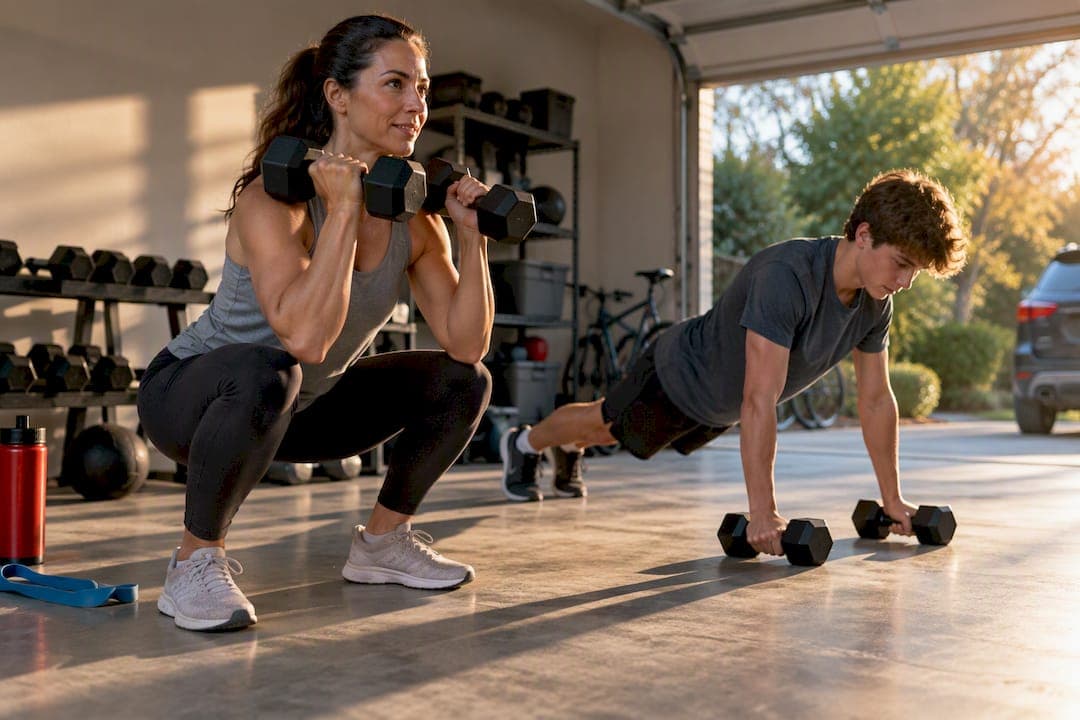
The best parent teen workout combines aerobic movement and resistance training, run 30 to 60 minutes, three to four times a week, with moves scaled separately for each of you. Warm up, train together at your own paces, cool down, and keep it consistent for at least six weeks before judging results. Safety comes first: check with a doctor if either of you has health concerns, and lean on qualified coaching when the lifts get heavier.
TL;DR:
- The routine should include three resistance sessions, two cardio workouts, and daily light movement to meet both CDC and strength guidance.
- Progression relies on adding reps and load gradually, with form quality and safety prioritized, especially during growth spurts.
- Supervision with a coach-to-teen ratio of roughly 1:10 is essential for safety once heavier lifts are involved, along with proper technique training.
- Consistency over intensity matters more; three to four weekly sessions for at least six weeks lead to mental health improvements and observable fitness gains.
- Teens are more likely to stay motivated when allowed to choose activities, track small wins, and feel ownership over their workout plan.
Table of Contents
- What Should a Parent-Teen Workout Program Include?
- A 30-Minute Parent-Teen Circuit You Can Do Today
- Building a 6 to 8 Week Progressive Plan Together
- How Do You Keep a Parent-Teen Workout Safe?
- What Does the Research Say About Exercise and Teen Mental Health?
- How Do You Keep a Teen Motivated to Keep Showing Up?
- Coach Justin's Checklist for Getting Started Safely
- What Should Teens Eat and Drink Before and After Training?
- Why Do Some Teens Resist Working Out, and What Actually Helps?
- What This Guide Gets Right That Most Advice Misses
- Get Supervised, Age-Appropriate Coaching Without the Guesswork
- Sources
- FAQ
What Should a Parent-Teen Workout Program Include?
A well-built program rests on four pillars: aerobic activity, resistance training, bone-strengthening movement, and flexibility work. The CDC recommends that teens get 60 minutes of moderate-to-vigorous activity daily, with muscle- and bone-strengthening work at least three days a week. When you train together, your shared sessions count directly toward your teen's daily total, and toward your own weekly activity goals too.
A simple weekly template looks like this:
- Three resistance sessions (bodyweight or light-load circuits, 20 to 40 minutes)
- Two cardio sessions (brisk walks, bike rides, sport-style drills)
- Daily light movement outside of formal workouts (walking the dog, yard work, stretching)
Scaling is what makes this work as a genuine parent teen workout instead of two separate routines happening in the same room, with ideas inspired by low-impact inclusive fitness that make exercise accessible to all. You might do weighted squats while your teen focuses on bodyweight squats with a pause at the bottom. Same exercise, same clock, different demand. That's the model behind most successful family fitness activities: shared time, individualized intensity. For more ideas on structuring sessions around each person's ability, see Teen Fitness Program Best Practices for Parents.
A 30-Minute Parent-Teen Circuit You Can Do Today
You don't need a gym membership to start. This routine needs a small patch of floor, a set of light dumbbells if you have them, and 30 minutes.
Warm-up (4 minutes): High knees, arm circles, walking lunges, and bodyweight squats, 30 seconds each, repeated once.
Main circuit (20 minutes, 40 seconds work / 20 seconds rest, 4 rounds):
- Push-ups (parent: standard, teen: knee or incline version)
- Reverse lunges (parent: add light dumbbells, teen: bodyweight)
- Plank shoulder taps
- Squat jumps (parent: step-back squats if joints need it)
- Mountain climbers
- Superman holds for core and back
Cooldown (6 minutes): Hamstring and hip-flexor stretches, plus a couple of minutes of slow breathing together.
If either of you has a knee, back, or shoulder issue, swap the jumping moves for step patterns and drop load before dropping range of motion. That order matters more than most people realize.
Pro Tip: Race to see who can hold good plank form longest instead of racing on speed. It keeps the teen focused on technique instead of rushing through reps, which is where most injuries during at-home circuits actually happen.
Building a 6 to 8 Week Progressive Plan Together
Before you start, log two baseline numbers: how many bodyweight squats each of you can do with good form in 60 seconds, and how long it takes to jog or brisk-walk a half mile. Retest every two weeks. Progress shows up faster than most families expect once the routine is consistent.
Progression should follow simple rules, not guesswork:
- Add one to two reps per exercise per week before adding weight
- Increase load only after form holds steady across every set
- Add a new movement pattern (single-leg work, tempo reps) before adding intensity
- Cap weekly load increases at roughly 10%, per HealthyChildren's strength guidance
A sample 4-day microcycle:
- Day 1: Push-focused strength (push-ups, presses, overhead work)
- Day 2: Legs and core (squats, lunges, planks)
- Day 3: Cardio or active recovery (bike ride, walk, light swim)
- Day 4: Full-body circuit combining the week's movements
If your teen is mid-growth-spurt, expect temporary clumsiness and slower progress on coordination-heavy moves. That's normal, not a setback. Dial back complexity, not effort, during that stretch, and focus on movement quality over adding weight. Parents managing very different fitness baselines should adjust volume, not the exercises themselves. Everyone does the same session, at their own working range.
How Do You Keep a Parent-Teen Workout Safe?
Safety in a parent teen workout starts before the first rep. If either of you has an existing health condition, get a medical check before ramping up intensity, and get pediatric clearance for your teen if there's any doubt.
Supervision matters more than most families assume. Guidance on youth resistance training recommends a coach-to-student ratio of roughly 1 to 10 or better when a program moves beyond simple bodyweight work, because form breaks down fast in group settings without enough eyes on technique.
A few non-negotiables:
- Delay maximal or near-maximal lifts until after your teen's growth spurt has settled
- Teach hinge and squat patterns with light loads for months, even years, before adding real weight
- Prioritize movement competency (balance, tempo control, single-leg stability) over external load
- Stop a session immediately if form breaks down under fatigue, rather than pushing to finish reps
Coach-to-student ratios of roughly 1:10 or better are the benchmark most youth resistance-training guidance points to for safe supervision once a program moves past bodyweight basics.
Home workouts are fine for warm-ups, cardio, and bodyweight circuits. Once barbells or heavier dumbbells enter the picture, a qualified coach earns their keep.
What Does the Research Say About Exercise and Teen Mental Health?
The evidence on this is more specific than most parents realize. A systematic review and network meta-analysis found that resistance and mixed-mode exercise reduce depression and anxiety symptoms in youths, with the clearest benefits showing up at three to four sessions per week, 30 to 60 minutes each, sustained past six weeks. Separate meta-analysis data confirms resistance training specifically drives down anxiety and depressive symptoms in young people when properly supervised and dosed.
The pattern across these reviews is consistent: it's not any single "magic" workout that moves the needle on teen mental health. It's showing up three or four times a week, for a month and a half or longer, with enough intensity to actually challenge the body.
That timeline explains why so many family fitness attempts stall. Two weeks in isn't long enough to feel or see the payoff, but six weeks in, both of you should notice a real shift.
How Do You Keep a Teen Motivated to Keep Showing Up?
Autonomy beats mandate almost every time. Letting your teen pick two of the five weekly activities dramatically improves whether they stick with the program, according to research on parental modeling and autonomy-supportive coaching.
Small, visible wins work better than big goals:
- Track one measurable win per week (an extra rep, a faster half mile, a longer plank)
- Let your teen choose the music or the order of the circuit
- Turn progress tracking into a simple point system with a low-stakes reward
- Stack the workout onto something social, like a Saturday morning session followed by breakfast
Pro Tip: Ask your teen to design one workout of the week themselves, using moves from your shared routine. Ownership over even one session tends to carry over into how much effort they bring to the other four.
If mood or energy dips during a growth spurt or a rough week at school, scale the session down rather than skipping it entirely. A lighter 15-minute version keeps the habit alive.
Coach Justin's Checklist for Getting Started Safely
Before loading a single rep, run through a short readiness check: can your teen hold a plank for 30 seconds with a flat back, complete a bodyweight squat to full depth without their heels lifting, and jog for 10 minutes without stopping? Those three markers tell you more about starting point than age or grade level ever will. Coach Justin's home workout checklist walks through exactly how to run that baseline test at home.

Virtual coaching or small-group "bring a buddy" formats tend to outperform pure DIY once a family wants structure without a full commute to a gym. The supervision keeps technique honest, and the social piece keeps teens engaged longer than solo workouts usually manage.
If you're building resistance work into your teen's routine for the first time, Introducing Weight Training to Teenagers Safely covers the technique-first progressions worth following before anyone touches a loaded barbell.
What Should Teens Eat and Drink Before and After Training?
Fuel matters more for teens than for adults, mostly because growing bodies burn through glycogen faster and recover slower on empty. A light carbohydrate snack, like a banana or a slice of toast with peanut butter, 30 to 60 minutes before your session keeps energy steady through a 30-minute circuit.

Hydration is the piece families skip most often. Teens should drink water steadily throughout the day, not just during the workout, and top off with a full glass 20 minutes before starting. During longer or hotter sessions, water breaks every 15 to 20 minutes prevent the fatigue and headaches that get mistaken for low fitness.
After training, a combination of protein and carbohydrates within an hour helps muscle repair and restocks energy stores. That doesn't require a shake or a supplement. Chocolate milk, a turkey sandwich, or Greek yogurt with fruit all do the job. Skip heavy, greasy meals right before a session. They sit poorly and drag down performance in ways that get blamed on the workout instead of the meal.
Why Do Some Teens Resist Working Out, and What Actually Helps?
Resistance to exercise in teens is rarely about laziness. It's usually about self-consciousness, competing time demands, or a workout that feels imposed rather than chosen.
Address the self-consciousness piece by training somewhere private, at least at first. A home workout or a small-group session with people your teen already knows removes the fear of being watched and judged, which is often the biggest barrier for teens new to strength training. Once confidence builds, expanding to bigger group settings gets easier.
Time competition is real. Between school, homework, and social life, a 30-minute session beats a 90-minute one every time for actual adherence. Fit workouts into existing routines instead of carving out new blocks. A session before dinner or right after school tends to stick better than one squeezed in late at night.
The "imposed" feeling dissolves fastest when teens get a real vote. Offer two or three workout options and let them pick, or let them lead a warm-up. Teens who feel some ownership over the plan show up more consistently than those simply told what to do, which tracks with the broader evidence on autonomy-supportive coaching. If a teen still balks, don't frame it as fitness. Frame it as time together. That reframe alone gets a surprising number of reluctant teens back on the mat.
What This Guide Gets Right That Most Advice Misses
Most parent teen workout advice treats teens like miniature adults, prescribing the same lifts, sets, and reps you'd give a grown client. That's the biggest mistake in this space. Adolescent bodies are mid-construction. Growth spurts scramble coordination, bone growth outpaces muscle strength at different points, and pushing heavy loads during that window trades short-term progress for long-term injury risk.
The conventional advice also overrates intensity and underrates consistency. Parents chase the "best" circuit or the trendiest split when the research is blunt about what actually works: three to four sessions a week, 30 to 60 minutes each, sustained past six weeks. There's no shortcut hiding in a fancier workout.
If you take one thing from this guide, prioritize supervision and technique over speed of progress. Teach the squat pattern for months before adding a barbell. Let your teen choose half the plan. Track small wins weekly instead of judging by how sore you both are. The families who stick with this longest aren't the ones training hardest. They're the ones who made it something to look forward to together.
— Coach Justin
Get Supervised, Age-Appropriate Coaching Without the Guesswork
Building a safe, effective parent teen workout on your own takes real trial and error, and Repphilosophy exists to skip that part for you. Small-group training lets you and your teen train side by side with a coach adjusting form in real time, at a lower cost than one-on-one sessions.

If distance or scheduling makes in-person sessions hard, the Exercise Video Library Membership gives your family a full catalog of coached routines to follow together on your own timeline. Families who want more personalized feedback before committing to a membership can book a Virtual Coaching Session to get a program built specifically around your teen's age and fitness level. For families who want to test the in-person experience first, a personal training trial session is the most direct way to see how a coached session actually feels before committing further.
Sources
For further reading beyond this guide, the CDC's Physical Activity Guidelines set the daily activity baseline referenced throughout. HealthyChildren.org's teen exercise guidance covers safety fundamentals in more depth, and the network meta-analysis on exercise and youth depression is worth reading if you want the full research behind the frequency and duration numbers cited here.
This article is general information, not a substitute for advice from a qualified doctor. Consult a qualified healthcare professional about your own circumstances before acting on anything here.
- Physical Activity Guidelines for School-Aged Children and Adolescents | Physical Education and Physical Activity | CDC
- Resistance training and combined resistance and aerobic training as a treatment of depression and anxiety symptoms in young people: A systematic review and meta-analysis
FAQ
What Is the 3-3-3 Rule for Workouts?
The 3-3-3 rule generally refers to training three days a week, focusing on three main movement patterns per session, with three main exercises per pattern. It's a loose framework rather than a strict standard, so treat it as a simple starting structure rather than a fixed rule.
What Workouts Should a 14-Year-Old Do?
Youth benefit most from a mix of bodyweight resistance work, cardio, and mobility, following the CDC's recommendation of 60 minutes of daily activity with muscle- and bone-strengthening work at least three days a week. Technique-first strength sessions of 20 to 30 minutes, per HealthyChildren's guidance, are a safe starting point before adding meaningful load.
What Type of Exercise Helps Most With Anxiety and Depression?
Resistance training and mixed-mode exercise show the strongest evidence for reducing anxiety and depression symptoms in youths, according to a systematic review and meta-analysis. Benefits are most consistent at three to four sessions per week, 30 to 60 minutes each, sustained beyond six weeks.
What Are Some Good Parent-Child Workouts?
A 30-minute circuit combining push-ups, lunges, planks, and squats, scaled separately for each person's ability, works well as a starting parent teen workout. Repphilosophy's small-group training and virtual coaching options are built around exactly this kind of shared, supervised session for families in the San Diego area.
How Much Does Repphilosophy's Virtual Coaching Cost?
The Exercise Video Library Membership costs $12.50 per month for on-demand access to coached routines. Pricing for one-on-one Virtual Coaching Sessions and in-person personal training memberships is available directly on the Repphilosophy site.