
Start with a 3×/week full-body dumbbell routine if you're new to lifting or short on time. If you can train five days a week, a 5-day split fits better because it lets each muscle group recover longer between sessions. Either way, the same rule applies: log your sets and reps, and add reps or weight every week or two once the work starts feeling manageable.
TL;DR:
- A 3-day full-body dumbbell program with compound movements efficiently recruits multiple muscle groups, making it ideal for beginners and home workouts.
- Progression relies on slowly increasing reps or weight every few weeks, with proper logging to track improvements and avoid plateaus.
- A 5-day split allows for more focused volume on specific muscle groups but requires longer training and recovery periods, better suited for experienced lifters.
- Emphasizing eccentric tempo, unilateral work, and gradual overload enhances results, especially when limited to lighter weights or space.
- Structured 8 to 12 week plans with defined phases build foundation, strength, and specialization, helping prevent stagnation and accommodating goals like hypertrophy or strength.
Table of Contents
- What Is the Best Dumbbell Only Workout Plan for Beginners?
- What Does a 5-Day Dumbbell Split Look Like?
- How Do You Structure an 8 to 12 Week Dumbbell Program?
- Which Dumbbell Exercises Should Anchor Your Program?
- How Should You Warm Up and Recover Between Sessions?
- What Weights Do You Actually Need at Home?
- When Should You Bring In a Coach?
- An Honest Take on Dumbbell Only Training
- Ready to Skip the Guesswork With Guided Programming?
- Where This Program's Guidance Comes From
- Sources
- FAQ
What Is the Best Dumbbell Only Workout Plan for Beginners?
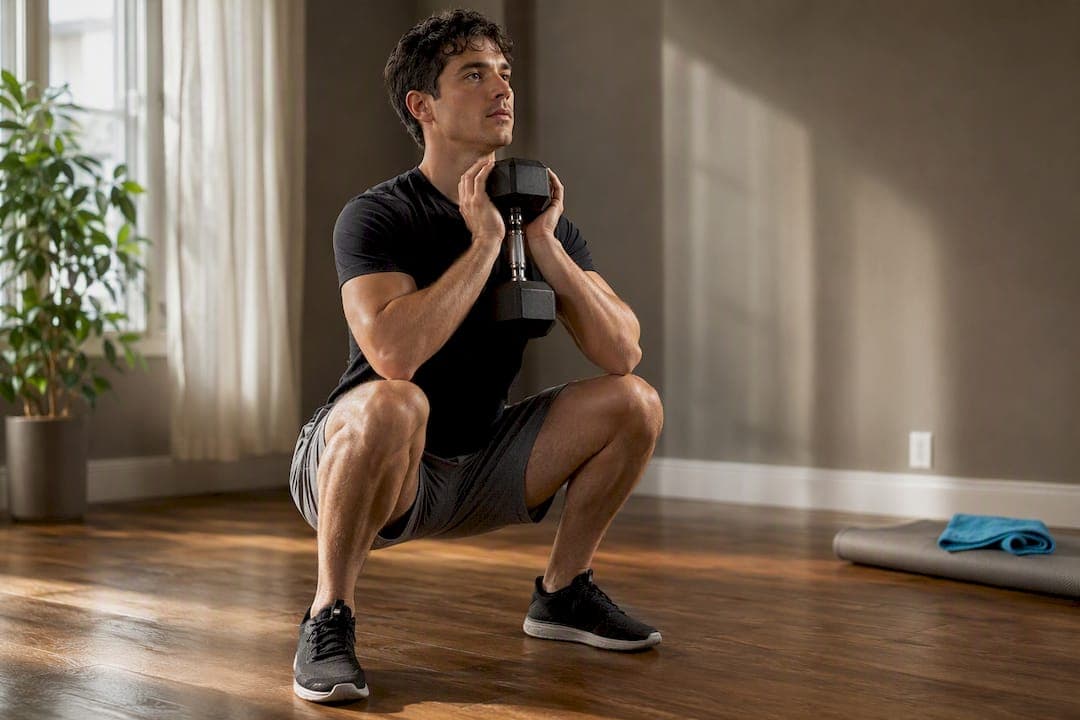
A 3-day full-body dumbbell strength training program works because compound dumbbell moves like goblet squats, rows, and presses recruit the same muscle groups a barbell would, plus extra stabilizer work your body doesn't get from a fixed machine. That's the core finding behind most effective full-body dumbbell workouts, and it's why a simple three-day rotation beats an overcomplicated split for most people just getting started with dumbbell exercises for beginners.
Here's the structure. You'll alternate between two workouts, "A" and "B," three times a week, something like Monday, Wednesday, Friday. Some weeks that means A, B, A. The next week flips to B, A, B. Either sequence gets you six total sessions every two weeks without ever training the same pattern back to back.
Workout A: Squat and Push Focus
- Goblet squat, 3 sets of 10 to 12 reps, 90 seconds rest
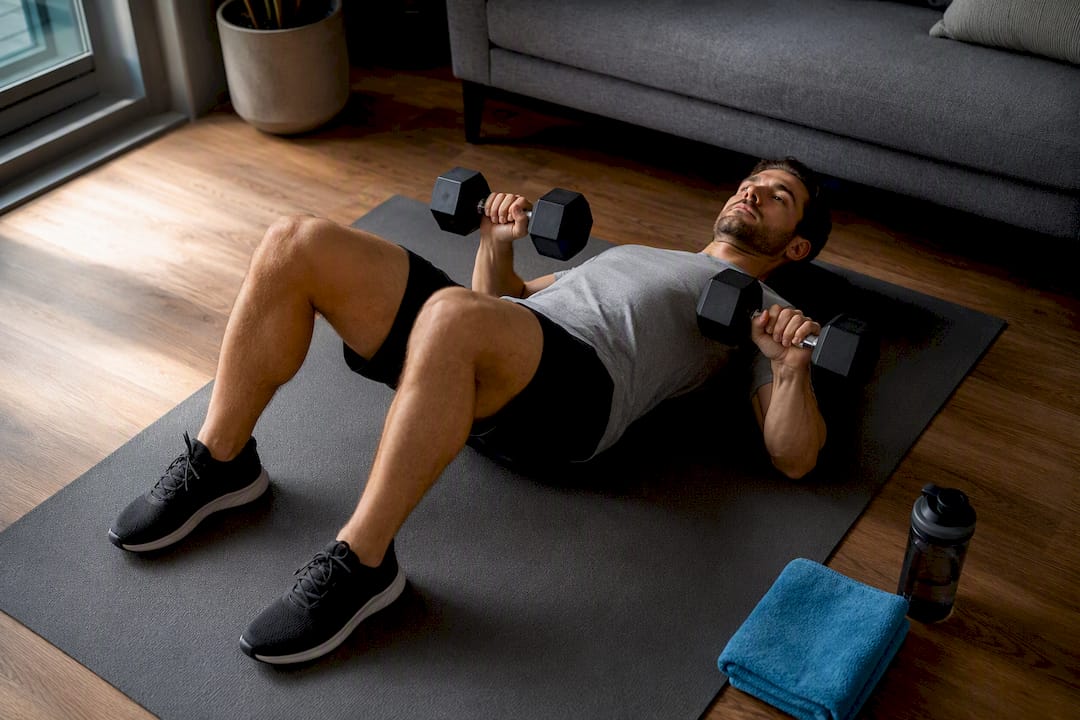
- Floor press (a bench substitute you'll read about below), 3 sets of 8 to 12 reps, 90 seconds rest
- Single-arm row, 3 sets of 10 per side, 60 to 90 seconds rest
- Walking lunges, 2 sets of 12 per leg, 60 seconds rest
- Plank, 3 sets of 30 to 45 seconds, 45 seconds rest
Workout B: Hinge and Pull Focus
- Dumbbell RDL (Romanian deadlift), 3 sets of 10 to 12 reps, 90 seconds rest
- Overhead press, 3 sets of 8 to 12 reps, 90 seconds rest
- Bulgarian split squat, 3 sets of 8 per leg, 90 seconds rest
- Renegade row or bent-over row, 3 sets of 10 per side, 60 seconds rest
- Side plank, 2 sets of 30 seconds per side, 45 seconds rest
This lands squarely in the range fitness coaches recommend for beginner hypertrophy work: 7 compound moves, done in roughly 30 minutes, trained two to three times weekly with real rest between sets, not the 15-second "circuit" pace so many home workout videos push. Rushing rest periods doesn't make you fitter faster. It just means your tenth rep looks nothing like your first.
Tempo notes: on the lowering phase of every exercise, count "two, one" before you push or pull back up. That two-second eccentric matters more than most beginners realize, and we'll get into exactly why later.
No bench? No problem. The floor press replaces a flat bench press by having you lie on the floor and press from your shoulder blades. You lose a small amount of range of motion at the bottom, but you get full triceps and chest activation without buying or clearing space for a bench. It's one of the most useful workarounds in any dumbbell strength training program built for home use.
Logging your workouts: write down the weight, reps, and how many sets you completed for every exercise, every session. This is the single most reliable way to know whether you're actually progressing or just going through the motions. Effort alone is a poor judge. Numbers on a page aren't.
What Does a 5-Day Dumbbell Split Look Like?
A 5-day split makes sense once you're training four or five days a week consistently and want more focused volume per muscle group. Splitting the work across five shorter sessions, usually 45 to 60 minutes each, lets you push each muscle group harder on its dedicated day, then give it four full days to recover before you hit it again.
Here's a sample week:
- Day 1, chest/shoulders/triceps: Flat floor press, incline floor press (shoulders elevated on a pillow or step), lateral raises, overhead press, triceps kickbacks. 3 to 4 sets of 8 to 12 reps per movement.
- Day 2, legs/core: Goblet squats, Bulgarian split squats, RDLs, walking lunges, weighted sit-ups, plank holds. 3 sets of 10 to 15 reps.
- Day 3, back/biceps: Single-arm rows, bent-over rows, reverse flyes, bicep curls, hammer curls. 3 to 4 sets of 10 to 12 reps.
- Day 4, legs/core: Repeat leg emphasis with different variations, deadlifts, step-ups, single-leg RDLs, side planks, bicycle crunches.
- Day 5, upper body compound focus: Full-body pressing and pulling combined, thrusters, renegade rows, push press, farmer's carries to finish.
If your priority is strength oversize, drop your reps to the 5 to 8 range on the big compound lifts and rest a full two to three minutes between sets. If hypertrophy (muscle size) is the goal, stay in the 8 to 12 rep window with 60 to 90 seconds rest, and don't be afraid to push sets closer to failure on isolation moves like curls and lateral raises.
Choosing between this and the 3-day full-body routine isn't about which one is "better." It's about your schedule and your training age. Beginners usually do better with full-body work because their nervous systems are still learning basic movement patterns, and frequent practice on the same lifts speeds that up. More experienced lifters benefit from a split because they can generate enough intensity in one muscle group's session to justify the extra recovery time before hitting it again.
How Do You Structure an 8 to 12 Week Dumbbell Program?
Random workouts get random results. A structured 8 to 12 week block gives your training direction, and it breaks down into three phases.
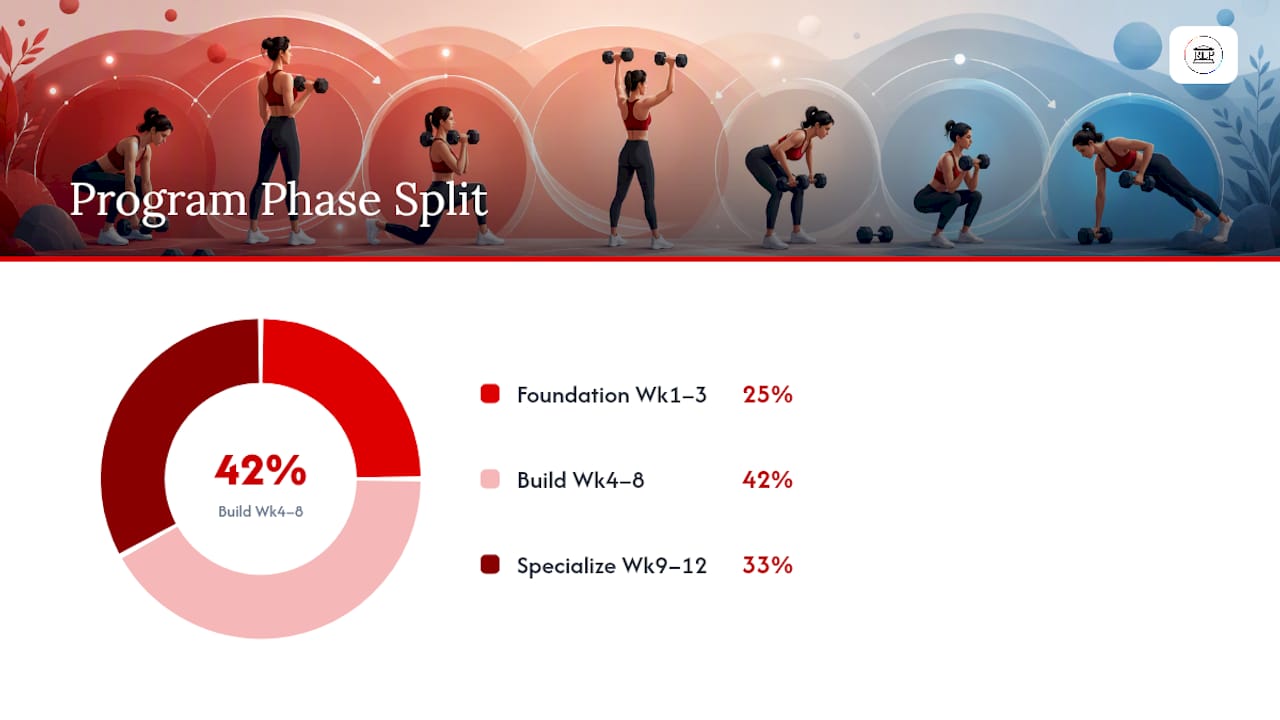
Weeks 1 to 3, foundation. The goal here isn't intensity. It's competence. You're learning to feel a goblet squat in your quads and glutes instead of your lower back, grooving the hip hinge for RDLs, and figuring out what weight actually challenges you without wrecking your form. Keep reps moderate (10 to 12) and leave a rep or two in the tank on every set.
Weeks 4 to 8, build. This is where most of your muscle and strength gains happen. You're pushing sets closer to failure, adding a set to key lifts, and applying real progressive overload week over week. Structured phase programming with a foundation, build, and specialization sequence is common across well-built beginner and intermediate templates for exactly this reason. It gives your body a predictable runway to adapt.
Weeks 9 to 12, intensify or specialize. Now you tilt the program toward whatever you actually want. Chasing strength? Drop reps to 5 to 8 and rest longer. Chasing muscle size? Add volume with extra sets or a finisher circuit. Chasing endurance or fat loss? Shorten rest periods and add conditioning work like carries.
The progression rule that ties all three phases together is called double progression, and it's simple:
- Pick a rep range, say 8 to 12 reps.
- Add reps each week until you hit the top of that range on all sets.
- Once you're at 12 reps across every set, increase the weight and drop back down to around 8 reps.
- If your dumbbells jump in large increments (5 pounds instead of 2.5), add a set instead of weight to bridge the gap smoothly.
Plateaus happen to everyone, usually somewhere around week 5 or 6. When your numbers stall for two sessions in a row, don't panic and don't necessarily add weight you don't have. Slow your eccentrics down further, swap a bilateral move for its single-leg or single-arm version, or add a fourth training day that week. Every six to eight weeks, plan a deload: same exercises, roughly 60% of your usual effort, so your joints and nervous system get a break before the next push. Building overload into a plan you can sustain matters more than any single workout you do inside it.
Which Dumbbell Exercises Should Anchor Your Program?
Seven movements do most of the heavy lifting in any solid dumbbell only workout plan. Master these and you'll have covered every major muscle group in your body.
- Goblet squat. Holds the dumbbell vertically against your chest. Targets quads, glutes, and core. Cue: keep your elbows pointed down between your knees, chest tall, and drive through your heels. Common mistake: letting your knees cave inward. Fix it by pushing your knees out against an imaginary resistance band.
- Dumbbell RDL. Targets hamstrings and glutes through a hip hinge. Cue: push your hips back like you're closing a car door with them, keep a soft bend in your knees, and feel the stretch in your hamstrings before standing back up. Common mistake: bending at the knees instead of the hips, which turns it into a squat.
- Floor press. Targets chest, shoulders, and triceps. Cue: keep your elbows at roughly 45 degrees from your torso, not flared to 90, and press the dumbbells together slightly at the top. Common mistake: bouncing the elbows off the floor. Pause briefly instead.
- Single-arm row. Targets lats and upper back, and it's one of the best tools for fixing side-to-side imbalances, since training one side at a time exposes strength gaps a barbell often hides. Cue: pull your elbow toward your hip, not straight up, and keep your torso still. Common mistake: twisting your torso to help the weight up.
- Overhead press. Targets shoulders and triceps. Cue: brace your core hard before you press, and stack the dumbbell directly over your shoulder at the top. Common mistake: arching your lower back to gain range of motion.
- Lunges. Targets quads, glutes, and balance. Cue: drop straight down rather than forward, and keep your front shin close to vertical. Common mistake: letting the front knee travel far past the toes.
- Bulgarian split squat. Targets quads and glutes with an added balance demand. Cue: keep most of your weight on your front foot; the back foot is just there for balance. Common mistake: pushing off the back leg to cheat the rep.
Every one of these has a built-in progression and regression path. Add a two-second pause at the bottom of any squat or lunge variation to build stability. Slow the eccentric on any press to add difficulty without more weight. Go single-leg or single-arm on nearly anything to add a stability challenge. Go bilateral and lighter if a unilateral version is beating you up.
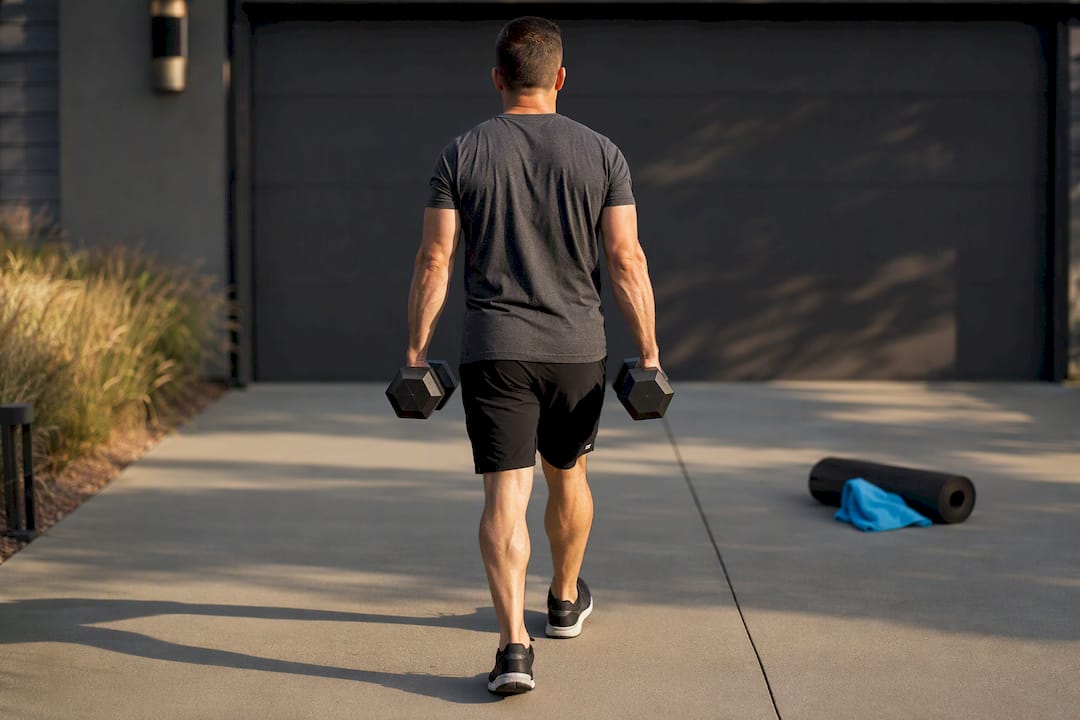
For conditioning and grip work, add farmer's carries: walk 30 to 40 steps holding a dumbbell in each hand, staying tall through your torso. It's a deceptively brutal core and grip finisher that takes 90 seconds and no extra setup.
Pro Tip: Film your first working set of any new exercise from the side on your phone. You'll spot form issues in ten seconds that would take you weeks to notice by feel alone.
How Should You Warm Up and Recover Between Sessions?
Skipping the warm-up is the fastest way to turn a good program into an injured one, especially when you're training alone with nobody watching your first rep.
Spend 5 to 10 minutes before every session on this sequence:
- Two minutes of light cardio, jumping jacks, or jogging in place to raise your heart rate.
- Dynamic mobility work: leg swings, arm circles, hip openers, bodyweight squats.
- One to two ramp sets of your first compound lift at roughly half your working weight.
Ramp sets before your heaviest lift prepare your joints and nervous system for the load ahead, and they cut injury risk meaningfully when you're training without a spotter or coach watching your setup.
Tempo is where a lot of home lifters leave results on the table. A "2, 1, 1" tempo means two seconds lowering the weight, a one-second pause at the bottom, then a controlled one-second lift up. Slowing the eccentric (lowering) phase increases muscle stimulus without adding a single pound to the dumbbell, which is exactly why it matters so much when your home setup only has one or two weight options. Research on eccentric training backs this up directly: the lowering phase does real work your muscles need, and most people rush right past it.
Rest about one to one and a half minutes between sets for muscle growth, and longer for heavier strength training sets. If you're waking up sore for more than three days after a session, or your logged numbers drop two workouts running, that's your deload signal. Sleep and protein intake matter here too. Neither one is optional if you want the work you're putting in to actually show up as muscle.
What Weights Do You Actually Need at Home?
Three weight ranges cover nearly every dumbbell exercise you'll ever do: a light pair (5 to 15 pounds) for shoulders, arms, and core work, a medium pair (15 to 25 pounds) for rows and presses, and a heavy pair (25 to 40+ pounds) for squats, lunges, and RDLs. Adjustable dumbbells are usually the most space-efficient and cost-efficient way to cover all three ranges without a rack full of fixed pairs cluttering your living room.
If you're stuck with one pair that's too light for squats or RDLs, you can use unilateral versions, slower eccentric phases, pauses, extra sets, or higher repetitions with controlled tempo to increase the difficulty without heavier weights.
None of these are consolation prizes. Unilateral and tempo adjustments are genuinely reliable tools for extending a light pair's usefulness, sometimes for months longer than you'd expect. If you're buying gear for the first time, a single adjustable pair that covers roughly 5 to 50 pounds will outlast almost any fixed-weight set you could fit in the same corner of a room.
When Should You Bring In a Coach?
Self-programming works, but it has a ceiling. A coach catches form breakdowns you can't see on video, adjusts your rep ranges when progress stalls, and builds regressions or progressions specific to your joints and goals, not a generic template.
If you're hitting plateaus you can't explain, or you just want someone checking your form on lifts like the RDL and overhead press, REP Philosophy's virtual coaching and video library is worth a look before you spend another month guessing. Self-program if you're consistent and progressing. Hire a coach the moment you stop being sure why you aren't.
An Honest Take on Dumbbell Only Training
The internet oversells dumbbell-only training as either a miracle shortcut or a lesser substitute for "real" gym equipment. Both framings miss the point. Dumbbells aren't a compromise. They're a legitimate tool that happens to force better unilateral balance and joint stabilization than a barbell ever will, precisely because each hand works independently.
Where most free programs fail readers isn't exercise selection. It's the complete absence of a plan for what happens when your one pair of dumbbells gets too light. That's the actual failure point for most home lifters around week six or eight, and it's why tempo control and unilateral progressions deserve more attention than they usually get in generic templates.
If I had to prioritize one thing for someone starting today, it's this: pick the 3-day full-body plan, log every single session, and don't touch a heavier weight until you've maxed out your rep range on the current one. Consistency with a simple structure beats a complicated program you abandon by week three.
— Coach Justin
Ready to Skip the Guesswork With Guided Programming?
A virtual coaching option can offer a more affordable path to coaching than some traditional personal training packages, providing structured feedback to help drive progress. The Exercise Video Library Membership costs $12.50 per month and gives you on-demand access to a full catalog of coached exercise demos, useful the moment you're unsure whether your split squat depth or press elbow angle is actually correct.
If you want more than a video library, a single Virtual Coaching Session gets you tailored programming and form feedback without committing to an ongoing membership yet. And if you're local to San Diego and want hands-on coaching, small-group training and personal training memberships are built for busy adults who want real accountability without figuring out every workout alone. Choose the coaching option that best matches your current level of desired guidance and explore available services online.
Where This Program's Guidance Comes From
- Legion Athletics' 3-day full-body dumbbell routine informed the compound-movement structure and frequency recommendations throughout this plan.
- NourishMoveLove's 30-minute dumbbell workout shaped the session-length and exercise-count guidance for beginners.
- Ohio State University Wexner Medical Center's eccentric training research backs the tempo and eccentric-emphasis recommendations.
- Macros Inc's beginner dumbbell program supports the rep-range and double-progression rules used across every phase.
Sources
- Best full-body dumbbell workout (3-day plan) | Legion
- 30-minute full-body dumbbell workout | NourishMoveLove
- What’s eccentric training and should you give it a try? | Ohio State University Wexner Medical Center
- Dumbbell-only workout program for beginners | Macros Inc
FAQ
Is It Possible to Work Out With Only Dumbbells?
Yes. Compound dumbbell movements like squats, presses, and rows activate the same major muscle groups as barbell or machine training, plus extra stabilizer work most machines skip entirely. A well-structured dumbbell-only routine covers every muscle group without needing a single machine.
What Is the 3-3-3 Rule for Working Out?
Definitions of the "3-3-3 rule" vary across fitness sources, and there's no single agreed-upon standard. If you're using it as a frequency guideline, sticking to 3 full-body sessions per week with roughly 3 sets of 3 core movement patterns (a squat, a hinge, and a press or pull) lines up well with the beginner structure in this article.
Is It Possible to Build Muscle Only With Dumbbells?
Yes, as long as your program includes progressive overload, meaning you add reps or weight over time instead of repeating the same workout indefinitely. Using 8 to 12 reps per set with double progression is a reliable way to build muscle with dumbbells alone over an 8 to 12 week block.
What Is the Best Workout Plan for Dumbbells Only?
For most beginners, a 3-day full-body split done Monday, Wednesday, Friday is the best starting point because it balances frequency with recovery. If you can train four or five days a week and want more focused volume, a 5-day split covering chest/shoulders, legs, back, legs again, and full-body compound work is a strong step up.
What's the Fastest Way to Start a Dumbbell Only Workout Plan?
Pick the 3-day full-body template from this article, write down your starting weights for each move, and commit to logging every session for four weeks before changing anything. If you'd rather have someone build and adjust the plan for you, Repphilosophy's virtual coaching options start at $12.50 per month for the video library.