

Take a 5 to 7 day deload when performance stalls, soreness lingers, or motivation dips, or build one into your program every 4 to 8 weeks regardless of symptoms. During that window, you cut training volume and effort while keeping light practice going. If you're not sure which trigger applies to you, the signals and templates below will show you exactly how to decide.
TL;DR:
- Athletes should schedule deload weeks every 4 to 8 weeks based on training intensity, with more frequent deloads needed when training fatigues accumulate rapidly.
- A deload primarily involves cutting volume and effort while maintaining frequency, with volume reductions of about 40 to 60 percent over 5 to 7 days.
- Signs indicating a deload is necessary include declining performance over three sessions, persistent soreness, poor sleep, low motivation, and increased perceived exertion.
- Differentiating between a deload and a taper is crucial, as deloads manage fatigue during regular training cycles, while tapers aim to peak performance before competitions.
- Objective tracking of performance metrics and subjective signals helps customize deloads, preventing under- or over-recovery and optimizing long-term progress.
Table of Contents
- What Is a Deload Week and Why Do Athletes Need One?
- When Should You Schedule a Deload Week?
- How Do You Actually Structure a Deload Week?
- What Signals Tell You It's Time to Deload?
- Is a Deload the Same as a Taper?
- Four Deload Templates You Can Use This Week
- How Coach Justin Applies Deloads With Real Clients
- Coach Justin's Take: The Deload Mistakes That Keep Showing Up
- Get Help Building and Monitoring Your Deload Weeks
- Sources
- FAQ
What Is a Deload Week and Why Do Athletes Need One?
A deload is a planned drop in training stress, not a week off the couch. You're deliberately pulling back volume, intensity, or both so your body can catch up with the work you've been asking it to do. Think of it as paying down a debt before the interest gets out of hand.
Here's what's actually happening under the hood. Heavy training blocks beat up your nervous system, create microtears in muscle and connective tissue, and blunt the hormonal signaling that drives adaptation. A deload gives your nervous system room to recover, lets tissue repair catch up to the damage, and resensitizes the signaling pathways that make your next hard block actually productive. Skip that reset long enough and you stop making progress even though you're training just as hard, sometimes harder.
The evidence base here is still developing. A cross-sectional survey of 246 competitive strength and physique athletes gives us the clearest look at how real athletes actually deload, but large randomized trials testing deload protocols head to head are still rare. Most of what coaches recommend comes from that kind of practice-based data combined with expert consensus, not decades of controlled experiments. That doesn't make it unreliable. It means the guidance is grounded in what's working for real training populations right now, with more rigorous trials starting to fill in the gaps.
A deload differs from full rest and taper; it is a planned reduction in training stress within a program, not complete cessation, nor is it a volume reduction timed specifically to peak competition performance (more on that distinction shortly). Here's the quick version of what separates a deload from those two:
- Deload: Reduced training stress inside an ongoing program, usually active rather than total rest.
- Full rest: Complete cessation of training, typically reserved for injury or illness, not routine fatigue management.
- Taper: A progressive volume reduction timed to peak performance for a specific competition.
A Cleveland Clinic guide on deload weeks makes a point worth repeating: most recreational exercisers never need a scheduled deload at all. If you're training three times a week at moderate intensity for general health, your body probably recovers between sessions without intervention. Deloads earn their place when training volume, intensity, or frequency climbs high enough that fatigue starts outpacing recovery, which is exactly the population competitive athletes and serious lifters fall into.
When Should You Schedule a Deload Week?
You've got two ways to time a deload, and the smartest athletes and coaches use both at once.
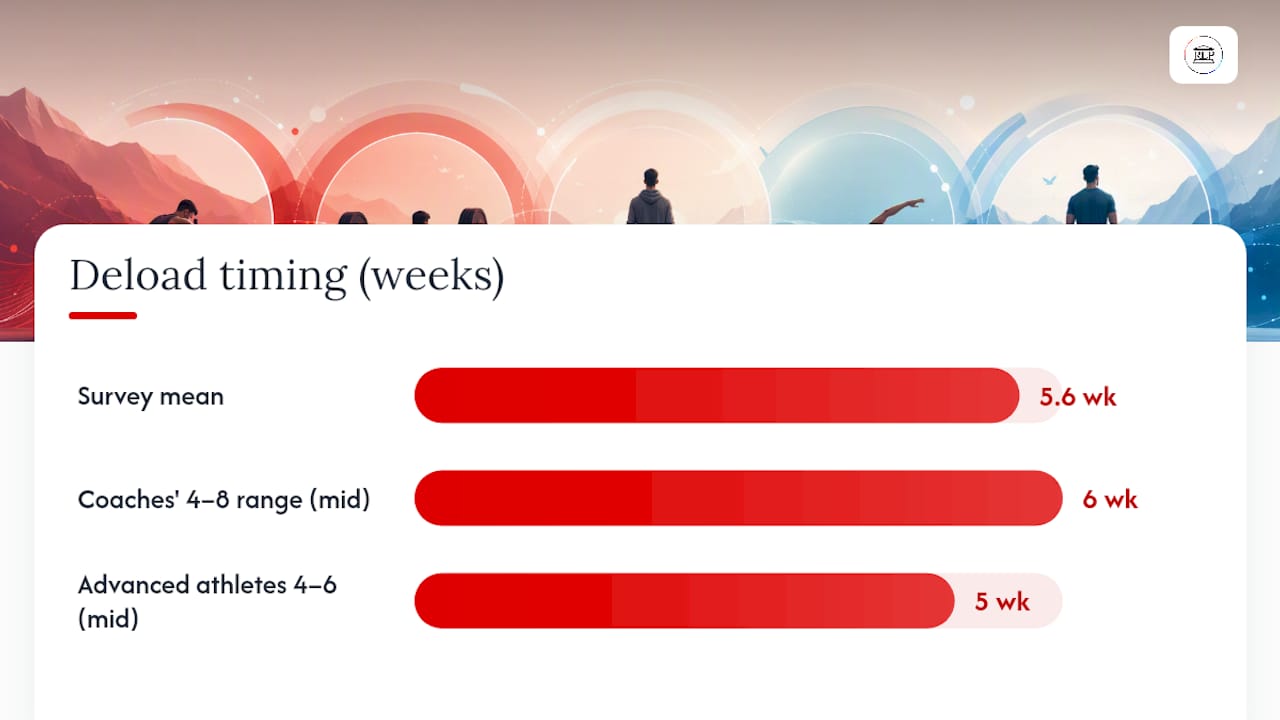
The pre-planned approach puts deloads on the calendar before you need them. In the survey of competitive strength and physique athletes referenced above, deloads were integrated roughly every 5.6 ± 2.3 weeks, which lines up closely with the 4 to 8 week range most coaches recommend as a starting point. That variance matters. A 4 week rhythm suits athletes running high-intensity, high-frequency blocks; an 8 week rhythm fits programs with built-in variation or lower overall stress.
The autoregulated approach, by contrast, reacts to what your body is actually telling you rather than what's written on a spreadsheet. You deload when the signs show up, whether that's at week 3 or week 10. The most useful practical rule here is what coaches often call the three-session decline: if your performance drops for three consecutive sessions on the same lift or workout despite normal effort, that's your trigger, calendar be damned.
Here's how to build your own decision framework:
- Set a baseline planned interval. Pick a number between 4 and 8 weeks based on your training intensity and history, and put it on your calendar as a default.
- Track performance every session. Log your top set weight, reps, or RPE so you can actually spot a trend instead of guessing.
- Watch for the three-session rule. Three straight sessions of declining performance at matched or lower effort override your planned date.
- Cross-check with subjective signals. Persistent soreness, poor sleep, or a flat mood alongside the performance dip confirms you're not just having an off week.
- Deload early if triggers stack up. Don't wait for the calendar date if two or more red flags show up together.
Training age changes this calculus considerably. Beginners rarely accumulate the kind of systemic fatigue that demands a deload, since their loads and volumes are comparatively low and their recovery capacity is high relative to the stimulus. Advanced athletes pushing near their genetic ceiling accumulate fatigue faster and need deloads more predictably, often every 4 to 6 weeks rather than the longer end of the range. Coaches working with younger or developing athletes should also weigh how training differs between beginners and advanced lifters before assuming a deload is even necessary.
The hybrid model is what actually shows up in practice. You keep a planned interval as your default, but you stay flexible enough to pull the trigger early when your body sends a clear signal. This isn't indecision. It's the same logic behind building a progressive overload plan that adjusts to real feedback instead of blindly following a template.
How Do You Actually Structure a Deload Week?
Four levers control how a deload feels: volume, effort, load, and frequency. Pull the right combination and you get real recovery without losing the neuromuscular groove you've built. Pull the wrong combination and you either don't recover enough or you lose so much stimulus that you feel flat coming back.
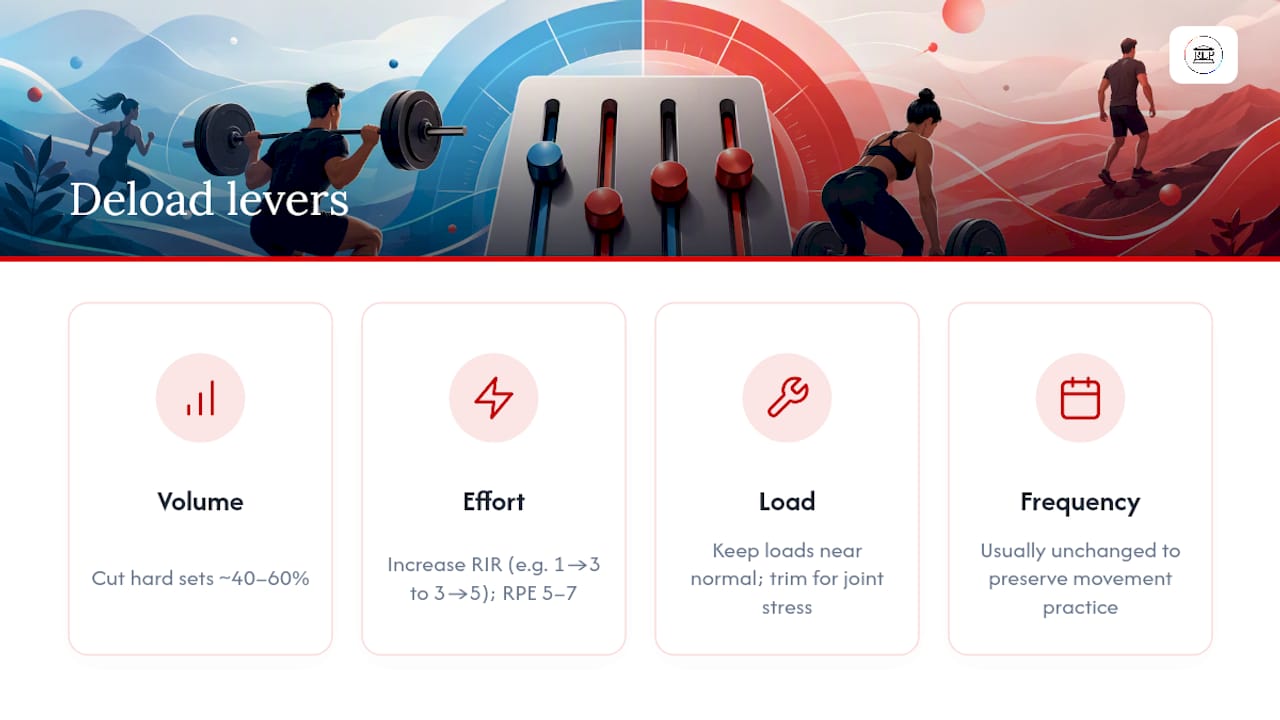
Volume is your primary lever. Cutting the number of hard sets you perform, while keeping the movements themselves familiar, does most of the recovery work with the least disruption to your skill and coordination. Effort comes next: raising your reps in reserve (RIR) from your usual 1 to 3 up to 3 to 5, or dropping your target RPE into the 5 to 7 range, takes the edge off without changing what the workout looks like on paper. Load matters less than most athletes assume. You can often keep weights close to normal as long as volume and effort both drop; some athletes prefer trimming load too, particularly if joint stress is a concern. Frequency, meanwhile, usually stays the same. Keeping your normal training days intact preserves movement practice and technique, which matters more for skill retention than most lifters give it credit for.
Pro Tip: If you're deciding which lever to pull first, cut volume before you touch load. Dropping weight too aggressively can actually make technique feel worse, since lighter loads sometimes expose sloppy bar paths that heavier weight was masking through tension and focus.
Here's how those levers translate into numbers for different training contexts.
Those volume reductions and RPE ranges track closely with what practical coaching templates commonly recommend, which puts typical deloads at 5 to 7 days with roughly 40 to 50% less volume and noticeably lower perceived effort.
Endurance athletes and mixed-sport competitors need a slightly different frame than pure strength athletes. Cutting weekly mileage or training hours by 40 to 60% while keeping one or two short, sharp intensity sessions preserves your aerobic and neuromuscular sharpness without piling on fatigue. Dropping every hard session entirely tends to leave endurance athletes feeling sluggish when they return to full volume, since the body loses touch with race-pace mechanics faster than it loses aerobic capacity.
High-fatigue blocks, whether from a brutal training camp, a stacked competition stretch, or an accumulation phase that ran longer than planned, call for a deeper cut. Extending the deload to 7 to 10 days and dropping volume by 50 to 60% gives your system more room to actually recover rather than just coast. This is also where extra recovery modalities, more sleep, better nutrition timing, occasional soft tissue work, earn their keep.
Restarting after a deload depends heavily on why you deloaded in the first place. If fatigue was systemic, ramp volume back up over 1 to 2 sessions before pushing intensity again. If you deloaded because of joint pain or breaking technique, prioritize exercise selection changes and reduced eccentric load on the offending movement rather than jumping straight back to your prior working weights. Rushing this step is one of the most common ways athletes waste the recovery they just earned. For strength athletes specifically, ramping back into a smart full-body training progression rather than jumping straight to previous maxes protects the gains the deload was meant to preserve.
What Signals Tell You It's Time to Deload?
Your body gives you warnings well before performance collapses, if you know what to look for.
On the objective side, watch for a consistent drop in reps or load across sessions at a matched or lower RPE, meaning the same weight feels harder than it did two weeks ago. A rising RPE for weights you used to move easily is one of the clearest early signs of accumulating fatigue. If you track heart rate variability, a downward trend over several days adds another data point, though it's a supplement to training log data, not a replacement for it.
Subjective signals carry real weight here too, sometimes more than people expect from something so easy to track. Persistent soreness that doesn't resolve within 48 to 72 hours, nagging joint aches, low motivation to train, and disrupted sleep or appetite are all reliable flags. In fact, subjective markers like sleep and mood are often more dependable triggers than any single wearable metric, since wearables can miss context that you feel directly.
A few field checks give you a fast read without any special equipment:
- Warm-up single test: Compare how a standard warm-up weight feels on the bar to how it felt a week ago.
- Jump or grip test: A countermovement jump or grip strength check tracked across 2 to 3 sessions reveals neuromuscular decline before it shows up in your main lifts.
- Session RPE trend: If your rated effort for identical work climbs three sessions running, treat that as your cue.
Roughly 92% of surveyed strength and physique athletes cited decreasing fatigue as their main motivation for deloading, which tells you fatigue management, not injury or scheduling, drives most deload decisions in practice.
One more distinction matters: an active deload, not full rest, is the right call for the overwhelming majority of fatigue-driven situations. Reserve total rest for actual injury, illness, or the rare case where even light movement aggravates a problem. A tool like a coach burnout check can also help you gauge whether the fatigue you're managing is purely physical or creeping into mental burnout territory, which changes how aggressively you need to pull back.
Is a Deload the Same as a Taper?
No, and mixing them up is one of the more costly programming mistakes an athlete can make.
A deload manages accumulated fatigue inside an ongoing training block so you can keep making long-term progress. A taper exists purely to peak your performance for a specific competition date, and it works through a very different mechanism. According to the international Delphi consensus on deloading, these are distinct tools with distinct goals, and treating one as a substitute for the other undermines both.
Timing separates them clearly. A deload sits wherever fatigue demands it, inside the middle of a training cycle, often multiple times across a season. A taper happens once, immediately before competition, and it's timed backward from a fixed date rather than forward from a fatigue trigger.
Structure differs too. Deloads tend to step down sharply, cutting volume by 40 to 60% for a short, defined window, then returning to normal training. Tapers progressively reduce volume over 1 to 3 weeks while carefully preserving intensity, since the goal is staying sharp and race-ready rather than simply resting.
Here's how to know which one you need:
- Use a deload when training volume has piled up and performance is drifting, regardless of your competition calendar.
- Use a taper in the final 1 to 3 weeks before a meet, match, or race, when the goal shifts from building fitness to expressing it.
- Never treat a taper as your recovery strategy for general accumulated fatigue. It's built for a different job.
Youth and school athletes navigating tryout season deal with this exact overlap. A 6 to 8 week tryout conditioning plan built around a 72 hour taper shows how a short-term peak and a longer conditioning block can coexist without one undermining the other.
Four Deload Templates You Can Use This Week
Pick the template that matches your current situation, then adjust the specifics to your own numbers.
- Strength-focused deload (5 to 7 days). Cut your working sets to 2 per main lift instead of your usual 4 to 5, load at 60 to 70% of your recent 1RM, and hold RPE around 5 to 6 with 4 to 5 reps in reserve. Keep frequency the same so your movement patterns stay sharp.
- Endurance down week (5 to 7 days). Drop weekly mileage or training hours by 40 to 60%, but keep one or two short sessions with brief intensity touches, think 4 to 6 minutes at race pace inside an otherwise easy run, so your legs don't forget what fast feels like.
- High systemic fatigue reset (7 to 10 days). Cut volume by 50 to 60%, trim frequency slightly if you're training more than 5 days a week, and add extra recovery work like additional sleep, mobility sessions, or light soft tissue care. This template fits after brutal training camps or stacked competition stretches.
- Beginner or light deload (3 to 4 days). Since beginners rarely accumulate the fatigue advanced athletes do, a shorter 3 to 4 day version with a modest 20 to 30% volume cut and slightly reduced load is usually enough to reset without losing training momentum.
| Template | Duration | Volume Cut | Best For |
|---|---|---|---|
| Strength-focused | 5 to 7 days | 40 to 50% | Powerlifters, strength athletes mid-block |
| Endurance down week | 5 to 7 days | 40 to 60% | Runners, cyclists, mixed-sport athletes |
| High systemic fatigue | 7 to 10 days | 50 to 60% | Post-camp, stacked competition stretches |
| Beginner/light | 3 to 4 days | 20 to 30% | New lifters, lower training age |
A few things shift these templates in practice. If competition is close, lean toward a shorter deload or transition directly into a taper instead of running both back to back. Younger athletes generally need shorter, lighter versions given their lower accumulated training age, similar to the logic behind preserving in-season strength with reduced weekly sessions. And if you're in a caloric deficit for a physique or weight-class goal, extend the deload slightly and lean harder on the effort reduction lever, since recovery capacity runs lower when you're also managing an energy deficit.
How Coach Justin Applies Deloads With Real Clients
Every deload decision starts with a simple question: is this fatigue predictable, or is it showing up as a surprise? For clients on a structured 12 week block, whether that's full-body strength programming or a youth athlete's off-season conditioning, a deload gets planned into the calendar from day one. For clients training in small-group or buddy sessions, deloads often happen as a group event, since shared accountability makes a lighter week easier to embrace instead of skip.
Virtual coaching clients get a slightly different approach. Without hands-on session checks, monitoring leans harder on session RPE logs and quick check-ins about sleep and soreness, the same subjective markers that matter most for catching fatigue early. In-person clients get an added layer: a coach's eye on bar speed and movement quality, which often catches decline before an athlete consciously notices it themselves.
Communication matters as much as programming here. Athletes resist deloads when they don't understand the purpose, so every deload week gets framed around the specific trigger that caused it, whether that's a calendar date or three flat sessions in a row. That context turns a "lighter week" from a source of guilt into a deliberate, evidence-backed decision.
Coach Justin's Take: The Deload Mistakes That Keep Showing Up
The biggest mistake I see isn't deloading too often. It's treating every deload identically regardless of why it was triggered. Fatigue from volume overload needs a different fix than fatigue from a nagging joint issue, and lumping them into the same generic "light week" wastes the opportunity.
The second mistake is emotional: athletes feel guilty taking a deload and quietly add extra sets back in, which defeats the entire purpose. The third is timing it purely by feel with zero tracking, so nobody can tell if the deload actually worked or if performance was already trending back up on its own.
My one-line checklist: track something objective every session, respect the number you land on, and don't apologize for the light week. Simple monitoring, a warm-up single, a logged RPE, beats guessing every single time.
— Coach Justin
Get Help Building and Monitoring Your Deload Weeks
A coached training plan offers monitoring of your numbers and adjusts your deload timing before fatigue turns into a stalled program. That's the real gap in most do-it-yourself deload plans. You can read every guideline in this article and still misjudge your own trigger point, because fatigue is easier to spot in someone else's training log than your own.

If you train in person or in small-group sessions, tracking of working weights and RPE every session helps catch declining performance patterns that might otherwise be missed. If distance or schedule makes in-person sessions tough, virtual coaching sessions build your deload timing directly into a custom program, with check-ins that catch subjective fatigue signals before they snowball. And if you just want a structured way to keep deload weeks organized without losing technique practice, the exercise video library membership runs $12.50 a month and gives you a ready-made way to keep lighter sessions purposeful instead of aimless.
Ready to stop guessing at your own fatigue signals? Book a session or explore membership options and let a coach handle the timing while you focus on the training.
Sources
The cross-sectional survey of 246 competitive athletes remains the most detailed look at real-world deload timing and duration. The international Delphi consensus offers the clearest expert framing on deloading versus tapering. For quick practical reference, the Cleveland Clinic's deload guide and the Stronger app's deload week guide both translate the research into usable numbers.
- Deloading Practices in Strength and Physique Sports: A Cross-sectional Survey
- How to Do a Deload Week: The Complete 2026 Guide — Stronger
- Deload week guide — Cleveland Clinic
FAQ
What Is the 3-3-3 Rule in the Gym?
There's no single established "3-3-3 rule" backed by research; the term gets used informally for various rep or rest schemes. If you've seen it applied to deloads specifically, treat it as an unofficial shorthand rather than a standard protocol, and rely on the three-session decline trigger described earlier instead.
How Long Should a Deload Week Last?
Most athletes run deloads for 5 to 7 days, with the surveyed average landing around 6.4 ± 1.7 days. High systemic fatigue situations sometimes justify extending that to 7 to 10 days.
Do You Train to Failure During a Deload Week?
No. Deload sessions call for raising your reps in reserve to 3 to 5 and keeping RPE around 5 to 7, which means you stop well short of failure. Training to failure defeats the purpose of the reduced effort that makes recovery possible.
Will You Be Stronger After a Deload Week?
Often, yes. Short deloads of about a week don't cause meaningful detraining, and many athletes come back feeling fresher with improved bar speed and readiness. The bigger risk is skipping the deload and letting fatigue accumulate until performance drops on its own.