

Being community focused is not a vague aspiration. It is a deliberate, structured approach to aligning your resources, programs, and decisions with the specific needs and strengths of the people you serve. Whether you are an educator, a local government leader, a nonprofit director, or a fitness coach working with youth athletes in 4S Ranch, the core idea stays the same: you start with the community, not a generic template.
Organizations like Innovageous, the International City/County Management Association (ICMA), and the National Committee for Quality Assurance (NCQA) have each built frameworks around this principle. Their guidance consistently points to one truth: when communities help shape the solutions, those solutions last.
What does "community focused" actually mean?

Being community focused means prioritizing local strengths and community-identified needs rather than applying one-size-fits-all solutions. The World Bank's community-driven development work, active since the 1990s, has reached millions globally by doing exactly this: giving communities real control over planning, funding, and implementation. The results show measurable reductions in poverty and inequality, particularly among the most vulnerable populations.
At its core, a community-focused approach involves:
- Recognizing that local people understand their own needs better than outside experts do
- Bringing together families, educators, local organizations, and other stakeholders as genuine partners
- Rejecting generic programs in favor of tailored, inclusive engagement
- Using both data and lived experience to guide decisions
- Measuring outcomes and reporting back to the community on what changed
Innovageous applies this thinking to educational collaboration, building programs that reflect the cultural and social fabric of each school community rather than importing a standardized curriculum. ICMA applies it to local government, emphasizing that resident trust grows when engagement is proximity-based and group-affiliated. NCQA applies it to healthcare, requiring accredited organizations to track social determinants of health alongside clinical outcomes. Three very different fields, one shared foundation.
Core principles that drive authentic community engagement
The most effective community-focused efforts share a set of principles that go deeper than good intentions. They require structural commitment.
"Knowing your community in terms of mood and feeling as well as facts and figures is extremely important. It means issues are less likely to emerge in the first place because you'll be responding to people's needs in everything you do." — UK Local Government Association
That quote captures something most engagement plans miss. Data tells you what is happening. Relationships tell you why, and what people actually care about. Both matter.
The principles that consistently appear across ICMA, NCQA, and Innovageous guidance include:
- Genuine two-way dialogue. Communication flows in both directions. You listen before you plan, and you report back after decisions are made.
- Inclusion by design. Barriers to participation, such as timing, language, transportation, and childcare, get addressed proactively, not as afterthoughts.
- Cultural responsiveness. Engagement methods adapt to the economic, linguistic, and social realities of each group. The NCQA's 2026 standards recommend data-driven measurement of interventions that account for social determinants of health, not just operational goals.
- Local leadership. Community members and trusted local organizations take active roles, not just advisory ones.
- Sustained relationships. One-time consultations do not build trust. Ongoing, iterative engagement does.
Northwestern University's NNSI puts it plainly: ceding control to the community enhances social resilience and produces solutions that outlast any single program or funding cycle. That is the difference between a project that ends and a change that sticks.
How do you recognize a truly community-focused organization?
You can tell the difference between an organization that talks about community engagement and one that actually practices it. The indicators are concrete, not abstract.
"Partnerships with community groups is a must for state and local governments that want to increase engagement, especially among under-represented communities." — ICMA, 2024
Real community-focused organizations show up in specific, observable ways:
- Sustained partnerships. They maintain ongoing relationships with local groups, faith organizations, neighborhood associations, and civic networks, not just during project launches.
- Co-created programs. Content, curricula, or services are developed with community input, not delivered to the community as finished products.
- Community leadership involvement. Local leaders and trusted voices help shape priorities and communicate decisions back to residents.
- Feedback loops. Participants learn how their input influenced outcomes. Without this step, engagement fatigue sets in fast.
- Measured outcomes. Progress is tracked using both quantitative data and qualitative community feedback.
A strong case study comes from the Philippines, where the World Bank's KC-NCDDP program financed 54,843 sub-projects benefiting 17.4 million households, with nearly 2.5 million community volunteers participating, 63% of whom were women. That scale was only possible because local communities controlled the planning and implementation. The program did not deliver solutions to communities. It gave communities the tools to build their own.
In education, Innovageous demonstrates this through school-based programs that treat teachers, parents, and students as co-designers rather than recipients. The result is higher buy-in and more durable outcomes than top-down curriculum rollouts typically achieve.
For fitness and youth sports, the same logic applies. When a youth sports performance program reflects the actual schedules, cultural backgrounds, and goals of the families it serves, participation rates climb and athletes stay engaged longer.
How to develop effective community-focused strategies
Getting this right takes more than good intentions. It takes a clear process, the right tools, and a willingness to adapt.
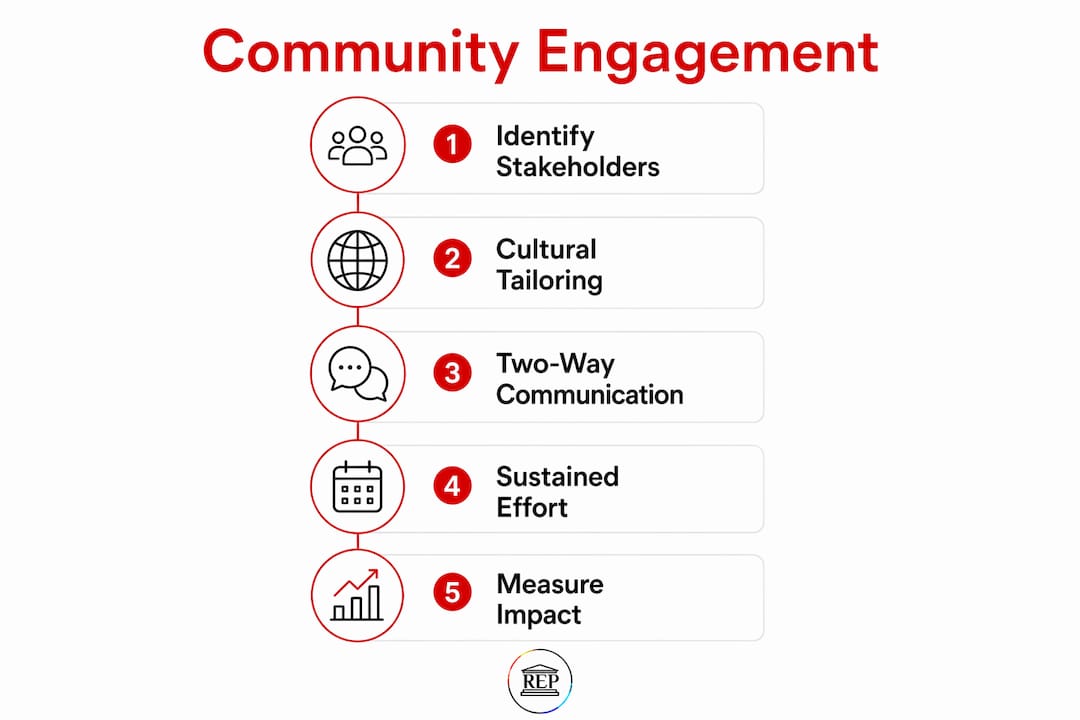
Start with stakeholder mapping
Before you design anything, identify who needs to be at the table. This means mapping not just obvious stakeholders but also the local influencers and trusted multipliers who can advocate within communities. ICMA's engagement pillars emphasize this as the essential first step. Faith leaders, school officials, grassroots organizers, and elected representatives all carry different kinds of trust with different segments of the community.
The LSU LEAP model takes this further by using structured focus groups of 8–12 participants to surface community priorities before any planning begins. Small groups allow for genuine dialogue. They surface concerns that surveys miss and build the kind of trust that makes larger workshops productive.
Use the right mix of communication channels
Reaching everyone requires more than a website update or a single email blast. ICMA's 2024 guidelines recommend combining digital outreach with offline methods: print materials, local signage, partnerships with community organizations, and in-person meetings. Proximity matters too. The closer an issue is to someone's home or daily life, the more likely they are to engage with it.
For local fitness programs, this might mean posting flyers at schools and community centers alongside running a targeted social media campaign. Both channels reach different people, and neither alone is enough.

Tailor engagement to cultural and economic realities
Generic outreach excludes people. Tailoring engagement to specific cultural, linguistic, and financial needs leads to more equitable and effective outcomes. The City of San Diego's Inclusive Public Engagement Guide makes this concrete: address barriers like childcare, transportation, language access, and meeting timing before they become reasons people do not show up.
Adaptive fitness programming follows the same logic. A program that works for one neighborhood's demographics may need real adjustments to serve another's. That is not a weakness in the model. It is the model working correctly.
Address common pitfalls head-on
The most common failure in community engagement is not lack of effort. It is lack of follow-through. Organizations collect input, make decisions, and never tell participants what changed. Trust erodes fast when people feel their time was wasted.
Pro Tip: Close the feedback loop every single time. The San Diego Inclusive Public Engagement Guide stresses that authentically sharing how community input shaped decisions is the single most effective way to prevent engagement fatigue and build lasting trust.
Other pitfalls to watch for:
- Engaging only the loudest voices while missing vulnerable or underrepresented groups
- Treating engagement as a one-time event rather than an ongoing relationship
- Using only digital tools in communities with limited internet access
- Setting unrealistic timelines that do not allow for genuine deliberation
Tools and platforms that support community-focused work
The right tools reduce friction and improve reach. For local government and nonprofit teams, platforms that centralize engagement data, combine demographic indicators with location data, and track participation across projects help teams identify gaps and adjust outreach in real time.
For fitness and sports programs, community management tools designed for local organizations outperform generic apps because they account for the specific workflows of community-based programs: scheduling, member communication, and progress tracking all in one place.
Interactive platforms like websites and social media can extend the reach of in-person engagement, but they work best as supplements to face-to-face connection, not replacements for it.
At Repphilosophy, being community focused is built into how we train. Our group classes, buddy training memberships, and youth sports performance programs in 4S Ranch are designed around the real schedules, goals, and needs of the families we work with. We do not hand you a generic plan. We build something that fits your life and your community. Ready to take that first step? Start your training with a program designed for you.
Key Takeaways
Being community focused produces lasting results only when engagement is tailored, two-way, and sustained over time, not treated as a one-time consultation.
| Point | Details |
|---|---|
| Start with local strengths | Identify community assets and needs before designing any program or strategy. |
| Map stakeholders first | Include local influencers and trusted multipliers, not just obvious leaders, from the start. |
| Use mixed channels | Combine digital and offline outreach to reach all demographics, especially underrepresented groups. |
| Close the feedback loop | Tell participants how their input shaped decisions to prevent engagement fatigue and build trust. |
| Measure and adapt | Track outcomes using both data and qualitative community feedback, then adjust accordingly. |