
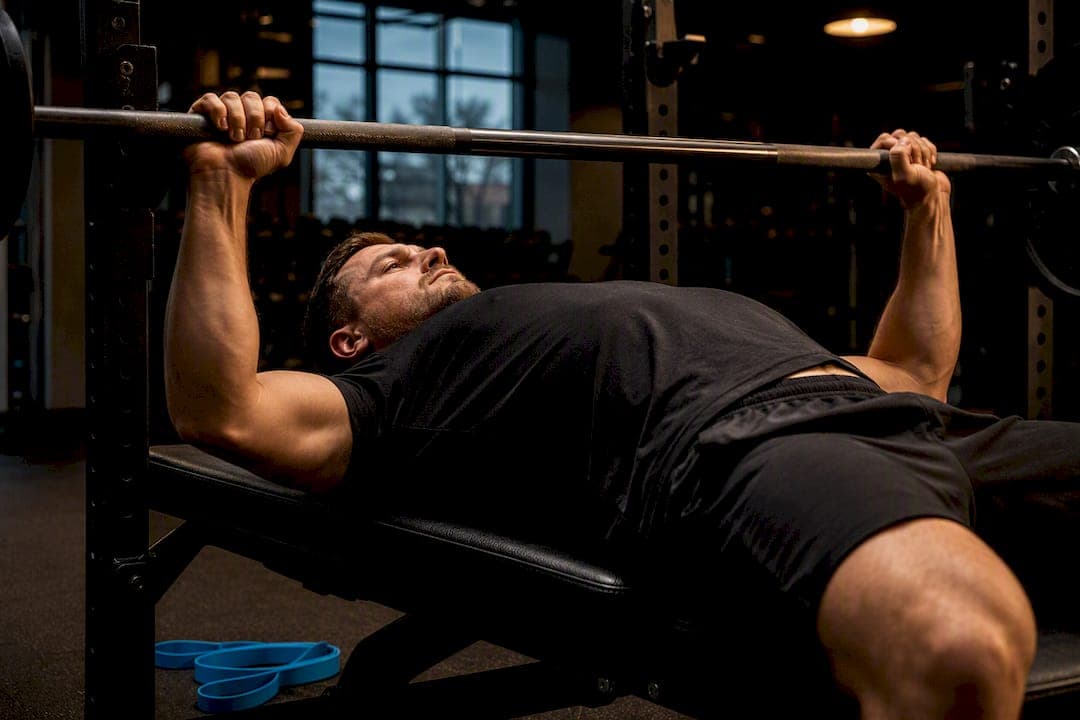
Bench pressing rarely damages a healthy shoulder out of nowhere. Most of the time, shoulder pain during pressing comes from technique, load, or mobility issues that respond well to a few targeted changes. Stop any rep that causes sharp pain, check your grip width and scapular setup before your next session, and if you feel a sudden pop, real weakness, or pain that wakes you up at night, get evaluated before you touch a barbell again.
TL;DR:
- Using a grip width of one to 1.5 times your shoulder width reduces shoulder joint stress during bench presses.
- Proper scapular retraction before lifting dramatically decreases joint reaction forces and stabilizes the shoulder.
- Pain lasting more than a few days, worsened with movement, or accompanied by weakness signals a potential injury requiring medical evaluation.
- Implementing targeted warm-up routines and gradually increasing load or volume helps prevent shoulder problems.
- Persistent pain, sudden popping, or increasing night pain after two weeks of modified training indicates the need for professional assessment.
Table of Contents
- Where Your Bench Press Shoulder Discomfort Shows Up (And What It Means)
- The Bench Press Mechanics That Load Your Shoulder Most
- Is It Just Soreness, or Is Something Actually Wrong?
- Your Pre-Press Warm-Up and Immediate In-Session Fixes
- A Rehab Progression That Gets You Back Under the Bar
- Chest Training Options While Your Shoulder Settles Down
- Red Flags That Mean It's Time to See a Professional
- How Coaches Actually Screen and Fix This in Real Sessions
- Getting Back to Heavy Pressing Without Rushing It
- Get a Movement Screen Before Your Next Heavy Bench Day
- Sources
Where Your Bench Press Shoulder Discomfort Shows Up (And What It Means)
The location of your pain tells you almost as much as the pain itself. Front-of-shoulder pain that flares during the descent usually points to the rotator cuff or the biceps tendon working overtime to control the bar. Pain sitting right on top of the shoulder, closer to the collarbone, often traces back to the AC joint, and repetitive heavy pressing can eventually cause distal clavicular osteolysis, a slow breakdown of that little joint from years of compression. Deep ache and catching sensations, especially with any feeling of the joint shifting, suggest something going on with the labrum or the ball-and-socket joint itself.
Timing matters too. Pain that shows up only under load and eases the moment you rack the bar behaves differently than pain that lingers for hours or worsens at night.
- Front shoulder pain: rotator cuff or biceps/pec strain, often worse at the bottom of the rep
- Top-of-shoulder pain: AC joint irritation, tender to direct pressure, aggravated by horizontal arm movement
- Deep joint pain or catching: possible labral involvement, sometimes paired with a feeling of instability
- Pain plus weakness: raises suspicion for something more significant than simple irritation
If you notice new weakness alongside the pain, that combination deserves more attention than pain alone. Northwell Health's orthopedic team advises stopping activity when pain is sharp, throbbing, or interrupts sleep, rather than pushing through it and hoping it settles on its own.
The Bench Press Mechanics That Load Your Shoulder Most
Grip width changes shoulder joint forces more than most lifters realize. A 2024 musculoskeletal simulation found that narrower grips, roughly 1 to 1.5 times your bi-acromial width (the distance between the bony points of your shoulders), meaningfully reduced both glenohumeral and acromioclavicular joint reaction forces compared to wider setups. Gripping wider than about 1.5 times the bi-acromial width can increase load on the rotator cuff and AC joint beyond their optimal capacity.
Flaring your elbows to a very wide angle increases shoulder torque and vulnerability, while keeping them at a moderate angle helps stabilise the shoulder.
Scapular retraction is the setup cue lifters skip most often. Pulling your shoulder blades down and together into the bench before you unrack, and keeping them there through the whole set, gives your rotator cuff a stable base to work from instead of forcing it to chase a moving shoulder blade on every rep. That same biomechanical study found scapular retraction, paired with a moderate grip, produced a measurable drop in joint reaction forces at both the shoulder and the AC joint.
Pro Tip: Set your shoulder blades before you touch the bar, not after you've already started your first rep. Retraction that happens mid set does almost nothing for you.
Bar path matters more than most lifters give it credit for. A slight curved bar path lowering to the lower chest area and pressing back up and slightly toward the face helps balance forces through the hands. Uneven pressure between your left and right hand creates asymmetric shoulder loading that can quietly build into one-sided pain over months.
Load and volume management round out the list, and this one takes patience. Muscle adapts to new stress within weeks. Tendons and the bone at the AC joint adapt far slower, sometimes over months, which is exactly why lifters who ramp weight up fast on bench often develop shoulder pain even when their pressing muscles feel strong and ready.
- Grip: 1 to 1.5 times bi-acromial width
- Elbow angle: 45 to 75 degrees, not flared to 90
- Scapulae: retracted and locked into the bench before unracking
- Bar path: slight J-curve, even pressure through both hands
- Loading: increase weight or volume gradually, not in big jumps
Is It Just Soreness, or Is Something Actually Wrong?
Delayed onset muscle soreness, or DOMS, shows up 12 to 48 hours after training, feels generalized rather than pinpointed, and tends to affect both sides if you trained symmetrically. It also gets a little better once you start moving and warming up. Injury pain behaves differently: it's often sharp, sits in one specific spot, and doesn't ease up with movement. It may even get worse.
Run these checks before your next session:
- Compare both shoulders. DOMS from a heavy chest day is rarely one-sided; injury often is.
- Test single-arm external rotation strength against light resistance. Notable weakness on one side is a signal worth heeding.
- Press against resistance through a small range and note whether pain is sharp and localized versus a dull, generalized ache.
- Press directly on the AC joint, at the top of the shoulder. Pinpoint tenderness there points toward AC irritation, not muscle soreness.
According to Cedars-Sinai's guidance on DOMS versus injury, pain that persists past a few days, worsens with the same movement each time, or shows up alongside weakness has crossed out of normal-soreness territory. A one to two week deload paired with the activation work below is reasonable for mild, non-specific discomfort. Persistent or worsening symptoms after that window call for a professional look.
Your Pre-Press Warm-Up and Immediate In-Session Fixes
Cold shoulders and heavy barbells don't mix well. Spend five to seven minutes on activation before you load the bar:
- Band pull-aparts: 2 sets of 15 to 20 reps to wake up the rear delts and mid-back
- Face pulls: 2 sets of 15 to 20 reps, focusing on external rotation at the end range
- Band external rotations: 2 sets of 12 to 15 reps per arm, elbow tucked at your side
- Scapular retractions: a few slow reps to rehearse the exact position you'll hold under the bar
The Bern Consensus on shoulder injury prevention specifically recommends folding short, low-risk routines like this into your regular warm-up rather than treating them as an occasional extra. It's a five-minute habit, not a separate workout. For a full warm-up structure that fits this in alongside your ramp sets, Repphilosophy's warm-up guide walks through the sequencing.
Once you're warmed up, run through this setup checklist before every set: shoulder blades set and pulled into the bench, feet driving into the floor, a slight arch through your upper back, and a grip width where your forearms land roughly vertical at your chest.
If pain still shows up once you're under the bar, three modifications buy you training time without forcing a full stop:
- Lower the load and volume. Drop 10 to 20% off your working weight and cut a set or two until pain-free reps become consistent.
- Reduce your range of motion. A floor press shortens the bottom portion of the lift, the part that usually stresses an irritated shoulder most.
- Switch to neutral-grip dumbbells or kettlebells. Independent arm paths let each shoulder find its own comfortable groove instead of being locked into a fixed bar position.
Pro Tip: If the pain only shows up at lockout or the very top of the rep, you likely don't need to abandon the movement entirely. Shorten your range, pause just below the sticking point, and reassess from there instead of scrapping the exercise altogether.
A Rehab Progression That Gets You Back Under the Bar
Structured rehab work outperforms simply resting and hoping. A rehabilitation evidence review found that targeted strengthening and stretching programs produce meaningful reductions in pain and disability for subacromial impingement, well beyond what passive rest alone achieves.
Start with band external rotations, side-lying external rotation with a light dumbbell, prone Y and T raises, scapular wall slides, and band pull-aparts. Run these two to three times per week, guided by pain rather than a fixed schedule, and progress once you hit three milestones: pain-free activation at your current load, roughly 75% of your baseline strength on the affected side, and clean, controlled reps at a moderate target weight. Guidance from the University of Iowa's sports medicine program reinforces the same priority: build posterior shoulder and scapular strength before you chase heavier pressing numbers again.
- Frequency: two to three sessions per week
- Progress according to pain-free repetitions
- Reintroduce bench pressing with light loads when technical reps cause no pain
- Gradually increase volume over several weeks
Chest Training Options While Your Shoulder Settles Down
You don't have to abandon chest training while things calm down. Neutral-grip dumbbell presses, kettlebell presses, floor presses, and controlled machine presses all reduce the specific stress points that flare up on a straight barbell bench.
- Neutral-grip dumbbell press: allows natural external rotation through the rep
- Kettlebell press: independent arm paths let each shoulder track its own path
- Floor press: removes the bottom-range stretch that often triggers pain
- Machine press: offers a fixed, controlled path with less stabilization demand
On the programming side, lean into rowing volume to balance out pressing, cut your pressing frequency for a few weeks, and favor slower tempo with higher rep ranges to keep building muscle without maxing out joint stress. If you're rebuilding your training base after time off, Repphilosophy's guide to strength training for overweight beginners covers pacing that applies just as well here.
Red Flags That Mean It's Time to See a Professional
Some signs mean this isn't a two-week fix. A sudden pop or tearing sensation, marked weakness you can't push through, night pain that's getting worse, or symptoms that haven't budged after two full weeks of modified training all warrant a real evaluation.
A clinician assessing bench-related shoulder pain will check pain location, test external and internal rotation strength, evaluate scapular control, and run provocative tests for AC joint irritation, impingement, or pec tendon involvement. Depending on what they find, next steps might include targeted physical therapy, imaging if a tear is suspected, or, in less common cases, a surgical referral. Mayo Clinic's guidance on rotator cuff injuries points to persistent weakness and sudden sharp pain as two of the clearest signals that self-management has run its course.
How Coaches Actually Screen and Fix This in Real Sessions
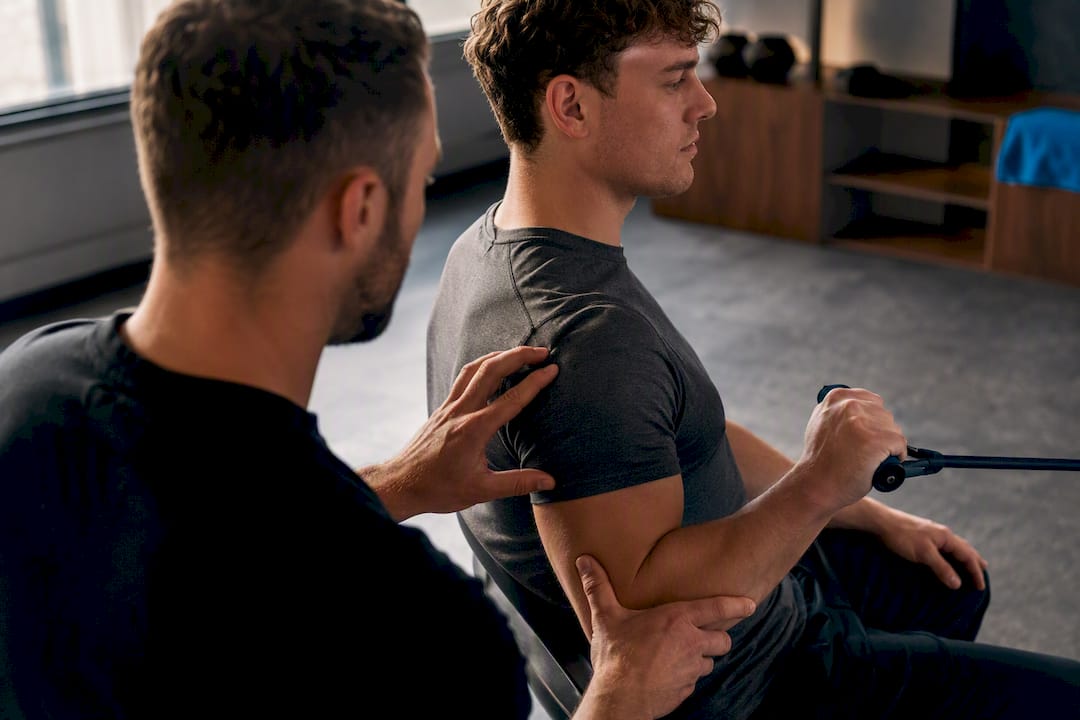
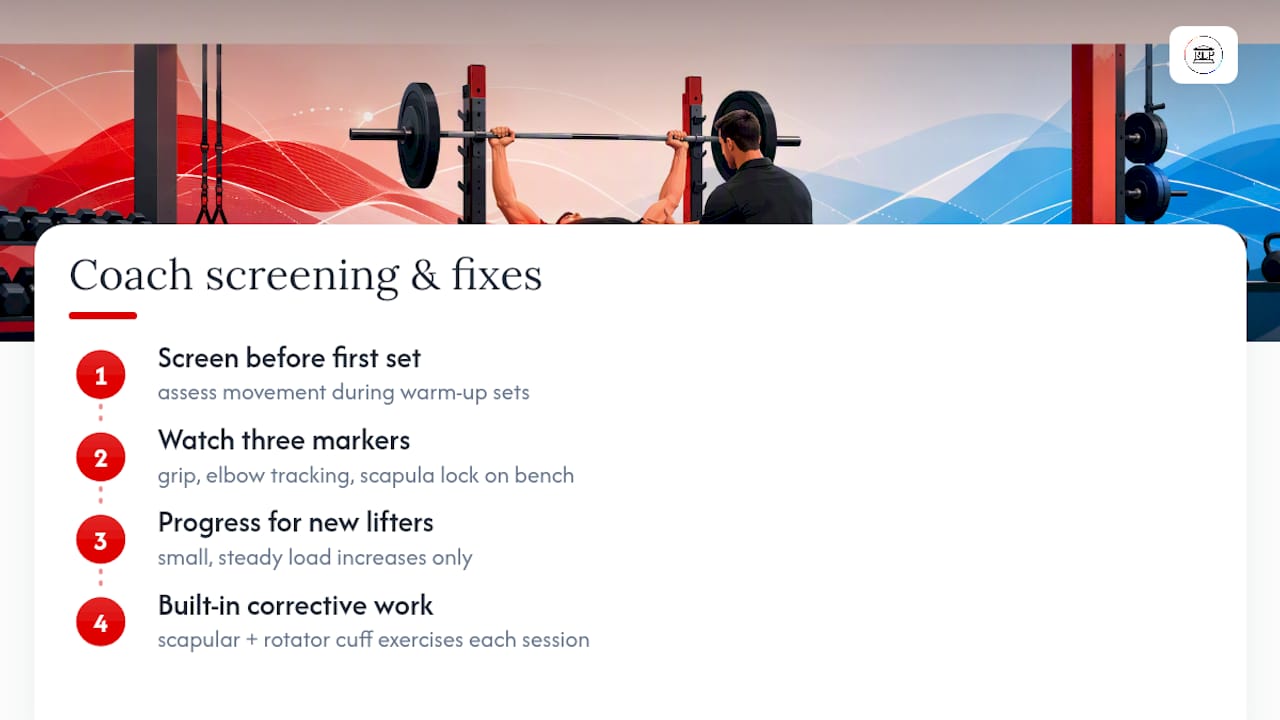
A good screen starts before the first working set. Watching how someone grips the bar, how their elbows track, and whether their scapulae stay locked into the bench tells a coach most of what they need to know within a warm-up set or two.
For newer or deconditioned lifters, the safest path is small, steady load increases paired with early, consistent scapular and rotator cuff work built into every session, not bolted on afterward. [Coach Justin's certifications and training experience will be detailed here.] [Client feedback on Repphilosophy's coaching programs will be included here.]
Getting Back to Heavy Pressing Without Rushing It
Shoulders don't heal on a schedule that matches your motivation. Fix your setup, respect that tendons adapt slower than muscle, and give the rehab work real weeks, not days. A coach who can spot the small technique errors you can't see yourself will almost always get you back to pressing heavy faster, and safer, than guessing alone.
— Coach Justin
Get a Movement Screen Before Your Next Heavy Bench Day
Reading about grip width and scapular retraction only gets you so far. Watching your own setup under load is what actually catches the problem. In-person movement screens are available at a local training space, along with small group and buddy training memberships if you'd prefer to work alongside a training partner instead of one-on-one sessions.
If distance or scheduling makes in-person coaching tough, our virtual personal training with on-demand exercise library gives you video-guided cues for the exact activation work covered here, plus custom programming that adjusts as your shoulder improves. Ready to get your bench press setup checked properly instead of guessing? Book a training session and let's build your return-to-press plan together.
This article is general information, not a substitute for advice from a qualified doctor. Consult a qualified healthcare professional about your own circumstances before acting on anything here.
Sources
- Effect of bench press technique on glenohumeral and acromioclavicular joint reaction forces
- Rehabilitation interventions for subacromial impingement syndrome (example evidence summary)
- Rotator cuff injury - Mayo Clinic
- 2022 Bern Consensus Statement on shoulder injury prevention