

The best warm-up for lifting is a three-phase routine you can finish in 10 to 15 minutes: a few minutes of easy cardio to raise your core temperature, a handful of dynamic mobility drills for the joints you're about to load, and lift-specific ramp sets that build toward your working weight. Avoid long static stretches. Prioritize the ramp sets above everything else, and you'll walk into your first heavy set already primed to move well.
TL;DR:
- Proper warm-up should take 10 to 15 minutes and include core temperature increase, dynamic mobility drills, and movement-specific ramp sets.
- Ramp sets should progressively decrease reps and increase load, with rest periods lengthening as the weight nears the working maximum.
- Long static stretches and excessive ramp repetitions can reduce strength and cause fatigue, undermining lifting performance.
- Equipment alternatives like resistance bands and bodyweight exercises can effectively replace barbell warm-ups for limited setups.
- Consistent, movement-specific warm-ups are more reliable than complex routines and should be tailored to individual lifts for maximum benefit.
Table of Contents
- What Goes Into a Proper Warm-Up Before Lifting
- How Many Ramp Sets Do You Actually Need?
- Three Warm-Up Routines You Can Use Today
- The Warm-Up Mistakes Costing You Reps
- How Coach Justin Scales Warm-Ups for Every Client
- Why REP Philosophy Builds Warm-Ups Around the Actual Lift
- Get a Warm-Up Built Around Your Actual Lifts
- Sources
What Goes Into a Proper Warm-Up Before Lifting
I coach a lot of people who treat warming up like an afterthought, a few arm circles and maybe a lap around the gym floor. That's not a warm-up before lifting, that's just stalling. A real one has three distinct jobs, and each one solves a different problem.
Phase 1: raise your core temperature. Three to five minutes on a rower, bike, or incline treadmill, or a few rounds of jump rope, gets blood moving and nudges your muscle temperature up by roughly 1°C, which measurably improves force production. You're not trying to get winded here. Easy effort is the goal.
Phase 2: dynamic mobility for the day's lifts. Match the drills to what you're training:
- Squat or deadlift day: leg swings, walking lunges, hip circles, world's greatest stretch
- Bench or overhead press day: band pull-aparts, arm circles, thoracic rotations, scapular push-ups
- General accessory day: a lighter mix of both, two or three drills tops
Simple, well-known dynamic drills like these outperform generic mobility flows because they rehearse the actual joint angles you're about to load.
Phase 3: movement-specific ramp sets. This is the part most people rush or skip entirely, and it's the one that matters most. Lightly loaded reps of your actual lift beat cycling or foam rolling for building peak power, because your nervous system learns the pattern under the bar, not on a machine. If you foam roll at all, do it early in phase one. Rolling right before a heavy set can blunt the explosiveness you're trying to build.
How Many Ramp Sets Do You Actually Need?
Most gym-goers either skip ramp sets entirely or do so many they're tired before the real work starts. Both mistakes come from not having a rule to follow.
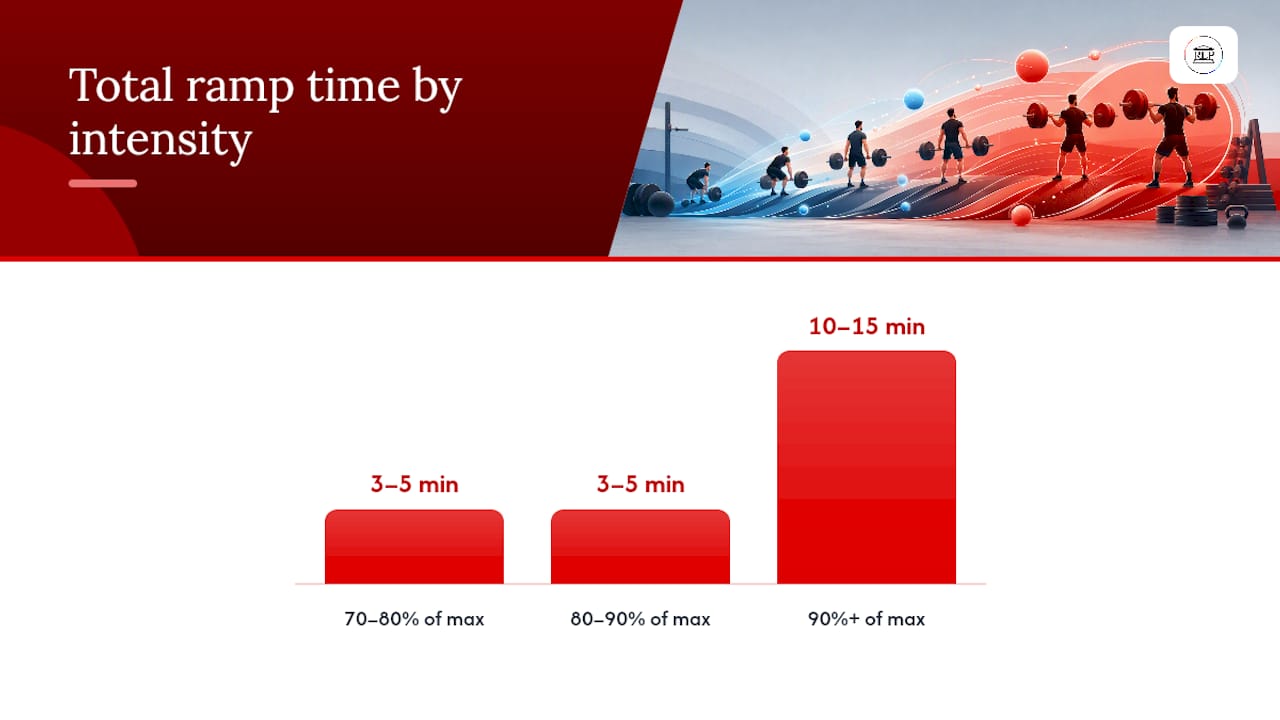
For big compound lifts, plan on several ramp sets before your first working set. Accessory movements, cable rows, dumbbell curls, leg extensions, need only a few or none. As the weight climbs toward your working load, your reps should drop. Start with 8 to 10 reps at a light weight, then trim to 5, then 3, then 1 or 2 as you approach your target. This keeps you sharp instead of pre-fatigued.
Rest periods should stretch out as the bar gets heavier. A light warm-up set might need 30 seconds before the next jump. Near your top ramp set, give yourself closer to 2 to 3 minutes, since a heavier stimulus needs longer to convert into readiness without accumulating fatigue.
| Working set intensity | Ramp sets | Typical rest between ramps | Total ramp time |
|---|---|---|---|
| 70 to 80% of your max | 2 to 3 | 30 to 60 seconds | 3 to 5 minutes |
| 80 to 90% of your max | 3 | 60 to 90 seconds | 3 to 5 minutes |
| 90%+ of your max | 3 | 90 seconds to 3 minutes | 10 to 15 minutes |
That timing lines up with what most coach-guided protocols recommend overall: 10 to 15 minutes total, with the bulk of that time going to specific ramp sets rather than general cardio. Trained lifters chasing a near-max attempt can lean on longer rest windows to let a potentiation effect build, but for most people in the gym, simple, consistent ramping gets the job done without overcomplicating things.
Three Warm-Up Routines You Can Use Today
Pick the one that matches your session, plug it into your phone's timer, and get moving.
- Lower-body heavy day (squat or deadlift focus). Start with 3 to 5 minutes on the bike or a brisk incline walk. Follow with three dynamic drills: walking lunges, leg swings, and hip circles, about 30 seconds each side. Then ramp the barbell: empty bar for 8 reps, then roughly 40% of your working weight for 5 reps, 60% for 3 reps, 80% for 1 to 2 reps, and finally a near-working set of 1 rep before your first real set.
- Upper-body heavy day (bench or overhead press focus). Two minutes of easy rowing or jump rope, then band pull-aparts, arm circles, and 8 to 10 push-ups to wake up the shoulders and chest. Ramp the bar the same way: empty bar, then 40%, 60%, and 80% of your working weight, dropping reps from 8 down to 1 or 2 as the plates go on.
- Accessory or general training day. A short 2 to 3 minute pulse raiser and one or two mobility drills for whatever you're hitting that day. Then take zero to two light feeder sets on machines or dumbbells before loading up. No need to overbuild this one.
Pro Tip: *If your bar speed feels noticeably slower than usual during your ramp sets, that's a signal, not just a feeling.
The Warm-Up Mistakes Costing You Reps
Most wasted warm-up time comes down to four repeatable errors.
- Long static stretching right before heavy lifts. Holding a stretch for more than about 60 seconds can measurably reduce the strength and power you produce right after. Save static stretching for after your session.
- Too many reps on ramp sets. If you're still doing sets of 8 at 70% of your working weight, you're building fatigue, not readiness. Drop reps as the weight climbs.
- Big jumps between ramp weights. Jumping from 60% straight to 90% can feel like a shock to your joints and nervous system. Add an intermediate set if a jump feels too large.
- Spreading full ramps across every exercise. Save your longest, most complete ramp for the first compound lift of the day. Later exercises, especially accessories, need far less.
Pro Tip: Think of your first compound lift as the one that "earns" the full warm-up. Everything after it inherits some of that readiness, so you can trim.
How Coach Justin Scales Warm-Ups for Every Client
Beginners don't need five ramp sets and a mobility checklist. I usually cut a new client's ramp down to two or three simple steps and coach the movement pattern itself more than the loading, especially with teens or anyone coming back from a long layoff. If you're working with teenagers or younger lifters, that extra coaching attention during warm-up matters more than the ramp scheme itself.
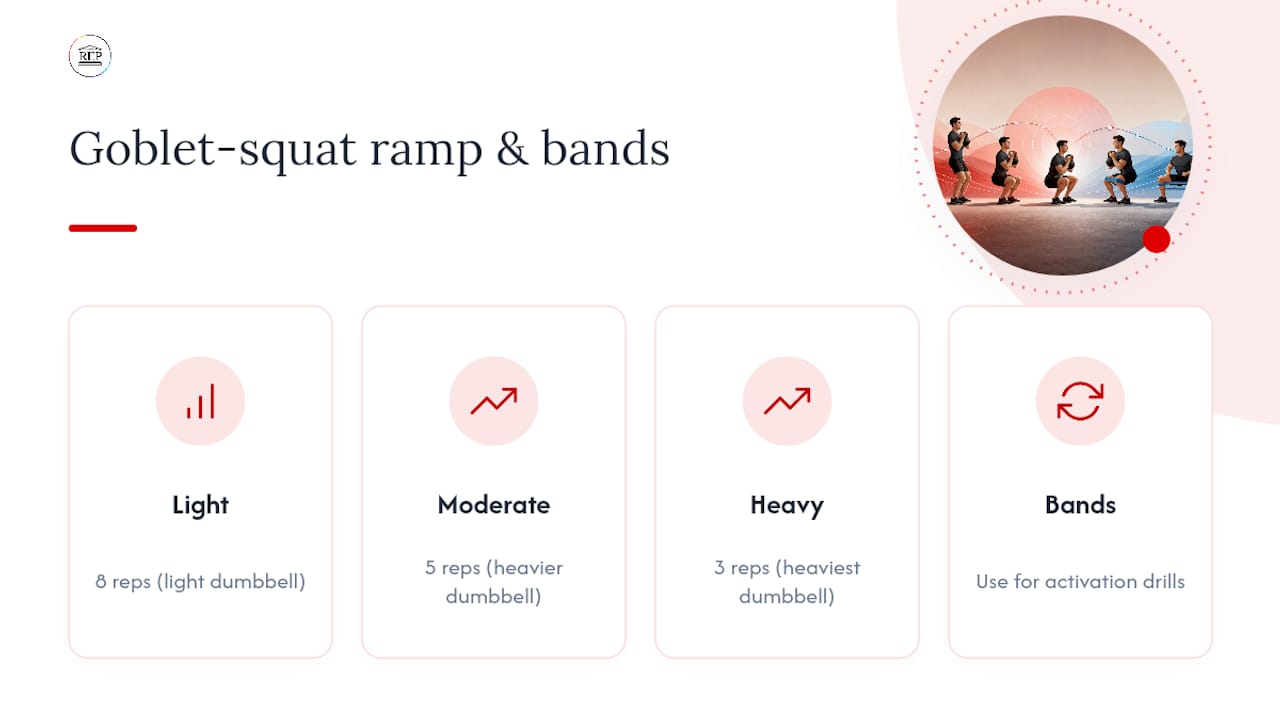
No barbell available? A goblet squat with a dumbbell, ramped the same way (light for 8, heavier for 5, heavier still for 3), rehearses the same pattern. Resistance bands work well for activation drills too. A set of resistance bands or a similar affordable band kit covers most of what a warm-up phase needs when equipment is limited.
Before any working set, I run a quick three-point check: does the movement look clean, does the bar speed feel normal, and is there any sharp pain anywhere. Two yeses and a no means you're ready.
Why REP Philosophy Builds Warm-Ups Around the Actual Lift
Here's what I believe after years of watching people warm up wrong: complexity is the enemy of consistency. A ten-minute, movement-specific ramp gets done every single session. A twenty-five-minute mobility circus gets skipped the moment someone's running late, which is most days.
That's exactly why some group classes and virtual programming use short, repeatable warm-up structures instead of elaborate routines. A warm-up that takes too long to remember or too long to complete is a warm-up that eventually gets abandoned, and an abandoned warm-up protects nobody.
— Coach Justin
Get a Warm-Up Built Around Your Actual Lifts
A generic warm-up video only gets you so far. What actually changes your session is having someone watch your bar path, check your mobility, and adjust your ramp sets on the spot, which is exactly what happens in a personal training coaching session.

New clients get a warm-up prescription built for their specific lifts, a technique check before the weight gets heavy, and a program that scales as they get stronger. If you're local to the area, in-person coaching sessions walk you through this from the first rep. Prefer to train on your own schedule? The on-demand exercise library gives you follow-along warm-ups and full programming you can use anywhere. Either way, the next step is simple: book a session and stop guessing about what your body needs before you load the bar.
Sources
For readers who want the underlying research, Bishop's review on warm-up and performance and the meta-analysis on static stretching and strength cover the physiology. PoinT GO's practical warm-up guide and Planfit's research on movement-specific warm-ups break down the protocol side in more depth.
- Bishop — Warm-up and performance
- Behm et al. — Effects of static stretching on strength
- PoinT GO — How to warm up before heavy lifting
- Nike — 8 warm-up exercises to prepare for your workout