
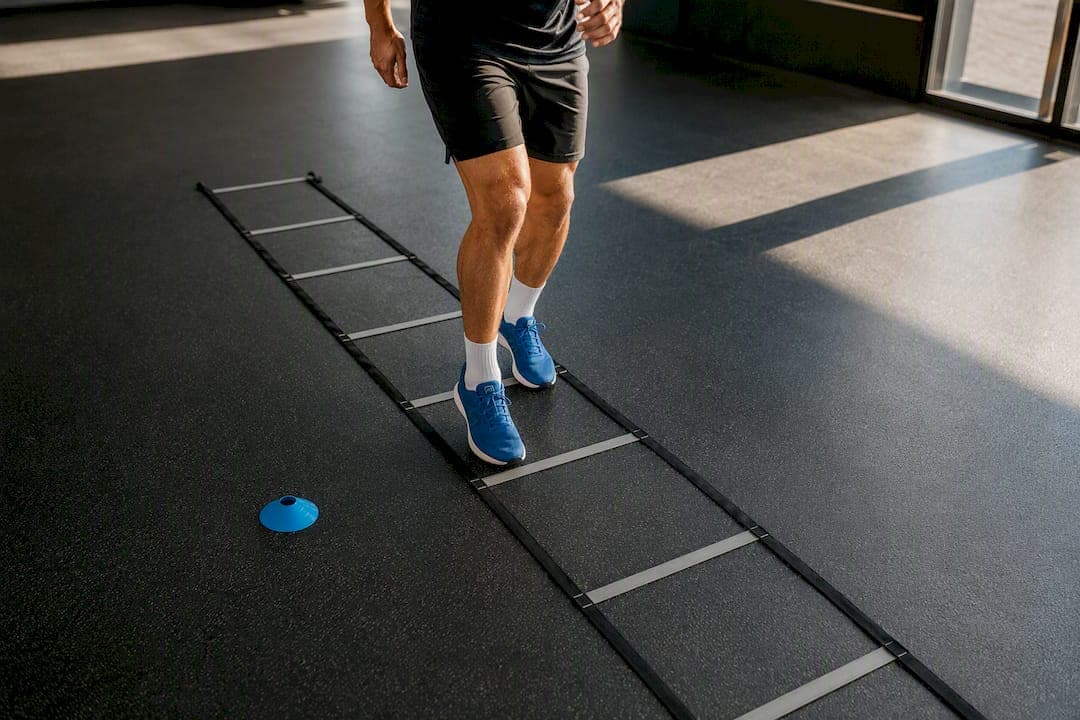
Agility ladder drills train foot speed, coordination, and the split-second timing between your brain and your muscles, but they won't build the raw strength or power that turns quick feet into real game speed on their own. The best way to use them: learn every pattern slow and clean before you chase speed, run them two to four times a week, and pair them with strength work. Get that order backwards and you're just practicing fast, sloppy footwork.
TL;DR:
- Properly mastering beginner drills at a slow, deliberate pace ensures accurate patterns and prevents reinforcing sloppy footwork before increasing speed.
- Advanced drills should incorporate reactive elements and sprint-out efforts only after pattern consistency and control are fully developed.
- Ladder drills alone mainly improve coordination and foot speed; pairing them with strength and power training is essential for actual game-speed performance.
- A six-week progressive plan prioritizes pattern mastery early, then gradually introduces speed, change of direction, and sprinting to measure real progress.
- Using tape or cones instead of a ladder works just as well, provided the spacing, surface, and safety measures meet basic standards.
Table of Contents
- What Are Agility Ladder Drills, Exactly?
- Beginner to Advanced Ladder Drill Progressions
- How to Program Ladder Drills Into a Real Training Week
- Coaching Cues and Safety Rules You Shouldn't Skip
- Choosing a Ladder (or Skipping One Entirely)
- Coach Justin's Take on Building Real Progressions
- What the Research Gets Right (and What It Leaves Out)
- Get Coached Through It, or Keep Practicing on Your Own
- Where to Learn More
- Sources
- FAQ
What Are Agility Ladder Drills, Exactly?
An agility ladder is a flat rope-and-rung tool you lay on the ground, and you move through its squares using specific footwork patterns. The tool itself is simple. The value comes from the patterns, and there are a lot more of them than the classic "run through it fast" version most people picture.
Coaches sometimes call these drills "ladder work" or "footwork drills," but they all fall under the same category: agility training exercises that build neuromuscular coordination, not straight-line running speed. That distinction matters when you set expectations. Common ladder drills like One-Step, the Ickey Shuffle, In-In-Out-Out, and High Knees each train a slightly different movement pattern, while a test like the 5-10-5 (Pro Agility Shuttle) measures something different altogether: change-of-direction speed under a stopwatch, not a rehearsed footwork pattern.
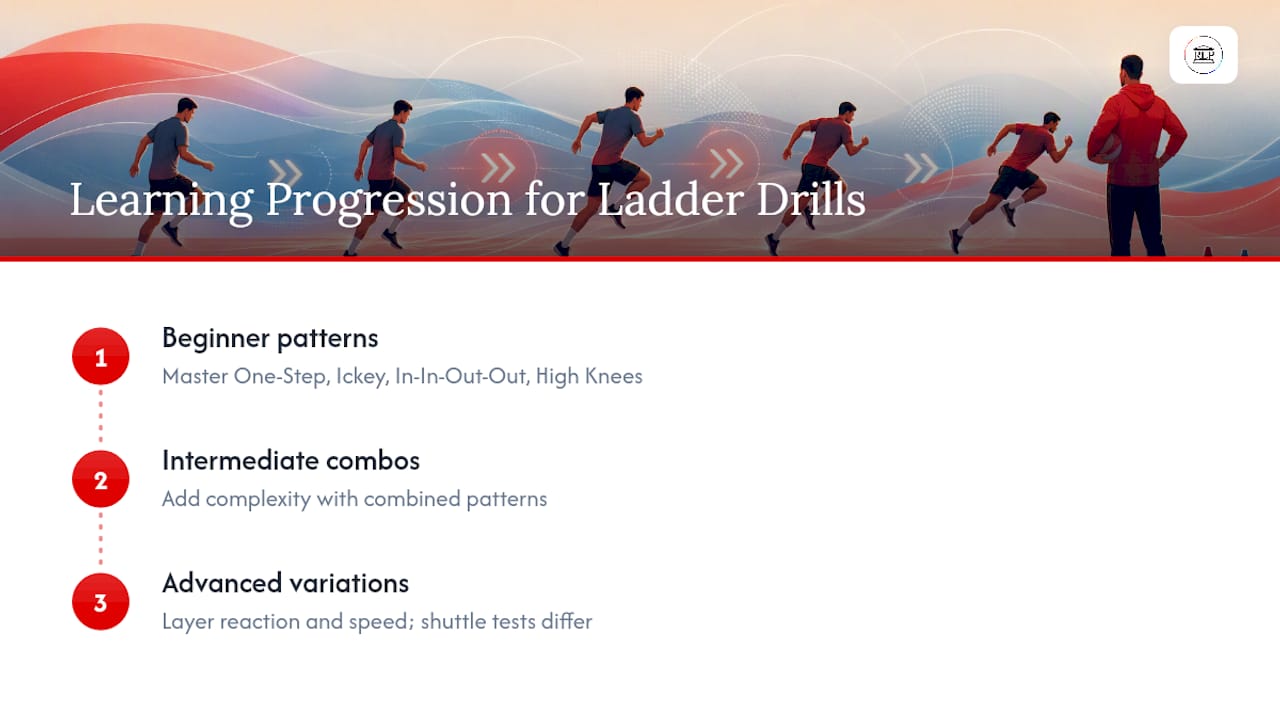
That's an important line to draw before you touch a single rung. Ladder drills teach your feet how to move. The 5-10-5 and similar shuttle tests measure how fast you can decelerate, plant, and redirect, which depends heavily on strength and reactive ability the ladder alone won't build. Below, you'll find the drills organized the way you should actually learn them: beginner patterns you master first, intermediate combinations that add complexity, and advanced variations that layer in reaction and speed.
Beginner to Advanced Ladder Drill Progressions
Every drill on this list follows the same underlying rule: nail the pattern slowly before you add speed. According to coaching guides from Active/ACE, ladder work is best treated as a quickness and body-awareness tool, which means precision comes first and pace comes second, every single time.
Beginner drills: build the pattern library
These four drills form the foundation. If you can't do them cleanly at a walking pace, you're not ready to do them fast.
- One Step: Step one foot into each square, alternating left and right, moving straight through the ladder. It trains basic rhythm and ground contact timing. Cue: "quiet feet, quick pop off the ground."
- Two-In Run: Both feet land inside each square before you move to the next one, essentially a controlled two-foot hop pattern. It builds coordination between your left and right sides. Cue: "stay on your toes, don't sink into your heels."
- High Knees: Drive your knees up through each square, one foot per rung, keeping your torso tall. It reinforces hip flexor drive and arm-leg coordination. Cue: "knees to hip height, drive your opposite arm."
- Lateral Shuffle: Facing sideways, shuffle through the ladder with one foot in each square before moving laterally to the next. It trains frontal-plane coordination, which straight-ahead running never touches. Cue: "stay low, don't let your feet click together."
Run each of these for three to five slow, deliberate passes before you even think about speed. This is the single most skipped step in home ladder workouts, and it's the reason so many people feel like the ladder "doesn't work" for them.
Intermediate drills: add complexity and cutting
Once the beginner patterns are automatic, you're ready for combinations that ask your feet to do two different things in the same sequence.
- Ickey Shuffle: A two-in, one-out cutting pattern where you step both feet into a square, then cut one foot out to the side before repeating on the next square. It's named after the running back who popularized the move, and it trains the same lateral cutting mechanics used in change-of-direction sports. Cue: "cut, don't drift, plant that outside foot with purpose."
- In-In-Out-Out: Step both feet inside a square, then both feet outside straddling the rungs, repeating down the ladder. It builds hip mobility and lateral control under a forward-moving rhythm. Cue: "hips stay square, feet do the work."
- Carioca: A crossover step pattern where you rotate your hips and cross one leg in front, then behind, as you travel sideways through the ladder. It's one of the better drills for hip rotation and trains a movement pattern soccer and basketball players use constantly. Cue: "open your hips before you cross, don't just twist your ankles."
- Hopscotch: Split your feet outside the ladder, then bring both feet together inside a square, alternating rhythm like the playground game. It trains single-leg landing control and rhythm changes. Cue: "land soft, absorb through your knees, not your lower back."
The most common progression mistake at this level is rushing the transition between steps before the pattern is memorized. According to FitnessVolt's coaching notes, accuracy should always come before speed when you add a new pattern, and that advice holds up in the field. Watch for feet clipping the rungs, hips rotating too early, or a drill that looks fast but falls apart the moment you glance away from your feet.
Advanced drills: reaction, single-leg control, and sprint-out speed
These variations are for athletes who've already built a clean pattern base and want to add reactive elements or true sprint speed.
- Ali Shuffle: A quick-feet variation with rapid, light in-and-out steps through each square, named for the boxing footwork it resembles. It sharpens reactive quickness for sports with constant small direction changes. Cue: "light feet, stay bouncy, don't stomp."
- Single-Leg Shuffle: Hop through the ladder on one leg only, moving laterally or forward depending on the variation. It exposes weak ankle stability and single-leg control fast, which is exactly why it belongs at the advanced tier. Cue: "control the landing before you think about the next hop."
- T-Pattern: Move forward through part of the ladder, then break laterally out of it in a T-shape, mimicking a cut you'd make chasing a ball or covering a receiver. It bridges pure footwork with actual directional change. Cue: "decelerate before you cut, don't just lean."
- Sprint-Out: Run any ladder pattern, then explode into a 5 to 10-yard sprint the moment your feet clear the last square. This is where ladder work finally connects to game speed, because it forces a transition from controlled footwork to open sprinting.
For a low-equipment way to make any of these harder, add a coach or partner call: have someone shout "left" or "right" mid-drill and react instantly, or bounce a ball to the athlete as they exit the ladder. Single-leg hops and small plyometric jumps between rungs (instead of stepping) also raise the difficulty without needing any new gear.
Pro Tip: Film yourself from the side during a new drill's first few passes. You'll catch heel-first landings and hip drift in about ten seconds that you'd never notice by feel alone.
How to Program Ladder Drills Into a Real Training Week
Where ladder work fits in your session depends on your goal. Used as a warm-up, three to five minutes of light, known patterns wakes up your nervous system and primes coordination before heavier lifting or sprint work. Used as a focused agility session, 15 to 20 minutes of drills, including new or harder patterns, becomes the main training stimulus for the day.
Nike's training notes suggest 20 to 30 seconds of work per drill with short rest between reps, and two to three minutes of rest between full sets when the intensity is high. That rest window isn't arbitrary. It gives your nervous system time to recover between high-speed efforts, which matters more for motor learning than most people assume, since sloppy reps performed while fatigued just wire in bad patterns faster.
Sample warm-up (3 to 5 minutes): One Step, Two-In Run, and Lateral Shuffle, one slow-to-moderate pass each, no rest needed between drills.
Sample focused session (15 to 20 minutes):
- Three slow passes of a new drill for pattern acquisition, no timing pressure
- Three to four fast passes of the same drill once the pattern looks clean
- Two to three minutes of rest
- Repeat with a second drill
- Finish with two sprint-out reps combining a ladder pattern with a short sprint
A six-week progression turns individual drills into an actual improvement in foot speed and coordination, according to a structured programming breakdown that lays out this exact tiered approach:
Weeks 1 to 2, pattern acquisition: Focus entirely on beginner drills at slow to moderate speed, two to three sessions a week. The goal is clean mechanics, not a stopwatch.
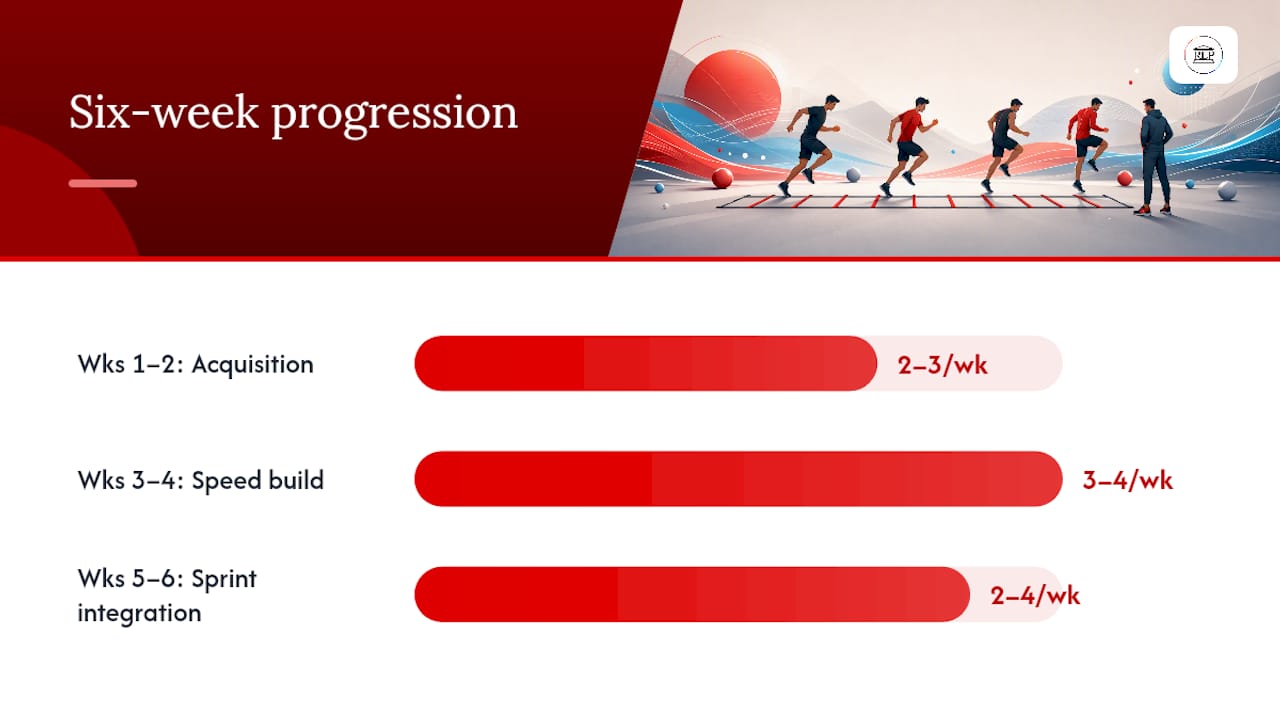
Weeks 3 to 4, speed build: Introduce intermediate drills and start timing your fastest clean pass through familiar beginner patterns, three to four sessions a week.
Weeks 5 to 6, sprint integration: Add advanced drills and sprint-out variations, and start benchmarking against yourself: time a fixed set of drills in week 5 and again at the end of week 6 to measure real progress.
Running two to four sessions weekly, with quality prioritized over rep count, is the range that shows up consistently across coaching programming for this kind of neuromuscular work.
Coaching Cues and Safety Rules You Shouldn't Skip
Good ladder technique comes down to a short list of cues, and almost every common mistake traces back to breaking one of them.
Stay on the ball of your foot with a slight forward lean, drive your arms in rhythm with your feet, keep ground contact short and light, and keep your eyes up instead of staring down at the rungs. That last one feels counterintuitive at first. Watching your feet actually slows your reaction time and wrecks your posture, and it's a habit worth breaking early.
The most common mistakes to correct:
- Speeding up before the pattern is actually clean, which just trains fast mistakes
- Landing heel-first instead of on the ball of the foot, which kills quickness and adds joint stress
- Crossing legs awkwardly on lateral drills instead of rotating the hips
- Letting the hips sag or wobble instead of staying stable and controlled
- Leaning too far forward, which throws off balance on cutting drills
Ladder drills aren't risk-free, and pretending otherwise does nobody any favors. Coaches who specialize in return-to-sport work caution that "fast feet" from ladder training doesn't automatically translate into safe, effective on-field agility, especially if it's substituted for actual strength and power training rather than added alongside it.
If you have a recent ankle sprain or ongoing Achilles tendinopathy, skip ladder drills or scale them down to very slow, low-impact patterns until a physical therapist clears you for lateral and reactive loading. A short dynamic warm-up (ankle circles, leg swings, a few bodyweight squats) before any ladder session goes a long way toward keeping your joints ready for the quick, repetitive contacts this kind of training demands.
Pro Tip: If a drill hurts anywhere below the knee, especially in the Achilles or the outside of the ankle, stop that drill for the day. Pain during footwork is your body flagging a mechanical issue, not something to push through.
Choosing a Ladder (or Skipping One Entirely)
A standard training ladder uses rungs spaced roughly 16 inches apart across a length typically around 10 to 15 feet, which matches the spacing recommended by ACE for general quickness work. Flat, low-profile ladders are the safer pick over the raised, tube-style versions, since a raised rung is exactly what catches a toe mid-sprint.
You don't need a manufactured ladder to do any of this. Painter's tape, sidewalk chalk, or a row of cones spaced evenly can replicate the same footwork patterns, since the pattern is what trains your coordination, not the equipment itself. A half-length ladder or a taped-out four-square pattern works fine for short-burst drills when space is tight.
Before any session, run through this quick checklist:
- Measure rung spacing evenly, roughly 16 inches apart
- Secure both ends so the ladder doesn't slide mid-drill
- Confirm the surface is flat and non-slip, grass, turf, or a clean gym floor all work
- Leave at least 5 to 10 feet of clear run-out space beyond the last rung for sprint-out drills
Coach Justin's Take on Building Real Progressions
The biggest error I see, whether it's a youth athlete or an adult picking up a ladder for the first time, is treating speed as the goal from day one. It isn't. Pattern quality is the goal, and speed is just what you're allowed to add once the pattern earns it.
My rule is simple: three to five slow, clean passes before anyone attempts a fast one, on every new drill, no exceptions. For younger athletes, that often means starting even earlier than most parents expect. Play-based footwork introduced around age six or seven, kept short and framed like a game rather than a drill, builds the same coordination without the pressure that makes kids sloppy or anxious about getting it "right."
Ladder work also never stands alone in a well-built program. It needs strength and power training on the other side of the ledger to actually show up as speed on a field or court. Pair the two, and you get an athlete whose feet move fast and whose body can back that speed up under real contact or real fatigue.
Fast feet are a tool, not a finish line. An athlete who can rip through a ladder pattern but can't decelerate and cut under load hasn't built agility, they've built a party trick. Pair the footwork with strength, and you build something that actually holds up on the field.
— Coach Justin
What the Research Gets Right (and What It Leaves Out)
Most agility ladder content online treats the ladder like a complete training system on its own, and that's the part worth pushing back on. The research is clear that ladder drills sharpen coordination and foot speed, but the same coaching literature that recommends them also warns, consistently, that quick feet don't automatically transfer to real agility without strength and power underneath them.
Where the conventional advice falls short is pacing. Most articles list drills and move straight to "do them fast for a great workout," skipping the unglamorous middle step: slow, deliberate reps until the pattern is boring to you. That boredom is the point. It means the movement has become automatic enough to survive speed and fatigue.
If you take one thing from this guide, prioritize the six-week structure over any single drill. A beginner running clean patterns for two weeks before adding speed will outpace someone who jumps straight to advanced drills and just reinforces bad habits faster. Ladder work rewards patience first, speed second.
Get Coached Through It, or Keep Practicing on Your Own
Plenty of athletes make real progress running these drills solo in a driveway or backyard, and that's a completely valid way to train. But if you want someone watching your form catch the heel-first landings or hip drift you can't see yourself, that's exactly where guided coaching earns its keep, and it costs less than most people assume compared to traditional one-on-one personal training.

Repphilosophy offers a few ways to close that gap depending on how much hands-on feedback you want. Virtual Coaching Sessions give you custom programming and direct feedback on your ladder work and everything around it, without needing to drive anywhere. The Exercise Video Library Membership, at $12.50 a month, gives you on-demand access to a full library of drill demonstrations you can reference anytime you're unsure whether a pattern looks right. And if you're training with a friend or want the energy of a group, Small-group training sessions in 4S Ranch build agility work into a broader athletic development program alongside strength and conditioning.
If you're a parent looking for coached agility work for a young athlete rather than DIY drills in the driveway, book a session to see which option, virtual or in-person, fits your family's schedule best.
Where to Learn More
- BarBend's breakdown of top agility exercises covers drill names and step-by-step form for the most common patterns.
- Eric Cressey's analysis of ladder drills and true agility is essential reading on why footwork alone isn't the whole picture, written from a strength and conditioning perspective.
- Active/ACE's quickness guide lays out equipment specs and general programming recommendations.
- FitnessVolt's ladder drill guide offers detailed how-to instructions for ten distinct drills.
- For strength work that complements ladder training, NRTH's guide to dumbbell strength training covers practical exercises that reduce injury risk while building the power ladder drills don't.
Sources
- Best Agility Training Exercises — BarBend
- The Truth About 'Quick Feet' and Agility Ladder Drills — Eric Cressey
- Train Like a Pro: 10 Agility Ladder Drills — FitnessVolt
FAQ
What are some good agility ladder drills to start with?
One Step, Two-In Run, High Knees, and Lateral Shuffle are the four best starting drills, since they each isolate a different basic movement pattern. Master all four slowly before moving on to combination drills like the Ickey Shuffle or In-In-Out-Out.
What are 5 good exercises for agility?
A well-rounded set includes One Step, Ickey Shuffle, Lateral Shuffle, Carioca, and a sprint-out finisher, which together train forward, lateral, and rotational footwork plus the transition into open sprinting. Rounding out ladder work with strength and plyometric training builds the power that turns quick feet into usable speed.
Does the agility ladder really work?
Yes, for what it's actually designed to train: foot speed, coordination, and body awareness. It does not, on its own, build the strength or power needed for full on-field agility, which is why coaches recommend pairing it with resistance training rather than using it as a standalone program.
What is the 5-10-5 drill?
The 5-10-5, also called the Pro Agility Shuttle, is a change-of-direction speed test, not a ladder drill. You sprint 5 yards one direction, 10 yards back the other way, then 5 yards to finish, and it's timed to measure how fast you can decelerate and redirect under load, a different skill than the footwork patterns ladder drills train.
How often should I do agility ladder drills?
Two to four sessions a week works well for most athletes, whether you're using ladder drills as a short warm-up or a focused 15 to 20 minute session. Rest two to three minutes between high-intensity sets so your nervous system can recover, since quality reps matter more than total volume for building coordination.