

Expect roughly $250 to $400 a year for recreational leagues, $2,000 to $4,500 for competitive club soccer (with all-in totals often reaching several thousands of dollars), and around $70 to $100 per private lesson in San Diego. The three biggest cost drivers are program tier, tournament travel, and coach credentials. The sections below break down typical costs and show you how to budget for the real total, not just the sticker price.
TL;DR:
- Private coaching in San Diego costs between $70 and $100 per lesson, with private lessons providing more value for technical improvements.
- Competitive club soccer often exceeds $5,000 to $10,000 annually when factoring in tournaments, travel, and gear, compared to base fees of $2,000 to $4,500.
- Lower-cost programs like AYSO or YMCA can reduce expenses significantly, with regional registration fees around $125 to $195 per season and aid options.
- Time commitments for recreational leagues are manageable at roughly 16 to 20 weeks a year, while competitive programs can demand full weekends and multiple weekly practices.
- The total cost of youth sports has risen 46% since 2019, making budget planning and fee transparency essential to avoid unexpected expenses.
Table of Contents
- Youth Sports Training Cost San Diego: Price Ranges By Program Type
- What's Included In Base Fees And What Gets Added On
- How To Compare Value: The Per-Hour Math That Actually Matters
- Lower-Cost Routes And Financial Assistance In San Diego
- How Much Time Youth Training Actually Requires
- Seasonal Cost And Availability Shifts In San Diego
- Registration Timelines: When To Sign Up And What To Expect
- A Local, Budget-Aware Path Through REP Philosophy And WayALife Athletics
- Try WayALife Athletics Before You Commit To A Full Season
- Where To Verify These Numbers And Find Local Assistance
- Sources
Youth Sports Training Cost San Diego: Price Ranges By Program Type
If you're comparing options, you need actual numbers, not vague ranges. Here's what San Diego families are paying by category, and where the gaps between advertised price and real price tend to open up.
Recreational leagues stay the most predictable. AYSO regional registration in San Diego typically runs $125 to $195 per season, which lands most families around $250 to $400 a year for a fall and spring commitment. That number usually covers a jersey, a ball, field access, and a volunteer coach.
Competitive club soccer is where budgets get complicated. Base club fees commonly run $2,000 to $4,500 annually, but that figure rarely reflects what a family actually spends. Once you add tournament entry, travel, showcase events, and gear, all-in totals frequently climb to $5,000 to $10,000 or more per year at the elite tiers like ECNL.
Private coaching sits in a wide band. San Diego averages tend to run $70 to $100 per lesson, though the broader market for private sports coaching spans $40 to $120 depending on the coach's experience and sport. Separate local reporting pegs West Coast private-lesson pricing closer to $80 to $90 per session, which lines up with what most San Diego parents report paying.
Group classes and camps fall between those extremes:
- Group skill classes: often $15 to $30 per session when purchased as a multi-week package
- Week-long camps: commonly $200 to $450 depending on sport and whether lunch or extended care is included
- Buddy training formats: split the coach's rate between two or more athletes, cutting per-child cost substantially
None of this is static. Family spending on youth sports overall has risen 46% since 2019, pushed by specialized coaching, travel, and association fees. That trend shows up in San Diego pricing too, so a program's quoted rate today may not hold next season.
What's Included In Base Fees And What Gets Added On
A base fee almost never covers the full cost of a season. Understanding what's bundled versus billed separately keeps you from getting surprised in October.
Recreational programs usually bundle the most into one price: league registration, field use, a basic coach, and sometimes a starter uniform. Competitive clubs unbundle almost everything. The base fee typically buys training sessions and league play only.
Here's what usually gets added on top:
- Uniforms and gear, often $100 to $300 per year and replaced annually as kids grow
- Tournament entry fees, frequently $50 to $150 per event, with competitive teams entering multiple tournaments per season
- Travel costs, including hotels and gas for away tournaments, which can add hundreds per trip
- Coach travel per diems, sometimes passed to families for showcase or out-of-region events
- Optional supplemental training, like private lessons or speed and agility clinics layered on top of team practice
Some clubs disclose all of this in one document. Many don't, which is why a written fee schedule matters more than a sales pitch.
Pro Tip: Ask every program for a full written fee schedule before you commit, and specifically request the prior year's average tournament and travel spend per family. If they can't produce that number, treat it as a red flag, not an oversight.
How To Compare Value: The Per-Hour Math That Actually Matters
Two programs charging wildly different prices can cost the same per hour of actual coaching. Do this math before you decide.
Take the total annual cost and divide it by the number of coached hours the child receives, not the number of games or the season length. A $3,000 club season with 100 hours of coached practice works out to $30 an hour. A $90 private lesson lasting 60 minutes is $90 an hour but delivers individualized attention a group session can't.
What separates a fair price from a poor one usually comes down to a few concrete factors:
- Coach credentials. Look for certifications relevant to the sport and age group, not just playing experience.
- Coach-to-player ratio. A 1:8 ratio in a skills class means more individual reps than a 1:20 ratio at the same price.
- Schedule transparency. Programs that publish practice and game calendars months ahead are usually more organized about everything else, including money.
- Fee transparency. If a club dodges specifics about travel costs at an information session, expect that pattern to continue after you've paid the deposit.
Ask directly: "What's your coach-to-player ratio, and can I see last season's average per-family travel cost?" The answer tells you more than the brochure.
Lower-Cost Routes And Financial Assistance In San Diego
You don't have to choose between competitive development and an affordable budget. San Diego has real lower-cost paths, and most families never ask about them.
AYSO remains the most accessible entry point, with regional registration in the $125 to $195 range per season and a philosophy built around inclusion over elimination. YMCA of San Diego County runs recreational leagues and offers income-based financial assistance at most branches. Volunteer-run community leagues, including programs through Area Youth Ministry, fill a similar role in specific neighborhoods and often charge less than half of club rates.
Asking for aid is simpler than most parents expect:
- Contact the program director directly, not the front desk, and ask specifically about scholarships or work-exchange options
- Apply before the registration deadline; most aid budgets run out early
- Ask whether siblings qualify for a discount, since many clubs offer one but don't advertise it
Group and buddy-training formats also lower cost without cutting supervised coaching time, since splitting a coach's rate between two or more athletes keeps quality high while cutting the per-child bill roughly in half.
Pro Tip: If travel to a facility is part of what's driving your cost up, ask whether a program offers a virtual or hybrid option for off-season skill work. It won't replace live coaching, but it stretches your training budget between seasons.
How Much Time Youth Training Actually Requires
Cost only tells half the story. Time commitment is the other half, and it varies more than most parents expect going in.
Recreational leagues typically run one practice and one game per week for 8 to 10 weeks per season, so a fall and spring commitment totals roughly 16 to 20 weeks a year. That's a manageable load for most families and most kids.
Competitive club soccer looks different. Expect two to four practices a week plus weekend games, often 10 to 11 months a year with a short off-season break. Add tournament weekends, which can mean full Saturdays and Sundays several times a season, and the time commitment starts to rival a part-time job for the whole family, not just the athlete.
Private lessons and group skill classes sit at the flexible end. A typical private session runs 30 to 60 minutes, and most families book one to two sessions per week. Group classes, like speed and agility training, usually run 45 to 60 minutes and meet once or twice weekly in structured blocks of 4 to 8 weeks.
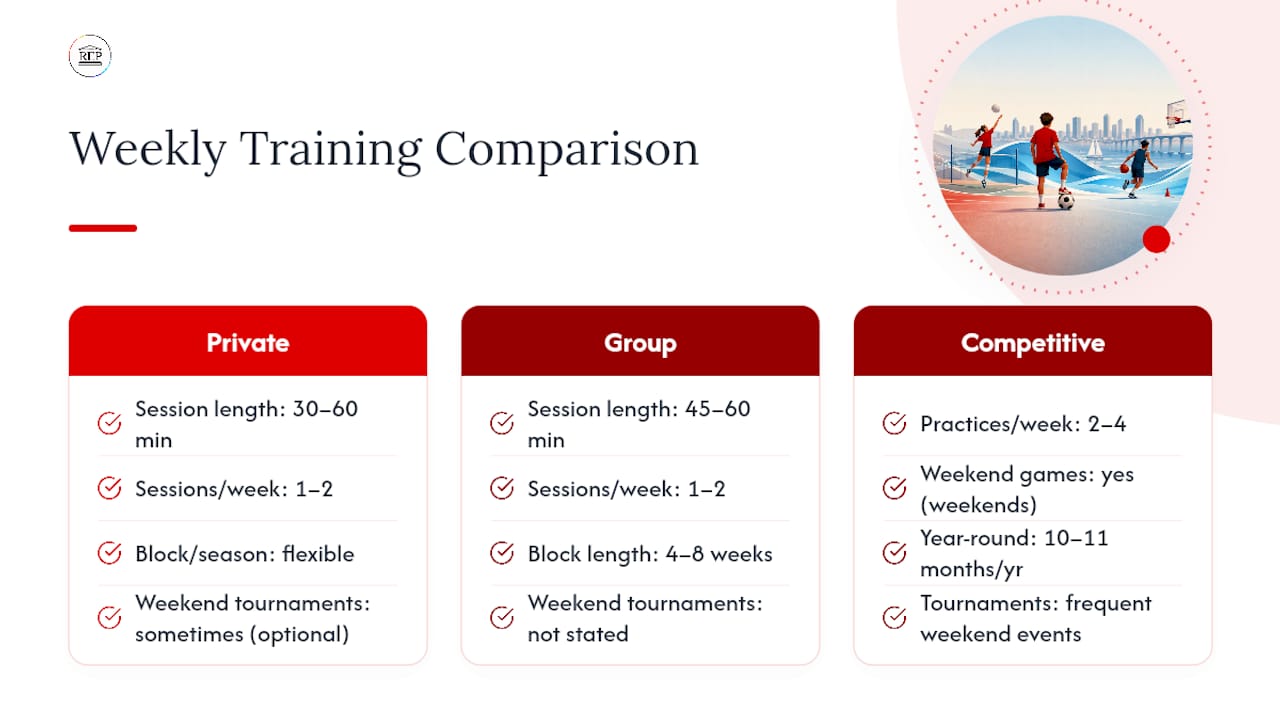
Before committing to any tier, map the weekly hours against your family's actual calendar, not the hours you assume you'll have. A club that requires four weekly practices plus travel weekends is a different lifestyle decision than a rec league with one practice and one Saturday game, even if the skill development looks similar on paper.
Seasonal Cost And Availability Shifts In San Diego
Prices and open spots in San Diego don't stay flat across the year, and timing your enrollment wrong can cost you money or a roster spot.
Late summer through early fall is peak demand for most sports, since school-year leagues and competitive club tryouts cluster in August and September. Popular programs fill first, and late registrants sometimes pay a premium or land on a waitlist. Winter tends to bring a lull in outdoor sports registration but a surge in indoor options like basketball and futsal, which can mean better availability for outdoor-sport private coaching since fewer families are booking lessons.
Spring often brings a second recreational season plus the start of club tryout cycles for the following fall, so costs can spike again as programs release new-season pricing. Summer is camp season almost exclusively, with week-long camps priced independently of the regular season, often $200 to $450 depending on sport and included amenities.
Tournament season adds its own seasonal cost layer. Competitive teams often see travel and entry-fee spending concentrate in specific windows, frequently late fall and late spring, which means a family's monthly spending on the same club membership can double during tournament heavy months compared to a quiet December.
If your budget is tight, ask a program directly which months carry the highest add-on costs before you sign up, not after the season starts.
Registration Timelines: When To Sign Up And What To Expect
Missing a registration window in San Diego usually means a waitlist, a late fee, or both, so knowing the typical calendar matters as much as knowing the price.
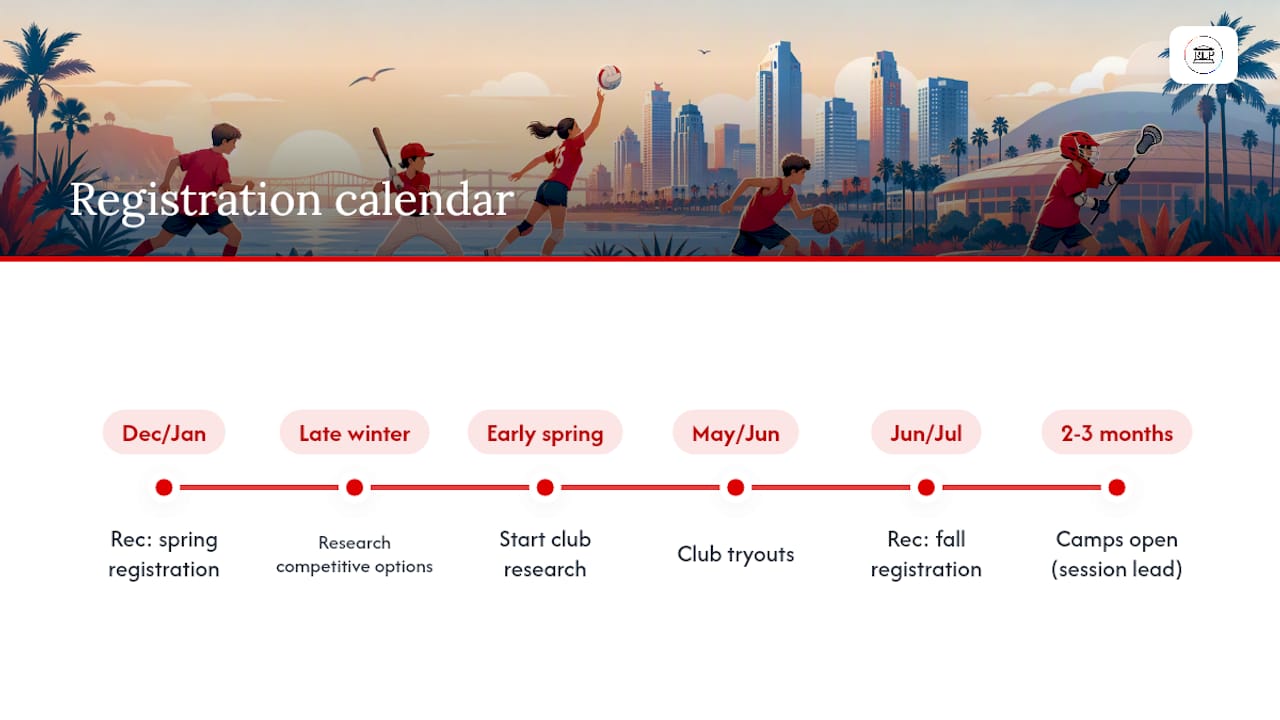
Recreational programs like AYSO generally open registration in June or July for a fall season starting in September, with a second registration window in December or January for spring. Registration itself is usually a short online process: create an account, select a division by age, pay the fee, and receive a team placement within a few weeks.
Competitive club tryouts follow a tighter, higher-stakes timeline. Most San Diego clubs hold tryouts in May or June for the following season, meaning a family evaluating fall club options needs to start researching by early spring. Some clubs also run mid-season tryouts to fill roster gaps, but spots and financial aid availability are far more limited outside the main cycle.
Private coaching and group classes have the most flexible registration, often allowing enrollment anytime with a session package purchase rather than a season-long commitment. Camps typically open registration two to three months ahead of the session date, and popular weeks sell out fast, particularly around spring break and the first weeks of summer.
The practical takeaway: start researching competitive options in late winter, recreational options in late spring or early winter, and treat private or group formats as the one category you can add to your plan at any point in the year without missing a deadline.
A Local, Budget-Aware Path Through REP Philosophy And WayALife Athletics
The clearest lesson in San Diego youth sports pricing is that cost and quality don't move in lockstep. A $4,000 club season and a $90 private lesson can both be worth it, or both be a poor use of money, depending on the format underneath the price tag.
WayALife Athletics, Repphilosophy's 4S Ranch youth performance program, runs on group classes and buddy-training memberships rather than one-on-one-only pricing. That structure changes the economics directly: splitting coach time between athletes keeps the per-child rate well below solo private lessons while preserving actual coaching attention, not just supervised open gym time.
Private one-on-one sessions still earn their cost in specific situations, particularly injury recovery or a technical flaw that needs individual correction. For general athletic development, most kids get more value from structured group work with a real coach-to-player ratio than from an expensive private package stretched thin.
— Coach Justin
Try WayALife Athletics Before You Commit To A Full Season
Repphilosophy's WayALife Athletics program gives San Diego parents a group-based, buddy-training path to youth development at a fraction of what elite club tiers charge, without trading away real coaching attention.

If you're weighing a $4,000 club commitment against something more flexible, start smaller. Book a session through the personal training and youth program catalog to see how a small-group format fits your child's schedule and your budget before you sign a season-long contract. Families who want an even lighter entry point can explore the on-demand exercise library to supplement in-person sessions between visits. For a look at the actual 4S Ranch facility and typical class structure, the WayALife Athletics program page lays out schedules and formats so you can compare it directly against the club and private-lesson numbers above.
Where To Verify These Numbers And Find Local Assistance
For a broader read on why family sports spending keeps climbing, the Project Play survey from the Aspen Institute tracks the national trend. KPBS covers the local San Diego angle and subsidy programs. Reach AYSO and YMCA of San Diego County directly for current regional registration windows and aid applications, and check Athlo's breakdown of youth soccer fees for a national cost-comparison reference point.
Sources
- Project Play / Aspen Institute press release
- San Diego youth soccer costs compared — Solstice FC (market research blog)