

The fat-burning heart rate zone is the intensity range where your body draws a higher proportion of energy from fat, typically 60–70% of your maximum heart rate. To get a quick estimate, subtract your age from 220, then multiply by 0.60 and 0.70. A 40-year-old gets an MHR of approximately 180 bpm, placing their fat-burning zone roughly in the moderate heart rate range often identified as zones 1 to 2. Keep in mind: this formula is a starting point, not a prescription. Medications, fitness level, and genetics all shift the real number, and total calorie burn across your whole week matters more for fat loss than staying glued to any single zone.
Key Takeaways
| Point | Details |
|---|---|
| Quick formula | Use 220 − age for MHR, then multiply by 0.60 and 0.70 for your zone range. |
| More precise method | Karvonen (heart rate reserve) gives a personalized range when you factor in resting HR. |
| Zone-2 weekly sessions | Aim for 2–3 steady zone-2 cardio sessions paired with 2 resistance training days. |
| Safety first | Medications, AFib, and heart conditions can alter HR response; consult a clinician before using HR targets. |
| Low-tech check | The talk test and RPE scale reliably estimate your zone when you don't have a monitor. |
Table of Contents
- How to calculate your fat-burning heart rate zone
- What the five heart rate zones mean for your training
- Quick reference: estimated fat-burning bpm by age
- How to measure your heart rate during a workout
- How to use the fat-burning zone in your weekly plan
- Safety notes and when to talk to your doctor
- How to judge your intensity without a heart rate monitor
- A coaching perspective on heart rate zones
- Sources
How to calculate your fat-burning heart rate zone
Two methods give you a personal bpm range. The first is fast; the second is more accurate if you know your resting heart rate.
Method 1: Age-predicted MHR (220 − age)
- Subtract your age from 220 to estimate your maximum heart rate (MHR).
- Multiply MHR by 0.60 to get the lower bound of your fat-burning zone.
- Multiply MHR by 0.70 to get the upper bound.
Worked example — 35-year-old: MHR = 220 − 35 = approximately 185 bpm The fat-burning zone is roughly estimated to be in the moderate heart rate range generally aligned with zones 1 to 2, without specifying exact bpm values.
Method 2: Karvonen (heart rate reserve)
The Karvonen method factors in your resting heart rate (RHR), giving a more personalized range. Measure your RHR first thing in the morning before getting out of bed.
- Calculate heart rate reserve (HRR): MHR − RHR
- Multiply HRR by 0.60 and 0.70, then add RHR back to each result.
Worked example — 35-year-old, RHR = 60 bpm: HRR is calculated by subtracting resting heart rate from MHR, which can then be used to estimate a personalized target range in the moderate intensity zones.
Notice how Karvonen produces a higher, tighter range. That's because it accounts for how fit your heart already is. For most recreational exercisers, the age-predicted formula is a perfectly usable starting point. A lab cardiopulmonary exercise test (CPET) measuring gas exchange is the gold standard for pinpointing your exact fat oxidation peak, but it's unnecessary unless you're training for competition or have a specific clinical need.
What the five heart rate zones mean for your training
Heart rate zones are commonly divided into five bands based on percentage of MHR. Understanding where the fat-burning zone sits helps you train with purpose rather than guessing.
Zone 2 is where the fat-burning zone lives. Research confirms that fat oxidation is proportionally higher at this moderate intensity, but total energy expenditure rises sharply as you move into zones 3 and 4. A 30-minute zone-4 run burns more total calories than a 30-minute zone-2 walk, even though the walk uses a higher percentage of fat. Both have a place in a smart program.

Quick reference: estimated fat-burning bpm by age
These figures use the 220 − age formula. Use them as a ballpark, and apply the Karvonen method or lab testing for greater precision.
These are estimates only. Individual MHR can vary by 10–12 bpm from the formula result.
How to measure your heart rate during a workout
Choosing the right tool makes a real difference in how accurately you can hit your target zone.
- Manual pulse check: Free and always available. Count beats at your wrist or neck for 15 seconds and multiply by 4. Accurate enough for a quick spot-check, but impractical mid-run.
- Wrist optical monitor (PPG): Built into most fitness watches and bands. Convenient for steady zone-2 sessions. Studies show wrist optical sensors can underreport rapid heart-rate changes, making them less reliable during high-intensity intervals.
- Chest strap (ECG-based): The most accurate wearable option. Recommended for interval training or any session where you need real-time precision. Pairs with most fitness apps and gym machines.
- Cardio machines (built-in grips): Handy but inconsistent. Grip sensors require steady hand contact and often read 5–10 bpm off target.
Practical recommendation: A chest strap is worth the investment if you do interval work or want accurate zone data. For steady zone-2 walks and jogs, a wrist monitor is fine. To improve wrist monitor accuracy, wear it snug (one finger above the wrist bone), keep firmware updated, and avoid loose sleeves that shift the sensor.
How to use the fat-burning zone in your weekly plan
Zone-2 training is a tool, not a complete program. Here's a simple weekly structure that puts it to work alongside the other elements your body needs.
- 2–3 zone-2 sessions per week: 30–45 minutes of steady-state cardio (brisk walking, easy cycling, light jog) where you can hold a conversation but feel your breathing.
- 2 resistance training sessions: Strength training preserves lean muscle, which keeps your resting metabolic rate from dropping as you lose fat.
- 1 higher-intensity session (optional): A short interval workout, like high-intensity sprints, burns more total calories per minute and adds variety without replacing your zone-2 base.
Myth: you have to stay in the fat-burning zone to lose fat. You don't. Higher intensities burn more calories per minute, and coaches consistently emphasize that overall energy balance, not zone selection, drives body-composition change. Zone 2 is excellent for building your aerobic base and for active recovery days. It's one piece, not the whole picture.
Pro Tip: Pair your zone-2 sessions with adequate protein intake (roughly 0.7–1 gram per pound of bodyweight is a common target) to protect lean muscle while in a calorie deficit. Losing muscle alongside fat slows your metabolism and makes long-term fat loss harder to sustain.
Safety notes and when to talk to your doctor
Heart rate targets are useful guides, but they're not universally reliable. A few situations call for extra caution.
- Beta-blockers and certain antidepressants can significantly lower your resting and exercise heart rate, making standard zone targets meaningless or even misleading. Your actual effort may be much higher than your monitor suggests.
- Pacemakers regulate heart rhythm artificially, so your HR reading won't reflect true cardiovascular demand.
- Atrial fibrillation (AFib) causes irregular heart rhythms that make zone-based training unreliable without clinician guidance.
- Known cardiovascular disease or unexplained chest pain requires medical clearance before starting any heart-rate-targeted program.
- Age formulas are broad baselines. The 220 − age estimate can be off by 10 bpm or more for a given individual, and the Cleveland Clinic notes that medications and health conditions can alter heart rate responses significantly.
If any of the above applies to you, speak with your physician before using HR targets as a training guide. RPE and the talk test (covered below) are safer alternatives when HR data is unreliable.
This article is general information, not medical advice. Confirm any exercise program with a qualified healthcare provider, especially if you have a pre-existing condition.
How to judge your intensity without a heart rate monitor
No wearable? No problem. The talk test and RPE scale are reliable field methods for landing in the right zone.
The talk test: If you can speak in full, comfortable sentences, you're in zones 1–2. If your sentences become short and choppy, you've crossed into zone 3. If speaking more than a word or two feels hard, you're in zone 4 or 5.
| RPE (1–10) | What it feels like | Approximate zone |
|---|---|---|
| 2–3 | Easy; could hold a long conversation | Zone 1 |
| 4–5 | Moderate; short sentences, slightly breathless | Zone 2 |
| — | Harder; broken sentences, aware of breathing | Zone 3 |
| — | Hard; few words at a time | Zone 4 |
| — | Max effort; can't speak | Zone 5 |
Use the talk test during group fitness classes or outdoor runs where glancing at a watch disrupts your flow. A wearable is more useful for structured interval sessions where you need to hit specific zones repeatedly and track trends over time.
A coaching perspective on heart rate zones
Here's something I see constantly with new clients: they come in convinced that staying in the fat-burning zone is the secret to losing weight. They walk on the treadmill for an hour, keep their heart rate carefully between 108 and 126 bpm, and wonder why the scale barely moves after six weeks.
Zone-2 work is genuinely valuable. I prescribe it regularly, especially in the early weeks of a program, because it builds aerobic base, improves recovery between harder sessions, and is sustainable for people who are just getting started. But it's one layer of a program, not the whole thing.
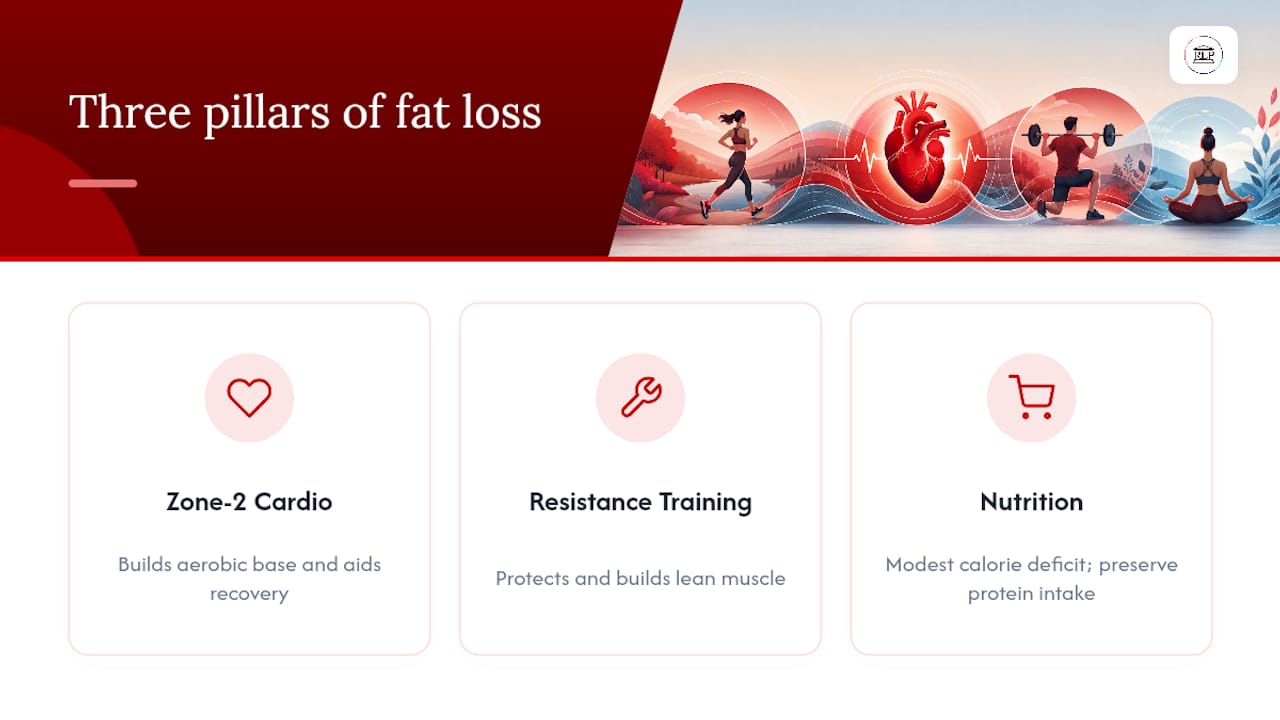
What actually changes body composition is the combination: zone-2 cardio for aerobic conditioning, resistance training to protect and build lean muscle, and a nutrition approach that creates a modest calorie deficit without gutting your protein intake. When those three work together, the fat-burning zone becomes a useful tool rather than a magic number you're chasing.
I also want to be honest about the formula. The 220 − age estimate is a starting point, not a clinical measurement. Some of my clients run comfortably at what the formula says is zone 3 and feel like they're barely moving. Others hit zone 4 effort at the "zone 2" bpm. That's why I always encourage people to use the talk test alongside their monitor, and to track how they feel over several weeks, not just what the numbers say on day one.
If you want a program built around your actual numbers, including your resting heart rate, your training history, and your goals, that's exactly what personalized coaching is for. You can track your progress more meaningfully when someone helps you interpret what the data actually means for you.
Ready to stop guessing and start training with a plan built around your body? Whether you prefer in-person sessions in 4S Ranch or the flexibility of virtual coaching, Repphilosophy has a format that fits your life.

Start your personal training program and get a bespoke plan that puts every zone to work for you. Prefer to train on your schedule? The on-demand exercise library gives you structured, coach-programmed workouts you can follow anywhere, at any intensity.
This article is general information, not a substitute for advice from a qualified doctor. Consult a qualified healthcare professional about your own circumstances before acting on anything here.
Sources
These are the primary references behind this article, each worth bookmarking if you want to read the original guidance.
- What Is a Fat‑Burning Heart Rate?
- Understanding exercise heart rate zones - Harvard Health
- Target heart rates | American Heart Association
Evidence quality note: the zone definitions and formula guidance are well-established and consistent across major health organizations. The fat oxidation research involves small study samples, so treat individual MFO estimates as directional rather than precise. Lab testing remains the only way to confirm your personal threshold.