

Virtual personal training runs from about $10 a month for app-based programs to $600 or more for premium one-on-one video coaching, with most people landing between $100 and $300 a month for real individualized programming. The reason the range is so wide has nothing to do with the internet connection and everything to do with how much of a trainer's direct attention you're buying. Below, I'll break down each tier so you know exactly what you're paying for.
TL;DR:
- Virtual coaching prices vary from $10 for app-based plans to over $600 for premium one-on-one video sessions, depending on attention level.
- Basic app programs offer little personal review and are best for self-motivated users, while individualized coaching at $100–$300 provides weekly feedback and custom plans.
- Premium packages include live sessions and frequent plan updates, costing $300–$600 or more, with limited client capacity due to high trainer workload.
- Per-session costs typically range from $30 to $80, with monthly expenses based on weekly session frequency; bulk session packs can reduce per-session cost.
- Match your budget to your goals by considering whether you need accountability, measurable progress, and schedule compatibility, rather than just comparing prices.
Table of Contents
- Virtual Personal Training Cost by Model: Ranges You Can Expect
- What You Actually Get at Each Price Tier
- Why Two Trainers Can Charge Wildly Different Rates
- Doing the Math: What Will This Actually Cost You Monthly?
- Matching Your Budget to the Right Virtual Trainer
- Repphilosophy's Virtual Options, Mapped to These Price Tiers
- The Real Question Isn't Price, It's Whether You'll Use It
- Ready to Start Virtual Training With Repphilosophy?
- Sources
Virtual Personal Training Cost by Model: Ranges You Can Expect
The single biggest mistake people make when shopping for virtual coaching is comparing prices without comparing what's included. A $20 app subscription and a $400 monthly coaching package are both technically "virtual personal training," but they're not competing products. One sells you content. The other sells you a person paying attention to your specific body and your specific week.
Here's how the market actually breaks down by model.
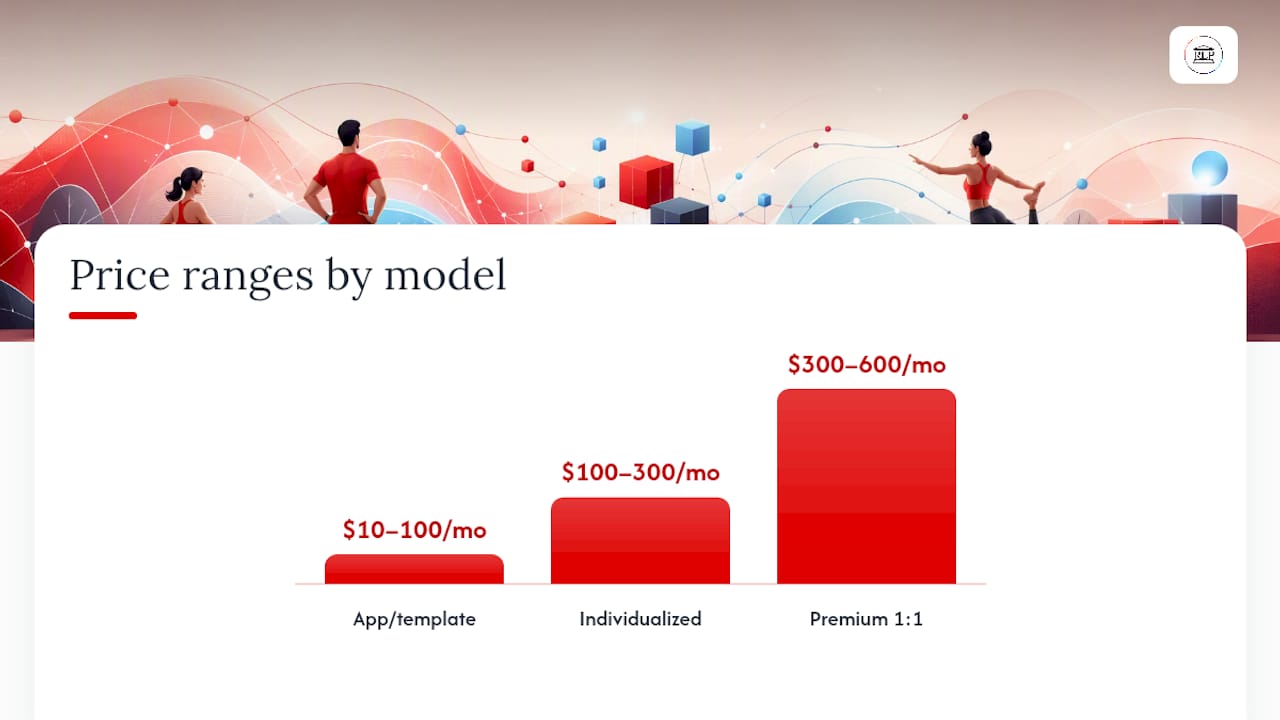
App and template programs sit at the bottom of the price ladder, typically $10 to $100 per month. You get pre-built workout plans, a video library, and maybe a habit tracker. There's no human reviewing your form or adjusting your plan when your knee starts acting up. This tier works well for self-motivated people who mainly need structure and instruction, not accountability.
Individualized coaching is the market's center of gravity, generally $100 to $300 per month. A real trainer builds your program, adjusts it based on your feedback, and checks in on a set schedule, usually weekly. This is the tier most people picture when they think "online personal trainer," and it's often the sweet spot coaches themselves aim for because it balances client volume with actual attention per client.
Premium 1:1 video coaching climbs to $300 to $600 or more per month. This tier bundles frequent live video sessions, near-daily messaging access, and programming that gets rewritten in real time based on how your week actually went, not a generic template with your name pasted on top. It scales the worst for trainers, which is exactly why it costs the most.
Hybrid models, blending occasional live video sessions with asynchronous programming and messaging, generally land between $200 and $500 a month. They suit people who want more contact than a pure app but can't justify daily live check-ins.
Live virtual per-session pricing, for people who'd rather pay per workout than commit to a subscription, typically runs $30 to $80 per session, sometimes framed as $25 to $75 depending on the trainer's experience level.
| Model | Typical Price | Best Fit |
|---|---|---|
| App/template | $10–$100/mo | Self-motivated, needs structure |
| Individualized coaching | $100–$300/mo | Most people wanting real feedback |
| Premium 1:1 video | $300–$600+/mo | High accountability, fast results focus |
| Hybrid | $200–$500/mo | Wants live contact without daily cost |
| Live per-session | $30–$80/session | Occasional or trial-based use |
A few things worth flagging as you compare quotes:
- App-only pricing rarely includes any human review of your technique, so factor in the risk of building bad habits unsupervised.
- Individualized coaching packages often have a minimum commitment, usually one to three months, so ask before you buy.
- Premium tiers frequently cap client rosters, meaning availability, not just price, can be the real gatekeeper.
- Per-session live pricing tends to run slightly higher per-hour than subscription models, since there's no volume discount baked in.
What You Actually Get at Each Price Tier
Price tags don't tell you much on their own. What matters is the deliverable behind the number, and marketing language around virtual training loves to obscure exactly that. "Unlimited messaging" sounds generous until you learn the trainer only responds once every 48 hours. "Custom program" can mean anything from a fully built plan around your injury history to a template with your name swapped in.
Here's a realistic breakdown of what each price band tends to actually deliver:
- App/template ($10–$100/mo): Pre-built workout library, general programming, minimal or no check-ins, no live sessions.
- Individualized coaching ($100–$300/mo): Custom program built around your goals and equipment, weekly check-ins, asynchronous messaging with a defined response window (often 24 to 48 hours), basic nutrition guidance.
- Premium 1:1 video ($300–$600+/mo): Live weekly or twice-weekly video sessions, near-daily messaging access, frequent program rewrites, detailed nutrition coaching, sometimes progress testing like body composition tracking.
- Hybrid ($200–$500/mo): One or two live sessions monthly paired with ongoing programming and moderate messaging access.
The personalization gap between tiers is the real story here. A $150 program built around your actual training history is worth more than a $250 program that's identical to what every other client received. Ask specifically how your plan gets built, not just how often it's updated.
Pro Tip: Before you sign up for anything advertising "unlimited support," ask the trainer directly what their average response time has been over the last month. A vague answer is itself an answer.

Nutrition guidance is another place tiers diverge sharply. Some individualized coaching packages include basic macro targets, while premium packages often include full meal planning and regular adjustments based on your progress photos or check-in data. If nutrition coaching matters to you, confirm it's included rather than assuming it comes standard.
Why Two Trainers Can Charge Wildly Different Rates
Two virtual trainers can offer what looks like the same service on paper and differ significantly in price. The gap usually comes down to a handful of concrete factors.
- Experience and specialization. A trainer fresh off certification often prices individualized coaching around $100 to $150 a month, while an established coach with a specific niche (post-partum recovery, powerlifting, youth athletic development) commonly charges $250 to $400 or more.
- Session frequency and format. Live video sessions cost more to deliver than asynchronous check-ins because they consume the trainer's real-time calendar. More frequent live contact almost always means a higher monthly rate.
- Session length. A 30-minute check-in call costs less than a full 60-minute live coaching session, even within the same coaching relationship.
- Extras bundled in. Nutrition coaching, body composition testing, or occasional in-person add-ons for hybrid clients all add to the base price.
- Business model. Coaches running high-volume, template-heavy operations can charge less per client because they're spreading fixed costs across more people. Coaches who deliberately cap their roster to preserve attention per client charge more, and that's a legitimate tradeoff, not a red flag.
- Demand and market positioning. A coach with a strong track record and waiting list can charge premium rates simply because demand supports it, independent of the actual service delivered.
None of this means higher price automatically means better coaching. It means price is a proxy for attention and scarcity, and you should ask what specifically you're buying before assuming the number reflects quality.
Doing the Math: What Will This Actually Cost You Monthly?
Here's the arithmetic that turns a per-session quote into a monthly budget, because that's usually where sticker shock (or pleasant surprise) actually happens.
The basic formula: rate × sessions per week × 4.3 = monthly cost. The 4.3 accounts for the average number of weeks in a month.
- One session per week at $50: $50 × 1 × 4.3 = about $215/month
- Two sessions per week at $50: $50 × 2 × 4.3 = about $430/month
- Three sessions per week at $50: $50 × 3 × 4.3 = about $645/month
At the lower end of typical virtual rates, one weekly session priced between $40 and $60 works out to roughly $170 to $260 a month, which lines up closely with the individualized coaching band most people end up choosing.
Quick reference: A single weekly live virtual session at $40 to $60 costs $170 to $260 per month. Bumping to twice weekly roughly doubles that, landing you near the top of the premium coaching tier.
Package pricing changes the math again. Buying sessions in bulk, say an 8 or 12-session pack, commonly shaves 10% to 20% off the per-session rate compared to paying one at a time. An 8-pack at $55 per session (versus a $65 drop-in rate) brings your effective monthly cost down noticeably if you're training twice a week.
Subscription pricing versus per-session pricing each have tradeoffs worth weighing:
- Subscriptions give you predictable monthly costs and usually bundle ongoing programming, but you're committed even during slow weeks.
- Per-session pricing gives you flexibility to scale up or down, but you lose the programming continuity that comes with a standing coaching relationship.
If you're testing whether virtual coaching fits your schedule, per-session or a short package makes sense. Once you know you're committed, a monthly subscription usually delivers more value per dollar.
Matching Your Budget to the Right Virtual Trainer
Choosing a price tier isn't really about how much you want to spend. It's about matching the level of attention you need to the goal you're chasing.
- Define what "success" looks like for you. Building a sustainable habit calls for a different level of support than rehabbing an injury or prepping for a competitive season. Habit-focused goals often do fine with app/template pricing or entry-level individualized coaching. Rehab, athletic prep, or aggressive body composition goals usually justify the premium tier.
- Watch for vague deliverables. If a trainer can't tell you exactly how often your program updates or what a "check-in" actually involves, that's a sign the service is thinner than the price suggests.
- Ask about response time in writing. Not "how quickly do you usually respond," but their actual average over recent weeks. Coaches confident in their service will tell you plainly.
- Confirm the cancellation and refund policy before you pay. Reputable coaching businesses spell this out without you having to dig for it.
- Ask how progress gets measured. Photos, measurements, strength benchmarks, or performance testing all mean something different. A program that never measures anything isn't really coaching, it's a subscription to workouts.
- Consider whether group or app-based options actually serve you better. If you're disciplined, know your way around a gym, and mainly need programming and variety, paying premium 1:1 rates is often overkill. Save the higher tiers for when you genuinely need someone adjusting your plan in real time.
Compared to in-person training, where one-on-one sessions commonly run $40 to $100 and in-home sessions climb even higher, virtual coaching generally delivers similar programming quality at a lower price point, simply because the trainer isn't burning drive time or renting floor space. The tradeoff is losing hands-on correction, which matters more for some goals than others.
Repphilosophy's Virtual Options, Mapped to These Price Tiers
Everything above describes the market broadly. Here's how Repphilosophy's own virtual offerings line up against those same bands, so you can judge where they fit rather than take our word for it.
Our on-demand exercise library sits squarely in the app/template tier: a video library of professionally coached movements you can pull from on your own schedule, ideal for someone who wants Repphilosophy's coaching standards without a monthly coaching relationship attached. Our virtual coaching memberships land in the individualized coaching band, structured workouts built around your goals, with the programming and communication cadence that tier typically includes. For readers wanting the full benefits of virtual personal training explained in more depth, that piece breaks down what real coaching outcomes look like over time.
What sets our approach apart within these tiers:
- Programming built by trainers who also coach in-person at our 4S Ranch facility, not a remote-only staff.
- A clear on-ramp: start with the exercise library, upgrade to virtual coaching membership once you know your schedule and goals.
- Youth and athlete-specific virtual programming available for families weighing remote options for teen athletes.
The Real Question Isn't Price, It's Whether You'll Use It
Here's what I've noticed after years of watching people shop for coaching by price alone: the cheapest plan and the most expensive plan fail for the exact same reason. Nobody uses them consistently.
My rubric for judging whether a virtual training price is worth paying comes down to three things. First, consistency: will this format actually get used three or four times a week, or does it sound good but quietly get skipped once life gets busy? Second, measurable progress: is there a clear way to see whether the plan is working, strength numbers, body composition, performance benchmarks, something concrete? Third, lifestyle fit: does the communication style and schedule match how you actually live, not how you wish you lived?
I think about this with a busy parent who has 20 minutes most mornings before the house wakes up. A $400 premium tier with live sessions scheduled for 6 PM is a bad match, no matter how good the coaching is, because it fights the calendar. A $150 individualized program with async check-ins and morning-friendly workouts, built specifically around that window, delivers far more value even at a third of the cost.

Price only matters relative to whether the format fits the life you're actually living.
— Coach Justin
Ready to Start Virtual Training With Repphilosophy?
If you've read this far, you already know the smartest move isn't picking the cheapest or the most expensive option, it's picking the tier that matches how much attention you actually need. Repphilosophy gives you a way to start small and scale up without switching coaches or losing programming continuity along the way, since our virtual tiers are built by the same trainers who coach in-person at our 4S Ranch facility.

Your first month typically starts with a short intake covering your goals, equipment access, and schedule, so your program actually fits your life instead of a generic template. From there, budget-conscious readers can start with the on-demand exercise library for a low monthly cost, while anyone wanting a real coaching relationship can move straight into a virtual coaching membership with structured programming and regular check-ins. Ready to see current pricing and options? Visit our personal training storefront to get started today.
Sources
- How Much Do Online Personal Trainers Charge? (TrainerBlueprint)
- How Much Does a Personal Trainer Cost in 2026? In Gym vs. Online vs. App (FitBudd)
- Personal Trainer Cost Calculator — 2026 Session & Monthly Pricing (UseCalcPro)
- Lessons