

Do these six desk moves, plus a 12 to 15 minute mobilize, stretch, and strengthen routine daily and take a 1 to 2 minute movement break every 30 to 60 minutes. Chin tucks, chest openers, shoulder blade squeezes, seated cat cow, hip flexor releases, and glute activation work together instead of alone. Hold each stretch for a duration generally recommended between 10 and 30 seconds, and treat strength as the piece that makes the correction stick.
TL;DR:
- Regular movement breaks every 30 to 60 minutes with brief stretches help counteract desk-related stiffness, but a structured routine is needed for lasting change.
- A 12 to 15 minute daily routine that includes mobilization, stretching, and strengthening can reverse common postural issues within 4 to 8 weeks.
- Strengthening exercises such as glute bridges, wall angels, and dead bugs are crucial to maintain improvements, as stretching alone does not support long-term correction.
- Correct ergonomic setup—monitor at eye level, appropriate keyboard angle, feet supported, and regular posture shifts—maximizes the effectiveness of movement routines.
- Pairing daily exercise with behavioral cues, like setting recurring reminders, helps build sustainable posture habits despite busy schedules.
Table of Contents
- Six Quick Posture Exercises You Can Do at Your Desk
- The 12 to 15 Minute Routine: Mobilize, Stretch, Strengthen
- What Ergonomic Setup Supports These Exercises?
- How Coach Justin Builds This Into a Real Habit
- Why Most Posture Advice Misses the Point
- Get Personalized Posture Coaching That Fits Your Desk Job
- Sources
- FAQ
Six Quick Posture Exercises You Can Do at Your Desk
You don't need a gym, a mat, or even a change of clothes for these. Each one takes under a minute and works right from your office chair.
- Chin tuck. Pull your chin straight back like you're making a double chin, hold for a beat, and repeat 8 to 10 times. This directly counters forward head posture, which is the single most common posture problem tied to staring at screens.
- Shoulder blade squeeze. Pull your shoulder blades toward each other as if pinching a pencil between them. Do 10 to 15 reps to wake up the mid-back muscles that keep you from slumping forward.
- Chest opener. Clasp your hands behind your chair back, lift your chest, and hold 10 to 30 seconds. Rounded shoulders come from tight chest muscles, and this stretch goes right after them.
- Seated cat cow. Alternate arching and rounding your spine for several slow cycles. It's one of the fastest ways to loosen a stiff lower back after sitting still.
- Seated spinal twist. Rotate gently toward each side, holding each stretch for a short period to release tension that builds up in your lower back and obliques.
- Glute squeeze. Clench your glutes for a few seconds and release, 10 to 15 reps. Sitting all day turns your glutes off, and a weak backside forces your lower back to overcompensate.
The 12 to 15 Minute Routine: Mobilize, Stretch, Strengthen
Scattered stretching helps in the moment, but it fades by mid-afternoon. What actually changes your posture over weeks is a routine that moves through three phases in order: loosen the joints, lengthen the tight spots, then build the strength to hold the new position. A structured daily routine combining these three phases can start reversing common desk-related imbalances within 4 to 8 weeks.
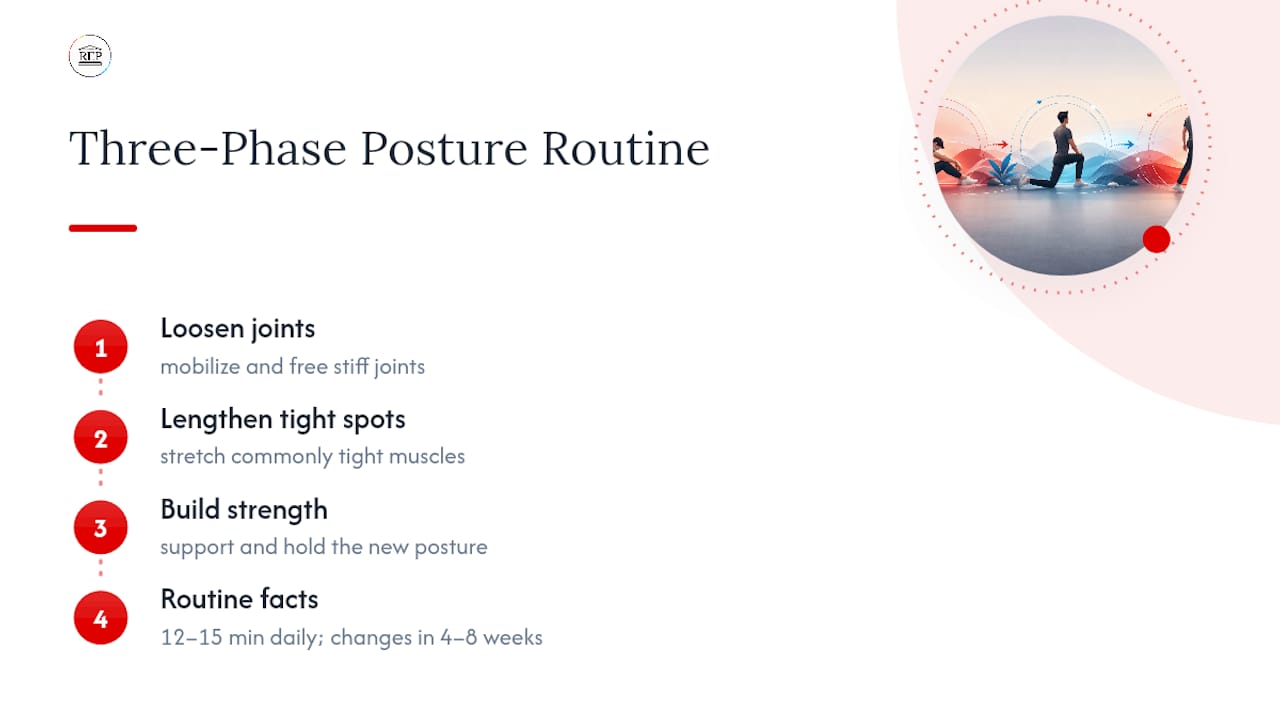
Phase 1: Mobilize (3 to 4 minutes)
Start here, not with static stretching. Dynamic movement that actively engages your spinal stabilizers re-educates posture more effectively than static stretching alone, which is why this routine leads with motion instead of holds.
- Cat cow: 90 seconds of continuous flow, restoring range of motion through the whole spine.
- Thoracic rotation: 2 sets of 8 reps each side, unlocking the upper back segment that gets stiffest from sitting.
Phase 2: Stretch (4 to 5 minutes)
Once the joints are moving, target the tissue that's actually shortened from hours in a chair.
- Chest opener: 2 sets, holding 20 to 30 seconds each, to reverse the internal shoulder rotation that comes from typing all day.
- Hip flexor lunge: 45 seconds per side, releasing the hip tightness that tilts your pelvis forward and flattens your lower back curve.
- Neck side stretch: 20 to 30 seconds per side, easing the tension that builds from tilting your head at a screen.
Phase 3: Strengthen (5 to 6 minutes)
This is the phase most desk routines skip, and it's the one that actually keeps the correction from unraveling by 2 p.m. Strength deficits in the core and glutes undermine posture over the long term, no matter how much you stretch.
- Glute bridge: 3 sets of 12 reps, rebuilding the hip strength that supports your lower back.
- Wall angels: 2 sets of 10 reps, training your shoulder blades to hold the retracted position instead of drifting forward.
- Dead bug: 2 sets of 8 reps per side, building core control so your spine has support when you're not thinking about it.
Run the full routine once a day, ideally as a morning anchor or as a midday reset when your back feels stiff. On busy days, split it into smaller sessions rather than skipping it. If you want to build this into a broader weekly plan, Repphilosophy's lunchtime workout structure shows how to extend short daily sessions into a progressive month.
What Ergonomic Setup Supports These Exercises?
Exercises fight the damage of a bad setup, but they can't out-work it. Fix the chair and screen first, and your posture work goes a lot further.
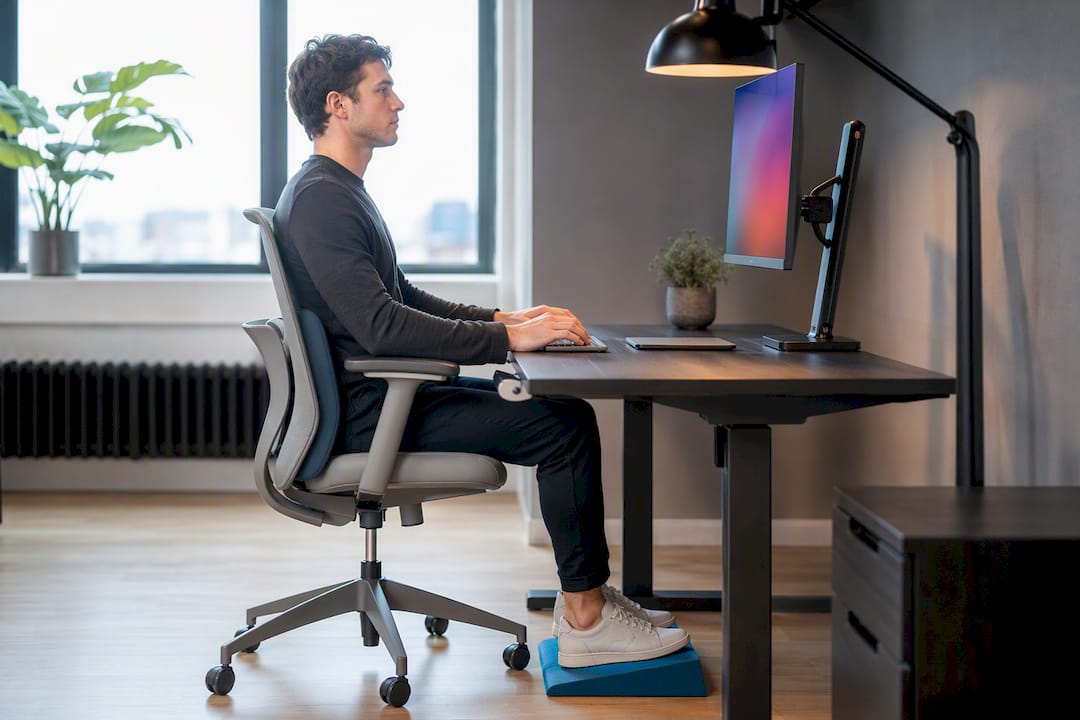
- Monitor: position the top portion at approximately eye level or slightly below, at a comfortable viewing distance.
- Keyboard and elbows: elbows bent at an angle generally recommended between 90 and 120 degrees with wrists in a neutral position; mouse within easy reach.
- Seat and feet: feet flat on the floor or supported by a footrest, thighs roughly parallel to the ground, with lumbar support filling the lower back curve.
- Laptop users: use an external keyboard and mouse, and elevate the laptop screen to avoid neck strain.
- Behavioral rule: shifting your posture every 30 to 60 minutes is more beneficial than maintaining a single position for long periods.
Pro Tip: Set a recurring phone alarm labeled "next posture" instead of "stretch break." It reminds you the goal is variety, not perfection.
OSHA's ergonomic guidance backs these exact numbers for elbow angle and monitor position, and MedlinePlus echoes the same principles for feet support and lumbar positioning. Getting these details right can cut the strain your exercises need to correct in the first place.
How Coach Justin Builds This Into a Real Habit
Knowing the moves is the easy part. Making them happen every day at your desk is where most people fall off, so pair each break with something you already do without thinking. Coffee refill, top of the hour, the moment a meeting ends. That's your cue.
- Progress the glute bridge: start with standard bridges for two weeks, move to single-leg bridges once those feel easy, then add a light dumbbell across your hips once single-leg reps are smooth and pain-free.
- Scale down when needed: if floor-based moves aren't realistic at your desk, do chair-supported versions of the same pattern. A seated glute squeeze still activates the muscle even without the floor.
- Know when to stop: sharp, radiating pain or numbness down an arm or leg is not a "push through it" signal. Stop the exercise and get assessed before continuing.
For readers ready to build real strength around these patterns, Repphilosophy's strength training guide for desk workers breaks down progressions that go beyond the desk routine.
Why Most Posture Advice Misses the Point
Most posture content treats stretching like the whole solution, and that's where it falls short. Stretching loosens what's tight, but it does nothing to fix what's weak. If your glutes and core can't hold a position, your body will drift back into the slouch within an hour of finishing your stretches, no matter how good they felt.
The other blind spot is frequency. People treat posture fixes like a one-time appointment: do the exercises once, feel better, move on. Your spine doesn't work that way. A 15-minute daily routine paired with movement every 30 to 60 minutes beats a single "perfect" 45-minute session once a week, every time.
If you take one thing from this article, make it the strength piece. Glute bridges, wall angels, and dead bugs aren't the flashy part of a posture routine, but they're the part that decides whether your progress lasts past Tuesday. Mobility opens the door. Strength keeps it open.
— Coach Justin
Get Personalized Posture Coaching That Fits Your Desk Job
Generic stretch routines help, but they can't assess your specific imbalances the way a trained eye can. Repphilosophy builds programming around what your body actually needs, not a one-size list pulled off the internet. Whether that means in-person sessions, a small-group buddy membership that splits the cost with a coworker, or a virtual option you can do from your own desk, the plan gets built around your posture, your schedule, and your pain points.

In-person coaching lets a trainer watch your movement and correct form in real time, something no article can do. The on-demand exercise library gives you guided versions of moves like the ones above, with progressions built in as you improve. Ready to stop guessing at reps and holds? Book a personal training session and get a plan that matches your desk, your schedule, and your body.
Sources
- eTools : Computer Workstations - Positions | Occupational Safety and Health Administration
- Guide to good posture — MedlinePlus
- 9 Posture Exercises for Desk Workers (Fix Slouching) — BackedApp
FAQ
How do I fix posture at an office job?
Combine hourly micro-breaks (chin tucks, shoulder blade squeezes, chest openers) with a daily 12 to 15 minute routine that mobilizes, stretches, and strengthens your glutes and core. Fix your ergonomic setup at the same time so you're not undoing the work every time you sit back down.
What are some good posture exercises to do at my desk?
Chin tucks, shoulder blade squeezes, seated cat cow, chest openers, seated spinal twists, and glute squeezes cover the most common desk-related imbalances. All six can be done seated, in under a minute each, without leaving your chair.
How often should I take posture breaks during the workday?
Move every 30 to 60 minutes, holding stretches for 10 to 30 seconds each time. Clinicians generally recommend standing or moving at least once an hour to prevent stiffness from setting in.
How did Taylor Swift fix her posture?
There's no verified, publicly documented posture routine tied to Taylor Swift specifically. What does work for anyone dealing with slouched, screen-driven posture is the same combination covered here: regular movement breaks, targeted mobility and stretching, and glute and core strengthening to hold the correction in place.
Why do stretches alone not fix my posture long term?
Stretching lengthens tight muscles, but weak glutes and core muscles can't hold your spine in the corrected position afterward. Strengthening those areas alongside stretching is what makes the improvement last past the first hour.