
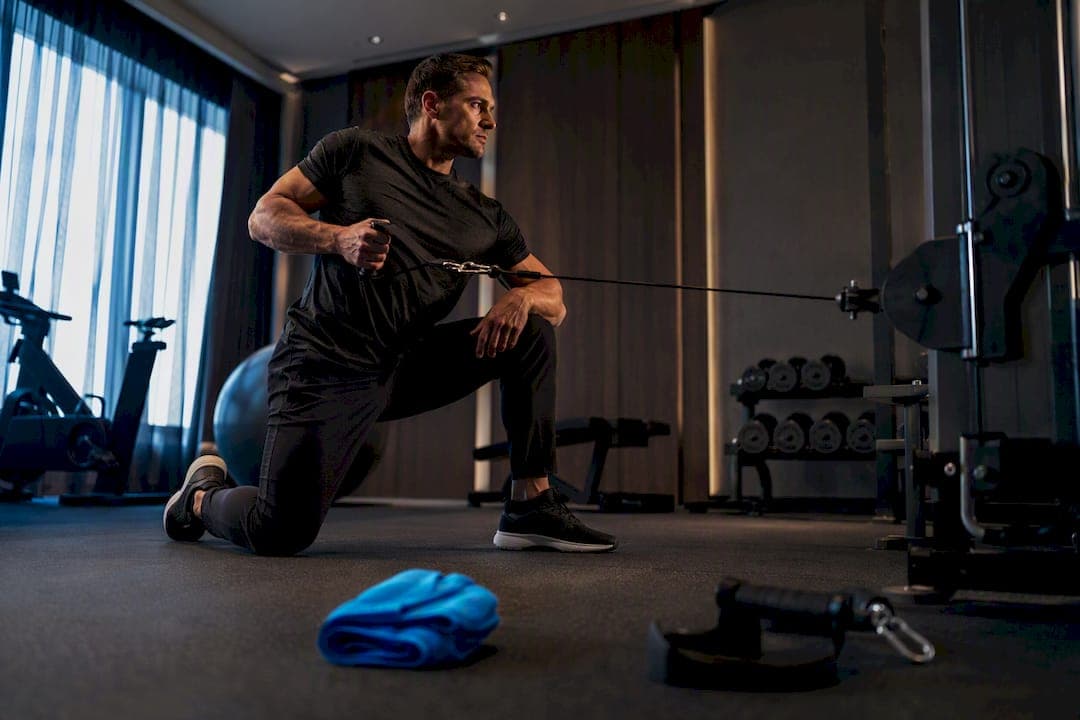
Full-body strength sessions done in focused short blocks multiple times a week represent the minimum effective dose for busy executives. Pick one format, calendar-block it like a board meeting, and start this week. You'll notice sharper focus within hours of a session and measurable strength gains in 4 to 12 weeks.
TL;DR:
- Short, focused strength sessions done two to three times weekly can improve executive function and sharpen focus within 40 minutes of exercise.
- Consistent resistance training supports long-term brain health, preserves muscle mass, and enhances metabolic health into midlife.
- The most effective routines are quick (16 or 30 minutes), use compound movements, and can be adapted for travel with minimal equipment.
- Prioritizing strength training as a fixed calendar habit boosts mental clarity during critical decision-making moments.
- Tracking progress and scheduling workouts like meetings increases adherence, with virtual coaching available for flexible, tailored programs.
Table of Contents
- Why Executive Strength Training Improves Cognition and Resilience
- Three Time-Efficient Program Templates for Busy Schedules
- Sample Weekly Plans and Exercise Choices That Fit Any Schedule
- How to Adapt Executive Workout Routines While Traveling
- Recovery, Mobility, and Nutrition That Protect Your Gains
- Building Leadership Fitness Training Into a Non-Negotiable Calendar Habit
- Meet Coach Justin and What Repphilosophy Offers Executives
- What the Research Actually Tells Leaders to Prioritize
- Ready to Put a Real Plan on Your Calendar This Week?
- Sources
Why Executive Strength Training Improves Cognition and Resilience
The case for executive strength training isn't a wellness trend. It's a performance lever with a research trail. A randomized controlled trial tracking adults over 12 months found that those who strength trained once or twice weekly showed measurable improvements in executive function, the same mental capacity you rely on for prioritizing decisions, filtering distractions, and switching between problems under pressure.
The effect isn't just long-term. One study found a single moderate-intensity strength session boosted inhibitory control for roughly 40 minutes afterward. That's a real window of sharper focus you can schedule right before a hard conversation or a strategic planning block. Public health researchers back this up more broadly: physical activity, including resistance training, supports brain health and cognitive performance across the board, not just in athletes.
Muscle also behaves like an organ, not just tissue you flex in the mirror. Stanford Medicine researchers describe resistance training as a biological requirement for adults in their 40s and 50s to preserve metabolic health and long-term function, not an optional upgrade.
Strength training benefits for professionals stack up fast:
- Sharper focus and inhibitory control within 40 minutes of a session
- Better long-term executive function with consistent weekly training
- Preserved muscle mass and metabolic health into midlife and beyond
- Lower perceived stress, according to exercise-and-stress research from the American Psychological Association
Statistic to remember: A single session's focus boost lasts about 40 minutes, long enough to cover the exact stretch of your calendar where clear thinking matters most.
Three Time-Efficient Program Templates for Busy Schedules
You don't need ninety minutes and a personal chef to get strong. You need one of these three formats, chosen honestly based on your week, not your fantasy version of it.
- The 16-minute morning block. Five minutes of dynamic warm-up (leg swings, arm circles, bodyweight squats), then two compound exercise pairs performed back to back with minimal rest, such as goblet squats paired with push-ups, and a hinge movement paired with a row. Moderate load, controlled tempo, done before your first email.
- The 30-minute full-body session. Five-minute warm-up, one primary compound lift (barbell squat, deadlift, or bench press), one secondary compound movement (dumbbell row or overhead press), and a short accessory or core finisher. This is the format that builds the most raw strength per minute invested.
- The 3x-per-week progression cycle. Three sessions weekly, roughly three hours total, cycling through push, pull, and lower-body emphasis. Practitioner blueprints built around this structure show that busy professionals can build real strength using nothing more exotic than compound lifts and consistent loading.
How to progress inside any of these:
- Add 5 to 10 pounds to a lift once you complete all prescribed reps with clean form two sessions in a row.
- Add one or two reps per set before you add weight if you're working with limited equipment.
- Take a lighter deload week every 4 to 6 weeks, cutting volume by roughly a third to let your joints and nervous system catch up.
Pick the format that matches your actual week, not your ideal one. The 16-minute block on a chaotic Tuesday beats a skipped 30-minute session every time.
Sample Weekly Plans and Exercise Choices That Fit Any Schedule
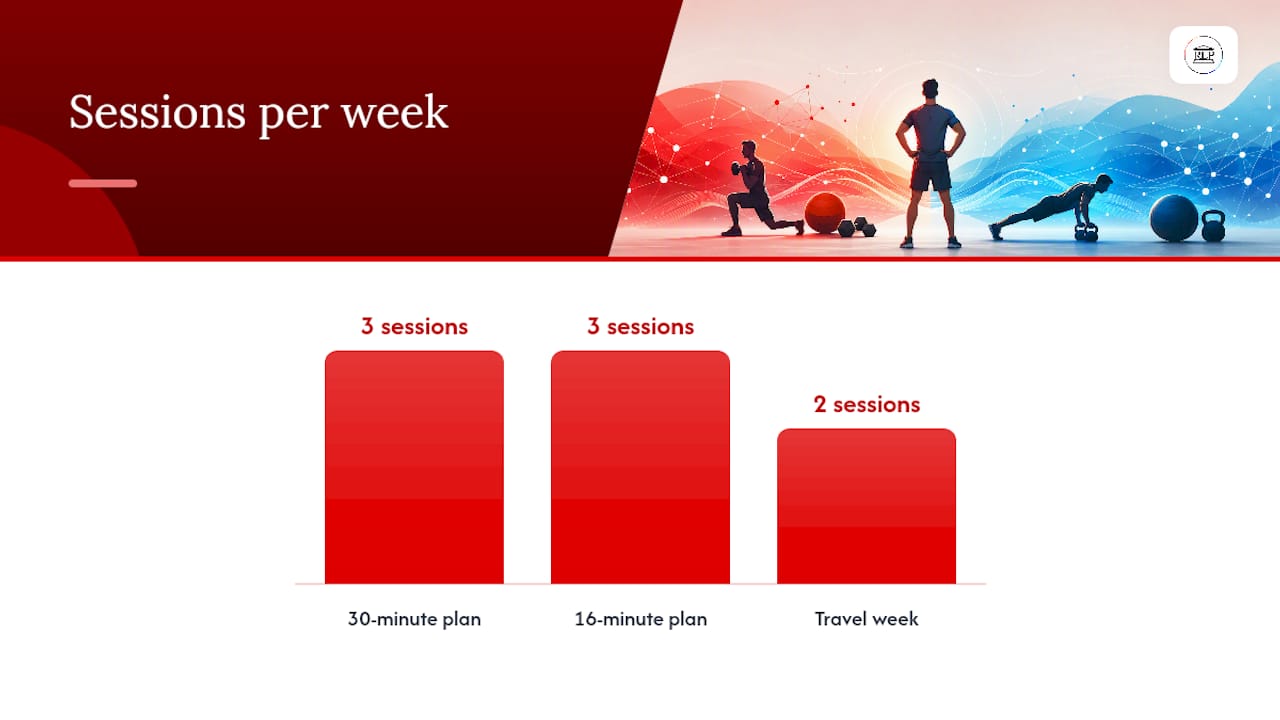
A 30-minute plan for a standard week looks like this: Monday, Wednesday, and Friday full-body sessions, with Tuesday, Thursday, and the weekend left open for walking, mobility, or complete rest. A 16-minute plan runs the same three days but compresses the work into two exercise pairs, ideal for weeks stacked with early flights or back-to-back calls.
For a travel week, cut to two sessions and lean entirely on bodyweight and bands. The goal isn't maximum output. It's not losing the thread on the habit.
Your exercise menu should stay simple across every format:
- Squat pattern: goblet squat or barbell squat; hotel substitution is a bodyweight squat or suitcase-loaded squat.
- Hinge pattern: dumbbell or barbell deadlift; hotel substitution is a single-leg Romanian deadlift using a duffel bag.
- Press: dumbbell or barbell bench press; hotel substitution is a push-up variation.
- Row: dumbbell or cable row; hotel substitution is a resistance band row anchored to a door.
- Carry: farmer's carry with dumbbells or kettlebells; hotel substitution is a loaded suitcase carry down the hallway.
- Core: planks, dead bugs, or loaded carries doubling as core work.
Our complete guide to strength training breaks these movement patterns down further if you want more exercise variety within each category.
Pro Tip: Track load and reps in your phone's notes app right after each session. Thirty seconds of logging now saves you from guessing your progression six weeks from now.
How to Adapt Executive Workout Routines While Traveling
Travel is where most strength programs quietly die. It doesn't have to be where yours does.
- Hotel-room circuit one (bands and bodyweight): banded rows, push-ups, banded squats, and glute bridges, three rounds, minimal rest. Twelve minutes, done.
- Hotel-room circuit two (loaded): suitcase deadlifts, suitcase carries down the hallway, step-ups onto a sturdy chair, and planks. Fifteen minutes.
- Airport or terminal routine: bodyweight squats, wall push-ups, calf raises, and standing marches, cycled for ten minutes near your gate or during a layover.
If your hotel has even a basic gym, prioritize the barbell or dumbbells over machines. Free weights recruit more stabilizing muscle in less time. Schedule training before a conference day starts, not after; post-conference willpower is a myth for most people. On red-eye travel days, skip the session entirely rather than forcing a workout on zero sleep. Consistency over a month matters more than any single missed day.
Recovery, Mobility, and Nutrition That Protect Your Gains
Strength training only works if recovery keeps pace with it, and for executives running on five hours of sleep and airport coffee, recovery is usually the actual bottleneck, not the training itself. Aim for at least 7 hours of sleep on training nights. Include protein at every meal, roughly 30 to 40 grams, to support muscle repair without needing to obsess over exact macros.
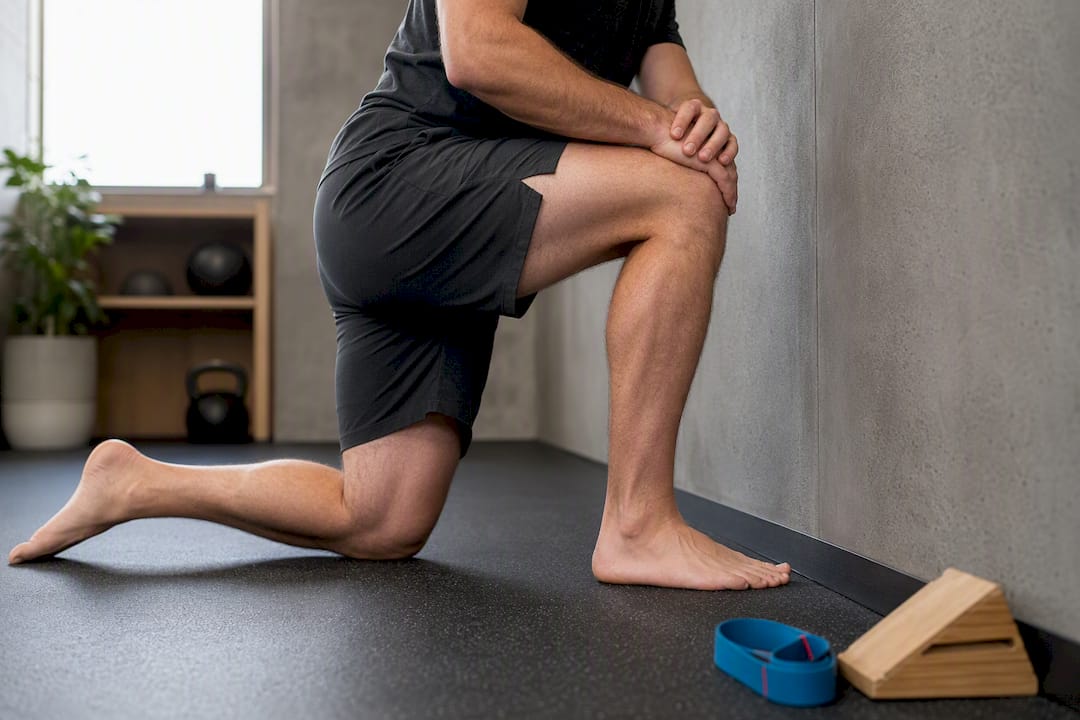
Ten minutes of daily mobility work, focused on thoracic spine rotation, hip openers, and ankle dorsiflexion drills, keeps your joints functional for the compound lifts that do the heavy lifting in your program. Our full-body training guide covers specific mobility drills that pair well with any of the templates above.
A useful recovery reminder: overtraining among busy professionals is rare. Under-recovering is far more common, especially when sessions get squeezed between back-to-back meetings with no buffer for sleep or nutrition. If you notice flat performance, rising irritability, or nagging joint pain across a week, scale back volume before you scale back sessions entirely. A short breathing routine after training, five slow diaphragmatic breaths, or a 10-minute contrast shower can speed the shift out of a stress response faster than sitting at your desk scrolling.
Building Leadership Fitness Training Into a Non-Negotiable Calendar Habit
The gap between executives who stay consistent and those who don't rarely comes down to motivation. It comes down to calendar discipline.
- Block sessions like meetings. Put them on the calendar with a title, a location, and a "do not double-book" note, exactly how you'd protect time with your CFO.
- Default to mornings. A morning-first rule beats an "I'll fit it in later" rule almost every time once the workday starts filling in.
- Build in a backup slot. One missed session gets moved to a pre-scheduled backup window that same week instead of quietly disappearing.
Accountability matters more at the top than anywhere else, since no one is checking your calendar for you. A coach check-in, even a brief weekly text exchange, keeps the habit visible.
Three metrics worth tracking: session completion rate, load progression on your main lifts, and a simple 1 to 10 self-rating of daily focus.
Pro Tip: Rate your focus level each morning in the same note where you log your workouts. After a month, you'll see the pattern connecting training days to your sharpest thinking.
Meet Coach Justin and What Repphilosophy Offers Executives
Strength training for professionals seeking efficient results includes options such as in-person coaching, small group and buddy training memberships, and virtual personal training with a full video exercise library suitable for executives who travel or work remotely.
Coach Justin leads programming with a direct focus on efficient, evidence-informed strength work for clients balancing demanding careers with real physical goals. Every plan gets adjusted to the client's schedule, equipment access, and current strength level rather than handed over as a generic template. For executives who want a structured starting point, a custom 6-week written program applies the templates above to your specific week, your specific travel calendar, and your specific lifts.
What the Research Actually Tells Leaders to Prioritize
Most fitness advice for executives still leans on the ninety-minute gym session, and that's exactly why so many leaders quit within a month. The research doesn't support that model as necessary. It supports something smaller and far more sustainable: two or three focused sessions, sometimes as short as sixteen minutes, done consistently enough to compound.
What gets overlooked is the immediate cognitive payoff. Executives chase long-term health outcomes and ignore the fact that a single session sharpens focus for the next 40 minutes, a window that could cover your toughest call of the day. That's the part worth prioritizing first, not the six-pack, not the marathon time. Train because it makes your 9 a.m. decision-making better, and the metabolic and longevity benefits will follow as a byproduct of consistency rather than the goal itself.
The conventional advice tells executives to "find balance." I'd argue the better instruction is to treat two or three short sessions as fixed infrastructure, the same category as sleep or a board meeting, not something you find time for when the week cooperates.
— Coach Justin
Ready to Put a Real Plan on Your Calendar This Week?
Repphilosophy is the practical alternative to guessing your way through a workout app or hiring a generic trainer who doesn't understand executive schedules. If you're time-poor and need structure fast, in-person or small group training sessions offer coached, accountable workouts without the planning overhead. If you're travel-heavy, the on-demand video exercise library provides hotel-room and airport-ready workouts you can start the moment you land.
Both paths start with the same first step: book a session and let a coach build the plan around your week instead of the other way around. Book your personal training session and get your first 16-minute or 30-minute block scheduled before your next Monday starts.
Sources
- Resistance training and executive function (PubMed entry)
- Boost brain health (CDC)
- Post-exercise inhibitory control improvements (Frontiers in Human Neuroscience DOI)
- Healthy habits for longevity in your 40s and 50s (Stanford Medicine)