
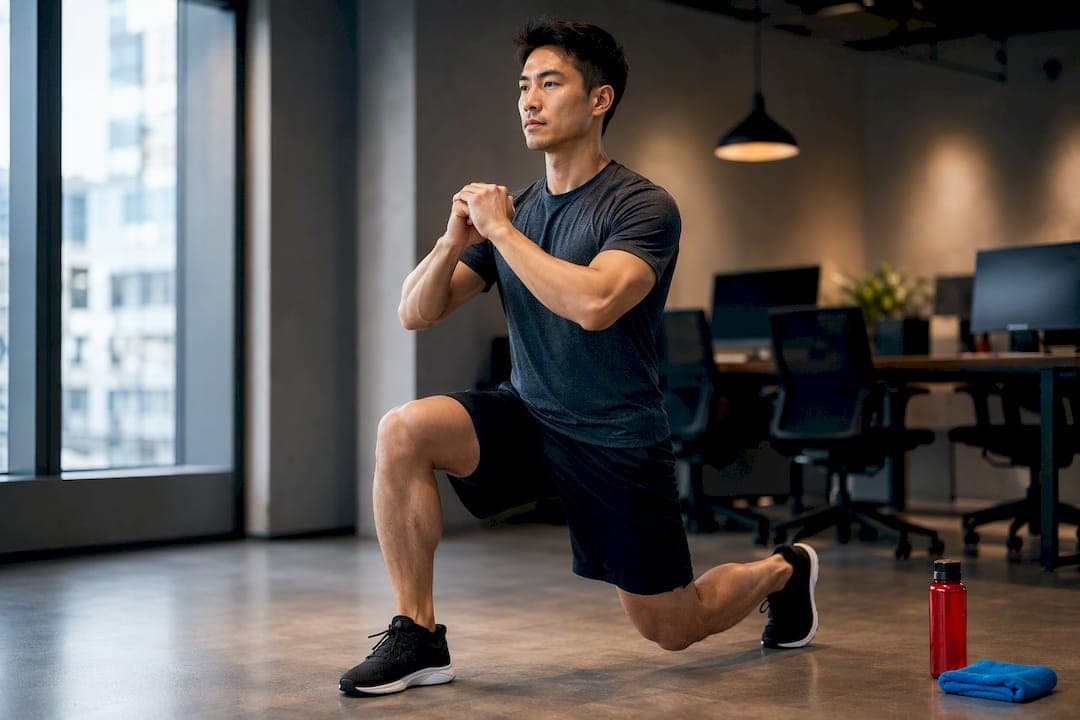
Do a 10 to 15 minute compound-movement circuit, three rounds of four to six exercises, to get a real muscle and metabolic stimulus during your lunch break. Expect a genuine strength challenge, a notable calorie burn, and a sharper afternoon focus. If you can carve out 25 to 30 minutes, you'll get even more from it, but the shorter version still counts, and it won't leave you sweaty or scrambling to change clothes before your next meeting.
TL;DR:
- Short workouts like the 10-minute compound circuit provide a full-body, strength-building, and calorie-burning session using only a few exercises, with three rounds of five moves.
- Incorporating slower, low-sweat routines or gym-based circuits can fit within 15 to 30 minutes, offering options based on energy levels and available equipment.
- Proper planning around your lunch window, including buffer time and suitable exercise locations, is essential to avoid rushing or delaying your afternoon commitments.
- Compound movements such as squats and push-ups maximize workout efficiency, delivering multiple muscle groups and high metabolic cost in minimal time.
- Progression requires adding rounds, reducing rest, or increasing exercise difficulty gradually, with two to four sessions per week being effective without risking overtraining.
Table of Contents
- Three Ready-to-Run Lunchtime Workouts You Can Start Today
- How to Structure Your Lunch Window Without Losing Your Lunch Hour
- Why Compound Movements Win When Time Is Short
- Warm-Up, Cool-Down, and Staying Presentable for the Afternoon
- Scheduling, Frequency, and Progression Without Adding More Time
- Coach Justin's 4-Week Lunchtime Progression Plan
- What Most Advice on Lunchtime Workouts Gets Wrong
- Ready to Take Your Lunchtime Training Further?
- Sources
Three Ready-to-Run Lunchtime Workouts You Can Start Today
You don't need a gym bag full of gear or an hour to spare. What you need is a plan that matches the time you actually have, not the time you wish you had. Here are three complete routines, scaled by duration, that you can run today.
The 10-minute compound circuit
This is your minimal effective dose. It's built around five compound exercises that hit multiple muscle groups at once, so you're not wasting a single second on isolation work when the clock is ticking.
- Warm-up (1 minute): March in place, arm circles, and bodyweight squats to get blood moving.
- Round 1 (2 minutes 30 seconds): Squats, push-ups, walking lunges, plank, and mountain climbers. Each move for 30 seconds, with 20 seconds rest between exercises.
- Round 2 (repeat the same sequence).
- Round 3 (repeat the same sequence).
- Cool-down (30 seconds to 1 minute): Standing forward fold and shoulder stretch.
This 30 seconds on, 20 seconds off structure comes straight from a beginner's bodyweight muscle workout published by Men's Health, and it's popular for a reason: it's brutally efficient. Three rounds through those five moves gives you roughly 12 total work sets in under 10 minutes, and because every exercise is a compound movement, you're training your legs, chest, back, and core simultaneously instead of picking them apart one muscle at a time.
Pro Tip: If you're short on space, drop the walking lunges for stationary reverse lunges. You get the same leg and glute work without needing six feet of clear floor.
The 15-minute low-sweat office routine
Some days call for zero perspiration, especially if you're headed straight into a client call after lunch. This routine trades speed for control, using slower tempos and isometric holds instead of explosive movement.
- Warm-up (2 minutes): Slow arm swings, hip circles, and a few bodyweight squats at half speed.
- Work block (10 to 11 minutes): Wall sits (45 seconds), incline push-ups against a desk or sturdy table (10 to 12 slow reps), standing glute bridges (12 reps per side), seated or standing rows using a resistance band anchored to a door (12 reps), and a forearm plank hold (30 to 45 seconds). Run through this sequence twice, resting 30 to 45 seconds between exercises.
- Cool-down (2 minutes): Standing quad stretch, chest opener, and slow deep breathing.
Low-sweat routines built around slow tempo and no-jump movement patterns, like the office-friendly lunch break workout outlined by OffShift, work because time under tension replaces speed as the intensity driver. You're not gasping for air, but your muscles still know they did something.
The 25 to 30-minute gym or dumbbell circuit
If your building has a gym, or you keep a pair of dumbbells at your desk, this is where you get real strength and conditioning stimulus in a single sitting.
- Warm-up (3 minutes): Bodyweight squats, arm circles, and a light row or bike to raise your heart rate.
- Circuit, 4 rounds (20 minutes): Goblet squats (10 reps), dumbbell rows (10 reps per side), push-ups or bench press (10 reps), reverse lunges (10 reps per leg), and plank shoulder taps (20 total). Rest 60 to 90 seconds between rounds.
- Finisher (2 to 3 minutes): 10-minute HIIT-style intervals, like the templates recommended by Kaiser Permanente, work well here if you want a metabolic kicker before you cool down.
- Cool-down (2 minutes): Static stretches for hamstrings, hips, and shoulders.
If jumping or heavier loads aren't right for your fitness level, swap plank shoulder taps for a standard plank hold, and reduce dumbbell weight before reducing reps. You'll keep the movement pattern intact while lowering the joint stress.
How to Structure Your Lunch Window Without Losing Your Lunch Hour
A one-hour lunch break sounds generous until you subtract commute time to a gym, changing, the workout itself, and getting cleaned up before your 1 p.m. call. The math only works if you plan the whole window, not just the exercise portion.
A realistic breakdown for a 30 to 45 minute lunchtime workout plan looks like this: 2 minutes to transition and change, 2 to 3 minutes of warm-up, 10 to 20 minutes of actual work, and 3 to 4 minutes for cool-down and cleanup. Building in that buffer is what keeps you from walking into your afternoon meeting flustered and 10 minutes late.
Where you exercise matters just as much as when. Consider these options:
- An empty meeting room booked as a recurring calendar block, so nobody accidentally takes it.
- A stairwell for step-ups, calf raises, or simple interval sprints between floors.
- An outdoor bench or grassy patch for bodyweight circuits when the weather cooperates.
- Your own desk, using it for incline push-ups, tricep dips, or seated leg extensions if leaving your floor isn't realistic.
Pack a small gym bag the night before: a sweat towel, deodorant, a change of shirt if you're doing higher-intensity work, and a reusable water bottle. Set a hard start time on your calendar, treat it the same way you'd treat a client meeting, and block the room or space in advance so you're not searching for options once your break has already started.
Pro Tip: Put a "Do Not Disturb, back at 12:45" sticky note on your monitor. It sounds simple, but it stops well-meaning coworkers from derailing your 10 minutes with a "quick question."
Why Compound Movements Win When Time Is Short
Every minute of a lunchtime fitness plan needs to earn its place, and compound movements simply deliver more per minute than isolation exercises. A squat recruits your quads, glutes, hamstrings, and core all at once. A push-up hits your chest, shoulders, triceps, and core simultaneously. Compare that to a bicep curl, which trains one small muscle group and nothing else, and the choice becomes obvious.
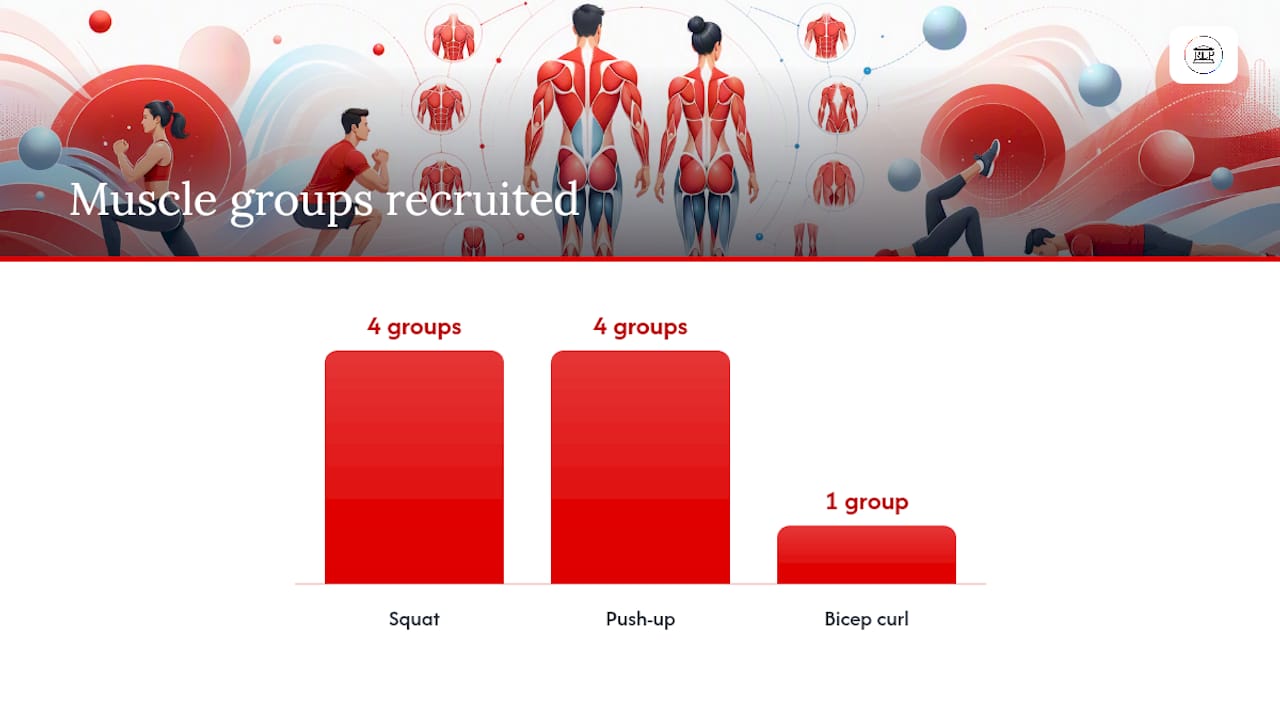
Squats, lunges, push-ups, rows, and planks form the backbone of nearly every effective short session because they combine multi-joint muscle engagement with a genuine metabolic cost. You're not just building strength, you're raising your heart rate enough to burn calories during and after the workout.
Structuring your work-to-rest ratio depends on your goals and your fitness level:
- 30/20 (30 seconds work, 20 seconds rest): A solid starting point for most people, balancing intensity with recovery.
- 40/20: For those with a base level of conditioning who want to push volume higher.
- Tabata-style 20/10: Short, brutal, and best reserved for advanced exercisers who can maintain form under fatigue.
A simple intensity check is the talk test: during your work interval, you should only be able to speak in short, broken sentences. If you can carry on a full conversation, you're not working hard enough. If you can't speak at all, dial it back before your form breaks down. This cue comes directly from trainer guidance in the same Men's Health bodyweight circuit that anchors the 10-minute routine above.
When equipment or space runs short, these substitutions keep the same movement patterns intact:
- Swap dumbbell rows for resistance band rows anchored to a door handle.
- Replace bench push-ups with incline push-ups against a desk if the floor isn't an option.
- Use a sturdy chair for tricep dips or elevated step-ups instead of a gym bench.
Form matters more, not less, when your sessions are compressed. Keep your knees tracking over your toes during squats and lunges, keep your core braced during planks and push-ups, and never sacrifice range of motion just to hit a rep count faster. A rushed rep with poor form does less for you than a slower, controlled one.
Warm-Up, Cool-Down, and Staying Presentable for the Afternoon
Skipping the warm-up to save 90 seconds is a bad trade. Cold muscles are more prone to strain, and a short dynamic warm-up primes your joints and raises your core temperature just enough to make the work portion more effective.
- Minute 1: March in place while swinging your arms front to back.
- Minute 2: Bodyweight squats and hip circles to loosen your hips and low back.
- Minute 3 (optional, for higher-intensity days): A few light jumping jacks or high knees to elevate heart rate before jumping into work sets.
For a slightly longer sequence tailored to lifting sessions, the 4-minute dynamic warm-up from Heala is a solid option that skips static stretching in favor of movement-based prep, which better matches what your muscles are about to do.
Your cool-down deserves the same two to three minutes. Slow your breathing, walk it out for 30 seconds, then move into static stretches for your hamstrings, hips, chest, and shoulders. This is what keeps you from feeling stiff and sluggish through your 2 p.m. slump.
If sweat management is a concern, lean toward slower tempo movements and isometric holds like wall sits and planks instead of jumping or sprinting intervals. Lowering the explosiveness of a movement while increasing the time you hold it under tension preserves the strength stimulus while keeping your heart rate in a more moderate zone.
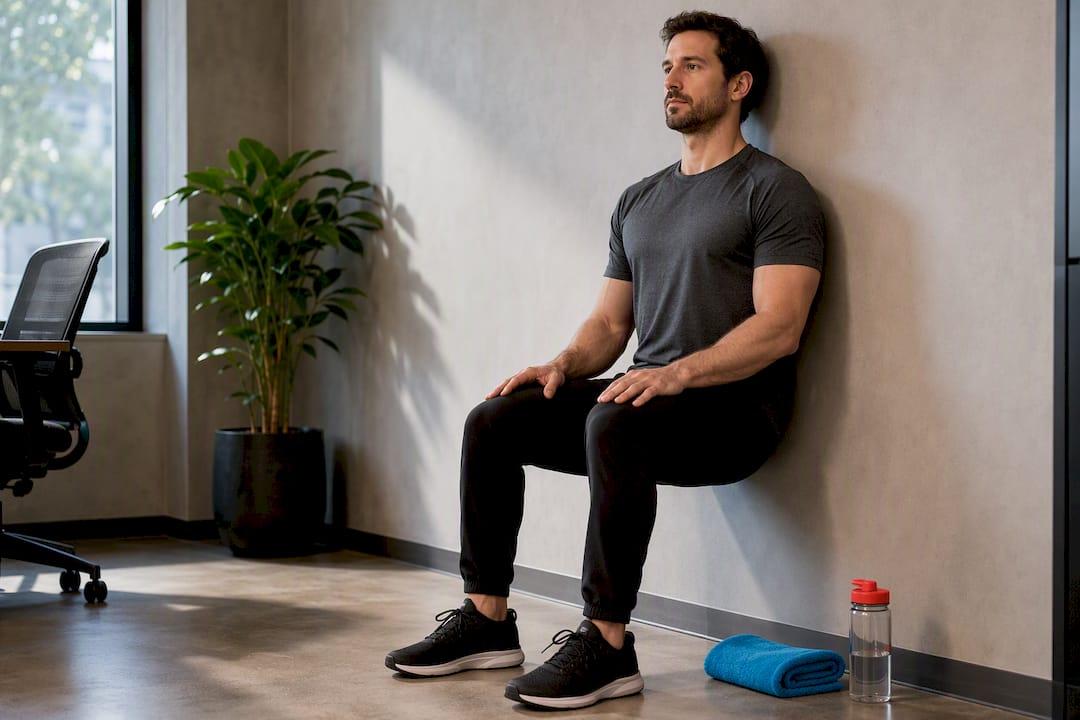
Pro Tip: *Keep a small hygiene kit at your desk: face wipes, a travel deodorant, and a spare shirt.
Choose a shower-required workout, like the full 25 to 30 minute gym circuit, on days when your afternoon schedule has some breathing room. Save the low-sweat 15-minute version for days packed with back-to-back meetings.
Scheduling, Frequency, and Progression Without Adding More Time
Two to four lunchtime sessions per week is a realistic and effective frequency for most desk workers. That adds up to 20 to 60 minutes of structured exercise weekly, on top of whatever else you're doing, and it stacks meaningfully toward broader activity guidelines. Major health organizations increasingly support accumulating your weekly activity in shorter bouts rather than requiring one continuous 30-minute block, according to Mayo Clinic's guidance on aerobic exercise.
Progressing without adding time is simpler than it sounds. Try these levers, one at a time:
- Add a fourth round to your circuit once three rounds start feeling manageable.
- Shave 5 seconds off your rest intervals every one to two weeks.
- Increase load, whether that's a heavier dumbbell or a more difficult exercise variation, like moving from incline push-ups to full push-ups.
- Repeat your circuit an extra time through, since repeating short circuits multiple times is a practical way to increase the total workout volume without needing more equipment or space.
If you're already hitting the gym one or two times a week outside of work, your lunchtime sessions complement that volume rather than compete with it, especially if you use lunch for the moderate-intensity, compound-focused work and save heavier lifting for your dedicated gym days. Watch for warning signs that you need to pull back: persistent soreness that doesn't fade within 48 hours, declining performance across sessions, or a lingering feeling of fatigue that outlasts your workday. When those show up, take a lighter recovery week instead of pushing through.
Coach Justin's 4-Week Lunchtime Progression Plan
Building consistency matters more than intensity in week one. Here's a four-week progression designed specifically for desk workers easing into a regular lunchtime fitness plan.
- Week 1: Two sessions per week, 10-minute circuit, three rounds, 30 seconds work and 20 seconds rest. Focus purely on form.
- Week 2: Three sessions per week, same circuit, but reduce rest to 15 seconds between exercises.
- Week 3: Three to four sessions per week, add a fourth round, and introduce one new compound movement (like goblet squats if you're ready for added load).
- Week 4: Four sessions per week, increase work intervals to 40 seconds, and consider stepping up to the 25 to 30-minute gym circuit on one of those days.
| Week | Sessions | Circuit Length | Key Change |
|---|---|---|---|
| 1 | 2/week | 10 min, 3 rounds | Focus on form |
| 2 | 3/week | 10 min, 3 rounds | Reduce rest to 15 sec |
| 3 | 3 to 4/week | 10 min, 4 rounds | Add new movement |
| 4 | 4/week | 10 min or 25 to 30 min | Increase work intervals |
This progression is the kind of framework Coach Justin builds into REP Philosophy Coaching's programming, adapting rep schemes and rest periods based on how a client's body responds week to week. If you want visual demonstrations of proper form for any of these movements, the on-demand exercise library walks through each one in detail. Always adjust volume and intensity to your own fitness level, and check with a healthcare provider before starting a new exercise routine if you have any underlying medical conditions.
What Most Advice on Lunchtime Workouts Gets Wrong
Most advice on this topic treats 30 minutes as the bare minimum worth doing, and that's backwards. The research on intermittent activity makes clear that 10 minutes of honest effort, done consistently, beats an occasional 45-minute session that only happens when your calendar magically clears. Consistency wins over duration almost every time.
The bigger blind spot is logistics. Plenty of workout plans assume you have a locker room, a full hour, and zero afternoon meetings. Real desk workers don't have that luxury, which is why the low-sweat, no-jump options matter as much as the high-intensity ones. A workout you'll actually repeat three times a week beats a harder one you'll quit after four days because it wrecked your hair and your schedule.
If you take one thing from this, prioritize the buffer time around your workout, not just the workout itself. A 10-minute circuit that makes you late and frazzled defeats its own purpose. Nail the logistics first, then let intensity build from there.
— Coach Justin
Ready to Take Your Lunchtime Training Further?
A self-guided circuit gets you started, but Repphilosophy offers coaching options to help busy professionals achieve fitness results efficiently, without requiring a full hour or leaving form and progression to guesswork. Whether you want hands-on coaching, a lower-cost bring-a-buddy membership, or virtual training you can do on your own schedule, there's a format that fits how your week actually runs.

If you're already comfortable with the movements in this plan and want someone adjusting your load, tempo, and progression in real time, high-intensity 30-minute personal training sessions build directly on what you just learned, minus the guesswork. Prefer to train on your own terms and location? The on-demand exercise library gives you guided video demonstrations for every movement in this plan, so form questions never slow you down. And if you're ready to commit to a structured program, you can book your first session today and start building a plan around your actual schedule, not an idealized one.
Sources
A handful of sources back the recommendations in this plan, and each one adds something specific worth knowing.
- Beginner's muscle bodyweight workout — Men's Health
- 7-minute workout — Cleveland Clinic
- 10-minute HIIT workouts — Kaiser Permanente