

Pain-free goals are realistic, function-first targets that help you make meaningful progress without requiring complete pain elimination. The standard clinical term for this approach is "functional goal-setting," and it sits at the heart of modern pain management. Rather than chasing a zero-pain outcome that may never arrive, you build toward milestones like walking 15 minutes without stopping or sleeping six hours straight. These stress-free objectives keep motivation alive, protect your mental health, and give you a clear path forward whether you are recovering from injury or managing a chronic condition.
What are pain-free goals and how do they differ from traditional goal-setting?
Pain-free goals prioritize function over the complete absence of discomfort. Traditional goal-setting often demands zero pain as the finish line, which sets most people up for failure and despair. A person recovering from a knee injury who aims to "feel no pain" will likely quit within weeks. A person who aims to "climb one flight of stairs without stopping" will likely succeed and build from there.
Nursing care standards as of june 2026 now recommend functional pain benchmarks such as pain at or below 3 out of 10 during activity, rather than total pain elimination. That shift reflects a broader clinical consensus: manageable discomfort during movement is not failure. It is progress.
The psychological difference between these two approaches is significant. When your goal is "no pain," any discomfort signals defeat. When your goal is "move better," discomfort becomes information rather than a verdict. That reframe alone changes how you respond to setbacks.
Here is how pain-free functional goals differ from traditional zero-pain targets:
- Zero-pain goals treat any discomfort as failure, triggering avoidance and self-blame.
- Function-first goals measure success by what you can do, not by how you feel in the moment.
- Zero-pain goals are often outcome-based and outside your direct control.
- Function-first goals focus on behaviors and actions you can repeat daily.
- Zero-pain goals collapse during flare-ups, causing people to abandon progress entirely.
- Function-first goals flex around flare-ups, allowing you to scale back without quitting.
Rephrasing your targets from "pain-free" to "function-first" removes unnecessary despair and builds a sustainable path forward with incremental capacity increases over time.
What proven frameworks help in setting and achieving pain-free goals?
Two evidence-based frameworks stand out for people managing pain: SOFT goals and WISE goals. Both improve on the traditional SMART framework in ways that matter specifically for chronic pain and injury recovery.

| Framework | Core Principle | Best For |
|---|---|---|
| SMART | Specific, Measurable, Achievable, Relevant, Time-bound | General productivity and performance |
| SOFT | Specific, Optimistic, Flexible, Transitional | High achievers prone to burnout and pain flare-ups |
| WISE | Within control, Ignite skills, Specific action, Enough regardless of outcome | Chronic pain, motivation, and intrinsic drive |
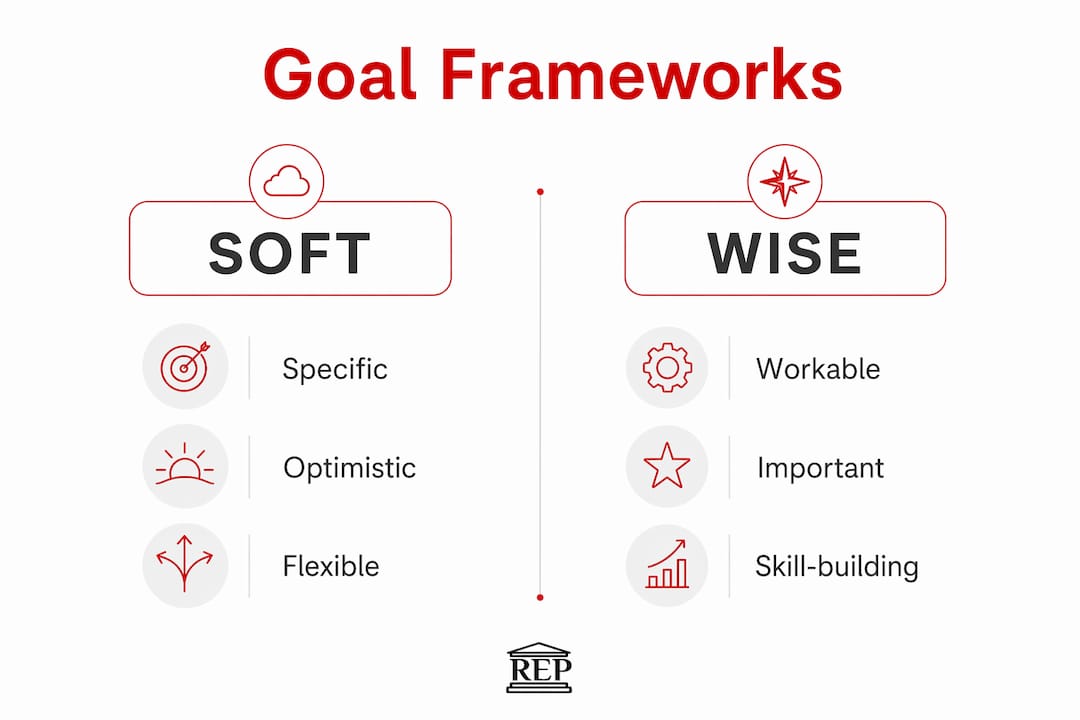
The SOFT goals framework adds two elements SMART lacks: optimism and flexibility. Optimism means you frame goals around what you expect to gain, not what you fear losing. Flexibility means you build in permission to adjust without abandoning the goal entirely. The "Transitional" element acknowledges that goals evolve as your condition changes, which is exactly what happens during recovery.
WISE goals, developed by Nir Eyal, solve a different problem. They separate dreams from goals. A dream is "I want to run a marathon." A WISE goal is "I will walk for 20 minutes three times this week." WISE goals stay within your control, build a specific skill, require a defined action, and remain valuable even if the outcome does not fully materialize. That last point is critical for pain management. Progress that stops short of the original target still counts.
SMART goals work well for people with predictable, stable conditions. For anyone managing fluctuating pain, SOFT and WISE goals provide the flexibility and psychological safety that SMART goals simply do not offer.
Pro Tip: Celebrate any result within 90% of your target. Reaching 90% of a goal is not falling short. It is succeeding with room to grow. That mindset shift prevents the all-or-nothing thinking that derails most people managing chronic pain.
How can realistic pain-free goals improve physical and mental health outcomes?
The connection between goal-setting and mental health is direct and measurable. A 2026 Edith Cowan University study involving 190 Australian adults found that re-engaging with new meaningful goals improved mental health scores for people living with chronic pain. That finding matters because it confirms that the act of pursuing goals, not just achieving them, drives well-being.
The Golden Rule of Pain Management captures this shift clearly. It prioritizes improving functional quality of life over eliminating pain, focusing on meaningful activities like sleeping through the night, playing with your kids, or returning to a hobby. This biopsychosocial approach replaces the older biomedical model, which treated pain as purely a physical problem to be solved.
"The goal is not to feel nothing. The goal is to live fully. When people shift from chasing zero pain to reclaiming the activities that matter to them, they regain a sense of control that pain had taken away." — Maeve Ashcroft, on the biopsychosocial shift in pain care
Realistic functional goals also reduce kinesiophobia, which is the fear of movement caused by anticipating pain. When you set a target you can actually reach, movement becomes less threatening. Each small win builds evidence that your body can handle activity, which gradually rewires your response to discomfort.
Here is what the research shows about the mental and physical benefits of function-first goal-setting:
- Re-engaging with new goals after pain-related loss directly raises mental health scores.
- Measuring success by function rather than pain intensity reduces cycles of self-blame.
- Pacing activities around manageable targets prevents flare-ups that cause people to quit entirely.
- Neurological patterns in injury recovery respond positively to graded, progressive movement goals.
- Adaptive coping strategies, built through flexible goal-setting, improve long-term resilience.
All-or-nothing thinking worsens outcomes across the board. People who measure success by ability to perform tasks despite minor pain fluctuations consistently outperform those who treat any discomfort as a reason to stop.
What practical steps should you follow to set and maintain pain-free goals?
Setting hassle-free targets that hold up over time requires a clear process. These steps work whether you are recovering from a specific injury or managing an ongoing condition.
-
Define "better" in functional terms. Write down one activity you want to do more easily. "Walk to the mailbox without limping" is a goal. "Feel better" is not. Functional specificity gives you something to measure and celebrate.
-
Limit your active goals to two or three at a time. Goal competition causes cognitive overload and physical exhaustion. Focusing on one or two key tasks per day increases completion rates and sustains motivation far longer than spreading effort across five or six targets.
-
Involve your healthcare provider early. A physical therapist, physician, or certified trainer can help you set targets that match your current capacity. They can also adjust your goals as your condition changes, which prevents you from pushing too hard during a good week and crashing the next.
-
Use graded exposure to build tolerance. Start with a version of the activity that produces minimal discomfort, then increase duration or intensity by small increments each week. For example, begin with a five-minute walk, then add two minutes every three to four days. This approach builds confidence alongside physical capacity.
-
Monitor your pain response, not just your output. After each session, note your pain level on a simple 0–10 scale. If you consistently land above 5 out of 10 after an activity, scale back the target. If you stay below 3 out of 10, you have room to progress. This data removes guesswork and keeps your goals calibrated to your actual condition.
-
Build in planned rest and recovery. Pacing is not weakness. Scheduling rest days as part of your goal plan prevents the boom-and-bust cycle that derails so many people managing chronic pain. Recovery is part of the goal, not a detour from it. The mental reprogramming required during recovery is just as real as the physical work.
Concrete examples of well-structured functional goals include: "walk 15 minutes without stopping three times this week," "sleep six consecutive hours four nights this week," or "complete a 10-minute stretching routine every morning for two weeks." Each of these is specific, within your control, and measurable without requiring zero pain.
Pro Tip: Track progress by output, not by pain intensity. Count tasks completed, minutes moved, or sessions finished. Pain scores fluctuate for reasons outside your control. Output tells you what you actually accomplished.
Using OKRs as a personal planning tool also helps here. Wolfram Hedrich notes that limiting goals to two or three essential objectives per quarter protects focus and reduces stress by building "no" decisions in advance. That discipline is especially valuable when pain flare-ups tempt you to either push through recklessly or abandon your plan entirely.
Key Takeaways
Pain-free goals succeed because they measure function over pain intensity, use flexible frameworks like SOFT and WISE, and limit goal quantity to prevent burnout and cognitive overload.
| Point | Details |
|---|---|
| Function-first definition | Define goals by what you can do, not by how much pain you feel. |
| Use SOFT and WISE frameworks | These frameworks add flexibility and intrinsic motivation that SMART goals lack for pain management. |
| Limit active goals | Focus on one to two key targets at a time to prevent exhaustion and maintain completion rates. |
| Re-engagement improves mental health | Pursuing new meaningful goals raises mental health scores even before full physical recovery. |
| Track output, not pain | Measure tasks completed and sessions finished rather than daily pain intensity scores. |
My honest take on goal-setting when pain is part of the picture
I have worked with enough people at Repphilosophy to know that the biggest obstacle is rarely physical. It is the story someone tells themselves after a bad day. They push hard on a good day, pay for it the next morning, and decide the whole plan is broken. That cycle is not a fitness problem. It is a goal-design problem.
The all-or-nothing mindset is the most common thing I see derail people who are otherwise motivated and capable. They set a goal that demands perfection, hit one rough patch, and quit entirely. The fix is not more willpower. It is a better goal structure. WISE and SOFT frameworks give you that structure because they build flexibility and self-compassion directly into the plan.
Redefining success as consistent progress rather than a perfect outcome changes everything. I have seen people recovering from injury accomplish more in three months of function-first training than they did in a year of chasing a pain-free ideal. The difference is not effort. It is direction.
Pain management is a dynamic process. Your goals need to be dynamic too. Rigid targets break under pressure. Flexible, function-first goals bend and come back stronger, and so do you.
— Coach Justin
Repphilosophy coaching built for your recovery goals
Repphilosophy works with people in 4S Ranch and online who are ready to build real, sustainable progress around their physical limits. Whether you are recovering from an injury or managing ongoing discomfort, the right coaching structure makes the difference between spinning your wheels and actually moving forward.

Repphilosophy offers personalized training sessions designed around your current capacity, not an idealized version of where you think you should be. You can also access the on-demand exercise library to work through structured, coach-designed workouts at your own pace from anywhere. If you want to see how it feels before committing, a single trial session in 4S Ranch is the lowest-pressure way to get started. Your goals deserve a plan that actually fits your life.
FAQ
What are pain-free goals in fitness and recovery?
Pain-free goals are function-first targets that measure progress by what you can do, not by the absence of discomfort. Clinical standards now recommend aiming for pain at or below 3 out of 10 during activity rather than zero pain.
How do WISE goals differ from SMART goals for pain management?
WISE goals focus on actions within your control that build skills and remain valuable even if the full outcome does not materialize. SMART goals work well for stable conditions but lack the flexibility needed when pain levels fluctuate.
How many goals should I set when managing chronic pain?
Focus on one to two active goals at a time. Goal competition causes cognitive overload and physical exhaustion, which reduces completion rates and increases the risk of burnout or flare-ups.
Can setting realistic goals actually improve my mental health?
A 2026 Edith Cowan University study found that re-engaging with new meaningful goals improved mental health scores for 190 adults living with chronic pain. Pursuing goals, not just achieving them, drives well-being.
How do I track progress without focusing on pain intensity?
Track output: count sessions completed, minutes of activity, or specific tasks finished each week. Pain scores fluctuate for reasons outside your control, while output gives you a clear, honest picture of your actual progress.