

An online personal training program is a remote fitness coaching service that delivers customized workout plans, ongoing progress tracking, and expert guidance entirely through digital platforms, without requiring in-person sessions. Platforms like Trainerize, TrueCoach, and TurnKey Coach power these programs, giving certified trainers the tools to coach clients anywhere in the world. The core components include individualized programming, asynchronous video feedback, and scheduled check-ins that mirror the structure of traditional personal training. What sets virtual personal training apart is not just the remote delivery. It is the combination of personalization and flexibility that makes it a genuinely powerful option for people with demanding schedules, limited local options, or a preference for training on their own terms.
How does an online personal training program work?
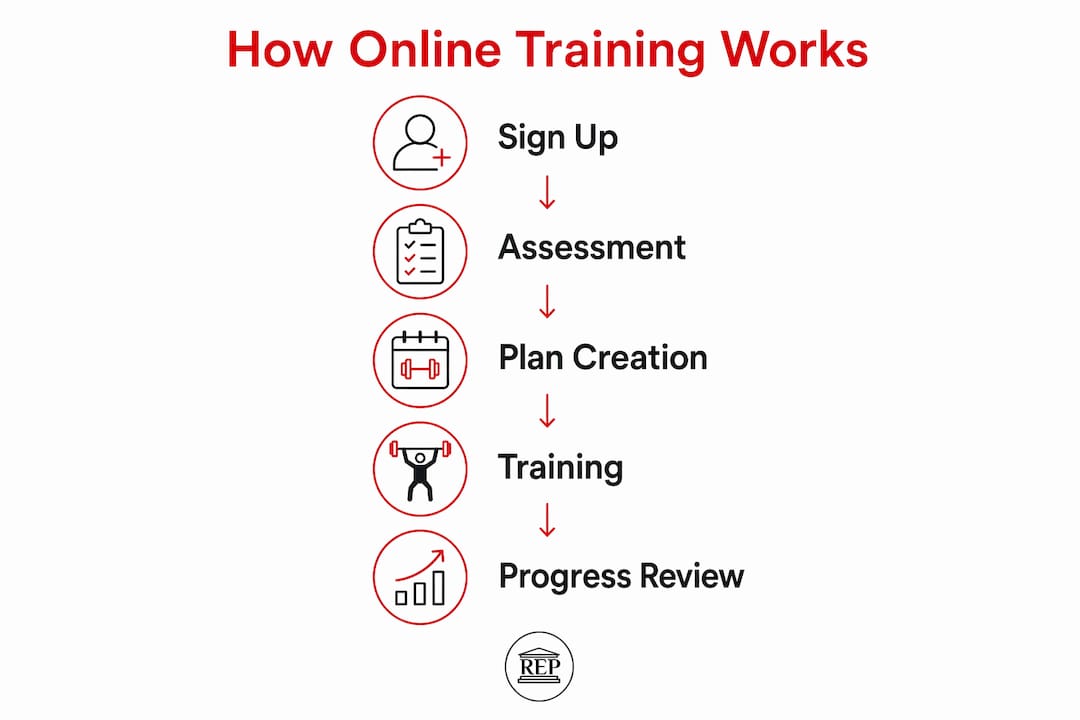
The 5-step structure of a well-run online program follows a clear progression: consultation, bespoke program design, app-based delivery, continuous adjustments, and ongoing coaching. Each step builds on the last, creating a feedback loop that keeps your training moving forward.
Here is how that process typically unfolds from day one:
- Initial intake and assessment. Your coach collects information about your health history, fitness level, goals, schedule, and available equipment. This is the foundation everything else is built on.
- Bespoke program design. Based on your intake, your trainer builds a training plan tailored specifically to you. This is not a template pulled from a library. It is a plan written with your goals, limitations, and lifestyle in mind.
- App-based delivery. Your program is delivered through a coaching app where you can view workouts, log sets and reps, track weights, and submit video of your lifts. Platforms like TurnKey Coach allow clients to upload workout videos for technique review and timestamped feedback.
- Regular check-ins and revisions. Your coach reviews your data and adjusts the program based on how you are responding. These check-ins happen weekly or biweekly and are where real coaching takes place.
- Ongoing coaching and accountability. Messaging, video calls, and automated reminders keep you engaged between sessions. This communication cadence is what separates a coached program from a generic plan.
Technology plays a significant supporting role here. Wearables like Garmin and Apple Watch, nutrition apps like MyFitnessPal, and smart scales all feed data into the coaching picture, giving your trainer a clearer view of your recovery and overall health.
Pro Tip: Before starting any online program, ask your coach exactly how and how often they will review your data. A coach who checks in weekly and responds to video submissions within 48 hours is giving you a fundamentally different service than one who sends a monthly plan.
What are the benefits of online personal training vs. in-person training?
The most compelling case for virtual personal training is flexibility. Clients complete workouts on their own schedule, at any location, without the constraint of fixed appointment times or commuting to a gym. That alone removes one of the biggest barriers to consistent training.
Beyond convenience, the benefits stack up in ways that might surprise you:
- Access to specialized expertise. You are no longer limited to trainers within driving distance. You can work with a coach who specializes in postpartum fitness, powerlifting, or endurance sports, regardless of where you live.
- Evidence-based outcomes. Randomized 2026 research shows that structured, supervised online coaching produces health and fitness improvements comparable to in-person training, including significant gains in populations like postmenopausal women and type 2 diabetes patients.
- Cost efficiency. Online coaching typically costs less than in-person sessions because trainers can serve more clients without the overhead of a physical facility. You get personalized coaching at a fraction of the price.
- Maintained personalization. The remote format does not dilute the coaching relationship. Program design, feedback, and adjustments remain individualized throughout.
- Technology-enabled accountability. Apps, reminders, and data logging create a structured accountability system that many clients find more consistent than sporadic in-person sessions.
"App-based exercise with structured communication can deliver results similar to face-to-face training if protocols are of high quality." — Comparative research on app-based vs. face-to-face training
The key phrase there is "high quality." Not every online program is created equal, which brings us to how you choose the right one.
What types of online training programs are available?
Online fitness coaching comes in several distinct formats, and the differences between them matter more than most people realize before signing up.

| Program Type | What It Includes | Best For |
|---|---|---|
| Fully bespoke 1-on-1 coaching | Custom plan, regular check-ins, direct coach access, video feedback | Clients who want personalized attention and ongoing adaptation |
| Subscription membership | Pre-built or templated programs, limited coach interaction | Budget-conscious clients with training experience |
| Fixed-duration plans | Set program (e.g., 8-week challenge), minimal ongoing coaching | Short-term goals with a defined endpoint |
| Hybrid coaching | Combination of online programming and occasional in-person sessions | Clients who want flexibility with some face-to-face support |
Fully bespoke coaching is the gold standard. Your trainer writes your program from scratch, reviews your videos, adjusts your plan based on real data, and communicates with you regularly. Subscription models are more affordable but often rely on automated delivery with limited human oversight. The outcomes from professional supervision are significantly better than mostly automated programs, which is worth factoring into your decision.
When evaluating any program, check three things: the trainer's certifications (look for NASM, NSCA, or ACSM credentials), the platform's communication tools, and whether the program adapts over time based on your feedback. A plan that never changes is not coaching. It is a PDF.
Pro Tip: Ask for a sample week of programming before you commit. A quality coach will show you exactly what a training week looks like, including how feedback is delivered and how adjustments are made.
What does effective coaching and progress tracking look like?
The quality of your online training experience comes down to one thing: how well your coach can see and respond to what you are doing. Without physical presence, that visibility depends entirely on the systems you both use.
Here is what a well-structured online coaching relationship looks like in practice:
- Video submissions with timestamped feedback. You record your lifts and upload them through your coaching app. Your coach reviews the footage and leaves specific, timestamped cues. Clear video submissions are critical because poor video quality makes effective form correction nearly impossible.
- Detailed workout logs. Every session, you log sets, reps, weights, and your RPE (rate of perceived exertion). Remote coaches depend on this data because they cannot physically spot you or observe your effort level in real time.
- Scheduled check-ins. Weekly or biweekly calls or voice messages give your coach a chance to ask about sleep, stress, soreness, and motivation. These conversations shape your next training block.
- Wearable and nutrition data integration. Syncing your Apple Watch, Garmin, or Whoop data with your coaching platform gives your trainer a fuller picture of your recovery and readiness.
- Consistent communication cadence. Program adherence and regular check-ins are the most reliable predictors of success in online training. Clients who engage consistently with their coach outperform those who go quiet between check-ins.
The accountability structure in online training is different from in-person work, but it is not weaker. It is just more self-directed. You have to show up for your check-ins, submit your videos, and log your sessions honestly. When you do, your coach has everything they need to keep you progressing.
Common misconceptions about online personal training
The biggest myth about online personal training is that it is just a workout plan sent over email. That misunderstanding leads people to either dismiss it entirely or sign up for a low-quality service and walk away disappointed.
Online training is coached, interactive, and adaptive. The delivery channel changes. The coaching does not. Here are a few other misconceptions worth clearing up:
- "I won't get real feedback on my form." You will, as long as you submit quality video. Timestamped, specific technique cues from a knowledgeable coach are often more useful than a quick verbal correction during a busy gym session.
- "It's only for experienced gym-goers." Online training works at every fitness level. Beginners benefit from structured programming and regular check-ins just as much as advanced athletes.
- "Cheaper means lower quality." Price reflects the coach's time and overhead, not necessarily their expertise. Some of the best coaches in the world work exclusively online because it lets them serve more clients without geographic limits.
- "I'll lose motivation without someone there in person." Accountability tools, scheduled check-ins, and a coach who genuinely invests in your progress can be just as motivating as a physical presence. The virtual personal training benefits extend well beyond convenience.
To get the most out of your program, communicate openly with your coach, log every session honestly, and treat your check-ins as non-negotiable appointments. The more data and context you give your trainer, the better they can serve you.
Key takeaways
Online personal training delivers individualized, coach-driven fitness results through digital platforms, and program quality combined with consistent communication determines whether you succeed.
| Point | Details |
|---|---|
| Core definition | Online personal training is remote, customized coaching delivered through apps, video, and messaging. |
| Evidence-based outcomes | Supervised online programs produce health gains comparable to in-person training when protocols are high quality. |
| Program types vary widely | Fully bespoke coaching outperforms automated subscription plans due to ongoing personalization and adaptation. |
| Video and logging are critical | Clear workout videos and detailed session logs give your coach the visibility needed for effective remote feedback. |
| Communication drives adherence | Regular check-ins and consistent engagement are the strongest predictors of long-term success in online training. |
Why I think online training is underrated, not just convenient
I have worked with clients in person and remotely, and the honest truth is that the format matters far less than the quality of the coaching relationship. What I have seen consistently is that clients who thrive online are not the ones with the fanciest apps or the most expensive programs. They are the ones who show up for their check-ins, submit their videos, and communicate when life gets hard.
The technology available in 2026 is genuinely impressive. Platforms like TurnKey Coach and Trainerize have made it possible to deliver a coaching experience that rivals anything you would get in a physical gym. But technology is just the vehicle. The coaching still has to be real, responsive, and built around the individual.
Where I see online training fall short is when coaches treat it as a passive income stream rather than an active coaching relationship. A plan that never changes is not coaching. If your trainer is not asking about your sleep, your stress, and your energy levels, they are not coaching you. They are selling you a PDF.
My advice: before you commit to any online fitness coaching program, have a real conversation with the coach. Ask how they handle a week when you miss sessions. Ask what happens when the program stops working. The answers will tell you everything you need to know.
Online training is not a compromise. For the right person with the right coach, it is the best option available.
— Coach Justin
Ready to train smarter with Repphilosophy?
At Repphilosophy, we believe every person deserves a coach who actually shows up for them, whether you are training in 4S Ranch or on the other side of the country. Our virtual personal training programs are built around your goals, your schedule, and your life. Not a template. Not a one-size-fits-all plan.
From our structured video library memberships to fully personalized one-on-one virtual coaching, we have options that fit different budgets and goals. You can also explore our full range of training programs and memberships to find the right fit. If you are ready to stop guessing and start making real progress, we are ready to stand by your side every step of the way.
FAQ
What is an online personal training program?
An online personal training program is a remote coaching service that delivers customized workout plans, progress tracking, and expert feedback through digital platforms like apps, video calls, and messaging, without requiring in-person sessions.
Is online personal training as effective as in-person training?
Yes. Randomized 2026 research shows that structured, professionally supervised online programs produce health and fitness improvements comparable to face-to-face training when protocols are high quality.
How often will I hear from my online coach?
Most quality programs include weekly or biweekly check-ins through calls, voice messages, or in-app messaging. Scheduled communication and consistent engagement are the strongest predictors of long-term success in online training.
What do I need to get started with online training?
You need a smartphone or computer to access your coaching app, a space to train, and whatever equipment your program requires. Your coach will assess your setup during the initial intake and design your program around what you have available.
How is online training different from just buying a workout plan?
A true online training program includes ongoing coaching, personalized adjustments, and regular feedback based on your actual performance data. A static workout plan does not adapt to your progress, your recovery, or your life.