

Expect to pay roughly $10 to $25 per drop-in class, $30 to $70 a month for budget gym access, and $50 to $160 a month at boutique studios across San Diego. If your budget sits under $40 a month, a community center or YMCA membership wins. Between $40 and $100, class packs or a small-group coaching membership like the ones we run at Repphilosophy stretch your dollar furthest. Above $100, you're paying for boutique atmosphere, not necessarily better coaching.
TL;DR:
- Drop-in classes in San Diego typically cost $10 to $25, with cheaper options available through class packs or community programs.
- Unlimited studio memberships range from $50 to $160 per month, but many specialty classes or amenities often cost extra.
- Smaller group sessions and community programs like YMCA offer more coaching attention for lower costs, especially under $100 monthly.
- Commuting distance and studio location heavily influence prices, with coastal and downtown areas charging premium rates.
- Trial passes and small-group coaching provide cost-effective ways to evaluate gyms before committing to long-term memberships.
Table of Contents
- How Much Does Group Fitness Cost in San Diego?
- What Do You Actually Get for Your Membership Fee?
- What Makes San Diego Group Fitness Prices Vary So Much?
- How to Choose the Right Group Fitness Membership for Your Budget
- Where to Find Discounts and Lower-Cost Group Fitness in San Diego
- Coach Justin's Take: Getting Coached Group Fitness Without the Boutique Price Tag
- Start With a Trial: Repphilosophy's Small-Group and Buddy Options
- Where to Verify Current Prices Before You Buy
- Sources
How Much Does Group Fitness Cost in San Diego?
Walk into any studio from North Park to Encinitas and ask "how much for one class?" and you'll usually hear a number between $10 and $25. Yoga and barre tend to sit at the lower end of that range, while specialty cycling or HIIT formats with premium equipment push toward $25 a class. That's the price of convenience: no commitment, no contract, just showing up.
Class packs change the math fast. A 10-class pack priced at $150 brings your per-class cost down to $15, which is where most regular class-goers land once they stop paying drop-in rates out of habit. A 20-class pack at $240 often dips closer to $12 per class. The pattern holds across the city: the more you buy up front, the less each session costs, provided you actually use the credits before they expire.
Budget gyms operate on a different model entirely. Monthly dues commonly fall within a moderate range, but almost every one of them tacks on a join or annual fee, often charged once at signup or once a year depending on the chain. That fee rarely gets mentioned in the advertised monthly price, so budget an extra $60 into your first month before you sign anything.
Here's a quick reference for what you'll typically encounter:
- Drop-in classes: $10–$25 per session, no commitment required
- 5-class packs: roughly $75–$110 total ($15–$22 per class)
- 10-class packs: roughly $130–$180 total ($13–$18 per class)
- Budget gym monthly: $30–$70, plus a common $59.99 join or annual fee
- Boutique studio monthly unlimited: $50–$160, depending on brand and neighborhood
- University or community wellness packages: $79–$99 a month, all-inclusive
Pro Tip: Before comparing any two memberships, divide the total monthly cost by how many classes you'd realistically attend. A $99 unlimited membership you use eight times a month beats a $15 drop-in rate you pay four times.
Local university wellness programs illustrate the community end of the spectrum well. The USD Student Wellness group fitness program offers an all-inclusive package around $99 a month and a more limited package near $79, both of which undercut most boutique studios while still delivering structured, coach-led classes.
Intro passes deserve their own mention because they distort your first month's cost in a good way. A one to three-week unlimited intro pass, commonly priced between $39 and $60, lets you sample a studio's full schedule before committing to a monthly rate. Popflow Studios in Coronado runs a 21-day unlimited intro pass for $60, which works out to roughly $2 to $3 per visit if you show up daily. That's cheaper than nearly any drop-in rate in the city, but only if you actually use it.
What Do You Actually Get for Your Membership Fee?
Not all "memberships" mean the same thing, and the differences matter more than the sticker price. Drop-in access gets you exactly one class, no perks, no locker, sometimes no parking validation. Class packs are drop-in access purchased in bulk, usually with an expiration window of 60 to 90 days, so unused credits can quietly evaporate.
Unlimited monthly memberships open the full class schedule, which sounds great until you realize "unlimited" doesn't always mean every class type. Many studios wall off specialty workshops, certain instructor-led signature classes, or new format launches behind an extra fee even for unlimited members. Semi-private and buddy training memberships sit in a different category altogether: instead of a room full of strangers, you're training with one or two other people under direct coach supervision, which is the model Repphilosophy built its buddy training program around specifically to keep coaching quality high while splitting the cost.
Here's what tends to be included versus what commonly costs extra:
- Usually included: access to the standard class calendar, basic equipment (mats, weights, bikes), locker room access
- Often extra: towel service, specialty workshops, nutrition coaching add-ons, guest passes
- Rarely included at budget gyms: pool access, childcare, sauna or steam room use
- Sometimes included at YMCA locations: pool access and family-oriented classes bundled into standard membership tiers
The YMCA of San Diego County is worth calling out here because it bundles unlimited group fitness classes, including cycling, yoga, and water exercise, into standard membership tiers without charging per-class fees on top. That bundling is rare outside the nonprofit and community-center world, where most boutique studios treat every class type as its own potential upsell.
Add-on fees are where budgets quietly blow up. Watch for charges tied to towel rental (often $2 to $5 per visit if you forget your own), locker rental beyond the free cubby option, and "premium" class formats that cost $5 to $10 more than a standard class even inside an otherwise unlimited membership. None of these show up in the headline price, so ask directly before you sign.
What Makes San Diego Group Fitness Prices Vary So Much?
A cycling class in La Jolla and the same format in Chula Vista can differ by $10 or more, and it isn't random. Several factors stack on top of each other to produce the price you see posted at the front desk.
- Neighborhood and real estate. Studios in coastal and central neighborhoods, La Jolla, Del Mar, downtown, pay commercial rents that get baked directly into class pricing. A quick look at studio clusters on Google Maps shows how tightly packed higher-end studios sit in expensive zip codes, while budget options concentrate in more affordable inland areas.
- Instructor credentialing and specialty equipment. A class built around proprietary bikes, rowers, or reformers costs more to run than one using mats and dumbbells, and that equipment investment shows up in your monthly rate.
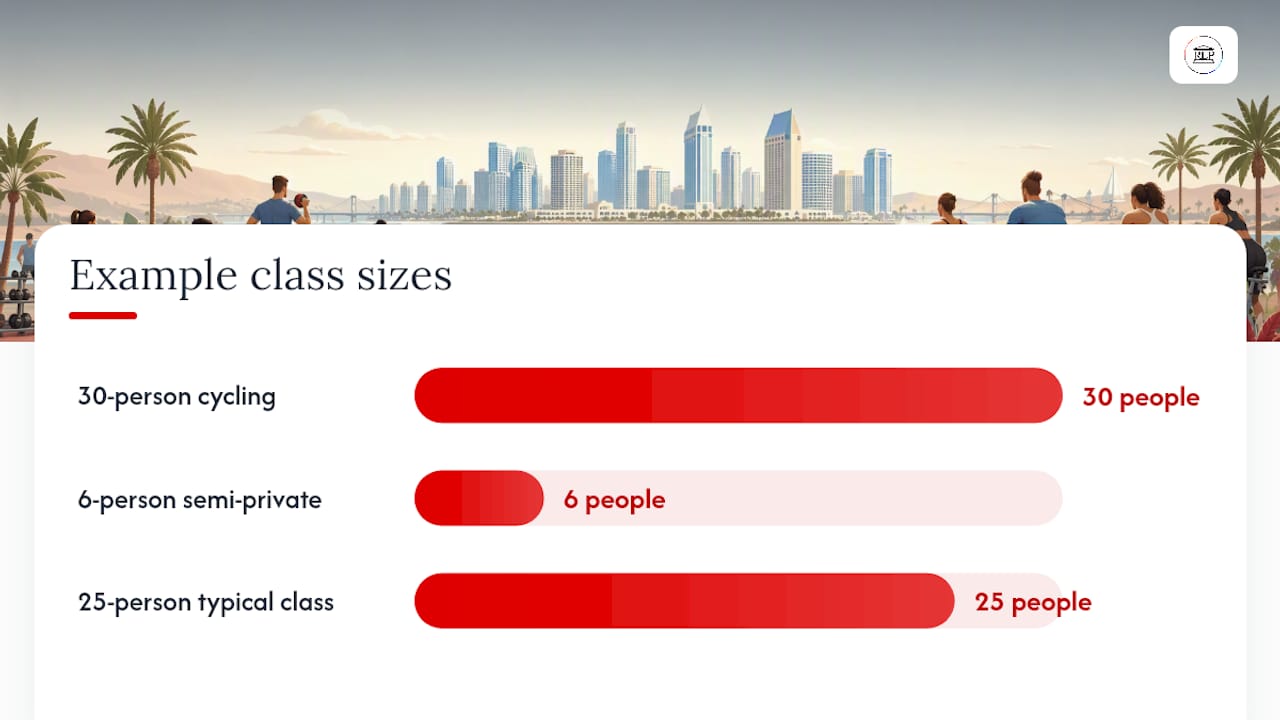
- Class size and coaching attention. A 30-person cycling class and a 6-person semi-private session both get called "group fitness," but the coach-to-client ratio is wildly different, and pricing usually reflects that gap.
- Business model. Boutique studios sell atmosphere and exclusivity. Chain gyms sell volume and low overhead per member. Community rec centers and the YMCA sell accessibility. Each model justifies a different price point for what is, technically, the same 45 minutes of exercise.
Session format plays into this too. A tightly coached 30-minute high-intensity session, the kind Repphilosophy structures its personal training sessions around, can deliver more per-minute value than a leisurely 60-minute boutique class, even at a comparable or lower price point, simply because the coaching attention is denser.
Pro Tip: When two memberships look similarly priced, ask about average class size. A $120/month unlimited membership with 25-person classes and a $90/month small-group option with 6-person classes are not competing products, even though they're priced close together.
How to Choose the Right Group Fitness Membership for Your Budget
Picking a membership shouldn't feel like guesswork, but most people compare sticker prices instead of comparing what they'll actually use. Work through this instead.
Step 1: Set your budget band first. Decide whether you're realistically a sub-$40, $40 to $100, or $100-plus monthly spender before you tour a single studio. This single decision eliminates half the options in the city immediately and keeps you from getting talked into a boutique membership you'll resent paying for in month three.
Step 2: Be honest about frequency. If you're going to attend twice a week, a $99 unlimited membership is a poor deal compared to a 10-class pack you can stretch over two months. If you're going four or five times weekly, unlimited almost always wins.
Step 3: Match the format to your goal. Weight loss and general conditioning goals fit well with higher-frequency, moderate-intensity formats, while strength and performance goals often benefit more from smaller coached groups where form gets corrected in real time.
Step 4: Factor in commute time as a real cost. A cheaper studio 20 minutes away costs you more in gas, parking, and time than a slightly pricier one five minutes from home. Price per class means little if you skip half your sessions because the drive feels like a chore.
Step 5: Confirm required amenities before comparing price. If pool access or childcare matters to you, cross off every option that doesn't offer it, then compare prices only among what's left.
Before you hand over a card number, ask these questions directly:
- What's the trial or intro policy, and does any of that fee roll into a first month's membership?
- Can you freeze or pause the membership, and for how long, without losing your rate?
- What's the actual cancellation notice period, 30 days is standard, but some contracts require 60?
- Are class spots guaranteed with a reservation, or is it first-come, first-served even for unlimited members?
- Does the advertised price include the join or annual fee, or is that billed separately?
Watch for a few red flags specifically. Long-term contracts (12 months or more) with steep early-termination penalties are common at big-box gyms and rarely worth it unless you're certain about long-term commitment. Vague "starting at" pricing on a studio's website, without a published rate sheet, usually means the real price is higher once you ask. And any intro offer that doesn't convert into first-month credit is designed to expire before you decide whether to stay.
The smartest sequence, for almost everyone, follows the same three steps: start with a trial class or intro pass to test the coaching style and vibe, move to a short class pack if you liked it, and only commit to a full monthly membership once you know your real attendance pattern. Rushing straight to a 12-month contract on your first visit is how most people end up overpaying for a membership they use twice.
Where to Find Discounts and Lower-Cost Group Fitness in San Diego
The gap between what people pay and what they need to pay for group fitness in San Diego usually comes down to not knowing where to look. A few channels consistently produce real savings, provided you read the fine print.
Groupon remains one of the most reliable sources for discounted class packs in the city, and per-class prices on Groupon's San Diego fitness listings frequently run 30% to 60% below a studio's standard drop-in rate. The catch: these deals almost always carry expiration dates, often 60 or 90 days, and some restrict which instructors or class times you can book. Verify the expiration window and any blackout dates before you buy, not after.
Community and public options remain the most underrated lower-cost route. The YMCA and city recreation centers typically charge less than commercial gyms while still offering full class calendars, and university wellness programs open to the public occasionally undercut even that. If you qualify for student, senior, or military pricing at any of these institutions, ask specifically, discounts often aren't advertised on the main pricing page.
A few more angles worth checking:
- Referral programs: many studios knock a month's dues off for both parties when you bring a new member
- Corporate wellness discounts: some employers partner directly with local gyms for reduced rates
- Seasonal promotions: January and September (post holiday, back-to-routine) tend to bring the deepest new-member discounts of the year
- Off-peak pricing: a handful of studios discount memberships that restrict class times to weekday mornings or midday slots
On the math side, class packs beat drop-in rates the moment you're attending more than twice a month at most studios, and unlimited monthly memberships typically beat packs once you cross six to eight visits monthly. Below that frequency, you're often better off paying as you go.
Coach Justin's Take: Getting Coached Group Fitness Without the Boutique Price Tag
Most people think affordable and coached are opposites in this city. They're not, and that assumption costs San Diego residents real money every month.
The boutique studio model prices in atmosphere, marketing, and prime real estate as much as it prices in coaching quality. You can absolutely get excellent instruction for $150 a month at a studio in La Jolla. You can also get equally attentive coaching for a fraction of that if you're willing to train in a small group instead of a crowded class.
That's the entire logic behind how we structure things at Repphilosophy. Bring-a-buddy training splits a coach's attention and cost between two people instead of spreading one coach across twenty, which keeps the per-person rate down without diluting the coaching. Small-group memberships work the same way, tight enough that form corrections and program adjustments still happen in real time. And for people who want structure without any in-person cost at all, our virtual training library gives access to programmed workouts and coaching guidance on a schedule that fits around work, kids, or a commute that makes evening classes impossible.
If you're working with a $30 to $70 monthly budget, here's my honest starting recommendation: skip the big unlimited boutique membership entirely. Look first at a community option like the YMCA for baseline class access, then supplement with a bring-a-buddy or small-group session once or twice a week for the coaching attention a crowded class simply can't give you. You get the volume from one source and the quality from the other, and your total spend still lands well under what a single boutique membership would cost.
The gap between what group fitness promises and what most people actually receive in a 25-person class is bigger than most new members realize until they've tried something smaller.
— Coach Justin
Start With a Trial: Repphilosophy's Small-Group and Buddy Options
If everything above has you leaning toward coached sessions without the boutique price tag, that's exactly the gap Repphilosophy was built to fill in 4S Ranch and the surrounding San Diego area. Bring-a-buddy memberships split the cost of real, hands-on coaching between two people, small-group classes keep the coach-to-client ratio tight enough to actually correct your form, and the virtual training library gives you programmed workouts on your own schedule if in-person sessions don't fit your week.

The best way to see whether this fits your budget and goals is to try it directly rather than guess from a price list. A personal training trial session in 4S Ranch lets you experience the coaching style firsthand before committing to anything. If in-person visits aren't practical right now, the on-demand exercise library gives you structured programming at a lower monthly cost. Pricing is straightforward and posted upfront, and if you're weighing options or asking about referral savings, just ask when you book. You can also browse full membership and session options anytime through the Repphilosophy shop.
Where to Verify Current Prices Before You Buy
Prices shift, so confirm details directly with each provider before purchasing anything mentioned here. Check the USD Student Wellness group fitness page for current package rates, the YMCA of San Diego County for membership and class benefits, Groupon's San Diego fitness listings for active discounted passes, and Popflow Studios for a current example of intro-pass pricing. For a deeper look at how coached formats influence programming and cost, Couch & Dumbbells' guide to group fitness programming is a useful outside reference. Studio pricing pages change more often than review sites do, so always confirm on the source itself.
Sources
- Group Fitness - Student Wellness
- Groupon — San Diego fitness classes
- Group Exercise Class Descriptions - YMCA of San Diego County
- Popflow Studios | Yoga, Pilates & Sculpt — Coronado + San Diego